
SpaceX Executes Largest IPO in History, Making Elon Musk the First Trillionaire
SpaceX debuted on the Nasdaq at a $2.1 trillion valuation, raising a record $75 billion and pushing CEO Elon Musk's net worth past the $1 trillion mark.
By Factlen Editorial Team
- Market Optimists
- Investors who view SpaceX as a generational opportunity to capture the emerging space and AI economies.
- Valuation Skeptics
- Financial analysts who warn that the stock's price is dangerously detached from its current cash flow.
- Systemic Risk Watchdogs
- Economists and consumer advocates concerned about the forced inclusion of mega-cap tech stocks into passive retirement funds.
What's not represented
- · Competitors in the aerospace sector facing a newly capitalized giant
- · Terrestrial telecommunications companies threatened by Starlink's expansion
Why this matters
SpaceX's record-shattering debut doesn't just mint the world's first trillionaire—it directly impacts the retirement savings of millions of Americans. Because major index funds are fast-tracking the stock's inclusion, everyday passive investors will automatically buy into the highly volatile, unprofitable company, tying their financial futures to the speculative space economy.
Key points
- SpaceX executed the largest IPO in history, raising $75 billion and achieving a market capitalization of $2.1 trillion on its first day.
- The soaring stock price officially made CEO Elon Musk the world's first trillionaire, with an estimated net worth of $1.1 trillion.
- Bypassing traditional IPO mechanics, SpaceX offered a fixed $135 share price that was massively oversubscribed by both retail and institutional investors.
- Despite generating $18.7 billion in revenue in 2025—driven largely by Starlink—the company reported a net loss of $4.9 billion.
- Analysts warn of a liquidity squeeze as major index funds use 'fast entry' rules to force passive retirement accounts to buy the stock.
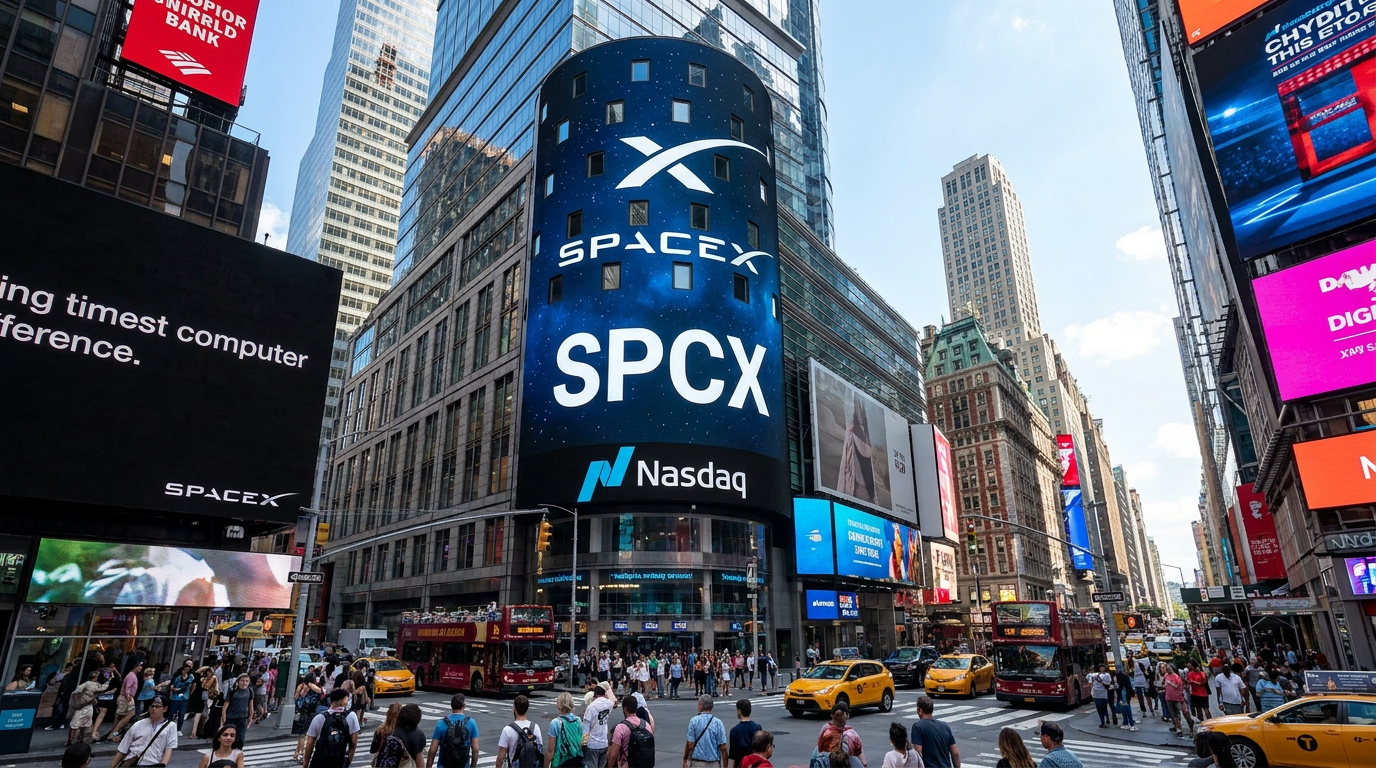
The financial world witnessed a tectonic shift on Friday as SpaceX executed the largest initial public offering in history, debuting on the Nasdaq under the ticker SPCX. The aerospace and communications behemoth raised $75 billion by selling 555.6 million shares, shattering the previous record set by Saudi Aramco in 2019.[1][7]
The sheer scale of the debut immediately rewrote global wealth rankings. After pricing its shares at a fixed $135, the stock opened at $150 and surged to close at $160.95. That 19 percent first-day pop pushed SpaceX's market capitalization past $2.1 trillion, making it the seventh-largest public company in the world.[1][5]
For CEO Elon Musk, the offering triggered a historic personal milestone. Holding roughly 42 percent of the company's equity, the soaring valuation pushed his estimated net worth to approximately $1.1 trillion. The event officially minted Musk as the world's first trillionaire, giving him a fortune nearly three times larger than the planet's second-richest individual.[1][6]

The mechanics of the SpaceX IPO were highly unusual, reflecting the company's immense leverage over Wall Street. Rather than engaging in the traditional "bookbuilding" process—where banks gauge institutional interest over weeks to narrow down a price range—SpaceX issued a take-it-or-leave-it price of $135 per share.[8]
The market eagerly took it. Demand for the shares reached an estimated $250 billion, oversubscribing the offering by nearly four times. Retail investors alone placed orders exceeding $100 billion, while institutional giants like BlackRock secured multi-billion-dollar allocations.[1]
Yet beneath the record-breaking capital raise lies a stark financial reality: SpaceX is not currently profitable. The company reported a net loss of $4.9 billion in 2025, even as its total revenue climbed to $18.7 billion.[1][8]
The engine driving that revenue is not the company's famous reusable rockets, but its Starlink satellite internet division. Starlink accounted for $11.4 billion—or 61 percent—of SpaceX's total revenue last year. Analysts view the telecommunications network as the company's most predictable cash flow stream and the primary justification for its massive valuation.[4][8]

The engine driving that revenue is not the company's famous reusable rockets, but its Starlink satellite internet division.
The company's pitch to investors also leans heavily into artificial intelligence. Following a February 2026 merger with Musk's AI startup xAI, SpaceX has positioned itself as an infrastructure play for the AI boom. The company is actively developing concepts for solar-powered orbital data centers, aiming to solve the severe energy constraints facing terrestrial AI development.[1][4]
This blend of aerospace and AI has generated immense hype, but it has also drawn sharp skepticism from traditional valuation experts. Analysts at Morningstar calculated the fair value of SpaceX's core launch and connectivity businesses at just $63 per share—less than half of the $135 offering price.[4]
The gap between that fundamental valuation and the market price is what analysts call an "option premium." Investors are effectively paying a massive surcharge for the right to participate in Musk's highly speculative future projects, from orbital data centers to the eventual colonization of Mars. Morningstar assigns only a 7 percent probability to these "moonshot" scenarios achieving full commercial success.[4]
Regardless of individual investor skepticism, millions of Americans will soon own a piece of SpaceX whether they actively choose to or not. Major index providers have recently overhauled their eligibility rules to accommodate mega-cap tech debuts, implementing "fast entry" mechanisms that bypass traditional seasoning periods.[2][7]
The Nasdaq-100, for instance, recently eliminated its requirement that a company trade publicly for months before inclusion. As a result, passive index funds and ETFs that track these benchmarks will be forced to purchase billions of dollars of SpaceX stock in the coming weeks to accurately reflect the index's new composition.[2][7]

This dynamic creates a severe liquidity squeeze. Because SpaceX only floated a small percentage of its total shares, the mandatory buying pressure from passive funds is expected to drive the stock price up further, potentially decoupling it entirely from the company's underlying financial performance.[7]
Consumer watchdogs and financial stability experts have raised alarms about this forced integration. Critics argue that tying the retirement savings and pension plans of everyday Americans to an unprofitable, highly volatile company based on executive hype poses a systemic risk to retail portfolios.[2]
The wealth concentration resulting from the IPO has also sparked intense debate. Organizations tracking global inequality noted on Friday that Musk's $1.1 trillion fortune now exceeds the combined wealth of the poorest 46 percent of the global population—roughly 3.8 billion people.[2][6]
As the dust settles on the largest stock debut in history, Wall Street faces a new paradigm. With SpaceX now a dominant force in the public markets, and other AI giants like OpenAI and Anthropic reportedly preparing their own mega-IPOs, the broader economy is becoming increasingly tethered to the speculative frontiers of space and artificial intelligence.[2][5]
How we got here
Dec 2025
A SpaceX tender offer prices shares at an implied $800 billion valuation.
Feb 2026
SpaceX merges with Musk's artificial intelligence startup xAI, boosting its private valuation to $1.25 trillion.
May 1, 2026
Nasdaq implements a 'fast entry' rule, allowing mega-cap companies to join major indices in just 15 days.
June 3, 2026
SpaceX files its S-1 prospectus, bypassing traditional bookbuilding to offer a fixed $135 share price.
June 12, 2026
SpaceX debuts on the Nasdaq under the ticker SPCX, closing at $160.95 and making Musk the first trillionaire.
Viewpoints in depth
Market Optimists
Investors who view SpaceX as a generational opportunity to capture the emerging space and AI economies.
This camp argues that traditional valuation metrics are insufficient for a company creating entirely new industries. They point to Starlink's rapid revenue growth and the strategic value of orbital AI data centers as justification for the $2.1 trillion market cap. For these investors, the $135 entry price is a rare chance to back a monopoly in commercial spaceflight before its most ambitious projects, like Mars colonization, are fully priced in.
Valuation Skeptics
Financial analysts who warn that the stock's price is dangerously detached from its current cash flow.
Skeptics, including institutional analysts at firms like Morningstar, emphasize that SpaceX is still losing billions of dollars annually. They argue that the current share price includes a massive "option premium"—meaning buyers are paying upfront for the flawless execution of highly speculative, unproven technologies. If projects like rapidly reusable Starships or space-based data centers face delays, they warn the stock could suffer a severe correction.
Systemic Risk Watchdogs
Economists and consumer advocates concerned about the forced inclusion of mega-cap tech stocks into passive retirement funds.
This group focuses on the structural mechanics of the IPO, specifically how index providers bent their own rules to fast-track SpaceX's inclusion. They argue that bypassing traditional "seasoning" periods forces millions of everyday Americans to unwittingly buy into a volatile, unprofitable company through their 401(k)s. They view the resulting liquidity squeeze—where passive funds must buy regardless of price—as a dangerous distortion of free-market price discovery.
What we don't know
- Whether SpaceX can achieve profitability in the near term to justify its $2.1 trillion valuation.
- How the stock will perform once the initial wave of mandatory buying from passive index funds subsides.
- If the company's ambitious plans for solar-powered orbital AI data centers are technologically and economically viable.
Key terms
- Initial Public Offering (IPO)
- The process by which a private company offers shares to the public for the first time, allowing retail and institutional investors to buy ownership.
- Public Float
- The portion of a company's shares that are in the hands of public investors and available to trade, excluding shares held by insiders.
- Index Fund
- A mutual fund or ETF designed to follow certain preset rules so that it tracks a specific basket of underlying investments, like the S&P 500 or Nasdaq-100.
- Option Premium
- In valuation terms, the extra price investors are willing to pay above a company's current fundamental value for the chance to profit from highly speculative future projects.
Frequently asked
Is SpaceX a profitable company?
No. Despite generating $18.7 billion in revenue in 2025, primarily driven by its Starlink satellite network, the company reported a net loss of $4.9 billion.
Why didn't SpaceX offer a price range for its shares?
SpaceX bypassed the traditional 'bookbuilding' process, offering a take-it-or-leave-it fixed price of $135 per share, relying on overwhelming investor demand rather than bank negotiations.
How does this affect my retirement account?
Because major indices like the Nasdaq-100 have adopted 'fast entry' rules, passive index funds that hold retirement savings will be forced to buy SpaceX shares shortly after the IPO.
Sources
Source coverage
8 outlets
3 viewpoints surfaced








[1]ForbesMarket Optimists
SpaceX's IPO Just Made Elon Musk The World's First Trillionaire
Read on Forbes →[2]The GuardianSystemic Risk Watchdogs
Americans' financial futures are about to be tied to the fortunes of Elon Musk
Read on The Guardian →[3]BloombergMarket Optimists
Inside the SpaceX IPO: Why Elon Musk Raced to Take SpaceX Public
Read on Bloomberg →[4]MorningstarValuation Skeptics
Why Is Morningstar So Bearish on SpaceX's IPO?
Read on Morningstar →[5]Washington PostMarket Optimists
Elon Musk becomes the first trillionaire as SpaceX soars in its market debut
Read on Washington Post →[6]CBS NewsSystemic Risk Watchdogs
Key details on the SpaceX IPO that made Elon Musk a trillionaire
Read on CBS News →[7]CME GroupSystemic Risk Watchdogs
The SpaceX IPO: A historic watershed moment
Read on CME Group →[8]ReutersValuation Skeptics
SpaceX bypasses traditional IPO bookbuilding with $135 fixed price
Read on Reuters →

Every angle. Every day.
Get business stories with full source coverage and perspective breakdowns delivered to your inbox.