
SpaceX Completes Largest IPO in History, Minting Elon Musk as World's First Trillionaire
SpaceX shattered Wall Street records with a $75 billion public debut that pushed its valuation past $2 trillion and opened unprecedented access to everyday retail investors.
By Factlen Editorial Team
- Retail Investors
- Everyday investors and retail brokerages who view the 30% allocation as a historic democratization of wealth creation.
- Space Industry Optimists
- Aerospace experts and early backers who see the capital influx as the necessary fuel for humanity's multiplanetary future.
- Institutional Skeptics
- Financial analysts and governance watchdogs who warn that the company's valuation is detached from its current financial reality.
What's not represented
- · Taxpayers funding government space contracts
- · Competitors in the commercial space sector
Why this matters
The sheer scale of this IPO fundamentally reshapes the stock market, forcing index funds to rebalance and proving that retail investors can command a massive slice of institutional-grade offerings. It also cements space exploration as a dominant, heavily capitalized commercial sector.
Key points
- SpaceX raised $75 billion in its initial public offering, making it the largest stock market debut in history.
- The stock surged 19% on its first day of trading, pushing the company's valuation past $2 trillion.
- The massive valuation surge officially made SpaceX CEO Elon Musk the world's first trillionaire.
- SpaceX reserved an unprecedented 30% of its share allocation for retail investors.
- The capital will fund the Starship rocket program, Mars colonization efforts, and Starlink expansion.
- Skeptics warn of the company's lack of profitability and Musk's 85% voting control.
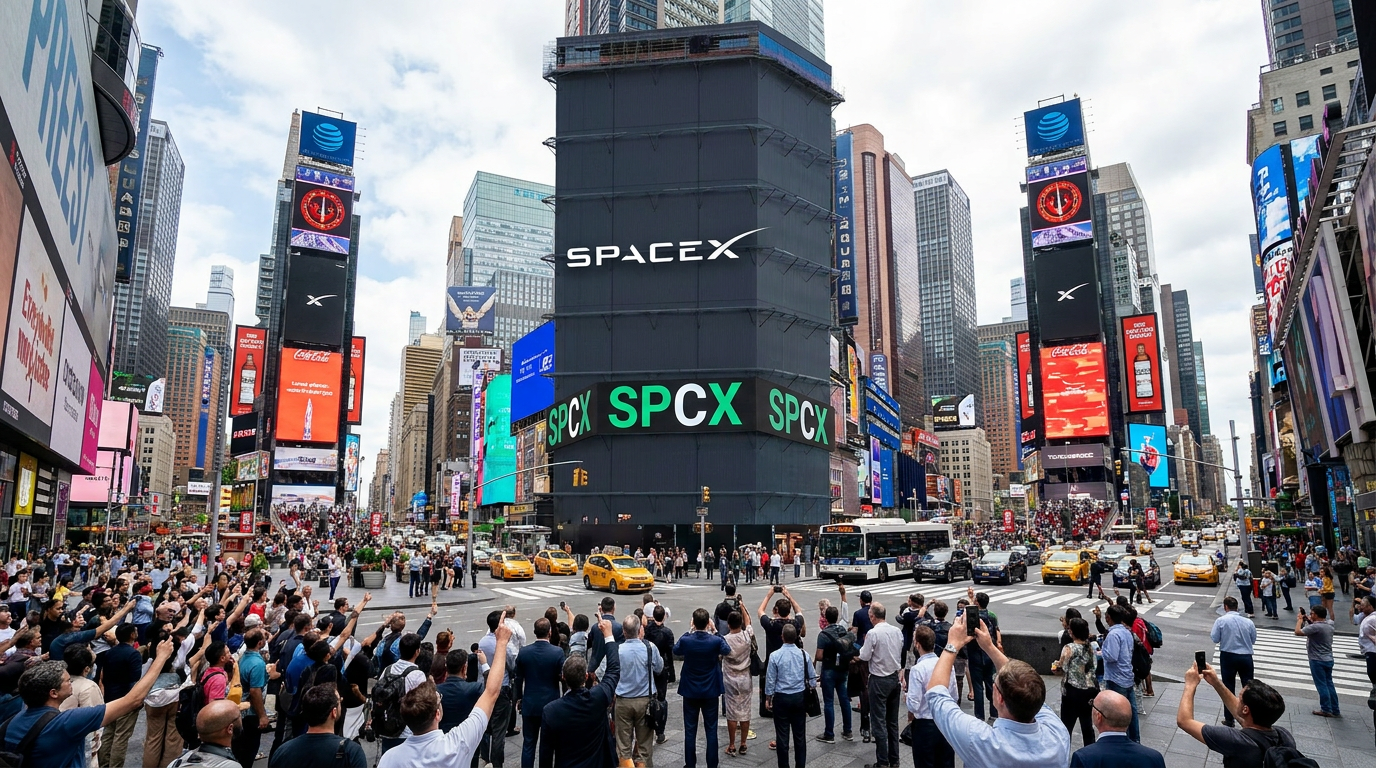
SpaceX officially transformed from a closely guarded private enterprise into a public market juggernaut on Friday, executing the largest initial public offering in history. Trading under the ticker symbol SPCX on the Nasdaq, the aerospace manufacturer raised a staggering $75 billion by selling more than 555 million shares at a fixed price of $135. The sheer scale of the offering eclipsed the previous global record set by Saudi Aramco's $29.4 billion debut in 2019, instantly cementing SpaceX as one of the most valuable companies on Earth.[1][6][7]
The market's reception was explosive. Public trading commenced at $150 per share and quickly surged, peaking at an intraday high of $176.52 before settling at $160.95 by the closing bell. That 19% first-day pop pushed SpaceX's total valuation past the historic $2 trillion threshold. The soaring stock price also triggered a personal milestone for CEO Elon Musk, whose 42% ownership stake and massive options package propelled his estimated net worth to $1.1 trillion, making him the world's first-ever trillionaire.[1][2][6]
Demand for the offering was unprecedented, with institutional investors placing orders totaling $250 billion—nearly four times the available shares. Asset management giant BlackRock alone submitted a single $5 billion order, an amount nearly equal to the entire IPO of AI chipmaker Cerebras earlier in the year. Yet, in a stark departure from traditional Wall Street playbooks, SpaceX and its underwriters deliberately engineered the offering to prioritize everyday buyers, reserving an unheard-of 30% of the allocation for retail investors.[3][4]

That retail focus triggered a frenzy across consumer brokerages. Firms like Fidelity lowered their minimum account balance requirements for IPO access from $100,000 to just $2,000 to accommodate the surge in interest. When trading opened, self-directed investors flooded the market, pouring nearly $20 million into SpaceX shares within the first 20 minutes alone. By mid-afternoon, SpaceX accounted for roughly 4% of all single-stock retail turnover, dwarfing the trading volume of retail favorites like Nvidia.[2][4][5]
The massive capital injection is earmarked for SpaceX's most ambitious, capital-intensive projects. Musk reiterated the company's core mission to "make humanity multiplanetary," emphasizing that the funds will accelerate the development of the massive Starship rocket and the establishment of a lunar base and eventual Mars colony. Additionally, the company plans to expand its highly lucrative Starlink satellite broadband network and pioneer unproven technologies, such as deploying solar-powered artificial intelligence data centers in low-Earth orbit.[6][7][8]
The massive capital injection is earmarked for SpaceX's most ambitious, capital-intensive projects.
Despite the euphoric market debut, some financial analysts and lawmakers are urging caution. SpaceX remains unprofitable, having lost $8.7 billion between the start of 2025 and March 2026, even as revenue from its Starlink division surged to $18.7 billion last year. Research firm Morningstar previously valued the company at just $63 per share—less than half of its IPO price—warning that the stock is "priced for perfection" and relies on engineering feats that have yet to be successfully demonstrated.[4][6][7]

Corporate governance also remains a flashpoint. Musk retains roughly 85% of SpaceX's voting power through supervoting shares, granting him absolute control over the company's direction. This concentrated authority prompted Senator Elizabeth Warren to send a 12-page letter to the Securities and Exchange Commission prior to the IPO, requesting a delay over concerns regarding potential accounting inaccuracies and the risks of a single individual wielding such immense influence over a $2 trillion entity.[1][4]
The ripple effects of SpaceX's debut are already reshaping the broader market. Because of its massive valuation, the company is expected to be fast-tracked into major indices like the Nasdaq 100, forcing passive funds and ETFs to buy the stock and potentially creating selling pressure on other technology heavyweights as portfolios rebalance. Meanwhile, the sheer gravitational pull of the SpaceX listing drained capital from smaller space-adjacent competitors on Friday, sending shares of Virgin Galactic and AST SpaceMobile tumbling by double digits.[8]
The wealth generated by the IPO extends far beyond Musk himself. The offering minted a new class of billionaires among SpaceX's early backers and long-time employees. Company president Gwynne Shotwell saw her stake valued at nearly $2 billion, while early investor Antonio Gracias held shares worth over $75 billion at the opening price. As SpaceX merchandise—including $125 rocket engine bells—flew off the shelves, the company's transition to the public sphere marked not just a financial milestone, but a cultural phenomenon that has firmly anchored the space economy on Wall Street.[2]

Wall Street is now viewing the SpaceX launch as a definitive stress test for a looming wave of mega-IPOs. With artificial intelligence giants like Anthropic and OpenAI reportedly exploring public offerings later this year, the market's willingness to absorb a $75 billion listing signals robust appetite for high-growth, visionary technology firms. As underwriters weigh their 30-day option to sell an additional 83 million shares, SpaceX's historic debut has undeniably redefined the boundaries of public market capital.[1][3]
How we got here
2002
Elon Musk founds SpaceX in El Segundo, California, with the goal of reducing space transportation costs.
2019
Saudi Aramco raises $29.4 billion in its IPO, setting the previous global record for the largest public offering.
May 20, 2026
The SEC publicly discloses SpaceX's S-1 filing, detailing the company's plans to go public.
June 11, 2026
SpaceX finalizes its IPO price at $135 per share, aiming to raise $75 billion.
June 12, 2026
SpaceX begins trading on the Nasdaq under the ticker SPCX, with shares surging 19% to push the company's valuation past $2 trillion.
Viewpoints in depth
Retail Investors
Everyday investors and retail brokerages view the 30% allocation as a historic democratization of wealth creation.
Retail traders poured millions into the stock within minutes of the opening bell. Advocates argue that for too long, the massive gains of hyper-growth tech companies were captured exclusively by private equity and institutional funds before the public was allowed to participate. By lowering minimum account balances and reserving a massive tranche of shares, this camp believes SpaceX has rewritten the rules of public offerings to reward the public whose tax dollars often subsidize space infrastructure.
Institutional Skeptics
Financial analysts and governance watchdogs warn that the company's valuation is detached from its current financial reality.
Skeptics point to SpaceX's $8.7 billion in recent losses and its reliance on unproven technologies, such as orbital AI data centers, to justify its $2 trillion price tag. Furthermore, corporate governance advocates like Senator Elizabeth Warren argue that Elon Musk's 85% voting control presents a severe risk to public shareholders. They caution that the stock is "priced for perfection" and that any delays in the Starship program could trigger a massive correction.
Space Industry Optimists
Aerospace experts and early backers see the capital influx as the necessary fuel for humanity's multiplanetary future.
For this camp, traditional valuation metrics like near-term price-to-earnings ratios miss the point. They argue that SpaceX has already revolutionized the launch industry by reducing costs by 95% and building the dominant Starlink network. The $75 billion raised is viewed as a war chest that will fund the extraordinarily expensive development of the Starship rocket, lunar landers, and eventual Mars colonization efforts, cementing U.S. dominance in the commercial space race.
What we don't know
- Whether the underwriters will exercise their 30-day option to sell an additional 83 million shares.
- How quickly SpaceX will be added to major indices like the S&P 500 and the resulting impact on passive funds.
- Whether the SEC will take any delayed action regarding the governance concerns raised by lawmakers.
Key terms
- Initial Public Offering (IPO)
- The process by which a private company offers shares of its stock to the public for the first time, allowing it to raise capital from public investors.
- Market Capitalization
- The total dollar market value of a company's outstanding shares of stock, calculated by multiplying the current share price by the total number of shares.
- Retail Investor
- An individual, non-professional investor who buys and sells securities for their personal account, rather than on behalf of an institution.
- Supervoting Shares
- A class of stock that provides its holders with disproportionately high voting rights compared to standard shares, often used by founders to maintain control of a company.
- Underwriter
- A financial institution, typically an investment bank, that administers the public issuance and distribution of securities from a corporation.
Frequently asked
What was the SpaceX IPO price?
The initial public offering was priced at $135 per share, but the stock opened for trading at $150 and closed its first day at $160.95.
How much money did SpaceX raise?
SpaceX raised $75 billion in its IPO, making it the largest public offering in history, surpassing Saudi Aramco's $29.4 billion debut.
Could retail investors buy SpaceX shares?
Yes, SpaceX reserved an unprecedented 30% of its IPO allocation for retail investors, and brokerages like Fidelity lowered their minimum account requirements to $2,000 to allow broader participation.
Is SpaceX a profitable company?
While its Starlink division generates significant revenue, SpaceX as a whole remains unprofitable, reporting an $8.7 billion loss between early 2025 and March 2026.
Did Elon Musk become a trillionaire?
Yes, the surge in SpaceX's valuation pushed Elon Musk's estimated net worth to $1.1 trillion, making him the world's first trillionaire.
Sources
Source coverage
8 outlets
3 viewpoints surfaced








[1]The GuardianSpace Industry Optimists
SpaceX makes largest ever stock market debut, making Elon Musk world's first trillionaire
Read on The Guardian →[2]Business InsiderRetail Investors
SpaceX IPO: SPCX stock rises 19% in its first day of trading, cementing Musk as the first-ever trillionaire
Read on Business Insider →[3]ForbesSpace Industry Optimists
SpaceX Opens At $150—Surging 20% After Largest IPO Ever (Live Updates)
Read on Forbes →[4]CoboInstitutional Skeptics
SpaceX Completes Largest IPO in History, Raising $75 Billion at $135 Per Share
Read on Cobo →[5]The Straits TimesRetail Investors
SpaceX IPO: Retail investors' dreams and allocations
Read on The Straits Times →[6]CBS NewsSpace Industry Optimists
SpaceX stock soars 19% on first day of trading following record-breaking $75 billion IPO
Read on CBS News →[7]Los Angeles TimesInstitutional Skeptics
SpaceX is poised to make history with record $75-billion stock IPO
Read on Los Angeles Times →[8]Global NewsSpace Industry Optimists
SpaceX stock surges in 1st day on Wall Street. Everything you need to know
Read on Global News →


Every angle. Every day.
Get finance stories with full source coverage and perspective breakdowns delivered to your inbox.