
SpaceX Completes Historic $75 Billion IPO, Reshaping the Commercial Space Economy
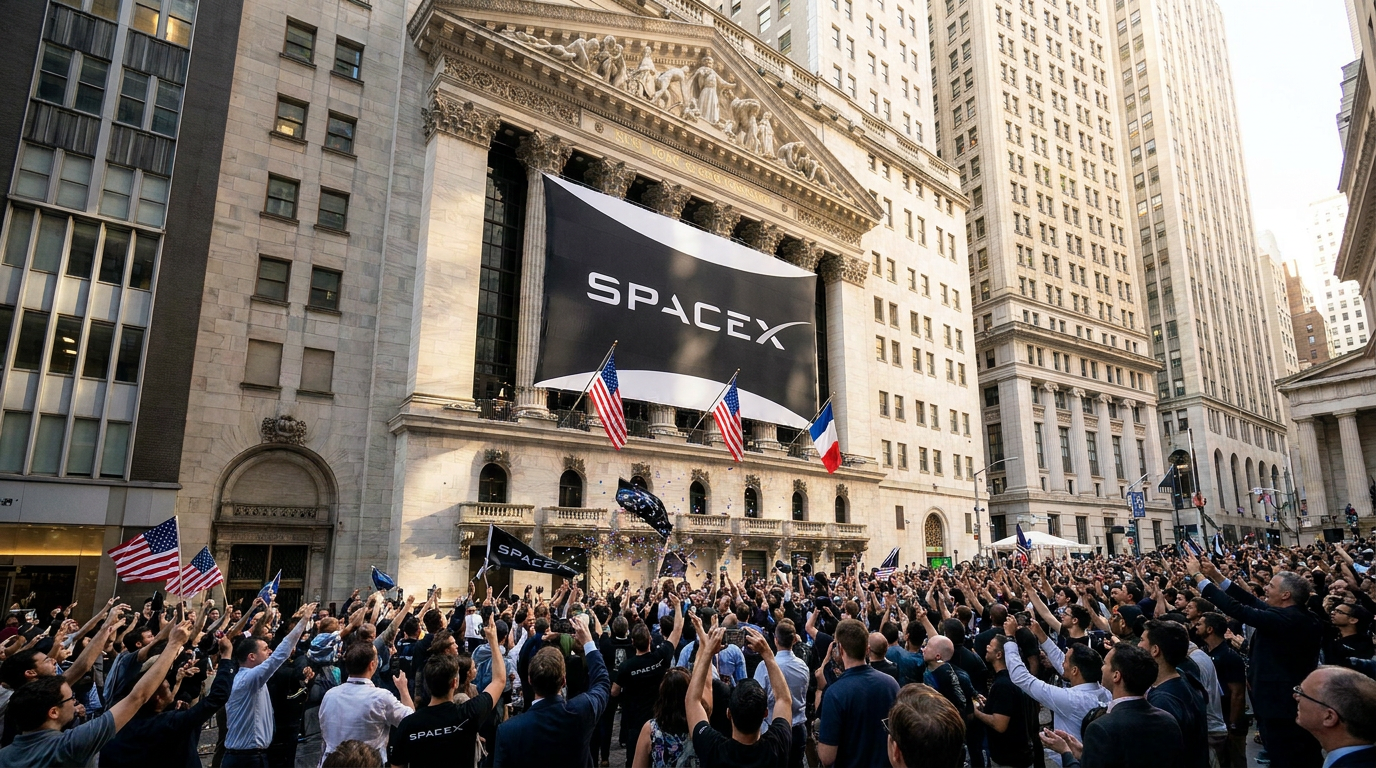
SpaceX has successfully executed the largest initial public offering in history, raising $75 billion while bypassing traditional Wall Street underwriting norms. The blockbuster debut unlocks massive capital for future space exploration and delivers a historic windfall to the company's long-term employees.
By Factlen Editorial Team
- Retail Investors & Enthusiasts
- Views the unconventional IPO structure as a victory for everyday investors who were granted direct access to a generational technology company.
- Traditional Financial Institutions
- Acknowledges the historic success of the offering while analyzing how the reduced-fee, direct-allocation model disrupts standard investment banking practices.
- Commercial Space Industry
- Sees the massive capital raise as a definitive validation of the space economy that will drive investment across the entire aerospace supply chain.
What's not represented
- · Local residents in SpaceX hub cities facing potential housing market pressures from newly wealthy employees.
Why this matters
The unprecedented scale of this public offering injects massive funding into next-generation space infrastructure while proving that retail-friendly, unconventional IPO structures can succeed at the highest levels of global finance.
Key points
- SpaceX completed the largest IPO in history, raising $75 billion.
- The offering bypassed traditional Wall Street norms to prioritize retail investor access.
- Thousands of early SpaceX employees experienced a massive wealth-creation event.
- The capital will fund Starship development, Starlink expansion, and Mars infrastructure.
- The successful debut validates the broader commercial space economy for institutional investors.
In a milestone that redefines the boundaries of both global finance and aerospace, SpaceX has successfully completed the largest initial public offering in history. Raising an astonishing $75 billion, the company shattered previous records held by state-backed giants and established a new high-water mark for commercial enterprise. The highly anticipated debut on the public markets was met with overwhelming demand, validating a decades-long vision of making humanity a multi-planetary species while rewarding the investors and employees who backed the venture during its riskiest early years.[1][2]
What makes the offering particularly notable is not just its sheer size, but the unconventional mechanics of how it was executed. Bypassing the traditional Wall Street playbook, the company structured the IPO to minimize underwriter fees and maximize direct access for retail investors. By bucking the standard institutional allocation model, SpaceX ensured that a significant portion of the shares was available to everyday investors on day one, a move that analysts note could not have gone much better in practice.[1][5]

The market reaction was immediate and overwhelmingly positive. Shares surged in early trading as retail brokerages reported record-breaking volume, with millions of individual investors flocking to secure a stake in the space exploration giant. Financial institutions, initially skeptical of the unorthodox pricing mechanism, quickly adapted to the immense liquidity the offering generated. The successful debut has effectively defied the gravity of traditional valuation metrics, proving that immense capital can be mobilized for long-term, capital-intensive infrastructure projects.[3][4]
Beyond the trading floor, the IPO has triggered a massive wealth-creation event for SpaceX's workforce. Thousands of early employees, engineers, and technicians who received equity compensation over the past two decades are now millionaires on paper. This sudden influx of wealth is already reshaping local economies around the company's primary hubs, particularly in South Texas, where the concentration of newly minted employee wealth is expected to drive significant regional investment and development.[1][6]
Beyond the trading floor, the IPO has triggered a massive wealth-creation event for SpaceX's workforce.
The $75 billion capital injection is earmarked for the company's most ambitious projects. According to regulatory filings, the funds will primarily accelerate the development and mass production of the Starship launch system, expand the Starlink satellite internet constellation, and lay the groundwork for early Mars colonization infrastructure. This war chest provides SpaceX with unparalleled financial runway, insulating its deep-space ambitions from short-term market volatility and allowing for sustained research and development.[7][8]
The ripple effects across the broader commercial space economy are already being felt. Industry analysts view the blockbuster IPO as a rising tide that validates the entire sector, from satellite manufacturers to orbital logistics startups. Competitors and suppliers alike are experiencing a halo effect, as the successful public offering demonstrates to institutional capital that the space economy is a mature, viable, and highly lucrative asset class.[7]

For traditional Wall Street banks, the event serves as a wake-up call. While major institutions still played a role in facilitating the massive transaction, the reduced fee structure and direct-to-retail allocation model forced them to accept a smaller piece of the pie. Financial strategists suggest that the success of this model may embolden other highly valued private companies to demand similar terms, potentially permanently altering the power dynamic between Silicon Valley unicorns and New York investment banks.[2][5]
Ultimately, the SpaceX IPO stands as a testament to the democratization of access to frontier technologies. By inviting the public to participate directly in the capitalization of space exploration, the company has aligned its financial structure with its populist mission of opening the cosmos to humanity. As the dust settles on the historic trading debut, the focus now shifts from the mechanics of the offering to the monumental engineering challenges the capital is meant to solve.[1][3]
How we got here
2002
SpaceX is founded with the long-term goal of reducing space transportation costs and colonizing Mars.
2020
The company successfully launches its first crewed mission to the International Space Station, cementing its role as a primary NASA partner.
2024
Starship achieves major operational milestones, proving the viability of fully reusable super-heavy launch vehicles.
June 2026
SpaceX executes a historic $75 billion IPO, transitioning from a privately held unicorn to a publicly traded aerospace titan.
Viewpoints in depth
Retail Investors & Enthusiasts
Views the unconventional IPO structure as a victory for everyday investors who were granted direct access.
For years, retail investors have watched from the sidelines as private equity and venture capital firms reaped the massive valuation gains of Silicon Valley's most successful startups. The SpaceX IPO flipped this dynamic by intentionally structuring the offering to ensure broad public access on day one. Proponents of this model argue that it democratizes wealth creation, allowing everyday enthusiasts who believe in the mission of space exploration to directly participate in the company's financial upside.
Traditional Financial Institutions
Analyzes how the reduced-fee, direct-allocation model disrupts standard investment banking practices.
While Wall Street banks ultimately facilitated the transaction, the mechanics of the SpaceX offering represent a structural threat to the traditional IPO playbook. By dictating lower underwriting fees and bypassing standard institutional allocation privileges, the company proved that mega-cap firms with immense public demand do not need to rely entirely on investment banks to generate liquidity. Financial analysts suggest this could set a precedent, empowering other highly valued private companies to negotiate far more aggressive terms when they decide to go public.
Commercial Space Industry
Sees the massive capital raise as a definitive validation of the space economy.
Within the aerospace sector, the $75 billion raise is viewed not just as a victory for one company, but as a watershed moment for the entire industry. For decades, commercial space ventures struggled to convince institutional capital that orbital infrastructure could generate reliable, massive returns. The overwhelming success of this IPO provides undeniable proof of market appetite, which industry leaders believe will lower the cost of capital for adjacent startups, satellite manufacturers, and deep-space research firms.
What we don't know
- How the stock will perform in its first full quarter of public earnings reports.
- Whether other major private technology companies will adopt this retail-friendly IPO structure.
- The exact timeline for when the newly raised capital will translate into a crewed Mars mission.
Key terms
- Initial Public Offering (IPO)
- The process by which a private company offers shares of its stock to the public for the first time, allowing it to raise capital from public investors.
- Retail Investor
- An individual, non-professional investor who buys and sells securities for their personal account, rather than on behalf of an institution.
- Underwriter
- A financial institution, typically an investment bank, that evaluates and assumes the risk of bringing a new securities issue to the market.
Frequently asked
How much money did SpaceX raise?
SpaceX raised $75 billion in its initial public offering, making it the largest IPO in global financial history.
What will the company do with the funds?
The capital is earmarked for accelerating the development of the Starship launch vehicle, expanding the Starlink satellite network, and funding early infrastructure for Mars exploration.
How did this IPO differ from traditional ones?
SpaceX utilized an unconventional structure that reduced traditional underwriter fees and allocated a significantly larger portion of shares directly to retail investors on the first day of trading.
Sources
Source coverage
8 outlets
3 viewpoints surfaced








[1]MarketWatchRetail Investors & Enthusiasts
How Elon Musk nailed the SpaceX IPO: ‘I’m not sure that this could have gone much better’
Read on MarketWatch →[2]The Wall Street JournalTraditional Financial Institutions
SpaceX's Historic $75 Billion IPO Reshapes the Stock Market
Read on The Wall Street Journal →[3]CNBCRetail Investors & Enthusiasts
Retail Investors Flock to SpaceX Debut as Shares Surge
Read on CNBC →[4]BloombergTraditional Financial Institutions
SpaceX Valuation Defies Gravity Following Record-Breaking Public Offering
Read on Bloomberg →[5]Financial TimesTraditional Financial Institutions
Musk's Unconventional IPO Strategy Pays Off for SpaceX
Read on Financial Times →[6]ReutersCommercial Space Industry
SpaceX Employees Reap Windfall After Blockbuster IPO
Read on Reuters →[7]SpaceNewsCommercial Space Industry
What the SpaceX IPO Means for the Future of the Commercial Space Economy
Read on SpaceNews →[8]U.S. Securities and Exchange Commission
Space Exploration Technologies Corp. Form S-1 Registration Statement
Read on U.S. Securities and Exchange Commission →



Every angle. Every day.
Get finance stories with full source coverage and perspective breakdowns delivered to your inbox.