
Quantum Computing Crosses the Fault-Tolerant Threshold
Multiple research teams have successfully demonstrated that quantum error rates decrease as systems scale, shifting the technology from a physics experiment to an engineering discipline.
By Factlen Editorial Team
- Hardware Scaling Advocates
- Focus on scaling physical qubits and proving that logical error rates decrease as systems grow.
- Commercial Adopters
- Focus on hybrid quantum-classical workflows and the timeline to practical applications.
- Algorithmic Efficiency Proponents
- Argue that smarter error-correcting codes are the key to reducing hardware overhead.
- Independent Analysts
- Evaluate the remaining engineering hurdles and realistic timelines for quantum advantage.
What's not represented
- · Classical Supercomputing Manufacturers
- · Post-Quantum Cryptography Researchers
Why this matters
For decades, quantum computing has been a theoretical promise constrained by fragile hardware. The 2026 error-correction breakthroughs prove the hardware can actually scale, unlocking a new era of computing that will eventually simulate molecular chemistry, revolutionize drug discovery, and solve optimization problems that are physically impossible for classical supercomputers and AI.
Key points
- Multiple quantum computing companies demonstrated below-threshold error correction at scale in 2026.
- Google's Willow processor proved that adding more physical qubits exponentially decreases the logical error rate.
- Atom Computing achieved similar continuous error correction results using a neutral atom hardware system.
- IQM Quantum Computers introduced new barbell codes that reduce the required physical qubit overhead by up to eight times.
- The breakthroughs shift quantum computing from a theoretical physics challenge to a practical engineering discipline.
For decades, quantum computing has been trapped in the Noisy Intermediate-Scale Quantum era. The machines were powerful in theory but too fragile in practice, severely limiting their real-world utility. In 2026, the field crossed a critical threshold, shifting from a physics research problem to a scalable engineering discipline.[1][6]
The core breakthrough is known as below-threshold error correction. Historically, adding more physical qubits to a quantum system introduced more noise than it fixed, making the system worse as it grew. Now, multiple independent teams have demonstrated the exact opposite: as systems scale, logical error rates decrease exponentially.[1][2]
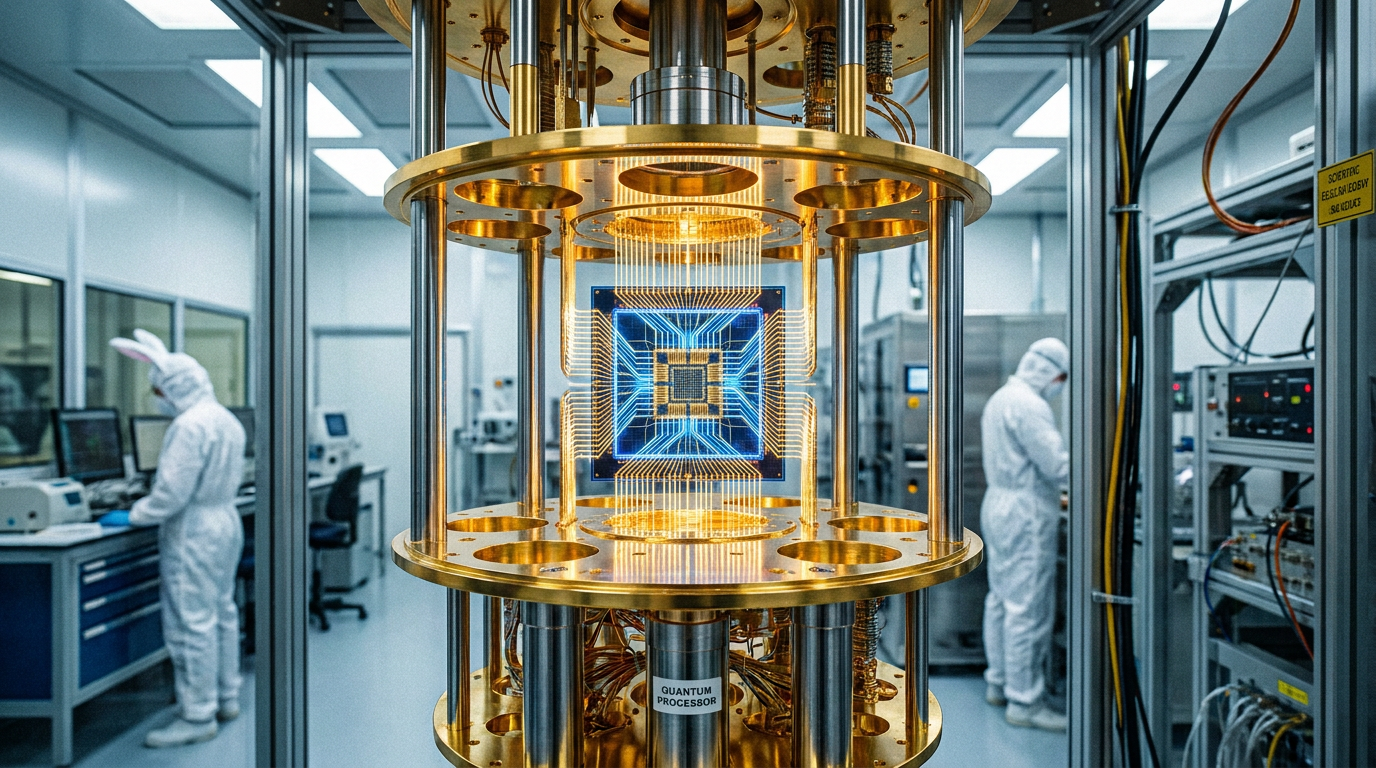
Google's Quantum AI team provided the most prominent evidence with their Willow processor. The 105-physical-qubit superconducting chip demonstrated that logical error rates decrease by a factor of roughly 2.14x with each increase in the surface-code lattice size.[3]
This means the theoretical scaling curves predicted by physicists actually hold true in hardware. By proving that redundancy can outpace decoherence, the industry has established a clear, mathematically sound path to fault-tolerant computing.[1][6]

To understand the weight of this evidence, one must distinguish between physical and logical qubits. A physical qubit is the actual hardware component—whether a superconducting circuit, a trapped ion, or a neutral atom.[2]
Because these physical components are highly sensitive to environmental noise, such as heat or stray electromagnetic fields, they lose their quantum state in mere microseconds. To solve this fragility, physicists group multiple physical qubits together to form a single, highly stable logical qubit.[2][6]
The operating theory has always been that if the error rate of the underlying physical qubits falls below a certain threshold, the system's error-correction code can catch and fix faults faster than they accumulate. Until 2026, reaching this threshold at scale remained elusive, with added qubits often introducing more noise than they corrected.[4][6]

The breakthrough is not confined to superconducting chips. Atom Computing recently published data demonstrating continuous quantum error correction in a neutral atom system.[4]
Atom Computing recently published data demonstrating continuous quantum error correction in a neutral atom system.
Their system proved that as the neutral-atom array became larger and more redundant, logical performance improved. This marks the first time a neutral atom company has demonstrated many rounds of performant quantum error correction, validating that the scaling principle applies across different hardware modalities.[4]
While Google relies on the standard surface code—which requires massive overhead, often demanding 1,000 physical qubits to sustain a single logical one—other teams are proving that hardware complexity can be reduced. IQM Quantum Computers recently introduced barbell codes, a family of quantum low-density parity-check codes.[5]
IQM claims this approach achieves up to three orders of magnitude lower logical error rates than the surface code while requiring up to eight times fewer physical qubits. This is engineered for the practical realities of superconducting qubit manufacturing, offering a highly competitive path to scalability.[5]

Taking a completely different physics route, Microsoft is betting on topological qubits based on Majorana fermions. In early 2026, the company unveiled its Majorana 1 chip.[1]
Topological qubits offer inherent error resistance at the hardware level, potentially reducing the need for massive software-level error correction. Alongside their hardware partners at Quantinuum, Microsoft previously created 12 highly accurate logical qubits, cementing what researchers are calling the fault-tolerant foundation era.[2]
The transition to fault-tolerant quantum computing unlocks computational domains that classical supercomputers and artificial intelligence cannot touch. While AI is highly effective at approximating and optimizing data, it remains bounded by classical architectures and cannot natively simulate quantum mechanics.[1][6]
Fault-tolerant quantum systems, however, will eventually run molecular and multi-physics simulations with perfect accuracy. This fundamentally changes materials science, catalyst discovery, battery chemistry, and pharmaceutical development.[1][2]

Despite the 2026 milestones, transparent uncertainty remains around the engineering hurdles ahead. The overhead problem is still massive; even with more efficient codes, building a machine with thousands of logical qubits will require millions of physical qubits.[5][6]
This scale necessitates unprecedented breakthroughs in cryogenic cooling, control electronics, and cabling infrastructure. Furthermore, the timeline to true quantum advantage—the point where a quantum computer solves a commercially valuable problem cheaper or faster than a classical machine—remains contested.[1][6]
While error correction has been solved in principle, scaling it to commercial relevance will require years of iterative engineering. The 2026 breakthroughs mark the end of the beginning for quantum computing; the physics works, and the focus now shifts entirely to manufacturing and integration.[2][6]
How we got here
Pre-2026
Quantum computers operate in the NISQ era, where adding more qubits often increases overall system noise.
2025
Google demonstrates early evidence of error suppression with its surface code on a smaller scale.
Early 2026
Microsoft and Quantinuum successfully create 12 highly accurate logical qubits.
Mid 2026
Google's Willow processor and Atom Computing's neutral atom system definitively prove that logical error rates decrease exponentially as systems scale.
June 2026
IQM announces barbell codes, significantly reducing the hardware overhead required for fault tolerance.
Viewpoints in depth
Hardware Scaling Advocates
Argue that the primary path to fault tolerance is brute-force engineering and scaling.
This camp, led by major players like Google and Atom Computing, argues that the primary path to fault tolerance is brute-force engineering. By demonstrating that the surface code works in practice—where adding more physical qubits exponentially decreases the logical error rate—they believe the fundamental physics risk has been retired. Their focus is now on building larger cryogenic systems and better control electronics to support millions of physical qubits.
Algorithmic Efficiency Proponents
Argue that smarter error-correcting codes are the key to reducing hardware overhead.
Researchers and companies like IQM argue that relying solely on the surface code is a dead end due to its massive 1,000-to-1 physical-to-logical qubit ratio. Instead, they advocate for advanced mathematical frameworks, such as quantum low-density parity-check (QLDPC) codes or barbell codes. By reducing the required hardware overhead by up to 8x, this camp believes fault-tolerant quantum computing can be achieved years earlier, using significantly smaller and more manageable cryogenic systems.
Topological Hardware Developers
Believe that building inherent error resistance into the physical qubits themselves is superior to massive software-level correction.
Microsoft and its partners champion a fundamentally different approach: topological qubits. Rather than building fragile qubits and correcting them with massive software overhead, this camp seeks to encode information in Majorana fermions—exotic particles that are inherently resistant to local environmental noise. While this physics is much harder to engineer initially, proponents argue it offers a cleaner, more scalable path to millions of qubits without the crushing burden of continuous error correction.
What we don't know
- How quickly the industry can manufacture the millions of physical qubits required for commercial-scale fault tolerance.
- Whether topological qubits will ultimately outcompete traditional superconducting circuits.
- The exact timeline for achieving quantum advantage in commercially valuable applications like drug discovery.
Key terms
- Qubit
- The basic unit of quantum information, capable of existing in multiple states simultaneously, unlike classical bits which are strictly 0 or 1.
- Decoherence
- The process by which a quantum system loses its delicate quantum state due to interaction with its environment, causing errors in calculation.
- Fault-Tolerant Computing
- A system design that allows a computer to continue operating reliably even when individual components fail or produce errors.
- Surface Code
- A widely used quantum error-correction algorithm that arranges qubits in a 2D grid to detect and fix faults.
- Neutral Atom Qubits
- A hardware approach that uses individual atoms, trapped and manipulated by lasers, to store quantum information.
Frequently asked
What is a logical qubit?
A highly stable 'virtual' qubit created by grouping together many fragile physical qubits and using software to correct their errors in real-time.
Why is the 2026 breakthrough important?
It proves that adding more physical qubits actually reduces the overall error rate, crossing the threshold needed to build large, reliable quantum computers.
Will quantum computers replace classical computers?
No. The future is hybrid. Quantum computers will be used as specialized co-processors for specific tasks like molecular simulation, while classical computers handle everyday processing.
What are topological qubits?
A different approach to quantum hardware that uses exotic particles to create qubits with built-in resistance to errors, potentially requiring less software correction.
Sources
Source coverage
6 outlets
4 viewpoints surfaced






[1]BQP SimCommercial Adopters
Google and Microsoft proved logical error rates decrease as systems scale
Read on BQP Sim →[2]Spin QuantaCommercial Adopters
2026 Qubit Breakthroughs: Quantum Computing Enters the 'Fault-Tolerant Foundation Era'
Read on Spin Quanta →[3]Google Quantum AIHardware Scaling Advocates
Exponential Error Suppression with the Willow Processor
Read on Google Quantum AI →[4]Atom ComputingHardware Scaling Advocates
A Sub-Threshold Quantum Error Correction Result in Neutral Atoms
Read on Atom Computing →[5]IQM Quantum ComputersAlgorithmic Efficiency Proponents
IQM Announces Novel Quantum Error Correction Approach Toward Fault-Tolerant Quantum Computing
Read on IQM Quantum Computers →[6]Factlen Editorial TeamIndependent Analysts
Synthesis by Factlen editorial team
Read on Factlen Editorial Team →

Every angle. Every day.
Get science stories with full source coverage and perspective breakdowns delivered to your inbox.