
Plant-Based vs. Traditional Leather: The 2026 Sustainability and Durability Showdown
As next-generation materials like mycelium and cactus leather scale up, consumers face a complex choice between traditional animal hides, synthetic plastics, and bio-based alternatives.
By Factlen Editorial Team
- Bio-Based Pragmatists
- Champions scalable plant-based alternatives, even if they require synthetic binders.
- Traditional Leather Advocates
- Argues that utilizing meat-industry byproducts for long-lasting goods is the most practical form of sustainability.
- Plastic-Free Purists
- Demands absolute circularity and rejects any material containing petroleum-based plastics.
What's not represented
- · Tannery Workers
- · Livestock Farmers
Why this matters
As the global leather market approaches $360 billion, consumers are increasingly forced to choose between animal welfare, plastic pollution, and carbon emissions. Understanding the hidden trade-offs of next-generation materials prevents eco-conscious shoppers from accidentally investing in greenwashed plastics.
Key points
- Traditional animal leather offers unmatched longevity but requires massive water inputs and toxic tanning chemicals.
- Synthetic PU leather is cheap and water-resistant, but relies entirely on fossil fuels and degrades quickly.
- Plant-based leathers drastically cut water and carbon footprints, though many rely on plastic binders for strength.
- 100% plastic-free innovations like Mirum and mycelium offer true circularity but face significant scaling and energy challenges.
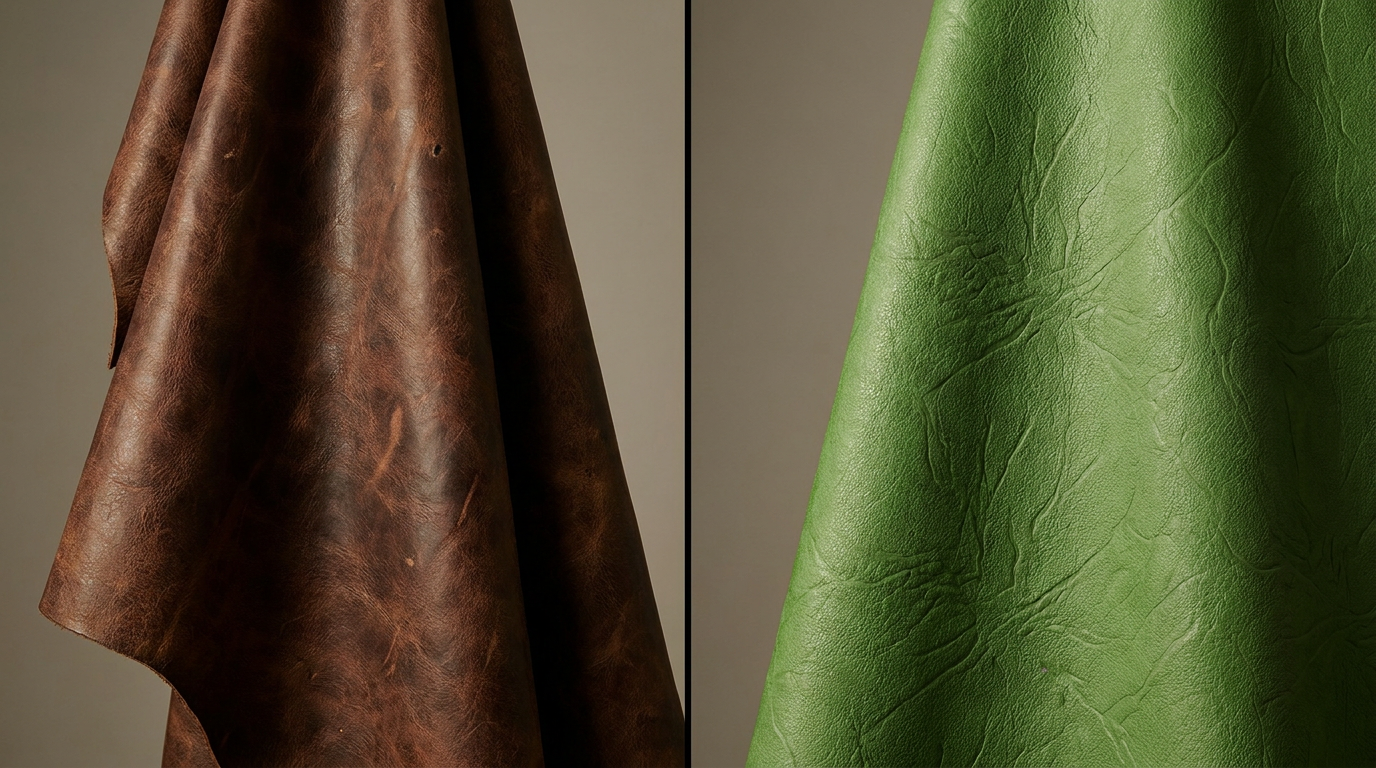
For decades, the choice in the fashion industry was binary: invest in the enduring luxury of animal leather, or settle for the plastic sheen of synthetic alternatives. Today, a third category has disrupted the $360 billion leather market. Plant-based and lab-grown leathers—derived from cactus, pineapple leaves, and fungal mycelium—promise the holy grail of sustainable fashion. They offer the premium feel of animal hides without the staggering environmental toll or ethical concerns. Yet, as these next-generation materials scale from boutique capsule collections to global supply chains, the reality of their environmental impact and long-term durability is proving far more complex than the marketing suggests.[9]
To understand the trade-offs, consumers must weigh the explicit arguments for and against each material, backed by emerging life-cycle evidence. Traditional animal leather remains the benchmark for longevity. The primary argument for genuine leather is its unmatched durability; a well-crafted cowhide bag can last for decades, developing a rich patina rather than peeling. Proponents argue that because leather is largely a byproduct of the meat industry, utilizing the hides prevents them from entering landfills. Furthermore, high-quality full-grain leather naturally biodegrades at the end of its life, unlike petroleum-based plastics.[4]
However, the arguments against traditional leather center on its massive resource consumption and chemical toxicity. According to the Higg Materials Sustainability Index, cowskin is the third most environmentally impactful material to produce. The evidence is stark: manufacturing a single traditional leather tote bag requires over 17,000 liters of water and generates roughly 100.5 kilograms of carbon dioxide. Furthermore, the conventional tanning process relies heavily on chromium sulfate, a toxic chemical that poses severe health risks to tannery workers and frequently pollutes local waterways.[7]

In response, the industry developed synthetic leather, primarily made from polyurethane (PU) or polyvinyl chloride (PVC). The argument for synthetics is their affordability, high water resistance, and surprisingly low initial environmental footprint—studies show synthetic leather has only a quarter of the immediate environmental impact of animal leather because it bypasses livestock farming. Yet, the arguments against it are equally compelling. Synthetics are entirely petroleum-based, non-biodegradable, and notoriously prone to cracking and peeling after just two to five years of use.[1][5]
This brings the showdown to the most heavily marketed category: plant-based leathers, such as Desserto (cactus) and Piñatex (pineapple). The argument for these materials is their innovative use of agricultural waste. Piñatex utilizes leftover pineapple leaves from the Philippines, providing extra income to farmers, while cactus leather requires minimal water to grow. Brands champion these materials for cutting carbon emissions and water use by orders of magnitude compared to animal agriculture.[6][8]
This brings the showdown to the most heavily marketed category: plant-based leathers, such as Desserto (cactus) and Piñatex (pineapple).
The argument against many plant-based leathers lies in their hidden plastic content. To achieve the necessary durability and weather resistance, materials like Desserto and Piñatex are often blended with or coated in polyurethane. Evidence from material analyses reveals that some cactus leathers contain up to 65% PU by weight. This reliance on plastic binders means the final product is not fully biodegradable, leading purists to accuse the industry of greenwashing. Additionally, manufacturers note that plant-based leathers can suffer a loss of tensile strength in larger items, sometimes fraying under constant friction.[3][8]

For consumers demanding zero plastic, the frontier has shifted to 100% bio-based materials like Mirum (made from plant oils and minerals) and mycelium leather (grown from the root structure of fungi). The argument for these innovations is absolute circularity; they require no petrochemicals and can be safely composted. Mycelium, in particular, can be grown in a matter of weeks on agricultural waste, offering a highly adaptable and cruelty-free textile that rivals calfskin in softness.[1][3]
Yet, the case against these plastic-free alternatives involves severe scaling challenges and hidden energy costs. While Mirum is celebrated by eco-purists, competitors point out that it remains a boutique material, unavailable at the industrial scale required to replace traditional leather globally. Meanwhile, a recent life-cycle assessment of lab-grown mycelium in Indonesia revealed a surprisingly high carbon footprint of 57.15 kg of CO2 equivalent per square meter. The evidence shows that maintaining the precise temperature and humidity required for indoor fungal cultivation demands massive electricity inputs, complicating its status as a climate savior.[2][6]

Ultimately, navigating this material showdown requires aligning purchasing decisions with specific use cases. Traditional animal leather fits well when the consumer prioritizes multi-decade durability, structural integrity, and a natural patina, such as for heirloom luggage or heavy-duty footwear. It does not fit when the buyer is strictly eco-conscious, vegan, or concerned about the water footprint of their wardrobe.[4]
Conversely, plant-based leathers like cactus or pineapple fit well when a consumer seeks a cruelty-free, everyday accessory with a significantly lower water footprint than cowhide, and is willing to accept a lifespan of five to ten years. They do not fit when the item will be subjected to extreme friction or when the buyer demands a 100% plastic-free, biodegradable product.[5]
Finally, next-generation plastic-free materials like Mirum and mycelium fit well when supporting cutting-edge, circular innovation is the primary goal, and the consumer is willing to pay a premium for early-stage technology. They do not fit when a brand requires millions of square meters of immediate, scalable supply. As the technology matures, the gap between durability, sustainability, and scale will narrow, but for now, every material demands a compromise.[9]

How we got here
2015
Piñatex (pineapple leather) is introduced as a commercial alternative utilizing agricultural waste.
2019
Desserto debuts the world's first highly scalable cactus-based leather.
2022
Luxury brands like Hermès begin experimenting with mycelium (mushroom) leather.
2025
Scrutiny increases over the hidden polyurethane (plastic) content in mainstream plant-based leathers.
Viewpoints in depth
Traditional Leather Advocates
Argues that utilizing meat-industry byproducts for long-lasting goods is the most practical form of sustainability.
This camp emphasizes that high-quality, full-grain animal leather is a multi-decade investment that naturally biodegrades at the end of its life. They argue that as long as the global population consumes beef, utilizing the hides prevents massive waste. They view the shift toward "vegan leather" as a downgrade to disposable plastics that will inevitably end up in landfills after a few years of use.
Bio-Based Pragmatists
Champions scalable plant-based alternatives, even if they require synthetic binders.
Pragmatists argue that perfection is the enemy of progress. They acknowledge that materials like cactus and pineapple leather currently rely on polyurethane coatings for durability, but stress that these materials still drastically reduce the water and carbon footprints compared to animal agriculture. Their focus is on capturing market share from traditional tanneries today, rather than waiting for 100% plastic-free technologies to scale.
Plastic-Free Purists
Demands absolute circularity and rejects any material containing petroleum-based plastics.
This viewpoint heavily criticizes the "greenwashing" of the vegan leather industry. Purists argue that blending organic matter with polyurethane creates a "monstrous hybrid" that can neither be recycled nor composted. They advocate exclusively for 100% bio-based innovations like Mirum and pure mycelium, insisting that the fashion industry must completely sever its reliance on fossil fuels, regardless of the short-term scaling challenges.
What we don't know
- Whether 100% plastic-free plant leathers can ever achieve the price parity required to replace synthetic PU globally.
- The exact long-term lifespan of newer plant-based leathers, as many brands have only existed for a few years.
- How quickly the energy grid powering indoor mycelium cultivation will transition to renewable sources, which would lower its carbon footprint.
Key terms
- Mycelium
- The branching, underground root structure of fungi, which can be grown and compressed into a leather-like textile.
- Polyurethane (PU)
- A synthetic, petroleum-based plastic frequently used as a binder or coating in both faux and plant-based leathers to increase durability.
- Life-Cycle Assessment (LCA)
- A scientific methodology used to calculate the total environmental impact of a product from raw material extraction to final disposal.
- Patina
- The soft sheen and darkened coloration that high-quality animal leather develops naturally over years of use and exposure to the elements.
Frequently asked
Is plant-based leather completely plastic-free?
Not always. Many popular plant-based leathers, such as those made from cactus or pineapple, use polyurethane (PU) resins to bind the fibers and provide weather resistance.
How long does vegan leather last compared to real leather?
High-quality animal leather can last for decades. Synthetic PU leather typically peels after 2 to 5 years, while well-made plant-based leathers can last 5 to 10 years with proper care.
What is the most environmentally friendly leather?
There is no perfect option. Animal leather uses massive amounts of water, while plastic-free plant leathers (like Mirum) are highly sustainable but currently lack the scale to supply the global market.
Does mushroom leather require a lot of energy to make?
Yes. While fungi grow quickly and use little water, maintaining the strict temperature and humidity controls for indoor commercial cultivation requires significant electricity.
Sources
Source coverage
9 outlets
3 viewpoints surfaced









[1]FaunalyticsBio-Based Pragmatists
Fungi Fashion: The Sustainable Appeal Of Mycelium Leather
Read on Faunalytics →[2]One4LeatherTraditional Leather Advocates
The Environmental Impact of Vegan Leather: A Closer Look
Read on One4Leather →[3]Curiously ConsciousPlastic-Free Purists
Sustainable Vegan Leather: 9 Materials
Read on Curiously Conscious →[4]B.S. Bag FactoryTraditional Leather Advocates
Vegan Leather vs Real Leather Guide for Fashion Brands
Read on B.S. Bag Factory →[5]RIJACBio-Based Pragmatists
Comparing Vegan Leather Materials: Which One Lasts Longest?
Read on RIJAC →[6]DessertoBio-Based Pragmatists
The MIRUM Mirage: Greenwashed by Perfection
Read on Desserto →[7]The Mushroom MovementPlastic-Free Purists
Are fungi the key to a more sustainable leather future?
Read on The Mushroom Movement →[8]MPLGBio-Based Pragmatists
Vegan Leather Study: Piñatex
Read on MPLG →[9]Factlen Editorial TeamPlastic-Free Purists
Synthesis by Factlen editorial team
Read on Factlen Editorial Team →

More in shopping
See all 5 stories →

Every angle. Every day.
Get shopping stories with full source coverage and perspective breakdowns delivered to your inbox.