
How Women's Wrestling Became the NCAA's Fastest-Growing Championship Sport
Fueled by grassroots expansion and an Olympic-aligned rule set, women's wrestling has officially cemented its status as the NCAA's 91st championship sport.
By Factlen Editorial Team
- Division II & III Pioneers
- Smaller schools that built the sport from the ground up to drive enrollment and offer new opportunities.
- Division I Powerhouses
- Major universities looking to build elite, fully-funded programs to dominate the new landscape.
- Olympic Pipeline Advocates
- National team coaches who view the NCAA system as the ultimate training ground for international success.
What's not represented
- · High school athletic directors managing the explosive youth growth
- · Male collegiate wrestlers reacting to the sport's expansion
Why this matters
The elevation of women's wrestling to full NCAA championship status opens up millions of dollars in athletic scholarships and institutional funding for female athletes. It also creates a direct, fully-funded domestic pipeline to the Olympic Games.
Key points
- Women's wrestling became the NCAA's 91st championship sport in 2026.
- McKendree University won the inaugural team title, defeating the University of Iowa.
- The sport grew from 40 to 112 varsity programs in just three years.
- Collegiate women compete in freestyle wrestling, mirroring the Olympics.
- Division III will launch its own separate championship bracket in 2028.
As thousands of young athletes gather in Westfield, Indiana, this week for the 2026 USA Wrestling Women's National Duals, they are stepping onto the mat in a fundamentally changed landscape. For the first time, these 14U, 16U, and Junior competitors have a fully sanctioned NCAA Championship to aim for at the end of their high school careers.[1]
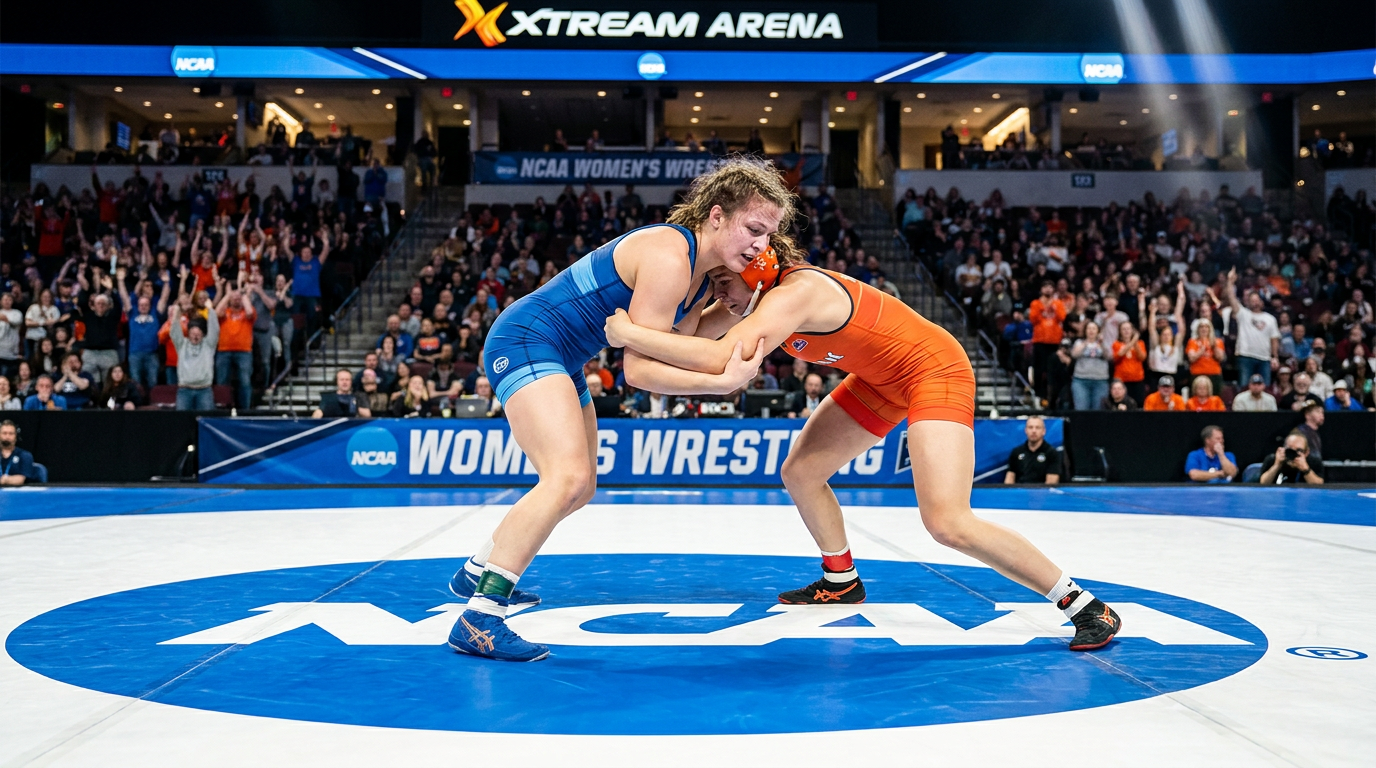
In March 2026, the NCAA hosted its inaugural National Collegiate Women's Wrestling Championships at Xtream Arena in Coralville, Iowa. The event marked the culmination of a decades-long grassroots effort, officially cementing women's wrestling as the NCAA's 91st championship sport and validating years of explosive growth at the youth level.[2][3]
The sheer scale of the sport's expansion is staggering. In the 2022-23 academic year, roughly 40 schools sponsored varsity programs. By the time the first official NCAA championship rolled around in 2026, that number had exploded to 112 programs supporting over 1,700 student-athletes across the country.[2][5]

The mechanism for this rapid ascent was the NCAA's Emerging Sports for Women program. Created in 1994 to help close gender participation gaps, the program provides a pathway for new sports to achieve full championship status once 40 schools sponsor them at the varsity level. Women's wrestling joined the program in 2020 and cleared the threshold in just three years.[3][6]
Unlike many major collegiate sports, the engine driving women's wrestling wasn't the Division I powerhouses. It was the Division II and Division III schools. Programs like McKendree University and North Central College recognized early that adding women's wrestling offered a high return on investment.[2]
For smaller institutions, emerging sports serve as powerful enrollment drivers. By offering a varsity program, these schools attracted dedicated high school athletes who previously had few collegiate options. This grassroots investment paid off spectacularly at the inaugural championship.[2]
In a unified "National Collegiate" format where Divisions I, II, and III competed in the same 180-wrestler bracket, the smaller schools proved their dominance. McKendree, a Division II program, captured the first-ever national team title, edging out Division I heavyweight the University of Iowa 171 to 166.[2][4]

In a unified "National Collegiate" format where Divisions I, II, and III competed in the same 180-wrestler bracket, the smaller schools proved their dominance.
The championship itself was a showcase of diverse talent and high-level technique. McKendree's Cameron Guerin made history by winning her fifth collegiate national title—counting the transitional pre-NCAA era—while Lehigh's Audrey Jimenez was named the tournament's Outstanding Wrestler after dominating the 110-pound weight class.[2]
The rules of the game also set women's collegiate wrestling apart from its male counterpart. While NCAA men compete in "folkstyle" wrestling—a rule set unique to American colleges and high schools—the women's collegiate format utilizes international "freestyle" rules.[2][4]
This stylistic alignment is a massive advantage for USA Wrestling. Because the collegiate rule set perfectly mirrors the Olympics, the NCAA system has instantly become a premier, fully-funded training ground for the national team.[2]
Athletes no longer have to choose between getting a college degree and training for the Olympics. For example, Iowa's Kennedy Blades, who won the 160-pound NCAA title in 2026, is also a 2024 Olympic silver medalist. The collegiate mat is now the direct pipeline to the 2028 Los Angeles Games.[2]

Despite the celebratory atmosphere, the sport faces structural growing pains. The unified championship format—while historic—places non-scholarship Division III programs at a severe competitive disadvantage against fully funded Division I and II teams.[4]
A split is already on the horizon. Recognizing the resource disparity, Division III members voted in early 2026 to establish their own separate women's wrestling championship beginning in 2028, ensuring a more level playing field for smaller schools.[2][4]
Furthermore, the qualification limits have sparked debate. The NCAA capped the 2026 championship field at 180 athletes, or 18 per weight class, down from the 320 who competed in the 2025 pre-NCAA transitional tournament. With 112 programs vying for those 180 spots, the regional qualifiers have become brutal gauntlets.[4]

As more Division I programs inevitably add the sport to comply with Title IX and capitalize on its popularity, the talent pool will only deepen. The recruiting landscape is already shifting, with top high school prospects fielding offers from a mix of historic Division II pioneers and deep-pocketed Division I newcomers.[5][6]
How we got here
1994
The NCAA creates the Emerging Sports for Women program to close gender participation gaps.
2020
Women's wrestling is officially added to the Emerging Sports program.
Jan 2025
The NCAA votes to elevate women's wrestling to full championship status.
March 2026
The inaugural NCAA National Collegiate Women's Wrestling Championship is held in Iowa.
2028
Division III women's wrestling is scheduled to split into its own separate championship.
Viewpoints in depth
Division II & III Pioneers
Smaller institutions view women's wrestling as a powerful enrollment driver and a point of pride.
For Division II and III schools, women's wrestling was an early opportunity to attract dedicated, high-achieving student-athletes who had few other collegiate options. Administrators at these schools note that the return on investment is exceptionally high. By building programs early, schools like McKendree and North Central established themselves as national powerhouses, proving that smaller institutions can compete with—and beat—Division I giants when given a level playing field.
Olympic & National Team Coaches
International coaches view the NCAA system as the ultimate training ground for Team USA.
Because the NCAA adopted international freestyle rules for women's wrestling rather than the folkstyle rules used by men, national team coaches see the collegiate system as a massive competitive advantage. Athletes can now wrestle 30 to 40 high-level freestyle matches a year while earning a degree, perfectly preparing them for the World Championships and the Olympics. This alignment ensures that the U.S. will remain a dominant force in international women's wrestling for decades to come.
Division I Powerhouses
Major athletic departments see an opportunity to build elite, fully-funded programs.
As the sport's popularity explodes, major Division I universities are beginning to add women's wrestling to their athletic portfolios. Programs like the University of Iowa have demonstrated that with full scholarship funding, state-of-the-art facilities, and massive fan bases, Division I schools can instantly become national contenders. These programs view the sport as a vital component of Title IX compliance and a new frontier for capturing national championships.
What we don't know
- How quickly more Division I Power Four conference schools will add varsity programs.
- Whether the NCAA will expand the 180-athlete qualification limit as the number of programs continues to grow.
Key terms
- Emerging Sports for Women
- An NCAA initiative that provides a pathway for new women's sports to achieve full championship status once 40 schools sponsor them.
- Freestyle Wrestling
- The international style of wrestling used in the Olympics and NCAA women's competition, which allows the use of legs in offense and defense.
- Folkstyle Wrestling
- The traditional American style of wrestling used in high school and NCAA men's competition, focusing heavily on ground control.
- National Collegiate Championship
- A unified NCAA tournament format where schools from Division I, II, and III compete against each other in a single bracket.
Frequently asked
When did women's wrestling become an NCAA sport?
The NCAA officially voted to make women's wrestling its 91st championship sport in January 2025, with the first championship held in March 2026.
Who won the first NCAA women's wrestling title?
McKendree University, a Division II program, won the inaugural team title in 2026, narrowly defeating the University of Iowa.
Do Division I, II, and III schools compete together?
Yes, currently they compete in a unified National Collegiate format, though Division III is slated to launch its own separate championship in 2028.
Is collegiate women's wrestling the same style as the Olympics?
Yes. Unlike men's collegiate wrestling, women's collegiate wrestling uses freestyle rules, directly aligning with international and Olympic competition.
Sources
Source coverage
6 outlets
3 viewpoints surfaced





[1]USA WrestlingOlympic Pipeline Advocates
Junior, 16U and 14U freestyle seeds announced for 2026 Women's National Duals in Westfield, Indiana
Read on USA Wrestling →[2]NCAADivision II & III Pioneers
The first NCAA women's wrestling champions are crowned. How bright is the sport's future?
Read on NCAA →[3]AP NewsOlympic Pipeline Advocates
NCAA adds women's wrestling as its 91st and latest championship sport
Read on AP News →[4]ESPNDivision I Powerhouses
Everything You Need To Know About The NCAA Women's Wrestling Championships
Read on ESPN →[5]NCSAOlympic Pipeline Advocates
Women's College Wrestling Recruitment & Scholarships Guide
Read on NCSA →[6]Texas Woman's University AthleticsDivision I Powerhouses
NCAA Announces Women's Wrestling As An Official Championship Sport
Read on Texas Woman's University Athletics →
More in sports
See all 6 stories →Olympic Sustainability
How the 2026 Winter Olympics Finally Solved the 'White Elephant' Stadium Problem
7 sources
Olympic Sports
How Flag Football is Gearing Up for Its LA28 Olympic Debut
7 sources
Transfer Market
Real Madrid Signs Bernardo Silva on Free Transfer Following Manchester City Exit
6 sources
Brain Health Tech
How Smart Mouthguards Are Revolutionizing Brain Health in Combat Sports
7 sources
Every angle. Every day.
Get sports stories with full source coverage and perspective breakdowns delivered to your inbox.