
2026 EV Showdown: Rivian R2 vs. Tesla Model Y
Tesla’s refined Model Y faces its toughest competition yet in the rugged, utility-focused Rivian R2.
By Factlen Editorial Team
- Value & Commuter Advocates
- Consumers and analysts focused on the lowest cost of entry, maximum driving range, and proven daily reliability.
- Utility Maximizers
- Buyers and reviewers who prioritize cargo space, ground clearance, and off-road capability over street dynamics.
- Driving Dynamics Purists
- Enthusiasts who evaluate vehicles based on suspension tuning, steering feel, and on-road handling characteristics.
What's not represented
- · Long-term reliability analysts
- · Insurance actuaries pricing repair costs
Why this matters
For families and commuters transitioning to electric vehicles in 2026, the midsize SUV segment is the most practical entry point. Choosing between the Model Y and the R2 dictates not just the daily driving experience, but whether a household prioritizes budget-friendly street efficiency or premium off-road utility.
Key points
- The 2026 Tesla Model Y starts at $41,380, significantly undercutting the currently available Rivian R2 trims which begin at $53,990.
- Rivian's R2 offers massive utility advantages, including 9.6 inches of ground clearance and 90.1 cubic feet of cargo space.
- Tesla's Juniper update refines the Model Y with acoustic glass, a smoother suspension, and a rear entertainment screen.
- Both vehicles deliver exceptional performance, with zero-to-60 mph times under 4 seconds in their top-tier trims.
- The Rivian R2 features a native NACS port, granting it direct access to Tesla's Supercharger network without adapters.
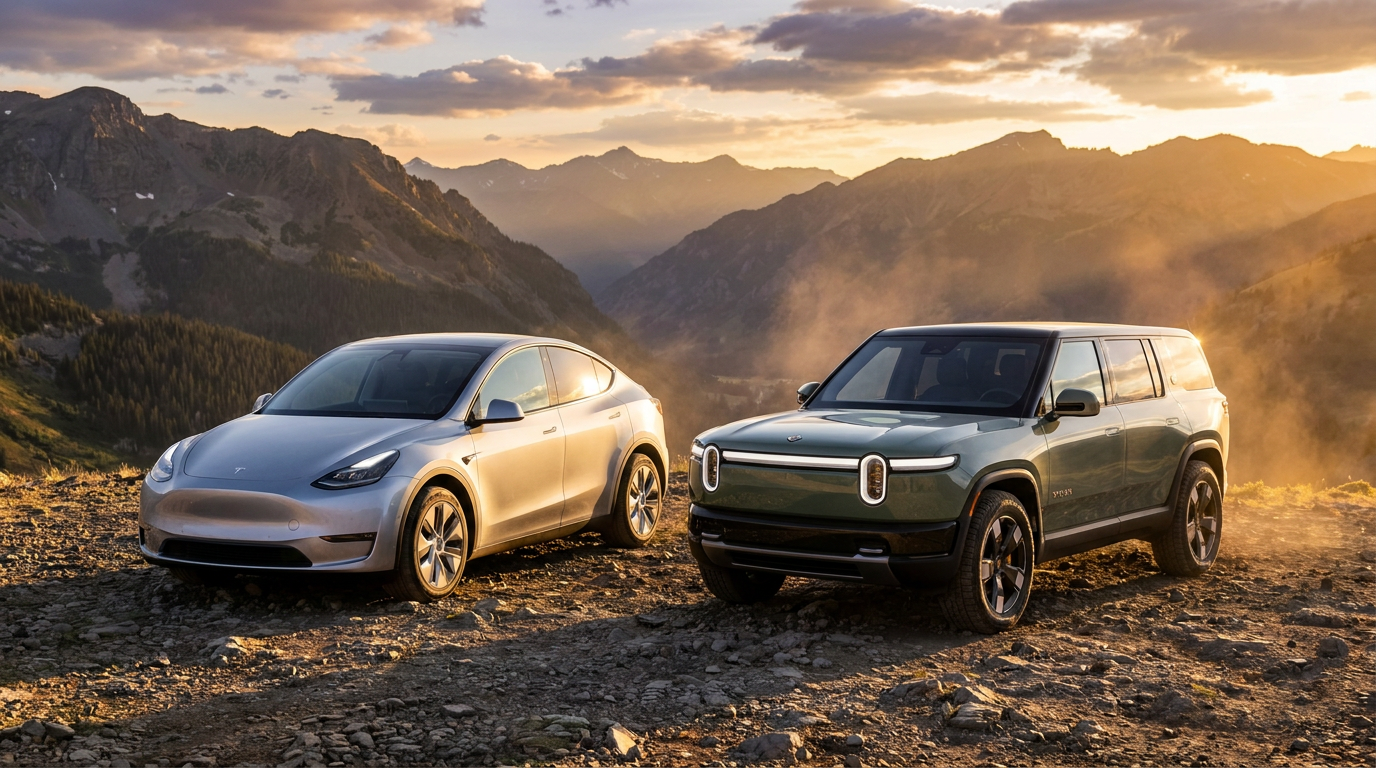
The midsize electric SUV segment has a new heavyweight bout for 2026. Tesla’s heavily refreshed Model Y—codenamed Juniper—now faces its most direct and capable challenger yet: the all-new Rivian R2. For years, the Model Y has dominated global sales charts by offering an unmatched blend of range, software, and value. However, Rivian’s entry into the midsize market brings a fundamentally different philosophy to the driveway. As the first R2 models roll off the production line in Normal, Illinois, consumers are presented with a genuine choice between two highly capable, yet philosophically opposed, electric family haulers. This side-by-side comparison breaks down the trade-offs, the evidence, and the specific use cases where each vehicle excels.[1][8]
While they occupy nearly identical footprints in a parking lot, their design philosophies could not be more divergent. The Model Y prioritizes aerodynamic efficiency and street performance, utilizing a sleek, sloped roofline that cuts through the air to maximize battery range. The Rivian R2, meanwhile, leans heavily into rugged utility and off-road capability. It opts for a taller, boxier shape with a more upright rear end—a design that sacrifices some aerodynamic slipperiness in exchange for maximum interior volume and that distinctive, adventure-ready Rivian aesthetic. The R2 is actually 2.7 inches shorter in length than the Model Y, yet it stands a full three inches taller, fundamentally altering the driving position and cabin feel.[3]
The case for the Rivian R2 centers on its uncompromising utility and adventure readiness. Rivian designed the R2 for buyers who need their daily commuter to double as a weekend basecamp. Its boxy silhouette is not just an aesthetic choice; it is a functional requirement for maximizing interior volume and accommodating bulky outdoor gear. The R2 is built to handle rough terrain, deep snow, and steep inclines without breaking a sweat, offering a level of ruggedness that traditional crossover EVs simply cannot match. For drivers who actively pursue outdoor hobbies, the R2 promises to be a far more capable companion.[4][7]
The evidence supporting Rivian's off-road superiority is found directly in its geometry and cargo metrics. The R2 boasts a massive 9.6 inches of ground clearance, representing a 60 percent increase over the Model Y's 6.0 inches. Combined with a 25-degree approach angle and a 26-degree departure angle, the R2 is genuinely trail-capable. Inside, the utility argument is just as strong. The R2 offers a cavernous 90.1 cubic feet of total cargo space when the seats are folded completely flat, dwarfing the Model Y's 76 cubic feet. Furthermore, the R2 features a larger 5.2-cubic-foot front trunk and a rear glass window that rolls down to accommodate oversized items like surfboards or lumber.[3][4][7]

The primary argument against the Rivian R2 in 2026 is its steep cost of entry and limited initial availability. While Rivian has promised a highly competitive $46,485 base model, that version will not arrive until the first half of 2027. Buyers looking to take delivery in 2026 are limited to the higher-tier Premium and Performance trims, which start at $53,990 and $57,990, respectively. This pricing strategy helps Rivian protect its profit margins during the initial production ramp-up, but it places the R2 significantly higher on the pricing ladder than its primary competitor, making it a tough sell for budget-conscious families who just want a reliable electric crossover today.[8]
Conversely, the case for the Tesla Model Y rests on its unmatched value, street refinement, and immediate availability. Tesla’s 2026 Juniper update refines an already dominant formula, making the Model Y the undisputed champion of daily commuting dynamics. Tesla has focused its engineering efforts on the environments where 99 percent of drivers spend their time: highways, city streets, and suburban neighborhoods. By ignoring the off-road use case, Tesla is able to optimize the Model Y for a smoother ride, better handling in tight corners, and a lower aerodynamic drag coefficient, all while keeping the manufacturing costs remarkably low.[1][2]
Conversely, the case for the Tesla Model Y rests on its unmatched value, street refinement, and immediate availability.
The evidence supporting Tesla's dominance lies in its aggressive pricing and efficiency metrics. The 2026 Model Y starts at an incredibly competitive $41,380 for the base rear-wheel-drive model, undercutting the currently available Rivian R2 by over $12,000. For those prioritizing distance, the Premium rear-wheel-drive trim achieves an impressive EPA-estimated 357 miles of range. The Juniper update also directly addresses past criticisms by introducing acoustic glass that reduces cabin noise by 25 percent, retuned adaptive suspension for a significantly smoother ride over rough pavement, and ventilated front seats. It is a highly polished product benefiting from years of iterative manufacturing improvements.[1][2]

The argument against the Model Y focuses on its physical limitations and polarizing interior design. The Model Y falls short for buyers who need rugged versatility; its 6.0-inch ground clearance limits it to paved roads and mild gravel, and its sloping roofline severely cuts into rear cargo height, making it difficult to haul tall, boxy items. Additionally, Tesla’s minimalist interior remains a point of contention. The Model Y famously omits a driver-facing instrument cluster, forcing the driver to look at the center screen for speed and navigation data. It also lacks physical buttons for basic climate and wiper controls, a design choice that some drivers find distracting.[3][5]
When comparing raw performance, both SUVs deliver blistering acceleration that rivals traditional sports cars. The Rivian R2 Performance trim utilizes a potent tri-motor setup producing 656 horsepower, rocketing the heavy SUV from zero to 60 mph in just 3.6 seconds. The Tesla Model Y Performance answers with a 3.3-second sprint to 60 mph, aided by its lighter 4,480-pound curb weight and aerodynamic profile. While the Tesla is marginally quicker in a straight line and feels more planted on twisty mountain roads, the Rivian offers a more commanding, truck-like driving position that many SUV buyers prefer.[2][7]
One of the most surprising data points in this comparison is the overall energy efficiency. Despite its boxy shape, heavy all-terrain tires, and 4,850-pound curb weight, the Rivian R2 manages a remarkable 109 MPGe combined rating in its Performance trim. This actually edges out the Model Y Performance's 104 MPGe rating. This metric highlights Rivian's significant advancements in powertrain engineering and battery management on their new midsize platform. While the Model Y's Long Range trims still hold the absolute crown for total distance per charge, Rivian has proven that a rugged, boxy SUV does not have to be an energy hog.[3][4]
Inside the cabin, the two vehicles offer distinct user experiences tailored to their respective audiences. Rivian provides a 12.3-inch digital gauge cluster directly in front of the driver, complemented by a massive 15.6-inch central display. The R2's interior is packed with clever storage solutions, including two gloveboxes, pop-out cupholders, and a large open console area. Tesla counters with a hyper-minimalist aesthetic, upgraded soft-touch materials, and a seamless software ecosystem that now includes an 8-inch rear-seat entertainment screen for passengers to play games or watch streaming video. Both vehicles omit Apple CarPlay and Android Auto, relying instead on their excellent proprietary navigation systems.[1][5]

Historically, charging infrastructure was the ultimate tiebreaker in any EV comparison, with Tesla holding a massive advantage via its proprietary Supercharger network. However, that moat has officially been crossed. The Rivian R2 features a native North American Charging Standard (NACS) port built directly into the vehicle. This grants the R2 seamless, plug-and-charge access to Tesla's vast global charging infrastructure without the need for clunky adapters. By neutralizing Tesla's biggest historical selling point, Rivian ensures that R2 owners will enjoy the exact same road-trip convenience and charging reliability as Model Y owners.[7]
The Rivian R2 fits well when a buyer prioritizes outdoor adventure, maximum cargo volume, and a commanding driving position. It is the superior choice for those who regularly haul bulky gear, navigate rough terrain, or simply prefer a rugged, truck-like aesthetic. The R2's flat-folding seats, massive ground clearance, and clever storage solutions make it a highly versatile tool for active lifestyles. However, this choice requires a willingness to pay the premium pricing associated with the early 2026 production trims and an acceptance of a slightly firmer ride on city streets.[4][6]
Conversely, the Tesla Model Y fits well when a consumer is focused on maximum range per dollar, street-handling dynamics, and immediate availability at a lower price point. It remains the logical, pragmatic choice for daily commuters and tech-focused families who want a refined, highly efficient electric crossover without paying the off-road tax. The Juniper update's improvements to ride quality and cabin noise make it an exceptionally comfortable daily driver. If your adventures rarely take you off the pavement, the Model Y delivers an unbeatable combination of value, efficiency, and proven reliability.[1][6]

How we got here
March 2024
Rivian officially unveils the R2 midsize SUV to the public.
Late 2025
Tesla rolls out the 'Juniper' refresh for the Model Y in European and Asian markets.
Early 2026
Tesla brings the updated Model Y to the US market.
Spring 2026
Rivian begins deliveries of the top-tier R2 Performance trim.
Late 2026
Rivian is scheduled to release the mid-tier R2 Premium trim.
First Half 2027
Rivian plans to launch the $46,485 base R2 Standard trim.
Viewpoints in depth
Adventure & Utility Buyers
Consumers who view their vehicle as a tool for outdoor hobbies and gear hauling.
This camp argues that the slight aerodynamic penalty of a boxy design is entirely worth the trade-off for usable space. They point to the Rivian R2's 9.6 inches of ground clearance and flat-folding seats as essential features for camping, skiing, and off-grid travel. For these buyers, the Model Y's sloping roofline and lower stance make it a glorified hatchback rather than a true sport utility vehicle.
Value & Efficiency Commuters
Drivers focused on the economics of daily driving, maximum range, and upfront costs.
This perspective emphasizes that 99 percent of driving occurs on paved roads, making extreme off-road geometry an unnecessary expense. They highlight the Tesla Model Y's $41,380 starting price and 357-mile maximum range as the ultimate pragmatic choice. From this viewpoint, paying a $12,000 premium for the Rivian R2's off-road capabilities is an emotional purchase rather than a logical one, especially when the Model Y offers superior highway refinement.
Tech & Design Enthusiasts
Reviewers and buyers who prioritize the software ecosystem and cabin interface.
This camp is split between Tesla's hyper-minimalism and Rivian's rugged-tech approach. Tesla advocates praise the seamless integration of the Model Y's single central screen, the new rear-seat entertainment display, and the industry-leading autonomous driving software. Conversely, Rivian supporters argue that the R2's inclusion of a dedicated driver-facing gauge cluster and physical steering wheel dials provides a safer, more intuitive user experience that doesn't force the driver to take their eyes off the road.
What we don't know
- Whether Rivian will be able to hit its target of releasing the $46,485 base R2 Standard trim by the first half of 2027 without delays.
- How the long-term reliability and repair costs of the all-new Rivian R2 platform will compare to the mature Tesla Model Y architecture.
Key terms
- MPGe
- Miles Per Gallon Equivalent, a metric used by the EPA to compare the energy consumption of electric vehicles to traditional gas cars.
- NACS
- North American Charging Standard, the charging plug design developed by Tesla that is now being adopted by most major automakers, including Rivian.
- Approach Angle
- The maximum angle of a ramp or obstacle a vehicle can climb from a flat surface without the front bumper hitting the ground.
- Frunk
- A front trunk, utilizing the space where a traditional internal combustion engine would normally sit.
Frequently asked
Which vehicle has more cargo space?
The Rivian R2 offers significantly more cargo space, with 90.1 cubic feet when the seats are folded flat, compared to the Model Y's 76 cubic feet.
Is the Rivian R2 cheaper than the Tesla Model Y?
No, the Tesla Model Y is currently cheaper, starting at $41,380 in 2026, while the available Rivian R2 trims start at $53,990.
Can the Rivian R2 use Tesla Superchargers?
Yes, the Rivian R2 is equipped with a native NACS charge port, allowing it to plug directly into Tesla Superchargers without an adapter.
Which SUV is faster from zero to 60 mph?
The Tesla Model Y Performance is slightly faster, hitting 60 mph in 3.3 seconds, compared to the Rivian R2 Performance's 3.6 seconds.
Sources
Source coverage
8 outlets
3 viewpoints surfaced








[1]EdmundsValue & Commuter Advocates
2026 Tesla Model Y Review, Pricing, and Specs
Read on Edmunds →[2]Car and DriverValue & Commuter Advocates
2026 Tesla Model Y: What We Know So Far
Read on Car and Driver →[3]ElectrekUtility Maximizers
Rivian R2 vs Tesla Model Y spotted side-by-side: Detailed size comparison
Read on Electrek →[4]CarBuzzUtility Maximizers
Rivian Has Built The Superior Off-Roader
Read on CarBuzz →[5]Car ConfectionsDriving Dynamics Purists
Rivian R2 vs Tesla Model Y: Which EV SUV is Right for You?
Read on Car Confections →[6]CarwowDriving Dynamics Purists
Rivian R2 vs Tesla Model Y batteries, range and driving
Read on Carwow →[7]RivianUtility Maximizers
R2: The soul of a Rivian, sized for every adventure
Read on Rivian →[8]Los Angeles TimesValue & Commuter Advocates
Rivian begins delivery of cheaper SUV as it aims to take customers from Tesla
Read on Los Angeles Times →
Every angle. Every day.
Get automotive stories with full source coverage and perspective breakdowns delivered to your inbox.