
Why the 'Negative' Phase of Lifting is the Key to Longevity and Strength
Exercise science reveals that the eccentric, or lowering, phase of a muscle contraction builds more strength, prevents injuries, and requires significantly less energy than lifting.
By Factlen Editorial Team
- Exercise Physiologists
- Focus on hypertrophy, mechanical tension, and the 'Repeated Bout Effect' to manage soreness.
- Gerontologists & Rehab Specialists
- Value the low metabolic cost and high force production for treating sarcopenia without stressing the cardiovascular system.
- Neuromechanics Researchers
- Study how eccentric loading rewires cortico-spinal excitability to stop the brain from 'guarding' injured joints.
What's not represented
- · Cardiologists evaluating the long-term impact of low-metabolic strength training on heart failure patients.
Why this matters
Most people focus entirely on the lifting portion of an exercise, missing out on the phase that actually drives the most profound physical adaptations. By simply slowing down the lowering phase of your movements, you can build more resilient muscles, protect your joints from injury, and maintain functional independence as you age with a fraction of the cardiovascular effort.
Key points
- Eccentric contractions occur when a muscle lengthens under tension, like lowering a weight.
- Just three seconds of daily eccentric exercise can significantly increase muscle strength.
- Eccentric movements generate more force but require four times less oxygen than lifting.
- The low metabolic cost makes it an ideal intervention for older adults fighting muscle loss.
- Eccentric training physically lengthens muscle tissue, acting as a shock absorber to prevent injuries.
- It rewires the nervous system to stop the brain from 'guarding' injured joints.
The gym is full of people obsessed with the lift. The upward push of the heavy bench press, the straining upward pull of the bicep curl, the explosive rise from the bottom of a squat. This is known as the "concentric" phase of a muscle contraction, where the muscle actively shortens under tension to move a load. For decades, fitness culture and athletic training have prioritized this upward battle against gravity. But a growing body of clinical exercise science suggests that we have been focusing our energy on the wrong half of the movement.[7]
The real magic for long-term longevity, functional strength, and injury prevention actually happens on the way down. This is the "eccentric" phase—when a muscle actively lengthens while producing force to resist a load. Think of the controlled motion of slowly lowering a heavy box to the floor, the descent of a push-up, or the braking force required to walk downhill. While it looks like yielding to gravity, the muscle is actually performing highly complex, high-tension work that triggers unique biological adaptations.[7]
For a long time, eccentric contractions were viewed primarily as a necessary evil by casual gym-goers because they are the primary culprit behind debilitating delayed-onset muscle soreness (DOMS). However, recent clinical reviews and biomechanical studies have triggered a massive paradigm shift in how we view resistance training. Researchers now understand that the "negative" phase of a lift triggers unique physiological and neurological adaptations that concentric lifting simply cannot match, making it a critical tool for everyone from elite athletes to aging seniors.[2][7]
Some of the most striking evidence for the power of the negative rep comes from researchers at Edith Cowan University, who recently investigated the absolute minimum effective dose of strength training. In a landmark study, they found that a single, three-second eccentric contraction performed five days a week was enough to significantly increase muscle strength. The researchers had participants perform maximum-effort bicep curls, isolating the different phases of the movement to see which yielded the highest return on time invested.[1]
The results were definitive. Participants who performed only concentric (lifting) or isometric (holding) contractions for the same three-second daily duration saw virtually no improvement in their strength or muscle thickness. "We found concentric muscle contractions contributed little to the training effects," noted the study's lead researcher. The data suggests that time-pressed individuals could literally cut their workouts in half—or reduce them to mere seconds—by exclusively focusing on the lowering phase of an exercise.[1]

To understand why eccentric training is so disproportionately potent, we have to look at the mechanical mechanism operating at the cellular level. When a muscle contracts concentrically, protein filaments called actin and myosin slide past each other to shorten the muscle, consuming massive amounts of cellular energy (ATP) in the process. But during an eccentric contraction, these cross-bridges are physically and forcefully pulled apart by the external load, creating a completely different mechanical stress profile on the tissue.[2][6]
This forced lengthening creates microscopic damage to the muscle's structural Z-disks. While "damage" sounds inherently negative, in the context of exercise physiology, it is the exact biological trigger required for positive adaptation. The micro-tears activate satellite cells—the specialized stem cells of skeletal muscle—which rush into the area to repair and rebuild the tissue. This robust cellular response results in significantly greater muscle thickness and hypertrophy than concentric lifting alone could ever produce.[3][6]
This forced lengthening creates microscopic damage to the muscle's structural Z-disks.
Beyond simply building thicker, stronger muscles, eccentric training actually changes the fundamental architecture of the tissue. It promotes a biological process known as "sarcomerogenesis," which is the addition of new sarcomeres (the basic contractile units of muscle) in series. By adding these units end-to-end, eccentric exercise physically lengthens the muscle fascicles, permanently shifting the muscle's optimal length-tension relationship to a longer, more resilient state.[2][3]
This architectural shift is considered a holy grail for injury prevention and physical rehabilitation. Most devastating sports injuries, particularly hamstring tears and ACL ruptures, occur when a muscle is rapidly stretched under a heavy load during deceleration. By lengthening the fascicles and increasing the tissue's ability to absorb force at extended, vulnerable ranges of motion, eccentric training acts as an anatomical shock absorber, drastically reducing the likelihood of catastrophic tissue failure.[5][6]
But perhaps the most fascinating and medically useful paradox of eccentric exercise is its metabolic cost. Despite generating up to 30 percent more force than concentric contractions, eccentric movements require significantly less cellular energy and consume about four times less oxygen. Because the muscle is acting like a brake rather than an engine, it relies on passive mechanical tension rather than active chemical energy consumption.[2][3]

This low-energy, high-yield characteristic makes eccentric training a breakthrough intervention for aging populations and those with compromised cardiovascular systems. As humans age, we naturally lose type II fast-twitch muscle fibers, leading to a condition called sarcopenia, which causes frailty and a loss of independence. Traditional heavy weightlifting can be too taxing on the heart and lungs of older adults, making it difficult for them to lift heavy enough weights to stave off this muscle wasting.[3]
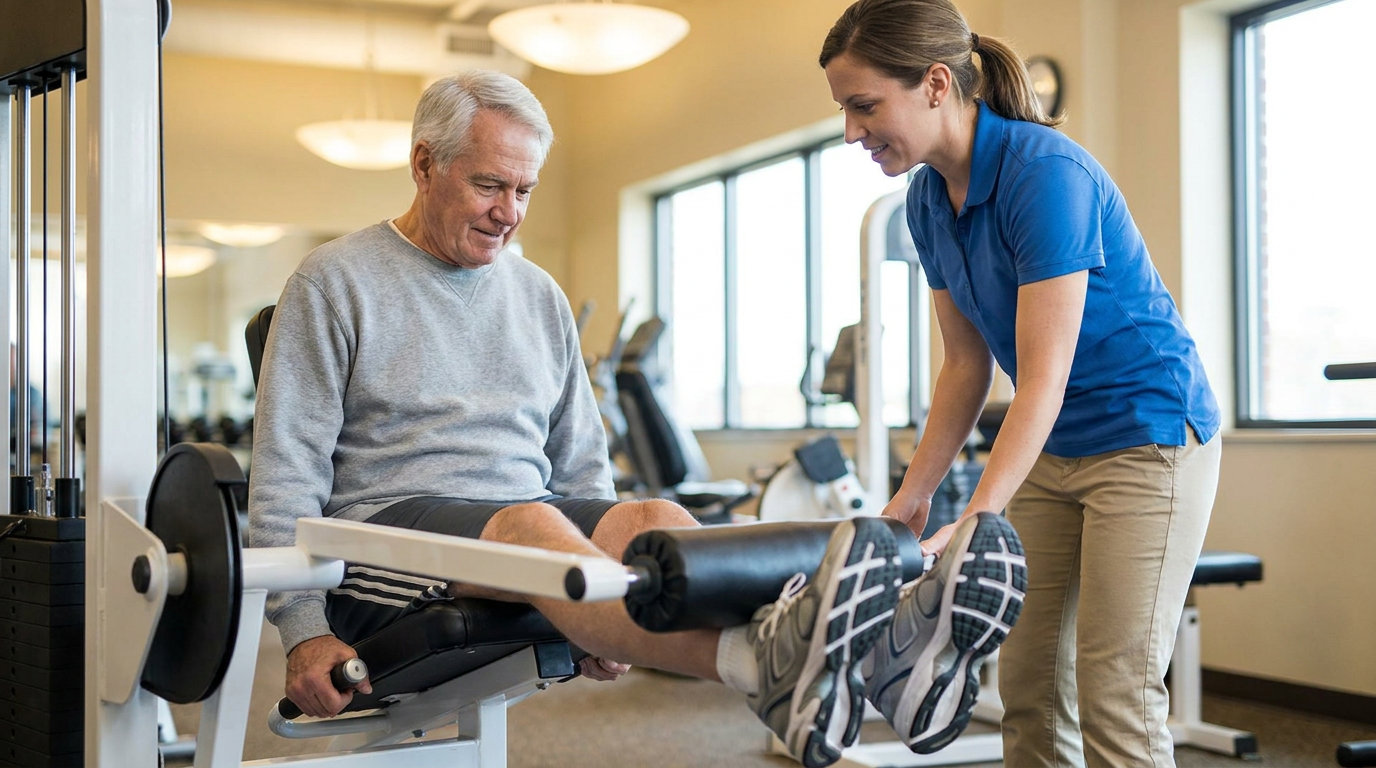
Because eccentric training imposes such a minimal cardiorespiratory burden, it allows older adults to safely handle much heavier loads. They can rebuild crucial fast-twitch muscle fibers and regain functional strength without exhausting their cardiovascular system. Geriatric researchers and physical therapists increasingly view eccentric-focused protocols as a frontline defense against age-related mobility loss, allowing seniors to build the strength necessary to prevent falls with minimal metabolic fatigue.[3][7]
The benefits of the negative rep also extend deeply into the central nervous system. Recent rehabilitation studies indicate that eccentric exercise can actually rewire the brain's neurological response to physical injury. When a joint or muscle is injured, the brain often adopts a reflexive "guarding" pattern, limiting the area's range of motion and altering movement mechanics to prevent pain, which often leads to chronic dysfunction.[4]
Traditional concentric exercises often fail to break this protective neurological cycle, but eccentric loading has been shown to increase cortico-spinal excitability. The high-tension, lengthening movement forces the nervous system to override the brain's protective reflexes. This restores normal neuromuscular control, dampens the pain response, and prevents the chronic compensatory loops that so often lead to secondary re-injuries in athletes and physical therapy patients.[4][6]

The primary catch to this highly effective training modality is the soreness. Because eccentric contractions cause more physical micro-damage to the muscle fibers, unaccustomed eccentric exercise can lead to severe delayed-onset muscle soreness. However, exercise physiologists point to the "Repeated Bout Effect"—a well-documented phenomenon where a single, light session of eccentric training provides a rapid protective adaptation that drastically reduces muscle damage and soreness in all subsequent workouts.[2][6]
For the general public, incorporating this cutting-edge science doesn't require specialized gym equipment or complex routines. It simply means changing the tempo of a standard workout. Instead of dropping a weight quickly after lifting it, individuals can take three to five seconds to slowly and deliberately lower the load, maximizing the time under eccentric tension. Even bodyweight exercises like squats and push-ups can be transformed by simply slowing down the descent.[1][7]
As the fitness and medical industries shift their focus from pure aesthetics to functional longevity and healthspan, the humble "negative" rep is finally getting its due. By embracing the descent and focusing on the lengthening phase of movement, we can build stronger, longer, and more resilient bodies with a fraction of the metabolic cost, proving that sometimes the best way to move forward is to focus on the way down.[7]
How we got here
1952
Early physiological studies first identify that eccentric contractions require significantly less oxygen than concentric ones.
1980s-1990s
Eccentric training becomes a staple in treating Achilles and patellar tendinopathy in sports rehabilitation.
2010s
Research accelerates on 'sarcomerogenesis,' proving eccentric exercise physically lengthens muscle fascicles to prevent tears.
Nov 2022
Edith Cowan University publishes landmark data showing just 3 seconds of daily eccentric contraction yields measurable strength gains.
2024-2026
Eccentric protocols become frontline recommendations for combating age-related sarcopenia due to their low metabolic cost.
Viewpoints in depth
Exercise Physiologists
Focus on hypertrophy, mechanical tension, and the 'Repeated Bout Effect' to manage soreness.
Sports scientists and exercise physiologists view eccentric training primarily as a tool for maximizing mechanical tension and muscle hypertrophy. Because the muscle can handle heavier loads during the lengthening phase, it creates more micro-damage, which in turn stimulates greater satellite cell activation. This camp emphasizes the 'Repeated Bout Effect,' advising athletes to introduce eccentric loads gradually to build a protective adaptation against debilitating soreness while maximizing strength gains.
Gerontologists & Rehab Specialists
Value the low metabolic cost and high force production for treating sarcopenia without stressing the cardiovascular system.
For medical professionals treating aging populations, the appeal of eccentric exercise lies in its metabolic paradox. Older adults suffering from sarcopenia often lack the cardiovascular endurance to perform traditional heavy weightlifting. Because eccentric movements require up to four times less oxygen, gerontologists use them to safely load the muscles of frail patients, rebuilding crucial fast-twitch fibers and preventing falls without risking cardiac overexertion.
Neuromechanics Researchers
Study how eccentric loading rewires cortico-spinal excitability to stop the brain from 'guarding' injured joints.
Researchers focusing on the nervous system's role in movement argue that the true power of eccentric training is neurological. When a joint is injured, the brain creates a reflexive 'guarding' pattern that limits mobility and perpetuates chronic pain. Neuromechanics experts have found that the high tension of eccentric contractions increases cortico-spinal excitability, effectively forcing the brain to override these protective reflexes and restore normal, pain-free movement patterns.
What we don't know
- The exact molecular signaling pathways that differentiate eccentric hypertrophy from concentric hypertrophy.
- The long-term optimal dosing of eccentric exercise to maximize longevity without overtaxing the central nervous system.
- How high-volume eccentric training interferes with concurrent endurance training adaptations in elite athletes.
Key terms
- Concentric contraction
- When a muscle shortens while producing force, such as the upward motion of a bicep curl.
- Eccentric contraction
- When a muscle lengthens while producing force to resist a load, such as slowly lowering a weight.
- Sarcomerogenesis
- The biological process of adding new muscle units in series, which physically lengthens the tissue.
- Sarcopenia
- The age-related loss of skeletal muscle mass and functional strength.
- Delayed-Onset Muscle Soreness (DOMS)
- The muscle pain and stiffness felt 24 to 72 hours after unaccustomed exercise, heavily associated with eccentric movements.
- Repeated Bout Effect
- A protective adaptation where a single session of eccentric exercise drastically reduces muscle damage in future sessions.
Frequently asked
What is an eccentric contraction?
It is the lengthening phase of a muscle movement under tension, such as slowly lowering a dumbbell or walking downstairs.
Why does eccentric training cause more soreness?
It physically pulls apart the muscle's cross-bridges, causing micro-tears that trigger adaptation but also result in delayed-onset muscle soreness (DOMS).
How can I add eccentric training to my routine?
Slow down the lowering phase of your exercises to 3-5 seconds, or use heavier weights on the way down with a spotter's help on the way up.
Is eccentric exercise safe for older adults?
Yes, it is highly recommended because it builds strength with a much lower cardiovascular and metabolic cost than traditional lifting.
Sources
Source coverage
7 outlets
3 viewpoints surfaced







[1]Edith Cowan UniversityExercise Physiologists
Focusing on 'eccentric' muscle contractions more important for increasing strength and size
Read on Edith Cowan University →[2]Frontiers in PhysiologyExercise Physiologists
Specific Muscle Adaptations to Chronic Eccentric Exercise
Read on Frontiers in Physiology →[3]Annals of Geriatric Medicine and ResearchGerontologists & Rehab Specialists
Eccentric Exercise for Older Adults: A Review of the Mechanisms and Benefits
Read on Annals of Geriatric Medicine and Research →[4]BTE TechnologiesNeuromechanics Researchers
A Paradigm Shift in Eccentric Exercise for Rehab
Read on BTE Technologies →[5]British Journal of Sports MedicineNeuromechanics Researchers
Eccentric exercises in rehabilitation: a paradigm shift
Read on British Journal of Sports Medicine →[6]National Institutes of HealthGerontologists & Rehab Specialists
Eccentric Muscle Contractions: Their Contribution to Injury, Prevention, Rehabilitation, and Sport
Read on National Institutes of Health →[7]Factlen Editorial Team
Synthesis by Factlen editorial team
Read on Factlen Editorial Team →
Every angle. Every day.
Get fitness stories with full source coverage and perspective breakdowns delivered to your inbox.