
Physicists Are Freezing Quantum States to Create Entirely New Forms of Matter
A series of landmark 2026 experiments has demonstrated that quantum states can be 'frozen' to resist thermodynamic decay, unlocking new phases of matter such as supersolids and prethermal states.
By Factlen Editorial Team
- Condensed Matter Physicists
- Focused on discovering and mapping entirely new phases of matter.
- Quantum Information Scientists
- Focused on leveraging frozen states to build fault-tolerant quantum computers.
- Science Communicators
- Focused on the fundamental defiance of thermodynamics and the concept of eternity.
What's not represented
- · Commercial Quantum Hardware Manufacturers
- · Materials Science Engineers
Why this matters
By stabilizing delicate quantum states that normally collapse in fractions of a second, scientists are laying the groundwork for fault-tolerant quantum computers and entirely new classes of zero-friction materials.
Key points
- Physicists have successfully 'frozen' quantum states, delaying the thermodynamic decay that normally destroys them.
- A 78-qubit processor was stabilized into a 'prethermal state' using structured random energy pulses.
- Researchers observed a superfluid freezing into a 'supersolid' in bilayer graphene, combining rigidity with frictionless flow.
- Strong electron interactions were shown to create stable topological states, defying previous physics assumptions.
- These breakthroughs could drastically reduce the error-correction overhead required for commercial quantum computers.
The universe is governed by the relentless march of entropy. In the macroscopic world, this means mountains eventually erode, iron inevitably rusts, and heat always dissipates. In the delicate quantum realm, entropy manifests as decoherence and thermalization—fragile quantum states absorb ambient energy, heat up, and rapidly collapse into chaotic, classical noise. For nearly 70 years, physicists have chased the theoretical dream of "quantum eternity": an arrangement of interacting particles so perfectly tuned that their quantum states remain frozen, refusing to thermalize or degrade over time, much like light bouncing indefinitely in a flawless hall of mirrors.
In the first half of 2026, a series of independent, landmark breakthroughs has shifted this concept from mathematical abstraction to laboratory reality. By manipulating extreme cold, intense magnetic fields, and highly structured laser pulses, researchers are proving that quantum states can indeed be locked into stable, long-lived phases that defy traditional thermodynamic decay. These discoveries are not merely academic curiosities; they are actively unlocking entirely new classifications of exotic matter and providing the foundational architecture for the next generation of fault-tolerant quantum computers.[1]
The primary claim emerging from this year's research is that driven quantum systems—those being actively manipulated or "shaken" by outside forces—can be engineered to resist heating up. According to classical thermodynamics, repeatedly striking or driving a quantum system should cause it to absorb energy, lose its intricate structure, and rapidly dissolve into a hot, disordered mess. However, theorists recently proposed that applying a very specific type of mathematical noise to the system could paradoxically act as a stabilizing anchor.[2]
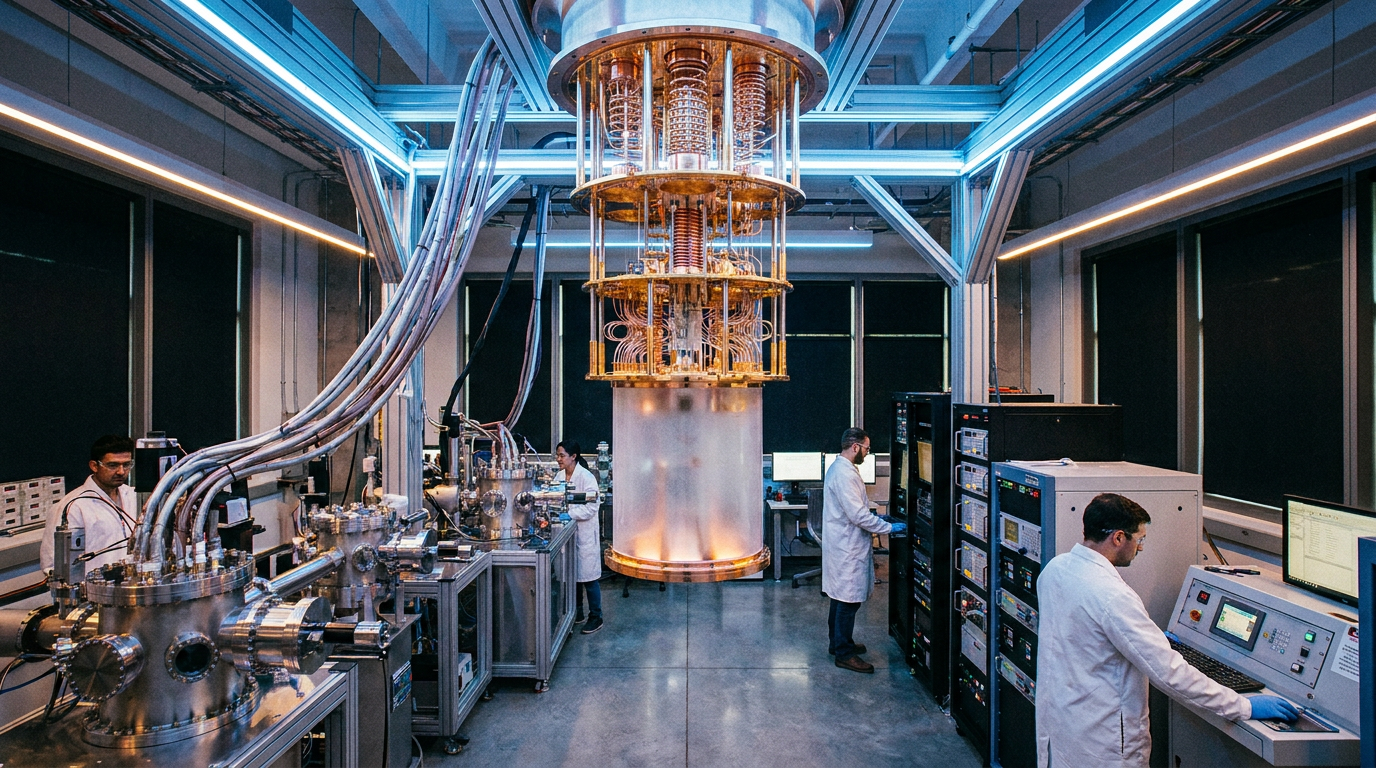
The definitive evidence for this stabilized state was published in January 2026 by an international team, including researchers from Imperial College London, using the Chuang-tzu 2.0 superconducting quantum processor. The state-of-the-art processor features 78 individual qubits arranged on a two-dimensional grid, allowing the research team to precisely simulate complex, interacting quantum particles. In a standard environment, the delicate entanglement between these 78 qubits would collapse almost instantaneously as the system absorbed energy from its surroundings and succumbed to thermal equilibrium.[2]
To test the theory of quantum freezing, the researchers struck the processor with "binary structured random drives"—a highly specific, calculated pattern of random energetic pulses. Rather than destroying the system, this structured randomness suppressed the uncontrolled heating. Instead of degrading, the 78-qubit system entered a predicted "prethermal state," remaining highly ordered and stable for over a thousand driving cycles. The quantum correlations spread across the entire processor, creating a complex, frozen web of entanglement that classical computers cannot realistically simulate.[2]

The transparent uncertainty surrounding this claim lies in the strict definition of "forever." While popular science coverage has aptly described the pursuit as capturing a "quantum state that lasts forever," the prethermal phase demonstrated in the lab is technically a metastable state. It delays thermalization by unprecedented orders of magnitude, but physicists continue to debate whether a macroscopic, interacting system can truly stave off entropy indefinitely, or if it merely stretches the timeline of decay far beyond our current measurement capabilities.[1][2]
A parallel claim in the pursuit of exotic, frozen matter involves the transformation of superfluids. Classical physics dictates a strict, linear progression of matter as temperatures drop: a chaotic gas condenses into a liquid, which eventually locks into a rigid solid. The discovery of helium's quantum properties in the 20th century introduced the superfluid—a liquid state that flows with absolute zero friction and can creep up the walls of containers. Now, physicists claim that under the right conditions, a frictionless superfluid can be frozen into a paradoxical "supersolid."[3]
The primary evidence for this bizarre phase of matter stems from a study published by Columbia University researchers. Using two atom-thin layers of graphene, the team manipulated quantum quasiparticles known as excitons. An exciton is formed when a negatively charged electron binds with the positively charged "hole" it leaves behind after being excited by light. Because excitons are thousands of times lighter than helium atoms, they serve as an ideal, highly tunable platform for observing quantum phase transitions.[3][7]
The primary evidence for this bizarre phase of matter stems from a study published by Columbia University researchers.
By applying a strong magnetic field and dropping the temperature to near absolute zero, the researchers observed the exciton superfluid undergo a distinct phase transition. It successfully formed a supersolid, a state that blends two seemingly contradictory identities. The material maintains the rigid, repeating crystal lattice structure characteristic of a standard solid, while simultaneously retaining the frictionless, unimpeded flow associated with a superfluid. The excitons lock into a grid, yet quantum mechanics allows them to glide through the lattice without resistance.[3][7]

The uncertainty regarding supersolids is primarily one of scalability and environmental fragility. The supersolid phase was achieved under extreme, highly controlled laboratory conditions—requiring intense magnetic fields and temperatures hovering just fractions of a degree above absolute zero. Translating this delicate, frozen state into higher-temperature environments for practical material science applications, such as ultra-efficient energy transmission or advanced sensors, remains a formidable engineering challenge. Physicists must find new material combinations that can host supersolid behaviors without requiring multi-million-dollar cryogenic infrastructure.[3]
Beyond prethermal states and supersolids, researchers are claiming that strong electron interactions can actually stabilize quantum systems rather than disrupt them. Historically, condensed matter physicists believed that strong interactions between particles would destroy the delicate, twisting wave patterns required for "topological" states—configurations of matter that are inherently resistant to local disruptions and structural changes. Topology was generally observed only in materials where electrons largely ignored one another, leading to a longstanding separation in how physicists approached quantum criticality and topological stability.[6]
Evidence published by Rice University researchers in Nature Physics upended this assumption. Their theoretical models, backed by observations of a highly unusual "pinball liquid" state, demonstrated that strong interactions can indeed produce robust topological behavior. In this hybrid state, electrons behave as though they are massively heavy, switching dynamically between conducting and insulating behaviors. The strong interactions actually enhance the quantum entanglement, creating a durable state that is highly sensitive to external signals yet resistant to decoherence.[4][6]

Furthermore, the quest to freeze and stabilize quantum states has led to entirely new methods of error correction at the atomic level. In June 2026, Oxford University researchers claimed that macroscopic quantum superpositions—the real-world equivalents of the famous "Schrödinger's cat" thought experiment, where an object exists in multiple states simultaneously—can be made vastly more resilient by altering their foundational building blocks. Rather than relying on standard binary qubits that easily flip and introduce errors, the team theorized that building superpositions from highly nonclassical components could lock the system into a more permanent, error-resistant configuration.[5]
The Oxford evidence relies on the precise manipulation of the motion of a single trapped ion. Rather than building the cat-like superposition from standard coherent wave packets, they utilized highly nonclassical motional states. The resulting superposition exhibited a unique sixfold rotational symmetry, revealing highly complex quantum interference. Because the quantum uncertainty is distributed differently across each part of this state, it acts as an intrinsic shield, protecting the superposition from the environmental noise that normally causes rapid decoherence.[5]
The uncertainty in the Oxford approach involves the daunting task of system integration. While a single trapped ion demonstrates remarkable stability and hints at a new era of resilient quantum memory, scaling this nonclassical motional state into a multi-qubit architecture without introducing new avenues for decoherence is an unsolved problem. The complex lasers and magnetic traps required to hold the ion steady become exponentially more difficult to manage as more ions are added to the computational grid.[5]
Collectively, these 2026 breakthroughs represent a profound paradigm shift in condensed matter physics and quantum mechanics. The ability to freeze quantum states, synthesize supersolids, and harness topological heavy electrons moves the field from passive observation of fragile phenomena to the active, architectural design of entirely new forms of matter. Researchers are no longer just watching quantum states decay; they are engineering the environment to force those states into permanence, rewriting the rules of what is physically possible at the atomic scale.

For the burgeoning quantum computing industry, the implications are immediate and profound. The extreme fragility of qubits is the primary bottleneck preventing the development of fault-tolerant, commercial quantum computers. Currently, machines require thousands of physical qubits just to correct the errors of a single logical qubit. If qubits can be locked into prethermal states using structured randomness, or protected by the intrinsic stability of topological pinball liquids, the massive computational overhead currently required for error correction could be drastically reduced, accelerating the timeline for quantum supremacy in drug discovery, materials science, and cryptography.
Ultimately, the pursuit of "quantum eternity" is redefining the fundamental boundaries of thermodynamics. While true, infinite eternity may remain a mathematical abstraction reserved for chalkboards, the ability to freeze the quantum world long enough to harness its most exotic properties is now firmly within our grasp. By defying the rapid decay that has plagued quantum physics for a century, scientists are opening the door to a future built on materials and machines that operate with perfect, frictionless precision.[1]
How we got here
1937
Physicists co-discover superfluidity in liquid helium, proving that matter can flow with zero friction.
1950s
Physicists first theorize the concept of 'Anderson localization,' suggesting that quantum waves can be frozen in place by disorder.
2017
Researchers create the first 'time crystals,' quantum systems that exhibit periodic structure in time rather than space.
January 2026
Columbia University researchers observe a superfluid freezing into a supersolid in bilayer graphene.
January 2026
Imperial College London and international partners demonstrate a long-lived 'prethermal state' on a 78-qubit processor.
June 2026
Oxford physicists successfully create highly stable, nonclassical 'Schrödinger's cat' superpositions using trapped ions.
Viewpoints in depth
Quantum Information Scientists
Focused on leveraging frozen states to build fault-tolerant quantum computers.
For researchers building quantum computers, the primary enemy is decoherence—the rapid collapse of quantum states due to environmental noise and thermalization. This camp views prethermal states and nonclassical superpositions as the ultimate engineering solution. If a qubit can be intrinsically locked into a stable state using structured randomness, the massive overhead required for algorithmic error correction could be bypassed entirely, accelerating the timeline for commercial quantum computing.
Condensed Matter Physicists
Focused on discovering and mapping entirely new phases of matter.
This camp is less concerned with computing and more interested in the fundamental architecture of the universe. For decades, the phases of matter were limited to variations of gases, liquids, solids, and plasmas. The discovery of supersolids and topological pinball liquids proves that the quantum realm hosts a vast, uncharted taxonomy of matter. They argue that understanding how strong electron interactions create stability will eventually lead to room-temperature superconductors and frictionless materials.
Thermodynamics Theorists
Focused on the fundamental limits of entropy and thermalization.
Theoretical physicists view these breakthroughs through the lens of the universe's ultimate law: entropy always increases. While headlines tout 'quantum eternity,' this camp emphasizes the nuance of metastability. They study exactly how long a prethermal state can stave off thermalization and whether true, infinite localization is mathematically possible in a macroscopic system, or if the universe always eventually wins.
What we don't know
- Whether a macroscopic quantum system can truly remain frozen 'forever' or if it merely delays thermalization beyond current measurement limits.
- How to scale the supersolid phase, currently requiring near absolute zero temperatures, into practical materials.
- If highly nonclassical motional states can be integrated into multi-qubit architectures without introducing new forms of decoherence.
Key terms
- Prethermal State
- A stable, long-lived quantum phase that resists absorbing energy and heating up, delaying the inevitable slide into thermal equilibrium.
- Supersolid
- A paradoxical state of matter that possesses the rigid, repeating crystal structure of a solid but flows without friction like a superfluid.
- Exciton
- A quantum quasiparticle formed when a negatively charged electron binds with a positively charged 'hole' left behind in a material.
- Topology
- In physics, a mathematical property of a material's quantum state that remains stable and unchanged even if the material is deformed.
Frequently asked
Does a frozen quantum state violate thermodynamics?
Not strictly. While it defies the usual rapid slide into thermal equilibrium, the system is in a 'prethermal' state. It resists heating for an exceptionally long time, though it may eventually succumb to entropy.
What is a supersolid used for?
Currently, supersolids are purely experimental. However, understanding frictionless flow within a rigid structure could eventually lead to ultra-efficient superconductors or advanced sensors.
Will these discoveries make quantum computers faster?
They will make them more reliable. The primary hurdle in quantum computing is 'decoherence'—when delicate quantum states collapse. Frozen states could act as highly stable qubits that resist errors.
Sources
Source coverage
7 outlets
3 viewpoints surfaced







[1]New ScientistScience Communicators
A quantum state that lasts forever may finally be within our grasp
Read on New Scientist →[2]Imperial College LondonQuantum Information Scientists
Nature study reveals unexpected stability of driven quantum systems
Read on Imperial College London →[3]Columbia UniversityCondensed Matter Physicists
Physicists Watch a Superfluid Freeze, Revealing a Strange New Quantum State of Matter
Read on Columbia University →[4]Popular MechanicsScience Communicators
Scientists Discovered a New, Deeply Weird Quantum State
Read on Popular Mechanics →[5]ScienceDailyQuantum Information Scientists
Oxford physicists just made Schrödinger's cat even stranger
Read on ScienceDaily →[6]Rice UniversityCondensed Matter Physicists
Scientists uncover new quantum state that could power future technologies
Read on Rice University →[7]NatureCondensed Matter Physicists
Observation of a superfluid-to-insulator transition of bilayer excitons
Read on Nature →

Every angle. Every day.
Get science stories with full source coverage and perspective breakdowns delivered to your inbox.