
OLED vs. Mini-LED: The 2026 Gaming Monitor Trade-Off Analysis
As OLED prices plummet and Mini-LED technology eliminates blooming, choosing a gaming monitor in 2026 comes down to room lighting and daily habits rather than raw specifications.
By Factlen Editorial Team
- OLED Purists
- Gamers who prioritize absolute motion clarity and perfect black levels above all else.
- Mini-LED Pragmatists
- Users who demand high brightness and zero burn-in anxiety for mixed-use setups.
- Budget Upgraders
- Value-conscious buyers taking advantage of the collapsing price floor for premium displays.
What's not represented
- · Graphic designers who require reference-grade color accuracy over gaming-focused refresh rates.
- · Console-exclusive gamers who play on televisions rather than desktop monitors.
Why this matters
Display technology has experienced a massive leap in affordability and performance, meaning gamers no longer have to settle for washed-out LCDs. Understanding the specific trade-offs between organic and inorganic panels ensures buyers invest in a screen that matches their exact room lighting and usage habits.
Key points
- OLED panels offer near-instant 0.03ms response times and perfect blacks, ideal for dark rooms.
- Mini-LED monitors provide sustained full-screen brightness and zero burn-in risk for mixed-use productivity.
- OLED burn-in warranties have expanded to 3-4 years, reflecting improved panel durability.
- 2026 Mini-LEDs feature thousands of dimming zones and 'Zero Optical Distance' to reduce blooming.
- Prices for both technologies have dropped significantly, making true HDR accessible under $600.
The gaming monitor market in 2026 has entered a golden age of visual fidelity, leaving traditional edge-lit LCDs in the dust. For years, gamers were forced to choose between fast response times and decent color accuracy. Today, the industry has consolidated around two flagship engineering paths: Organic Light Emitting Diodes (OLED) and Mini-LED. Both technologies deliver stunning High Dynamic Range (HDR) experiences, but they achieve these results through fundamentally different physics, creating distinct advantages depending on how and where a monitor is used.[1][2][7]
OLED technology relies on self-emissive pixels, meaning each of the millions of pixels on the screen generates its own light and can turn off completely. This creates infinite contrast and perfect, inky blacks. Mini-LED, on the other hand, uses a traditional LCD panel illuminated by thousands of microscopic, inorganic gallium nitride LEDs grouped into local dimming zones. While it cannot turn off individual pixels, it can push massive amounts of light through the panel without the thermal limitations of organic materials.[3][7]
When analyzing OLED technology, the trade-offs are stark and highly specialized. For the technology: it delivers unmatched motion clarity with near-instant 0.03-millisecond response times, zero blooming around bright objects, and infinite contrast that makes dark scenes look incredibly lifelike. Against the technology: users must navigate the risk of long-term burn-in from static UI elements, tolerate Auto Brightness Limiters (ABL) that aggressively dim full-screen white scenes to protect the panel, and deal with text fringing caused by non-standard subpixel layouts.[1][3][4]

The evidence for OLED's viability in 2026 is stronger than ever. Manufacturers have introduced 4th-generation Tandem WOLED and QD-OLED panels that run cooler and brighter. More importantly, the industry has shifted its warranty policies to back up the hardware. Brands like Gigabyte and MSI now offer three-to-four-year burn-in warranties, proving that mitigation features like pixel orbiting and logo dimming are working. Prices have also plummeted, with highly rated 27-inch 1440p QD-OLEDs like the Alienware AW2725D frequently selling for around $550.[4][5]
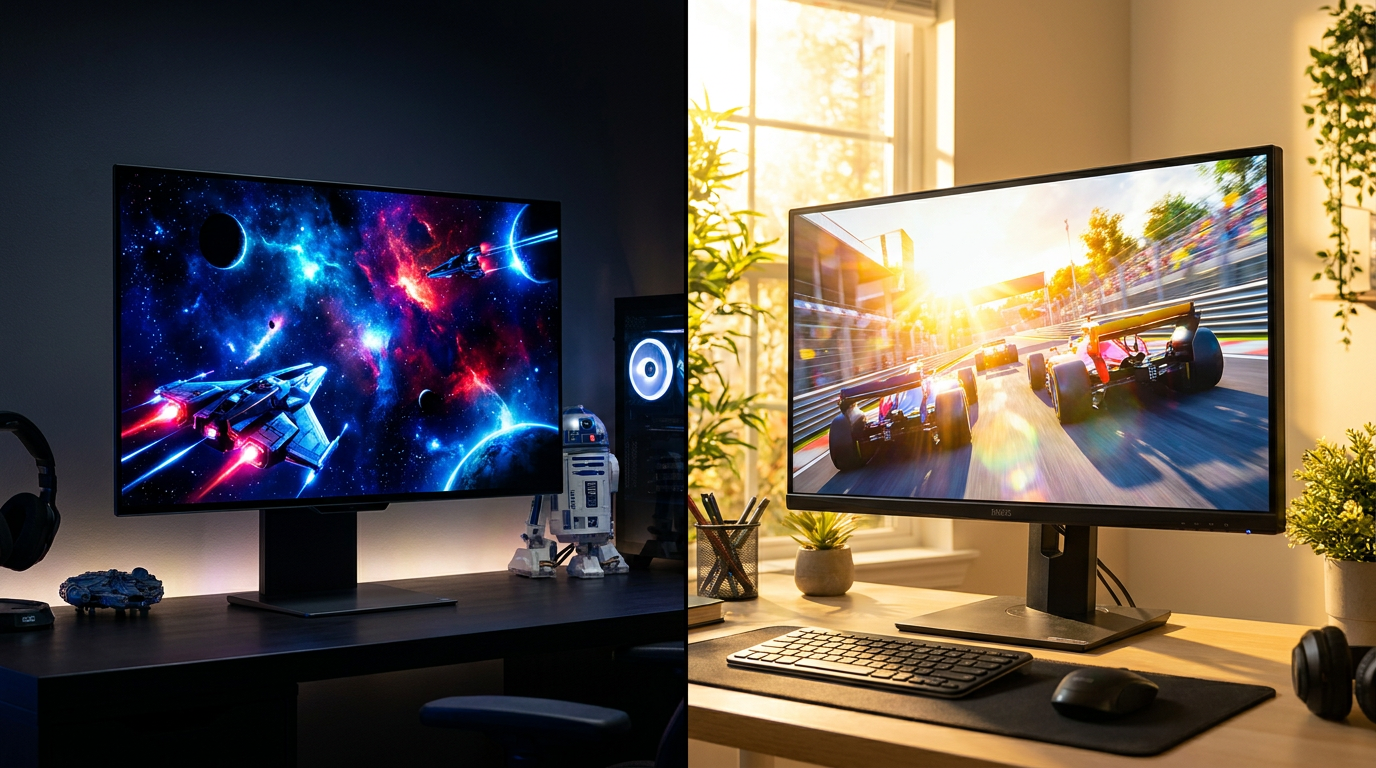
Ultimately, OLED fits well when playing fast-paced esports, consuming HDR media in light-controlled dark rooms, or prioritizing absolute motion clarity above all else. The instant pixel response virtually eliminates motion blur, making it a godsend for competitive shooters. It does not fit when working 40-hour weeks with static taskbars, coding for hours on end, or gaming in heavily sunlit rooms where the panel's lower full-screen brightness struggles to overcome ambient glare.[2][3][7]
Ultimately, OLED fits well when playing fast-paced esports, consuming HDR media in light-controlled dark rooms, or prioritizing absolute motion clarity above all else.
Conversely, the trade-off analysis for Mini-LED centers on brute force, versatility, and durability. For the technology: it offers sustained full-screen brightness that can easily exceed 1,000 nits, zero burn-in risk thanks to its inorganic materials, and superior text clarity via standard RGB subpixel layouts. Against the technology: it suffers from slower 1-millisecond response times, thicker chassis designs to accommodate heat sinks, and the potential for blooming—a distracting halo effect around bright objects on dark backgrounds.[1][3][6]

The evidence supporting Mini-LED's evolution is found in the sheer density of 2026 hardware. Early Mini-LEDs struggled with blooming because they only had a few hundred dimming zones. Today, monitors like LG's UltraGear evo 27GM950B pack 2,304 independent dimming zones into a 27-inch frame. Furthermore, new Zero Optical Distance engineering has virtually eliminated the physical gap between the backlight and the LCD panel, crushing the halo effect and allowing Mini-LED to mimic OLED's contrast much more closely.[6][7]
Mini-LED fits well when mixing heavy desktop productivity with gaming, working in brightly lit environments, or playing UI-heavy strategy games for thousands of hours without fear of differential aging. The technology is also incredibly cost-effective, with entry-level HDR1000 models like the AOC Q27G40XMN delivering blindingly bright highlights for under $450. It does not fit when absolute motion perfection is required, or when playing horror games in a pitch-dark room where even the slightest backlight blooming might break immersion.[2][3][7]

The conversation around burn-in has also matured. In 2026, burn-in is no longer viewed as a short-term fear, but rather a long-horizon variable measured in years of heavy use. Reviewers note that for the average buyer who uses their monitor for a healthy mix of work, gaming, and media, the realistic amount of degradation they will experience is remarkably low. The risk only truly materializes for users who leave static stock-trading dashboards or messaging windows open at maximum brightness for 60 hours a week.[4][7]
For buyers building a workstation in 2026, the decision matrix is simpler than it was three years ago. The price gap between the two technologies has narrowed, meaning consumers no longer have to pay a massive premium just to access true HDR. Instead, the choice is entirely environmental. If the monitor lives in a dark basement and is used exclusively for gaming, OLED is the undisputed king. If the monitor sits next to a sunny window and doubles as a 9-to-5 office display, Mini-LED is the bulletproof choice.[1][2][7]
How we got here
2022
The first mainstream OLED gaming monitors hit the market, plagued by high prices and burn-in fears.
2024
Mini-LED monitors begin scaling up local dimming zones to compete with OLED's contrast.
Early 2025
Major manufacturers introduce standard 3-year burn-in warranties for QD-OLED and WOLED panels.
Jan 2026
LG unveils the first 5K Mini-LED monitors with 'Zero Optical Distance' to eliminate blooming.
June 2026
Gigabyte pushes the industry standard by offering 4-year burn-in warranties on new OLED models.
Viewpoints in depth
OLED Purists
Gamers who prioritize absolute motion clarity and perfect black levels above all else.
For this camp, the 0.03-millisecond response time of an OLED panel is a non-negotiable advantage. Competitive players argue that the complete elimination of motion blur and ghosting provides a tangible edge in fast-paced shooters like Valorant or Counter-Strike 2. Furthermore, they view the infinite contrast of self-emissive pixels as the only way to truly experience HDR gaming, arguing that even the best local dimming algorithms on Mini-LEDs still crush shadow detail or introduce subtle blooming in pitch-black rooms.
Mini-LED Pragmatists
Users who demand high brightness and zero burn-in anxiety for mixed-use setups.
This perspective values durability and versatility. Pragmatists point out that most people use their PCs for more than just gaming—they browse the web, write code, and leave static windows open for hours. For them, the inorganic nature of Mini-LED provides profound peace of mind. They also highlight that in real-world, brightly lit rooms, OLED's Auto Brightness Limiter (ABL) can make snow scenes or bright web pages look dull, whereas a Mini-LED panel can sustain blinding 1,000+ nit brightness across the entire screen indefinitely.
Budget Upgraders
Value-conscious buyers taking advantage of the collapsing price floor for premium displays.
This camp is less concerned with the bleeding-edge spec war and more focused on the incredible value available in 2026. They note that just three years ago, true HDR gaming required a $1,500 investment. Today, they can secure a 240Hz QD-OLED for $550 or a 336-zone Mini-LED for $449. For these buyers, the debate isn't about which technology is objectively superior, but rather which one offers the biggest leap over their old edge-lit IPS panel for the lowest price.
What we don't know
- How 4th-generation OLED panels will actually fare after 5 to 7 years of heavy, real-world desktop use.
- Whether Micro-LED (which combines the benefits of both) will become affordable for consumers before the end of the decade.
Key terms
- OLED (Organic Light Emitting Diode)
- A display technology where each pixel generates its own light and can turn off completely, resulting in perfect black levels.
- Mini-LED
- An LCD display backed by thousands of microscopic LEDs grouped into zones that dim independently to improve contrast.
- Blooming (Halo Effect)
- A visual artifact on Mini-LED screens where light bleeds from a bright object into the surrounding dark areas.
- Burn-in
- Permanent image retention on an OLED screen caused by leaving static elements, like taskbars or health meters, on screen for thousands of hours.
- Auto Brightness Limiter (ABL)
- A safety feature in OLED monitors that automatically dims the screen when too much of it displays bright white, preventing overheating.
- Local Dimming Zones
- Specific clusters of backlights in a Mini-LED monitor that can turn off or dim independently to create deeper blacks.
Frequently asked
Will my OLED monitor get burn-in?
While the risk exists, 2026 panels use advanced mitigation features like pixel orbiting. With mixed use, most gamers will not see burn-in for many years, and new 3-to-4-year warranties provide a safety net.
Is Mini-LED better for working from home?
Yes. Mini-LED has zero risk of burn-in from static taskbars, offers better text clarity due to standard subpixel layouts, and gets bright enough to overcome glare in sunlit home offices.
Which technology is faster for competitive gaming?
OLED is significantly faster. Its 0.03ms pixel response time virtually eliminates motion blur, making it the preferred choice for fast-paced esports compared to Mini-LED's 1ms response time.
What is the 'toggle tax' on Mini-LED monitors?
Because Mini-LED relies on backlights, users sometimes have to manually toggle local dimming settings or switch between SDR and HDR modes in Windows to get the best text clarity or gaming performance.
Sources
Source coverage
7 outlets
3 viewpoints surfaced







[1]Tom's HardwareOLED Purists
Best Gaming Monitors 2026: OLED and Mini-LED Tested
Read on Tom's Hardware →[2]TechSpotBudget Upgraders
The Best Gaming Monitors: 4K, OLED, and Mini-LED Options
Read on TechSpot →[3]RTINGSMini-LED Pragmatists
OLED vs Mini LED Monitors: Which Panel Technology Is Better?
Read on RTINGS →[4]XDA DevelopersOLED Purists
It's time to accept OLED into your life: Burn-in fears are outdated
Read on XDA Developers →[5]FlatpanelsHDBudget Upgraders
Monitor manufacturers extend OLED burn-in warranties to up to 4 years
Read on FlatpanelsHD →[6]LG ElectronicsMini-LED Pragmatists
LG UltraGear evo 27GM950B 5K Mini-LED Gaming Monitor
Read on LG Electronics →[7]Factlen Editorial TeamBudget Upgraders
Synthesis by Factlen editorial team
Read on Factlen Editorial Team →
Every angle. Every day.
Get shopping stories with full source coverage and perspective breakdowns delivered to your inbox.