
Inside the NPU: How Dedicated AI Silicon is Reshaping the Modern Laptop
Neural Processing Units (NPUs) have become a standard component in 2026's 'AI PCs,' fundamentally changing how laptops handle machine learning tasks. By processing AI workloads locally, these specialized chips offer significant improvements in battery efficiency, processing speed, and user privacy.
By Factlen Editorial Team
- Silicon Architects
- Focused on maximizing raw AI throughput and power efficiency through hardware design.
- Privacy Advocates
- Focused on keeping user data secure and on-device via Edge AI.
- Software Ecosystem Developers
- Focused on optimizing and compressing AI models to run efficiently on local hardware.
What's not represented
- · Cloud Infrastructure Providers
- · Legacy Software Vendors
Why this matters
The inclusion of an NPU in modern laptops means you can run powerful artificial intelligence tools directly on your device without an internet connection. This shift not only drastically improves battery life but also ensures your personal data remains entirely private instead of being sent to cloud servers.
Key points
- NPUs are specialized chips designed to run AI workloads locally on a device.
- They are significantly more power-efficient than CPUs or GPUs for matrix multiplication tasks.
- Local processing (Edge AI) ensures user data remains private and eliminates network latency.
- NPU performance is measured in TOPS, with modern 2026 chips reaching up to 80 TOPS.
- Techniques like quantization compress AI models to fit within a laptop's memory constraints.
The laptop aisle in 2026 looks different. Almost every new machine bears a sticker declaring it an "AI PC." But beneath the marketing buzzword lies a genuine hardware revolution that is fundamentally changing how computers process information. The secret ingredient isn't a faster central processor or a beefier graphics card—it is a tiny, highly specialized piece of silicon known as a Neural Processing Unit, or NPU.[1][2]
To understand why the NPU exists, we have to look at the problem it solves. For decades, the CPU (Central Processing Unit) has been the generalist brain of the computer, capable of handling everything from running the operating system to managing background tasks. When graphics and gaming demanded more parallel processing, the industry introduced the GPU (Graphics Processing Unit). But artificial intelligence workloads—specifically the neural networks that power modern generative AI—require a completely different kind of mathematical heavy lifting.[1][2][7]
Neural networks rely on massive amounts of matrix multiplication and vector math. Asking a CPU to run a Large Language Model (LLM) is like asking a single brilliant professor to grade ten thousand multiple-choice tests; they can do it, but it takes forever. A GPU can grade those tests much faster because it acts like a massive auditorium of teaching assistants. However, GPUs are notoriously power-hungry. If you spin up a high-end GPU to run an AI model on a laptop, your battery will drain rapidly, and the chassis will become uncomfortably hot.[1][2]

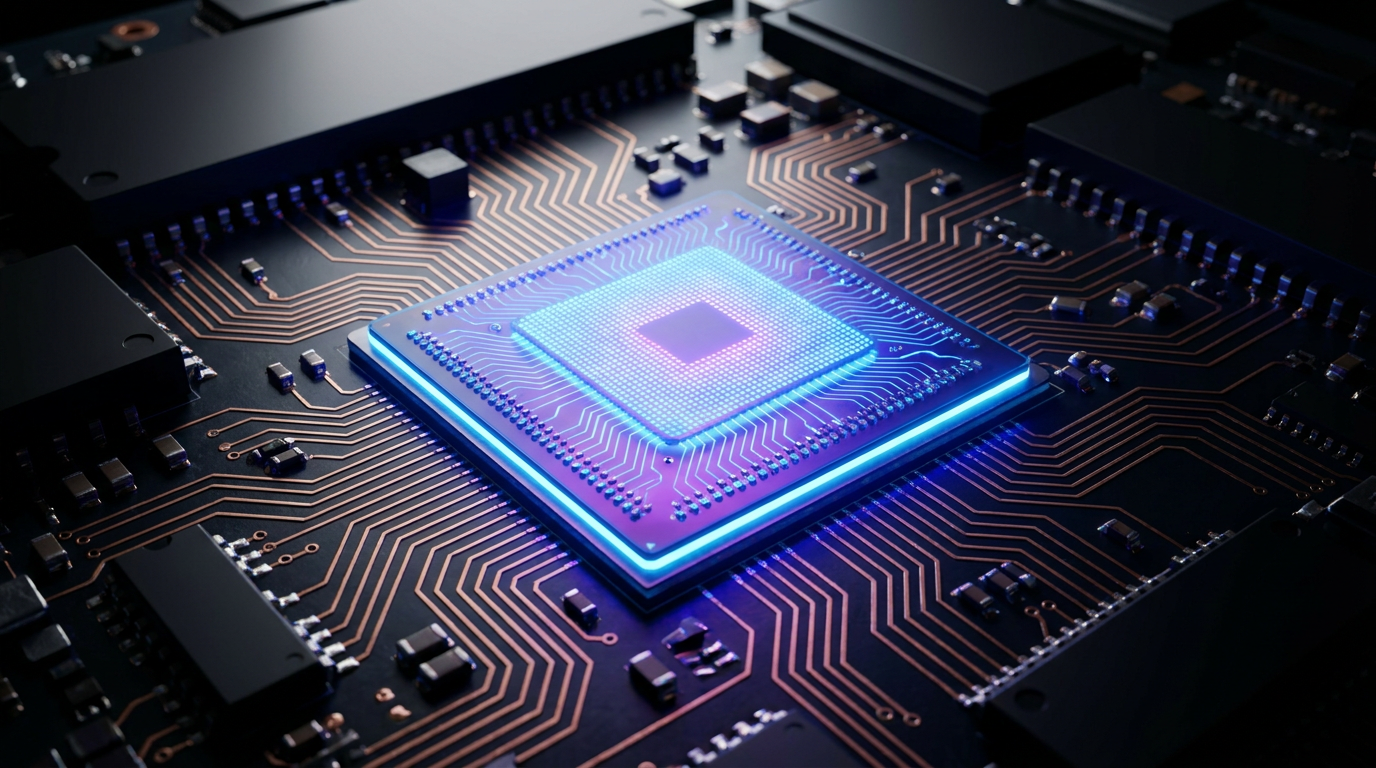
Enter the NPU. Designed exclusively for the specific mathematical operations that neural networks demand, the NPU is a master of efficiency. It strips away the general-purpose logic gates of a CPU and the graphics-rendering pipelines of a GPU. Instead, it is packed with tensor accelerators and multiply-accumulate units that do one thing perfectly: process AI inference tasks at lightning speed while sipping a fraction of the electricity.[1][2][3]
The architecture of a modern NPU is a marvel of microscopic engineering. Take Qualcomm’s Hexagon NPU, which powers the Snapdragon X Elite and the newer X2 Elite Extreme platforms. Qualcomm’s engineers fused three distinct accelerators into a single cohesive unit. The scalar accelerator handles the sequential control logic, the vector accelerator manages parallel streaming data, and the tensor accelerator performs the heavy matrix math.[3]
The real magic of the Hexagon architecture, however, lies in how it handles memory. Moving data back and forth between a processor and the laptop's main system RAM is one of the most power-intensive operations a computer performs. To solve this, Qualcomm implemented "micro-tile inferencing." By slicing the data into tiny chunks, the NPU can process multiple layers of a neural network entirely on-chip, eliminating the constant, power-hungry trips to external memory.[3]
Intel has taken a similar leap with its Lunar Lake architecture, introducing its fourth-generation NPU. Intel’s engineers tripled the number of neural compute engines compared to their previous generation and quadrupled the vector compute capabilities. By widening the data pipelines, Intel’s NPU 4 can process significantly more data per clock cycle, dramatically speeding up tasks like image generation while preserving battery life.[4][5]
Intel has taken a similar leap with its Lunar Lake architecture, introducing its fourth-generation NPU.
Across all these manufacturers, the battleground metric is TOPS, or Trillions of Operations Per Second. Think of TOPS as the horsepower rating for an NPU. In 2024, Microsoft drew a line in the sand, declaring that any laptop wanting the "Copilot+ PC" certification must have an NPU capable of at least 40 TOPS.[4][5]

The industry blew past that baseline almost immediately. While the first wave of Copilot+ PCs hovered around 45 to 50 TOPS, the silicon of late 2025 and 2026 pushed the boundaries further. Qualcomm’s Snapdragon X2 Elite Extreme, for instance, boasts an astonishing 80 TOPS of AI processing power. This massive headroom allows laptops to run increasingly complex, multi-agent AI workflows entirely locally, without ever pinging a cloud server.[6]
But raw hardware power is only half the equation; software optimization is the other. Because large language models are incredibly memory-intensive, running them on a laptop requires a technique called quantization. Quantization compresses the massive, high-precision mathematical weights of an AI model down to smaller, 4-bit integers.[3][6]
Doing math with smaller numbers literally saves energy. By shifting to this lower precision, modern NPUs can deliver up to 60 percent in power savings while maintaining near-identical output quality. This compression is what allows a multi-billion parameter AI model to physically fit into a laptop's memory and run smoothly without draining the battery or requiring an internet connection.[3]

This shift from cloud-based AI to local, on-device processing is known as "Edge AI," and it is the primary reason NPUs matter to the average consumer. When your laptop processes AI locally, there is zero network latency. Features like real-time language translation, automatic background blur in video calls, and active noise suppression happen instantaneously, without the lag of sending audio and video to a remote server.[1][2]
More importantly, Edge AI fundamentally changes the privacy equation. When you ask a local AI assistant to summarize a confidential legal document, draft an email to your doctor, or search through your personal photos, that data never leaves your machine. For enterprise users and privacy-conscious consumers, the NPU transforms AI from a potential data-harvesting liability into a secure, hyper-personalized tool.[1][2][7]

Despite these breakthroughs, it is important to understand the limitations of the NPU. These chips are designed specifically for "inference"—the act of running a pre-trained AI model to generate a result. They are not designed for "training" those models in the first place. Training a massive new language model still requires warehouses full of industrial-grade GPUs consuming megawatts of power.[2][7]
As we move deeper into 2026, the NPU is no longer a novelty; it is becoming as standard and essential as the CPU and GPU. Software developers are rapidly rewriting their applications to take advantage of this new silicon, moving beyond simple video call filters to complex, agentic workflows where your laptop autonomously organizes your files, drafts your correspondence, and anticipates your needs. The AI PC era is here, and the NPU is its beating heart.[7]
How we got here
2017
Apple introduces the Neural Engine in the A11 Bionic chip for smartphones, an early precursor to modern NPUs.
2020
Qualcomm fuses scalar, vector, and tensor accelerators into a single Hexagon architecture.
Late 2023
Intel launches 'Meteor Lake', its first generation of mobile processors featuring an integrated NPU.
May 2024
Microsoft announces the 'Copilot+ PC' standard, requiring a minimum of 40 TOPS of NPU performance.
Late 2025
Next-generation laptop chips, including the Snapdragon X2 Elite Extreme, push NPU performance to 80 TOPS.
Viewpoints in depth
Silicon Architects
Hardware engineers focused on maximizing raw AI throughput and power efficiency.
For chip designers at companies like Qualcomm, Intel, and AMD, the NPU represents the most significant architectural shift in a decade. Their primary goal is increasing TOPS (Trillions of Operations Per Second) while shrinking the power envelope. This camp argues that the future of computing relies on heterogeneous architectures—fusing scalar, vector, and tensor accelerators—to ensure that laptops can run massive AI models locally without thermal throttling or destroying battery life.
Privacy Advocates
Security professionals who view local AI processing as a vital defense against cloud data harvesting.
Privacy and security experts champion the NPU because it enables 'Edge AI'—keeping sensitive data entirely on the device. From their perspective, sending personal documents, emails, or biometric data to a cloud server for AI processing is an unacceptable security risk. By providing the hardware necessary to run Large Language Models offline, NPUs ensure that hyper-personalized AI assistants can exist without compromising user privacy or feeding corporate data silos.
Software Ecosystem Developers
Programmers and AI researchers focused on shrinking and optimizing models for edge deployment.
For the software community, the raw power of an NPU is useless without optimized models. This camp focuses heavily on techniques like quantization—compressing 32-bit floating-point models down to 4-bit integers (INT4). Developers argue that the real breakthrough isn't just the silicon, but the open-source frameworks and tools that allow complex generative AI to fit within the strict memory constraints of a consumer laptop, unlocking real-time, offline applications.
What we don't know
- How quickly legacy software developers will rewrite their applications to fully utilize local NPU hardware.
- Whether the 80 TOPS ceiling reached in 2026 will be sufficient for the next generation of multi-agent AI models, or if hardware requirements will continue to double.
- How the integration of NPUs will impact the long-term lifespan and upgrade cycles of consumer laptops.
Key terms
- NPU (Neural Processing Unit)
- A specialized computer chip designed specifically to accelerate the mathematical operations required by artificial intelligence.
- TOPS (Trillions of Operations Per Second)
- A metric used to measure the raw processing power of an AI accelerator.
- Edge AI
- The practice of running artificial intelligence models locally on a user's device rather than relying on cloud servers.
- Inference
- The process where a pre-trained AI model analyzes new data to generate a result, such as translating text or recognizing an image.
- Quantization
- A technique that compresses large AI models into smaller formats, allowing them to run efficiently on consumer hardware.
- Tensor Accelerator
- A specific component within an NPU designed to handle massive matrix multiplication tasks simultaneously.
Frequently asked
Do I need an NPU if my laptop has a powerful GPU?
Yes, if you value battery life. While GPUs are excellent at running AI, they consume massive amounts of power. An NPU performs the same AI inference tasks using a fraction of the electricity.
Can an NPU train new artificial intelligence models?
No. NPUs are designed for 'inference'—running models that have already been trained. Training massive models still requires industrial data centers packed with high-end GPUs.
Will an NPU make my traditional software run faster?
Not directly. An NPU only accelerates applications that have been specifically written to use AI features, like background blur in video calls or local AI assistants. Traditional tasks still rely on the CPU.
Does local AI processing on an NPU protect my privacy?
Yes. Because the AI model runs entirely on your device's NPU, your personal data, documents, and voice recordings never need to be sent to a cloud server for processing.
Sources
Source coverage
7 outlets
3 viewpoints surfaced






[1]HPPrivacy Advocates
What Is an NPU (Neural Processing Unit)?
Read on HP →[2]LenovoPrivacy Advocates
NPU (Neural Processing Unit) Glossary
Read on Lenovo →[3]QualcommSilicon Architects
What makes the Hexagon NPU different?
Read on Qualcomm →[4]PCMagSilicon Architects
Intel's 'Lunar Lake' Explained: The Architecture Behind the Next AI PCs
Read on PCMag →[5]Tom's HardwareSilicon Architects
Intel Unveils Lunar Lake Architecture: Up to 120 TOPS of AI Performance
Read on Tom's Hardware →[6]NotebookcheckSilicon Architects
Qualcomm Snapdragon X2 Elite Extreme details: Hexagon NPU 6 hits 80 TOPS
Read on Notebookcheck →[7]Factlen Editorial TeamSoftware Ecosystem Developers
Synthesis by Factlen editorial team
Read on Factlen Editorial Team →

More in ai
See all 9 stories →On-Device AI
The Era of On-Device AI: Why Small Language Models Are Taking Over Your Phone
7 sources
Self-Driving Labs
How Self-Driving Labs Are Automating Scientific Discovery
6 sources
Local AI
How Local AI Tools Are Running on Everyday Laptops
6 sources
Prompt Engineering
How Advanced Prompting Techniques Are Evolving Into Agentic Workflows
7 sources

Every angle. Every day.
Get ai stories with full source coverage and perspective breakdowns delivered to your inbox.