
How Virtual Reality is Solving the Skilled Trades Labor Shortage
Immersive VR simulations are accelerating vocational training by allowing students to safely practice high-stakes trades like welding and electrical work. By reducing training time and material waste, the technology is helping close a massive skilled labor gap.
By Factlen Editorial Team
- Vocational Tech Providers
- Argue that immersive simulations democratize access to trades and accelerate the learning curve safely.
- Contractors & Employers
- Focus on the immediate return on investment through reduced material waste and faster onboarding of field-ready technicians.
- Traditional Trades Educators
- Maintain that while virtual reality is a powerful supplementary tool, it cannot fully replace the tactile muscle memory developed through physical practice.
What's not represented
- · Underfunded public school districts
- · Students who experience severe motion sickness
Why this matters
The U.S. faces a critical shortage of skilled tradespeople, driving up costs for home repairs, construction, and infrastructure projects. VR training accelerates the pipeline of new workers, making career transitions into lucrative trades faster, safer, and more accessible for thousands of people.
Key points
- The U.S. needs over 546,000 new skilled trades professionals annually to meet demand.
- Virtual reality allows trainees to practice dangerous tasks like high-voltage wiring without physical risk.
- A landmark NCCER study found VR-trained students scored 75% on exams compared to 53% for traditional learners.
- Companies are using VR to cut HVAC training time from a full year down to under 90 days.
The United States is facing a critical bottleneck in its physical infrastructure: a massive shortage of skilled tradespeople. Industry estimates suggest that over 546,000 new professionals are needed annually just to keep pace with retiring workers and expanding demand in construction, renewable energy, and home services. For decades, the pathway into these careers has relied on a slow, expensive, and resource-heavy apprenticeship model. Trainees learn by shadowing master tradespeople, reading dense technical manuals, and practicing on physical equipment. This traditional approach, while effective at producing master craftsmen, simply cannot scale fast enough to meet modern labor demands. It requires significant one-on-one time from already overworked professionals and involves a high risk of costly material waste when novices inevitably make mistakes.[8]
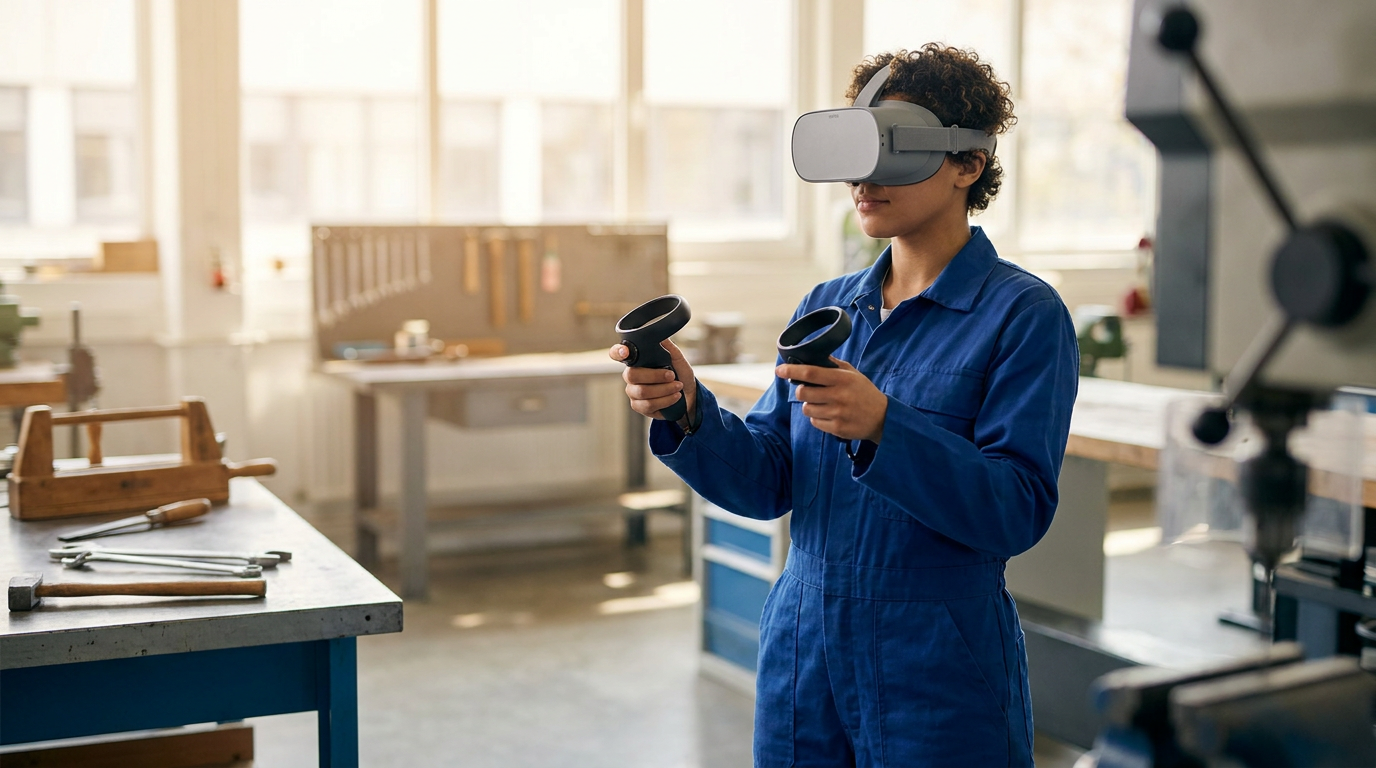
To solve this bottleneck, vocational schools and corporate training programs are increasingly turning to virtual reality. By replacing static textbooks with immersive, three-dimensional simulations, platforms like Interplay Learning, Transfr, and ImmerseLearn are fundamentally changing how technical skills are acquired. Instead of sitting in a classroom looking at diagrams of an air conditioning unit, a student puts on a modern VR headset and is immediately transported to a virtual rooftop or basement. They are handed virtual tools and tasked with diagnosing a failing compressor or wiring a complex electrical panel. This shift from passive observation to active, spatial problem-solving engages learners in a way that traditional instruction struggles to match, bridging the gap between theoretical knowledge and practical application.[3][4][5][7]
The core mechanism driving this educational shift is the ability to simulate high-stakes environments without real-world consequences. In the skilled trades, beginner mistakes are not just academically disappointing; they can be incredibly dangerous. A novice electrician wiring a high-voltage commercial panel or a student learning to operate an acetylene welding torch faces genuine physical risks. Virtual reality removes these hazards entirely. Trainees can practice lockout/tagout safety procedures, experience the simulated consequences of an electrical short, and learn the precise angle required for a strong weld, all within a completely controlled digital environment. If they make a catastrophic error, the system simply resets, allowing them to learn from the mistake without injury or property damage.[5]
Beyond safety, virtual reality fundamentally alters the economics of repetition. Developing the muscle memory required for skilled labor requires doing the same task dozens, if not hundreds, of times. In a traditional physical lab, every practice run consumes expensive consumables: copper wire, PVC pipe, welding gas, and sheet metal. With virtual reality, the cost of the hundredth practice session is exactly the same as the first. Students can repeatedly strip virtual wires, braze virtual pipes, and calibrate virtual thermostats until the sequence becomes second nature. This unlimited repetition allows learners to build a deep, intuitive understanding of complex systems before they ever touch a physical tool.[1][2]
The empirical evidence supporting this immersive approach is becoming difficult for traditionalists to ignore. In a landmark pilot study conducted by the National Center for Construction Education and Research (NCCER), researchers compared the outcomes of students learning via traditional lab instruction versus those using virtual reality simulations. The results were stark. Students in the VR-enhanced cohort scored an average of 75 percent on their final certification assessments, significantly outperforming the traditional lab students, who averaged just 53 percent. The immersive environment allowed the VR students to grasp spatial relationships and procedural sequences much faster than their peers who relied on physical demonstrations alone.[3][5][6]

The benefits of this accelerated comprehension extend directly into the job market. In the same NCCER study, the employment outcomes for the two groups diverged dramatically. An impressive 100 percent of the students who trained using virtual reality secured employment in their chosen trade following the program. In contrast, only 69 percent of the students from the traditional lab setting successfully transitioned into the workforce. Employers reported that the VR-trained graduates arrived on day one with a higher degree of confidence and a better grasp of complex diagnostic procedures, making them immediately valuable to active job sites.[3]
For corporate employers, the most vital metric is the reduction in "ramp time"—the duration it takes to turn a green recruit into a profitable, independent technician. Platforms like Interplay Learning have demonstrated that immersive, simulation-based training can compress this timeline dramatically. Historically, it could take a full year of shadowing and field practice for a new HVAC technician to become proficient enough to run service calls alone. By supplementing field work with intensive VR diagnostics, companies are now getting new hires job-ready in under 90 days. This acceleration allows businesses to expand their service capacity rapidly without compromising on the quality of their work.[4]
For corporate employers, the most vital metric is the reduction in "ramp time"—the duration it takes to turn a green recruit into a profitable, independent technician.
The financial impact of this technology is being felt acutely by mid-sized contractors. Cardinal Plumbing Heating & Air, a home service company in Virginia, overhauled its technician development strategy by integrating VR simulations. Previously, training took place entirely in the field, where a novice's mistake meant ruined materials and wasted time. The company estimated that field-training a single technician could cost upwards of $1,000 in wasted parts alone. By shifting the initial learning phase into virtual reality, Cardinal virtually eliminated these material costs. Furthermore, the company found that the engaging nature of the technology helped them retain younger technicians who might have otherwise quit out of frustration during the difficult early months of field training.[2]

Major corporations are also leveraging the technology to build their own internal talent pipelines. Lowe's, the home improvement giant, launched its "Track to the Trades" program to help its retail employees transition into skilled careers. By partnering with VR training providers, Lowe's has offered tuition-free access to immersive courses in HVAC, electrical, and plumbing to over 31,000 of its associates. This massive scale of workforce development would be logistically impossible using traditional physical classrooms. By delivering the curriculum through cloud-based simulations, the company can provide standardized, high-quality instruction to employees across thousands of different retail locations simultaneously.[8]
The accessibility of virtual reality is also opening new avenues for vocational training outside of traditional corporate structures. Public school districts, such as Santa Rosa in Florida, are deploying VR headsets to introduce fifth-graders and high school students to the trades. Rather than building expensive, liability-heavy physical workshops, schools can use a fleet of headsets to let students safely experience climbing a cell tower or repairing a furnace. Similarly, correctional facilities are using VR to provide inmates with industry-recognized certifications, offering a tangible, highly employable skill set that significantly reduces the likelihood of recidivism upon release.[1]
Despite the overwhelming enthusiasm from tech providers and corporate executives, the technology is not without its limitations. The most significant hurdle is the current state of haptic feedback—the technology that simulates the sense of touch. While a VR headset can perfectly replicate the visual and auditory experience of wiring a house, it cannot yet accurately simulate physical resistance. A digital simulation cannot teach a mechanic how much torque is required before a rusted bolt snaps, or let a plumber feel the subtle vibration of a failing water pump. These tactile nuances are critical components of a master tradesperson's intuition.[7]

Because of these tactile limitations, veteran educators and union leaders insist that virtual reality must be viewed strictly as a supplementary tool. Master craftsmen argue that while a simulation is unparalleled for teaching the sequence of a procedure or the logic of a diagnostic test, it cannot replace the physical conditioning and muscle memory developed on a real job site. An apprentice still needs to experience the physical exhaustion of pulling heavy gauge wire through a hot attic, and they still need to learn how to handle physical tools with precision. The industry consensus is settling on a blended approach, where VR handles the theory and procedural repetition, leaving physical labs to focus purely on tactile execution.[6][7]
Furthermore, the upfront cost of implementing these systems remains a barrier for many underfunded vocational programs. While enterprise-grade VR headsets have dropped significantly in price, outfitting a classroom of thirty students still requires a substantial capital investment. Beyond the hardware, schools must pay ongoing annual subscription fees for access to the software platforms and simulation libraries. For community colleges and rural high schools operating on razor-thin budgets, these costs can be prohibitive, threatening to create a digital divide where only well-funded programs can offer accelerated, immersive training.
As the technology matures, the integration of artificial intelligence is expected to make these virtual environments even more potent. Future iterations of VR training will feature AI-driven virtual instructors capable of analyzing a student's eye movements and hand gestures in real-time, offering personalized corrections before a bad habit forms. This level of individualized coaching, delivered at scale, has the potential to further compress training timelines and elevate the baseline competency of the entire workforce.[3]

Ultimately, the integration of virtual reality into the skilled trades represents a necessary evolution in how society transfers essential knowledge. By lowering the barriers to entry, eliminating the physical risks of early learning, and drastically reducing the cost of repetition, immersive technology is making the trades more accessible to a broader demographic. While it will never completely replace the calloused hands and hard-won intuition of a master craftsman, virtual reality is proving to be the most effective tool available for building the next generation of the physical workforce.
How we got here
2018
Lowe's launches its Track to the Trades program, eventually incorporating VR to train thousands of employees.
2022
The NCCER conducts a landmark pilot study proving VR-trained students outperform traditional lab students.
2024
Major VR platforms partner with industry bodies like HVAC Excellence to offer official Employment Ready certification exams.
2026
VR trade training sees widespread adoption across public high schools, corporate fleets, and correctional facilities.
Viewpoints in depth
Vocational Tech Providers
Advocates for immersive learning believe VR is the key to solving the labor shortage.
Technology companies building these platforms argue that the traditional apprenticeship model is fundamentally unscalable. By digitizing the training environment, they believe they can democratize access to lucrative careers. Providers point out that VR allows a single instructor to monitor a dozen students simultaneously practicing high-risk tasks, removing the bottleneck of one-on-one mentorship. They view the technology not just as a cost-saving measure, but as a way to engage a younger, digitally native generation that might otherwise overlook the skilled trades.
Contractors & Employers
Business owners focus on the immediate financial and operational returns of virtual training.
For the companies actually hiring these technicians, the appeal of virtual reality is strictly mathematical. Employers highlight the massive reduction in 'ramp time'—the period it takes for a new hire to become profitable in the field. By allowing trainees to make their inevitable beginner mistakes in a digital environment, companies save thousands of dollars in wasted copper pipe, blown fuses, and damaged equipment. Furthermore, employers note that VR training significantly reduces the rate of 'callbacks' or recalls, where a senior technician has to return to a site to fix a junior employee's mistake.
Traditional Trades Educators
Veteran tradespeople emphasize the irreplaceable nature of physical, tactile experience.
While generally supportive of new teaching tools, master craftsmen and traditional educators urge caution against over-relying on simulations. They argue that while VR is excellent for teaching the sequence of a procedure or the theory behind a diagnostic test, it cannot replicate the physical realities of the job. A digital simulation cannot teach a plumber how much torque will snap a rusted pipe, or prepare an electrician for the physical exhaustion of working in a 120-degree attic. These educators insist that VR must remain a supplement to—never a replacement for—traditional, hands-on apprenticeships.
What we don't know
- Whether the muscle memory developed using lightweight VR controllers fully translates to the physical exertion required when wielding heavy, vibrating power tools.
- How quickly older, traditional master tradespeople will accept and trust apprentices whose primary early experience comes from digital simulations rather than physical shadowing.
- The long-term impact of AI-driven virtual coaching on the retention rates of tradespeople over a multi-decade career.
Key terms
- Haptic Feedback
- Technology that simulates the sense of touch through vibrations or force resistance, helping users feel virtual objects.
- HVAC
- Heating, ventilation, and air conditioning; a core skilled trade focused on indoor environmental comfort systems.
- OSHA 10-Hour
- A foundational safety training certification required for many entry-level construction and trades jobs.
- Muscle Memory
- The ability to reproduce a particular physical movement without conscious thought, acquired as a result of frequent repetition.
Frequently asked
Can you get fully certified just by using virtual reality?
No. VR is used as a powerful supplementary tool to accelerate learning, but official certifications still require physical, hands-on demonstration of skills and traditional apprenticeship hours.
What specific trades are using VR training the most?
The technology is currently most popular in HVAC repair, electrical wiring, plumbing, and welding, where safety risks and material costs are highest for beginners.
Does virtual reality training cause motion sickness?
While early VR headsets caused nausea for some users, modern enterprise headsets use high refresh rates and precise tracking that have largely eliminated motion sickness for the vast majority of trainees.
How much does a VR training setup cost for a school?
Enterprise-grade headsets typically cost between $500 and $1,500 each, plus annual software subscription fees for the training modules, which can be a financial hurdle for underfunded public schools.
Sources
Source coverage
8 outlets
3 viewpoints surfaced







[1]Facilities DiveContractors & Employers
Companies and schools turn to VR to train technicians and introduce students to skilled trades
Read on Facilities Dive →[2]ACHR NewsContractors & Employers
New Tech for New Techs: Using VR to Train and Retain Technicians
Read on ACHR News →[3]TransfrVocational Tech Providers
Is VR Training Effective for Skilled Trades?
Read on Transfr →[4]Interplay LearningVocational Tech Providers
Get HVAC Technicians Ready in Weeks, Not Years
Read on Interplay Learning →[5]ImmerseLearnVocational Tech Providers
VR Trade Training Programs Transform Skilled Trades
Read on ImmerseLearn →[6]NCCERTraditional Trades Educators
Construction Industry Trends to Watch in 2025
Read on NCCER →[7]Factlen Editorial TeamTraditional Trades Educators
Synthesis by Factlen editorial team
Read on Factlen Editorial Team →[8]SkillCatVocational Tech Providers
Interplay Learning Review: Is it the Best HVAC Training?
Read on SkillCat →

Every angle. Every day.
Get education stories with full source coverage and perspective breakdowns delivered to your inbox.