
AI Mapping Identifies 166,000 Square Kilometers of Climate-Resilient Coral Reefs
A landmark global study has identified vast stretches of coral reefs capable of surviving ocean warming, tripling previous estimates and offering a targeted roadmap for marine conservation.
By Factlen Editorial Team
- Marine Conservationists
- Advocates focused on translating the new data into immediate legal protections.
- Climate Modellers
- Scientists focused on the intersection of oceanography and artificial intelligence.
- Coastal Communities
- Local populations whose livelihoods depend directly on the health of the reefs.
What's not represented
- · Commercial fishing fleets that operate in the unprotected 72 percent of these resilient reef zones.
- · Tourism boards of the five nations hosting the majority of these reefs.
Why this matters
For years, the scientific consensus suggested that nearly all tropical coral reefs were doomed by climate change. This new evidence provides a highly specific, actionable map of where conservation funds can be deployed to successfully save one-third of the world's most biodiverse marine ecosystems.
Key points
- A new study identifies 166,000 square kilometers of coral reefs capable of surviving global warming.
- This figure triples previous estimates and represents about one-third of all global reef systems.
- AI models analyzed 45,000 field observations to find 'refugia' protected by cool currents and reduced sunlight.
- Over 60% of these resilient reefs are located in Australia, the Bahamas, Cuba, Indonesia, and the Philippines.
- Only 28% of these climate-resilient reefs are currently situated within marine protected areas.
The prevailing scientific narrative regarding coral reefs has long been characterized by inevitable, irreversible decline. The Intergovernmental Panel on Climate Change (IPCC) has previously warned that 70 to 90 percent of tropical reefs could face extinction with 1.5 degrees Celsius of global warming, and up to 99 percent at 2 degrees.[7]
A landmark global study presented at the Our Ocean Conference in Mombasa, Kenya, fundamentally challenges that timeline. The research claims that a substantial portion of the world's coral ecosystems possess the capacity to withstand or recover from the effects of severe global warming.[1][6]
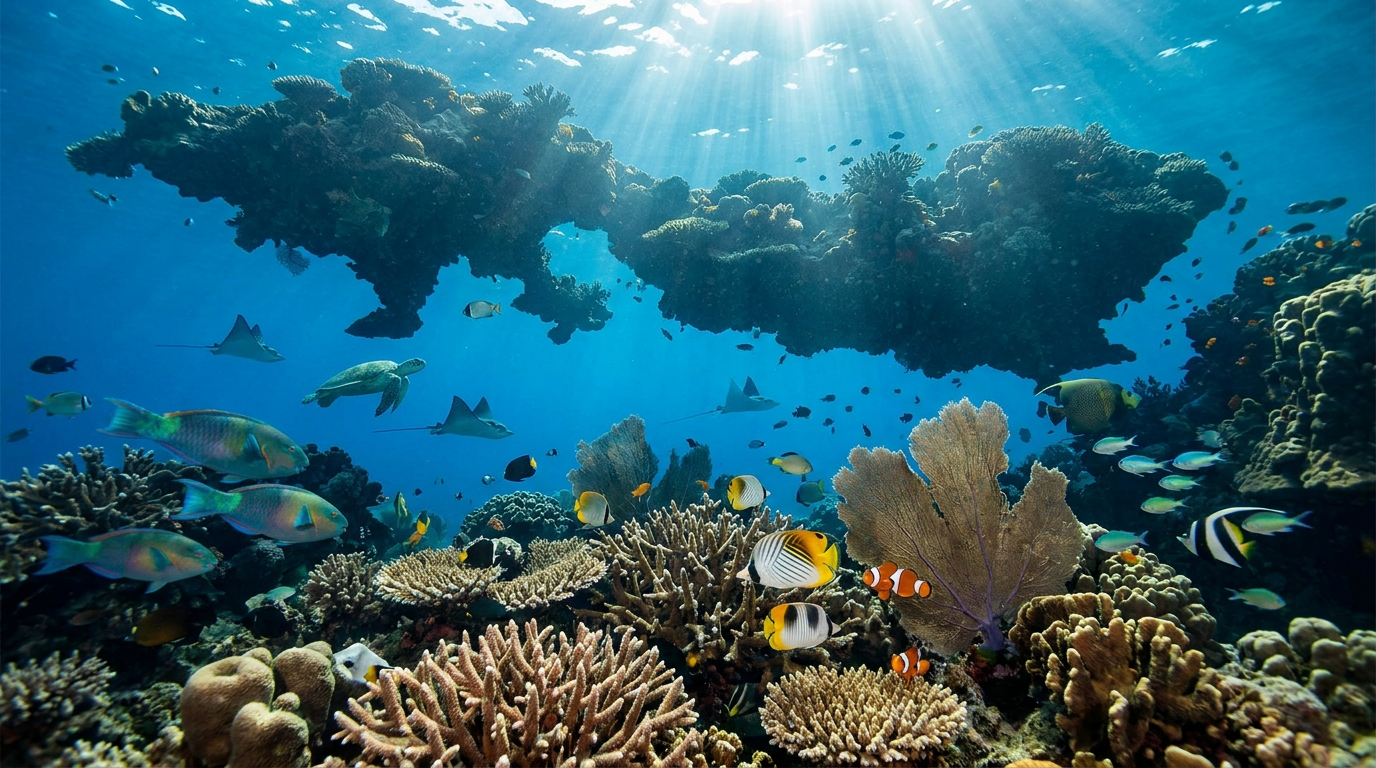
According to the findings, researchers have identified approximately 166,000 square kilometers (64,000 square miles) of climate-resilient coral reefs. This represents roughly one-third of the world's total reef systems, offering a rare note of optimism for an ecosystem that supports a quarter of all marine life.[3][4]
The evidence base for this claim relies on a massive integration of historical data and artificial intelligence. Led by the Wildlife Conservation Society (WCS) and Macquarie University, the research team utilized machine-learning models to map these "climate refugia" with unprecedented precision.[2][5]

To train the AI, scientists inputted more than 45,000 field observations of coral cover and composition gathered over 65 years, alongside decades of climate and oceanographic data. The resulting map is reportedly 10,000 times more detailed than any previous assessment of reef resilience.[3][4][5][6]
The models identified 42 distinct environmental factors that create the conditions for these coral havens. Rather than relying solely on the biological heat tolerance of the coral itself, the evidence points to specific physical oceanographic features that shield the reefs from surface heatwaves.[1][6]
The primary mechanism of protection in these refugia involves the upwelling of cooler, deep-ocean currents that regulate surface temperatures. Additional factors include reduced exposure to intense sunlight and geographic positioning outside the typical paths of destructive tropical cyclones.[1]

The primary mechanism of protection in these refugia involves the upwelling of cooler, deep-ocean currents that regulate surface temperatures.
Beyond physical shielding, the data indicates that some reef systems are demonstrating rapid biological recovery. In areas like Kenya's Wasini-Mkwiro island, WCS data showed that while a major bleaching event in 2024 reduced coral cover from 44 percent to 27 percent, the local ecosystem recovered to 40 percent within a single year.[6]
The geographic distribution of these resilient reefs spans 71 countries and 100 territories, including newly recognized strongholds in the Caribbean, Pacific, and Atlantic oceans. This marks a significant expansion from the pioneering 2018 "50 Reefs" study, tripling the known extent of viable coral habitats.[1][3][4][5]
However, the distribution is highly concentrated. The data reveals that more than 60 percent of the identified climate-resilient ecosystems are located within the waters of just five nations: Australia, the Bahamas, Cuba, Indonesia, and the Philippines.[4][6]

While the identification of these refugia provides a clear roadmap for conservation, the study highlights a critical vulnerability regarding their current status. The evidence shows a severe deficit in formal protection for these specific, high-value ecosystems.[5]
Currently, only 28 percent of the identified resilient reefs fall within established marine protected areas (MPAs). This leaves more than 119,000 square kilometers of viable coral exposed to immediate, localized threats that could destroy them before climate change does.[5][6]

Researchers emphasize that even if these reefs can survive warming waters, they remain highly susceptible to human activities. Destructive practices such as bottom-trawling, dynamite fishing, and agricultural runoff can shatter centuries-old coral colonies in seconds, neutralizing their climate resilience.[4][6]
The policy implication of the study is a call for targeted conservation. As global governments develop action plans for the "30 by 30" initiative—aiming to protect 30 percent of marine environments by 2030—this data provides a precise blueprint of where to allocate limited resources for maximum ecological return.[3]
By shifting the focus from a narrative of total ecosystem collapse to one of strategic preservation, the research suggests that the most biodiverse habitats in the ocean can be saved. The uncertainty now lies not in whether the coral can survive the heat, but whether political will can be mobilized to protect these specific refugia from local destruction.[3][5]
How we got here
2018
The pioneering '50 Reefs' study is published, representing the first systematic attempt to identify coral habitats that could survive climate change.
2024
A major global bleaching event devastates reefs, but researchers note rapid recovery in specific sheltered pockets off the coast of Kenya.
October 2025
Scientists warn that coral reefs globally are passing a point of no return due to accelerating marine heatwaves.
June 16, 2026
Researchers unveil the new AI-driven map at the Our Ocean Conference in Mombasa, revealing 166,000 square kilometers of resilient reefs.
Viewpoints in depth
Marine Conservationists
Advocates focused on translating the new data into immediate legal protections.
Conservation groups view this study as a critical tool for the global '30 by 30' initiative. They argue that knowing exactly which reefs can survive climate change removes the guesswork from marine protection. Their primary concern is that while these reefs can withstand warmer waters, they are completely defenseless against bottom-trawling, overfishing, and pollution. They are pushing governments to immediately designate the unprotected 72 percent of these refugia as strict marine protected areas.
Climate Modellers
Scientists focused on the intersection of oceanography and artificial intelligence.
For climate scientists and oceanographers, the breakthrough lies in the methodology. By moving away from broad, global temperature averages and using AI to analyze 42 highly localized environmental factors, they have proven that the ocean's response to warming is highly nuanced. They emphasize that the upwelling of cool currents and localized shading create micro-climates that global models previously missed, fundamentally altering the timeline of coral extinction.
Coastal Communities
Local populations whose livelihoods depend directly on the health of the reefs.
For the nearly one billion people who rely on coral reefs for food security and coastal defense, the identification of these resilient zones is a matter of economic survival. In areas like Kenya's Wasini-Mkwiro island, local fishing communities are already taking the lead by forming beach management units to patrol the waters and prevent destructive fishing practices, demonstrating that local stewardship is just as vital as global climate policy.
What we don't know
- Whether the upwelling of cool deep-ocean currents that protect these refugia will eventually be disrupted by long-term changes in global ocean circulation.
- How quickly governments will act to incorporate these newly mapped coordinates into their official marine protected areas.
- The exact genetic mechanisms that allow some of these specific coral populations to recover from severe bleaching faster than others.
Key terms
- Climate Refugia
- Specific geographic areas that remain relatively buffered from contemporary climate change, providing a safe haven for vulnerable species.
- Upwelling
- An oceanographic process where deep, cold, and nutrient-rich water rises toward the surface, displacing warmer surface water.
- Coral Bleaching
- A stress response where corals expel the symbiotic algae living in their tissues due to elevated water temperatures, turning them completely white.
- 30 by 30 Initiative
- A global conservation target aiming to protect 30 percent of the planet's land and marine environments by the year 2030.
Frequently asked
Are all coral reefs going to die from climate change?
No. While previous models warned of massive losses, this new study indicates that roughly one-third of the world's reefs have the environmental conditions necessary to survive and recover from warming oceans.
How do these specific reefs survive the heat?
They are located in 'climate refugia'—areas protected by 42 specific environmental factors, most notably the upwelling of cooler deep-ocean currents that regulate surface temperatures.
Where are these resilient reefs located?
They are spread across 71 countries, but more than 60 percent are concentrated in just five nations: Australia, the Bahamas, Cuba, Indonesia, and the Philippines.
Are these surviving reefs safe from human activity?
Not currently. Only 28 percent of these climate-resilient reefs are in marine protected areas, leaving the majority vulnerable to overfishing, bottom-trawling, and pollution.
Sources
Source coverage
7 outlets
3 viewpoints surfaced







[1]The New York TimesClimate Modellers
New Coral Study Identifies Areas Where Reefs Are Hanging On
Read on The New York Times →[2]Wildlife Conservation SocietyMarine Conservationists
Machine-learning and prioritization models reveal climate refugia for coral reefs into 2050
Read on Wildlife Conservation Society →[3]The IndependentClimate Modellers
Scientists just identified 166,000 sq km of coral reef capable of surviving climate change
Read on The Independent →[4]Inside Climate NewsMarine Conservationists
More Coral Reefs May Survive Climate Change Than Scientists Once Thought
Read on Inside Climate News →[5]Oceanographic MagazineMarine Conservationists
Reef relief: Scientists map 165,000km² of climate resilient coral
Read on Oceanographic Magazine →[6]Agence France-PresseCoastal Communities
Vast areas of climate-resistant coral reefs found: study
Read on Agence France-Presse →[7]Intergovernmental Panel on Climate ChangeClimate Modellers
Special Report on Global Warming of 1.5°C
Read on Intergovernmental Panel on Climate Change →
Every angle. Every day.
Get science stories with full source coverage and perspective breakdowns delivered to your inbox.