
Solid-State EV Batteries Move from Lab to Production Line in 2026
After years of development, major manufacturers and startups are inaugurating the first automated production lines for solid-state batteries. The breakthrough technology promises to double EV range, cut charging times to under 10 minutes, and eliminate the risk of battery fires.
By Factlen Editorial Team
- Western Battery Innovators
- Argue that the lithium-ion S-curve has peaked, and anode-free solid-state is the only path to true energy abundance and safety.
- Asian Manufacturing Giants
- Determined to maintain their global battery dominance by rapidly scaling polymer and oxide solid-state tech.
- Legacy Automakers
- View solid-state as the silver bullet to finally overtake early EV pioneers by offering 1,000km ranges.
- Market Skeptics
- Caution that scaling microscopic precision to millions of vehicles without defects will keep these batteries out of affordable cars until the 2030s.
What's not represented
- · Lithium-Ion Manufacturers
- · Raw Material Miners
Why this matters
Solid-state batteries solve the three biggest anxieties of electric vehicle ownership: range, charging speed, and fire risk. As this technology hits the market, it will make EVs lighter, safer, and capable of road trips that mirror the convenience of gas-powered cars.
Key points
- QuantumScape opened its highly automated 'Eagle Line' pilot facility in San Jose in early 2026.
- Solid-state batteries replace flammable liquid electrolytes with stable solid materials, eliminating fire risks.
- The new chemistry allows for pure lithium-metal anodes, doubling energy density to 400-600 Wh/kg.
- Charging times are expected to drop to under 10 minutes for a 10% to 80% charge.
- Chinese automakers like Chery and GBT are also targeting 2026 for their first solid-state vehicle launches.
- Initial rollouts will focus on motorcycles and luxury vehicles before reaching the mass market.
For the better part of a decade, the electric vehicle industry has been chasing a holy grail: a battery that charges in minutes, never catches fire, and drives from New York to Detroit on a single charge. For years, this technology—known as the solid-state battery—was dismissed by skeptics as a perpetual lab experiment, always "five years away." But in 2026, the narrative has definitively shifted. Across California, Japan, and China, major manufacturers and nimble startups are finally moving solid-state cells off the whiteboard and onto automated production lines. It marks the most significant leap in energy storage since the commercialization of the lithium-ion battery in the 1990s, promising to fundamentally rewrite the economics and user experience of electric mobility.[7]
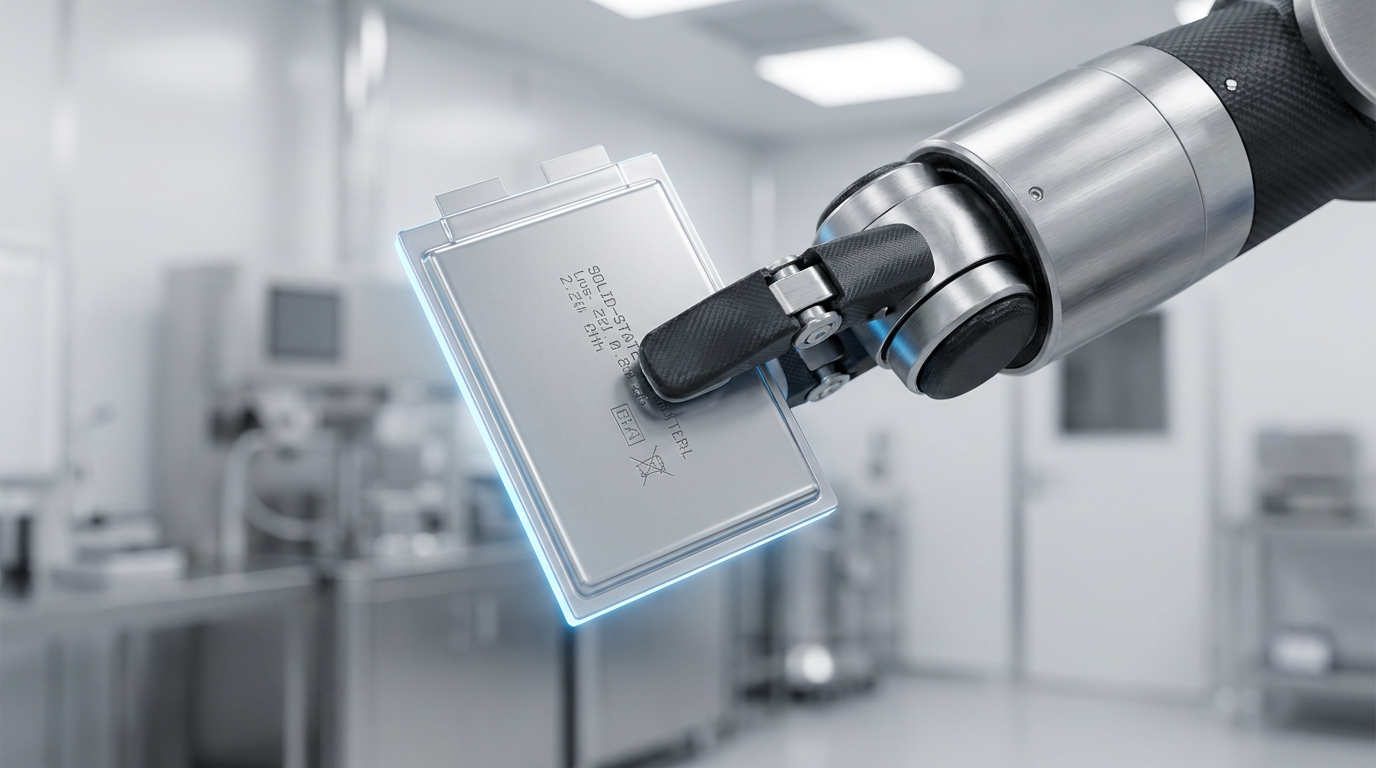
The shift from prototype to product was crystallized in early 2026 when QuantumScape, a California-based battery developer backed by Volkswagen, inaugurated its "Eagle Line" in San Jose. Company executives described the opening of the highly automated pilot facility as their "Kitty Hawk moment." After fifteen years of research and development, the facility is now churning out anode-free, lithium-metal cells designed for automotive integration. The Eagle Line serves as the blueprint for gigawatt-hour-scale manufacturing, proving that the notoriously difficult chemistry can actually be mass-produced.[1][2][8]
To understand why the industry is treating 2026 as a watershed moment, one must look inside the cell. Traditional lithium-ion batteries rely on a liquid electrolyte—a chemical soup that shuttles ions back and forth between the cathode and the anode as the battery charges and discharges. While effective, this liquid is inherently volatile and flammable. If the battery is punctured in a crash, overcharged, or exposed to extreme heat, the liquid can ignite, leading to a dangerous chain reaction known as thermal runaway. Solid-state batteries eliminate this vulnerability entirely by replacing the liquid with a solid material, typically a specialized ceramic, polymer, or sulfide glass.[7]

The safety implications of this architectural change are profound. Comparative testing shows that thermal events in solid-state systems do not begin until temperatures reach roughly 247°C, compared to just 90°C for conventional lithium-ion cells. Even when subjected to extreme abuse—such as needle penetration or severe extrusion—the solid electrolyte refuses to explode or catch fire. For consumers who have hesitated to adopt electric vehicles due to highly publicized, albeit rare, battery fires, the inherent stability of solid-state chemistry offers profound peace of mind. Furthermore, the solid material performs flawlessly in extreme cold, eliminating the frustrating range drops that plague current EVs during winter months.[7][8]
But safety is only half the equation; the true prize is energy density. Because the solid electrolyte is physically robust, it suppresses the formation of dendrites—microscopic, needle-like structures that grow inside liquid batteries and cause short circuits. This allows engineers to use pure lithium metal for the anode, drastically shrinking the battery's size and weight. Today's best lithium-ion batteries max out at around 200 to 300 watt-hours per kilogram (Wh/kg). The solid-state cells entering production in 2026 are targeting 400 to 600 Wh/kg. In practical terms, this means an automaker can double a vehicle's driving range without adding a single pound of weight, or maintain the current range while cutting the battery pack's size in half.[5][7]
But safety is only half the equation; the true prize is energy density.
This leap in density is accompanied by a transformation in charging speeds. Because solid electrolytes can handle massive influxes of current without degrading or overheating, the agonizing highway charging stop is poised to become a relic of the past. QuantumScape and its competitors are demonstrating cells that can safely charge from 10% to 80% in under ten minutes. At that speed, replenishing an EV battery takes roughly the same amount of time as filling a gas tank and grabbing a coffee, effectively neutralizing the last major logistical hurdle to mass EV adoption.[4][8]

While passenger cars are the ultimate prize, the first wave of solid-state technology is hitting the streets on two wheels. Because motorcycles have incredibly tight packaging constraints, they benefit disproportionately from lighter, denser batteries. In early 2026, Estonian startup Donut Lab partnered with Verge Motorcycles to deliver the world's first production two-wheeler powered by an all-solid-state battery, boasting a staggering 600-kilometer range. Similarly, QuantumScape and Volkswagen's PowerCo division recently completed a live demonstration of their solid-state cells powering a Ducati motorcycle, proving the technology's viability under the extreme power demands of high-performance riding.[2][6]
Meanwhile, a fierce geopolitical race is unfolding as China moves aggressively to dominate the solid-state era just as it did the lithium-ion generation. Chinese automaker Chery has announced plans to release its first solid-state EV in 2026, utilizing a novel polymer electrolyte cell that achieves 600 Wh/kg. Concurrently, Greater Bay Technology (GBT), backed by the GAC Group, rolled its first A-sample all-solid-state cells off the production line this year. GBT's cells have already passed rigorous safety testing and are slated for gigawatt-hour-level mass production by the end of 2026, signaling that Chinese manufacturers are not ceding any ground in the next-generation battery wars.[5][7]
Not to be outdone, legacy automotive giant Toyota is quietly executing its own solid-state master plan. After years of hybrid dominance, Toyota is ramping up its pure EV production, targeting one million units in 2026. A crucial pillar of this strategy is the domestic manufacturing of advanced solid-state cells in Japan. Toyota's roadmap promises a driving range exceeding 1,000 kilometers (621 miles) on a single charge, utilizing a proprietary bipolar structure. By securing approval from Japanese regulators to gradually implement production, Toyota is positioning itself to leapfrog competitors who remain tethered to incremental lithium-ion improvements.[4]

Despite the euphoria surrounding these 2026 milestones, the transition will not happen overnight. Manufacturing a solid electrolyte at scale requires microscopic precision; even a microscopic defect can compromise the cell's performance. QuantumScape's proprietary "Cobra process" and similar manufacturing innovations are designed to solve this exact problem, but scaling from a pilot line to a global supply chain is a monumental task. As a result, the first solid-state vehicles hitting the market in 2026 and 2027 will almost certainly be flagship luxury sedans and high-end sports cars, where premium pricing can absorb the initially high cost of the new cells.[2][4][8]
Beyond the automotive sector, the solid-state breakthrough carries significant implications for national security and global supply chains. Conventional lithium-ion batteries rely heavily on graphite anodes, a material whose supply chain is overwhelmingly controlled by China. By utilizing an anode-free, lithium-metal design, Western companies like QuantumScape are effectively bypassing the graphite bottleneck. This strategic advantage has already attracted the attention of the defense and aerospace sectors, which are eager to deploy the lightweight, non-flammable batteries in drones, unmanned ground vehicles, and AI data centers where safety and energy density are paramount.[3][6]

As 2026 unfolds, the electric vehicle industry stands at a technological inflection point. The conventional lithium-ion battery, which powered the first great wave of electrification, is rapidly approaching the top of its developmental S-curve. While liquid batteries will remain the workhorse of affordable EVs for years to come, the inauguration of solid-state production lines marks the beginning of a new paradigm. By finally solving the trilemma of range, charging speed, and safety, solid-state technology is no longer just a promise for the future—it is the reality rolling off the assembly line today.[3][7]
How we got here
1991
Sony commercializes the first lithium-ion battery, revolutionizing portable electronics.
2010s
Automakers adapt lithium-ion tech for the first mass-market EVs, but face limits on energy density and charging speed.
2020
QuantumScape goes public, promising a breakthrough in anode-free solid-state chemistry.
2023
Toyota announces a major pivot to EVs, centering its strategy on solid-state commercialization.
Feb 2026
QuantumScape inaugurates its Eagle Line pilot facility in San Jose.
Q1 2026
Verge Motorcycles delivers the first two-wheelers powered by solid-state batteries.
Viewpoints in depth
Battery Innovators
Startups argue that the lithium-ion S-curve has peaked, and anode-free solid-state is the only path to true energy abundance.
Companies like QuantumScape and Donut Lab believe that incremental improvements to liquid batteries are no longer sufficient to drive the next wave of EV adoption. By entirely redesigning the cell architecture to be anode-free and solid, they argue they are unlocking a fundamental paradigm shift. They point to their ability to bypass the Chinese-dominated graphite supply chain as a critical strategic advantage for Western markets, pitching their technology not just as a consumer upgrade, but as a matter of national energy security.
Legacy Automakers
Traditional car companies view solid-state as the silver bullet to finally overtake early EV pioneers.
For legacy giants like Toyota, solid-state technology represents an opportunity to leapfrog competitors who built their empires on lithium-ion. Rather than competing on incremental software updates, these automakers are focusing on hardware supremacy. By promising 1,000-kilometer ranges and 10-minute charge times, they aim to eliminate consumer range anxiety entirely, converting the massive demographic of buyers who have thus far refused to abandon internal combustion engines.
Chinese Manufacturers
Determined to maintain their global battery dominance by rapidly scaling polymer and oxide solid-state tech.
Chinese firms like Chery and Greater Bay Technology refuse to cede the next generation of energy storage to Western startups. Leveraging massive existing manufacturing infrastructure and state support, they are aggressively pushing their own solid-state designs from the lab to the factory floor. They argue that their ability to scale production quickly and cost-effectively will allow them to dominate the solid-state era just as thoroughly as they dominated the lithium-ion era.
Industry Skeptics
Caution that scaling microscopic precision to millions of vehicles without defects will take years.
While acknowledging the impressive lab results and pilot lines, manufacturing experts warn that building a few thousand flawless cells is vastly different from building billions. Because solid electrolytes are incredibly sensitive to microscopic defects during manufacturing, skeptics argue that yield rates will remain low and costs will remain astronomically high for the foreseeable future. They predict that while luxury buyers will enjoy the technology soon, the average consumer won't see a solid-state vehicle in their driveway until well into the 2030s.
What we don't know
- The exact price premium consumers will have to pay for the first generation of solid-state EVs.
- How quickly manufacturers can scale from gigawatt-hour pilot lines to the terawatt-hour scale needed for global adoption.
- Whether unforeseen degradation issues will emerge once the batteries are subjected to years of real-world driving.
Key terms
- Solid Electrolyte
- A solid material, such as ceramic or polymer, that conducts ions between a battery's cathode and anode without the fire risks of a liquid.
- Energy Density
- The amount of energy a battery can store relative to its weight, typically measured in watt-hours per kilogram (Wh/kg).
- Thermal Runaway
- A dangerous chain reaction in traditional batteries where overheating causes the liquid electrolyte to catch fire or explode.
- Dendrites
- Microscopic, needle-like metallic structures that can grow inside liquid batteries and cause short circuits.
- Anode-Free Design
- A battery architecture that manufactures the cell without a traditional anode, instead forming a pure lithium-metal anode dynamically during the first charge.
Frequently asked
What makes a solid-state battery different?
It replaces the volatile liquid chemical soup found in current batteries with a stable solid material, making it vastly safer and more energy-dense.
Will this make electric cars cheaper?
Not immediately. The first solid-state batteries will be expensive and reserved for luxury cars, but prices are expected to drop as manufacturing scales up.
Can I put a solid-state battery in my current EV?
No. The battery architecture, cooling systems, and software are entirely different, meaning they will only be available in newly designed vehicles.
Are they really fireproof?
While no energy storage device is perfectly invincible, solid-state batteries require temperatures hundreds of degrees higher than current batteries to experience thermal events, making them exceptionally safe.
Sources
Source coverage
8 outlets
4 viewpoints surfaced








[1]InsideEVsWestern Battery Innovators
QuantumScape's Solid-State Battery 'Eagle Line' Is Finally Here
Read on InsideEVs →[2]ElectrekWestern Battery Innovators
QuantumScape inaugurates Eagle Line pilot for solid-state battery production
Read on Electrek →[3]BatteryTech OnlineWestern Battery Innovators
QuantumScape CEO details commercialization strategy
Read on BatteryTech Online →[4]Green Car ReportsLegacy Automakers
Toyota to ramp up EV production, make solid-state batteries in Japan
Read on Green Car Reports →[5]NotebookCheckAsian Manufacturing Giants
Chery to beat Toyota to first solid-state battery EV in 2026
Read on NotebookCheck →[6]The American Ceramic SocietyAsian Manufacturing Giants
Superfluidized solid-state battery breakthrough marks ProLogium's 20th anniversary
Read on The American Ceramic Society →[7]To7MotorAsian Manufacturing Giants
Solid-state batteries are no longer simply lab experiments
Read on To7Motor →[8]QuantumScape OfficialWestern Battery Innovators
QuantumScape Inaugurates Eagle Line for Solid-State Battery Production
Read on QuantumScape Official →
Every angle. Every day.
Get technology stories with full source coverage and perspective breakdowns delivered to your inbox.