
How Self-Driving Labs Are Automating Scientific Discovery
By merging artificial intelligence with advanced robotics, 'self-driving labs' are executing closed-loop experiments 24/7, promising to cut the time and cost of discovering new drugs and materials by up to 90%.
By Factlen Editorial Team
- Academic Researchers
- Scientists view SDLs as tools to eliminate tedious manual labor and accelerate breakthroughs.
- Biotech & Pharma Industry
- Commercial entities are focused on the massive cost savings and speed-to-market advantages.
- AI & Robotics Developers
- Engineers focus on the technical challenges of protocol translation and hardware-software integration.
- Bioethics & Policy Experts
- Legal and ethical scholars warn that AI-driven science outpaces current IP and safety regulations.
What's not represented
- · Traditional Lab Technicians
- · Open-Source Hardware Advocates
Why this matters
The traditional scientific method is slow and expensive, often taking a decade to bring a new material or drug to market. Self-driving labs remove the physical bottlenecks of human labor, accelerating breakthroughs in clean energy, medicine, and advanced manufacturing that will directly impact consumer technology and healthcare.
Key points
- Self-driving labs (SDLs) combine AI decision-making with robotic execution to automate the entire scientific method.
- These systems operate in a closed loop, instantly analyzing experimental results to design the next test without human intervention.
- Researchers aim to use SDLs to reduce the time and cost of discovering new materials and drugs by a factor of ten.
- The technology is rapidly advancing in materials science and pharmaceuticals, though challenges remain in translating human protocols into machine code.
- The rise of autonomous science has sparked legal debates over whether AI-generated discoveries can be patented under current laws.
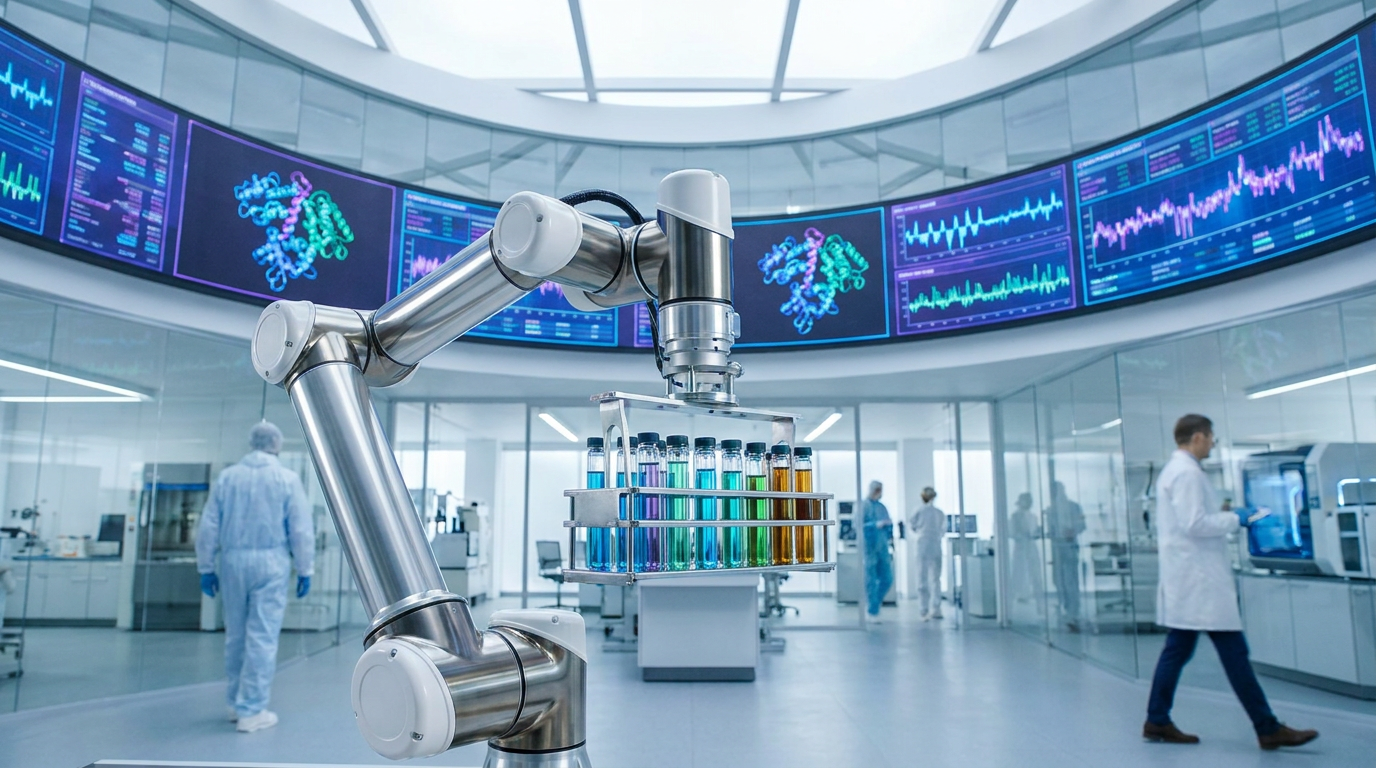
For centuries, the image of scientific discovery has been intrinsically linked to human hands: a researcher carefully pipetting liquids, adjusting microscopes, or mixing compounds in a fume hood. But in a growing number of research facilities, the lights are off, the humans are asleep, and the science is moving faster than ever. Welcome to the era of the "self-driving lab" (SDL), a paradigm shift where artificial intelligence doesn't just analyze data—it physically conducts the experiments.[1]
A self-driving lab is an autonomous experimentation platform that merges robotics, AI-driven decision engines, and comprehensive data pipelines. Unlike traditional automation, which simply repeats a pre-programmed physical task, an SDL operates on a "closed-loop" system. It designs an experiment, directs robotic hardware to execute it, analyzes the results in real-time, and uses that data to formulate the next hypothesis without requiring human intervention.[1][2]
The motivation behind this technological leap is simple: traditional scientific discovery is painstakingly slow and prohibitively expensive. In materials science, discovering a new functional material—such as a more efficient battery component or a novel solar cell—can take an estimated ten years and cost $10 million, relying heavily on trial-and-error screening. Researchers aim to use SDLs to reduce both the time and financial cost by a factor of ten, bringing the timeline down to a single year and the cost to $1 million.[2]
The architecture of a self-driving lab relies on four distinct pillars working in continuous harmony. The first is the algorithmic brain, typically powered by active learning or Bayesian optimization models. Instead of running thousands of random tests, the AI analyzes massive datasets of molecular structures to predict the most promising candidates, effectively narrowing the search space before any physical chemicals are mixed.[1][4]

The second pillar is the physical hardware. Once the AI selects a candidate, it sends instructions to an array of automated liquid handlers, robotic arms, and precision synthesizers. These machines physically execute the experiment, mixing reagents, heating compounds, or culturing cells with a level of precision and reproducibility that human hands struggle to match.[1][5]
The third step is in-line analysis. As the physical experiment concludes, integrated characterization tools—such as spectrometers or computer vision systems—immediately measure the properties of the newly synthesized material or molecule. There is no waiting for a technician to move a sample from one machine to another; the data is captured instantly and fed directly back into the system.[1][2]
Finally, the loop closes. The AI digests the fresh experimental data, compares it against its initial predictions, updates its internal models, and instantly designs the next experiment to push the results closer to the target goal. This cycle repeats continuously, 24 hours a day, iterating at a speed that fundamentally upends the traditional pace of research.[1][6]
This cycle repeats continuously, 24 hours a day, iterating at a speed that fundamentally upends the traditional pace of research.
The impact of this closed-loop approach is already being felt across multiple disciplines, with materials science leading the charge. At the University of Toronto's Acceleration Consortium, researchers are utilizing SDLs to explore high-entropy alloys, metallic glasses, and advanced ceramics. By integrating AI with automated synthesis, they are accelerating the discovery of novel fabrication strategies that could revolutionize energy storage and advanced manufacturing.[2]

The pharmaceutical industry is also aggressively adopting physical AI to overhaul drug discovery. Traditional drug development is notorious for its high failure rates and decade-long timelines. By integrating advanced AI models into self-driving virtual screening and experimental workflows, researchers can rapidly test biomolecular interactions. Companies like Atinary Technologies are partnering with major pharmaceutical firms to deploy these platforms, aiming to discover breakthrough molecules exponentially faster.[4][5]
Despite the rapid progress, building a fully autonomous lab presents immense technical hurdles. One of the most significant bottlenecks is "protocol translation." For decades, experimental protocols have been written in natural language for human comprehension, full of tacit knowledge and subtle physical cues. Translating these human-centric instructions into structured, machine-executable code that a robotic arm can understand requires complex software orchestration and expert-level semantic mapping.[4]
To categorize the progress of these systems, researchers have adopted an autonomy scale similar to that used for self-driving cars. Level 0 represents entirely manual science, while Level 1 involves basic robotic assistance. Today's most advanced SDLs operate at Level 3: they are "conditionally autonomous," capable of performing multiple cycles of the scientific method and learning from previous results, but still requiring human intervention for anomalous edge cases. The ultimate goal is Level 4, where the system acts as a highly skilled, fully independent lab assistant.[1]

As SDL technology matures, it is giving rise to the "cloud lab" model. In this framework, scientists do not need to purchase millions of dollars worth of robotics for their own facilities. Instead, they can write experimental code from their laptops and send it to a centralized, subscription-based autonomous facility. This democratizes access to cutting-edge research, allowing a brilliant chemist with a small budget to execute massive, high-throughput experiments remotely.[1][6]
However, the rise of autonomous science brings profound ethical and legal questions. If an AI system independently designs, executes, and validates the discovery of a highly lucrative new drug or material, who owns the intellectual property? Current patent laws across the globe generally recognize only human inventors. If AI-generated inventions remain unpatentable, it could severely constrain commercial funding for SDL development.[1]
There are also valid concerns regarding safety and dual-use risks. An autonomous system capable of rapidly synthesizing novel chemical compounds or biological agents could, in theory, be directed to optimize toxins or pathogens. Experts stress that the proliferation of SDLs must be accompanied by robust cybersecurity measures, strict access controls, and ultimate human accountability to ensure these powerful tools are used safely.[1]
For the scientists themselves, the advent of the self-driving lab is not a threat of replacement, but an elevation of their role. Dr. Milad Abolhasani, a leading researcher in the field, describes SDLs as "robotic co-pilots." They are designed to strip away the tedious, repetitive tasks of manual pipetting and data entry, freeing human researchers to focus on high-level creativity, complex problem-solving, and the ethical application of new discoveries.[3]
The transition from manual experimentation to autonomous, AI-driven laboratories represents one of the most significant leaps in the history of the scientific method. By merging the digital intelligence of machine learning with the physical capability of advanced robotics, self-driving labs are transforming science from a reactive, resource-limited endeavor into a proactive, scalable engine of discovery.[1][6]
How we got here
1982
The first Level-3 conditionally autonomous system for post-reaction chemical separation is reported.
Early 2010s
Advances in machine learning and liquid-handling robotics begin to merge, laying the groundwork for modern autonomous labs.
2023
The University of Toronto secures a $200 million grant to develop self-driving labs through its Acceleration Consortium.
2025-2026
Major pharmaceutical companies begin integrating physical AI and self-driving platforms into their commercial drug discovery pipelines.
Viewpoints in depth
Academic Researchers
Scientists view SDLs as tools to eliminate tedious manual labor and accelerate breakthroughs.
For academic labs, the primary appeal of autonomous systems is the massive increase in throughput and reproducibility. Researchers argue that human hands are inherently prone to error and fatigue, limiting the scale of experimentation. By offloading the physical pipetting and data entry to robots, scientists can focus entirely on high-level hypothesis generation and complex problem-solving, effectively acting as 'co-pilots' to the AI.
Biotech & Pharma Industry
Commercial entities are focused on the massive cost savings and speed-to-market advantages.
In the pharmaceutical sector, bringing a single drug to market can take over a decade and cost billions, with a high rate of failure in the physical testing phases. Industry leaders view self-driving labs as a way to bridge the gap between virtual AI screening and physical validation. By automating the synthesis and testing of drug candidates, companies hope to drastically reduce the time spent on dead-end compounds, fundamentally altering the economics of drug development.
Bioethics & Policy Experts
Legal and ethical scholars warn that AI-driven science outpaces current regulations.
As AI systems begin to independently design and validate new molecules, policy experts are raising alarms about intellectual property. Current global patent laws require a human inventor, creating a legal gray area for materials discovered entirely by an autonomous loop. Furthermore, security experts warn of dual-use risks: the same automated system that can rapidly optimize a life-saving drug could, in the wrong hands, be used to synthesize dangerous pathogens or toxins, necessitating strict cybersecurity controls.
What we don't know
- How global patent offices will ultimately rule on intellectual property generated entirely by autonomous AI systems.
- Whether the high upfront costs of building self-driving labs will limit their use to wealthy institutions and corporations.
- How quickly regulatory bodies like the FDA will adapt to validate drugs discovered and synthesized through continuous, closed-loop AI processes.
Key terms
- Self-Driving Lab (SDL)
- An autonomous experimentation platform where AI and robotics continuously design, execute, and learn from scientific experiments.
- Closed-Loop Experimentation
- A continuous cycle where the results of a physical experiment are immediately fed back into an AI model to design the next experiment.
- Bayesian Optimization
- A mathematical strategy used by AI to find the most effective experimental conditions using the fewest number of tests.
- Protocol Translation
- The complex process of converting human-written scientific instructions into structured code that robotic hardware can execute.
- High-Throughput Experimentation
- The use of automation to conduct hundreds or thousands of scientific tests simultaneously.
Frequently asked
What exactly is a self-driving lab?
A self-driving lab is an autonomous system that combines AI and robotics to run scientific experiments. The AI designs the experiment, robots execute it, sensors analyze the results, and the AI uses that data to plan the next test without human help.
Will these labs replace human scientists?
No. Experts describe self-driving labs as 'robotic co-pilots.' They handle the tedious, repetitive physical tasks, freeing human scientists to focus on creative problem-solving and high-level experimental design.
What is a 'cloud lab'?
A cloud lab is a centralized, highly automated laboratory that researchers can access remotely over the internet. Scientists write experimental code on their computers and send it to the cloud lab, which physically executes the experiment and sends the data back.
Who owns the patent if an AI discovers a new material?
This is currently a major legal debate. Most global patent laws require a human inventor, meaning inventions generated entirely by an autonomous AI system exist in a legal gray area that could complicate commercial funding.
Sources
Source coverage
6 outlets
4 viewpoints surfaced






[1]Royal Society PublishingBioethics & Policy Experts
Autonomous, 'self-driving' laboratories
Read on Royal Society Publishing →[2]University of TorontoAcademic Researchers
AI for Discovery and Self-Driving Labs
Read on University of Toronto →[3]NC State UniversityAcademic Researchers
Science acceleration and accessibility with self-driving labs
Read on NC State University →[4]arXivAI & Robotics Developers
Expert-level protocol translation for self-driving labs
Read on arXiv →[5]Atinary TechnologiesBiotech & Pharma Industry
AI's Next Frontier: Physical AI in the Lab
Read on Atinary Technologies →[6]Factlen Editorial TeamAcademic Researchers
Synthesis by Factlen editorial team
Read on Factlen Editorial Team →


Every angle. Every day.
Get ai stories with full source coverage and perspective breakdowns delivered to your inbox.