
How Local AI Tools Are Running on Everyday Laptops
Advances in model compression and dedicated neural hardware are allowing powerful AI tools to run entirely offline on consumer laptops. This shift offers users unprecedented privacy, zero subscription fees, and offline capabilities without relying on cloud servers.
By Factlen Editorial Team

- Hardware & Tech Industry
- Focus on the performance benchmarks and the commercial push to upgrade consumers to a new generation of 'AI PCs' equipped with NPUs.
- Privacy & Security Advocates
- View local AI as the only secure way to utilize language models without exposing sensitive personal or corporate data to third-party servers.
- Open-Source AI Community
- Champion local models as a way to democratize artificial intelligence and prevent a few massive tech monopolies from controlling the technology.
What's not represented
- · Cloud AI Providers
- · Everyday Non-Technical Consumers
Why this matters
Running AI locally means your sensitive data—like financial documents, personal emails, or proprietary code—never leaves your machine. It also eliminates the need for expensive monthly subscriptions and constant internet connectivity, democratizing access to powerful computing tools.
Key points
- Advances in quantization allow massive AI models to be compressed and run on standard 16GB laptops.
- Dedicated Neural Processing Units (NPUs) handle AI math efficiently without draining battery life.
- Local AI ensures 100% data privacy, as prompts and documents never leave the user's device.
- Running models locally eliminates the need for monthly subscriptions to cloud AI providers.
- User-friendly apps like LM Studio and Ollama have made local AI accessible to non-programmers.
The era of cloud-only artificial intelligence is quietly ending. For the past few years, using a powerful language model meant sending your prompts, documents, and private data to massive server farms owned by tech giants. Today, a quiet revolution in both software optimization and consumer hardware has brought that immense computational power directly to everyday laptops and desktops.[1]
This shift from cloud to local computing represents one of the most significant democratizations of technology in the 2020s. Instead of paying monthly subscription fees or worrying about data privacy policies, users are downloading highly capable language models and running them entirely offline. The result is a faster, more private, and significantly cheaper way to interact with artificial intelligence.[3]
The foundation of this hardware shift is a new piece of silicon known as the Neural Processing Unit, or NPU. While Central Processing Units (CPUs) handle general computing tasks and Graphics Processing Units (GPUs) render visuals, NPUs are purpose-built for the specific matrix-math operations required by neural networks. They are designed to do one thing incredibly efficiently.[4]
By offloading AI tasks to the NPU, modern laptops can run complex models without draining the battery in an hour or spinning up loud cooling fans. The industry standard for these "AI PCs" now demands at least 40 Tera Operations Per Second (TOPS) from the NPU alone, ensuring that local models can generate text as fast as a user can read it.[1][4]
But hardware is only half the story. The true breakthrough that made local AI possible is a software technique called quantization. Large Language Models are essentially massive collections of numbers, or "weights," which traditionally require vast amounts of memory to store. A standard model might require 30 to 40 gigabytes of RAM, far more than a typical consumer laptop possesses.[2]
Quantization compresses these models by reducing the precision of those numbers. Think of it like converting a massive, uncompressed RAW photograph into a smaller JPEG file; you lose a tiny bit of pixel-perfect detail, but the image still looks virtually identical to the human eye. In the AI world, this means rounding off long decimal numbers to save space.[2][6]
Quantization compresses these models by reducing the precision of those numbers.
By shrinking models from 16-bit precision down to 4-bit precision, developers have managed to fit models with billions of parameters into the standard 16 gigabytes of RAM found in typical consumer laptops. Remarkably, research shows that this drastic compression results in only a negligible drop in the model's actual reasoning and writing capabilities.[6]
Standardized file formats, most notably GGUF, have made these compressed models incredibly easy to distribute and run. Users no longer need to be Python developers or machine learning engineers to use local AI; they simply download a single file and load it into a user-friendly application, much like opening a document in a word processor.[5]
Applications like LM Studio, Ollama, and GPT4All have emerged as the "web browsers" of the local AI movement. These tools provide clean, intuitive chat interfaces that look exactly like popular cloud-based chatbots, completely masking the complex engineering happening under the hood. They allow users to swap between different models with a single click.[1][5]
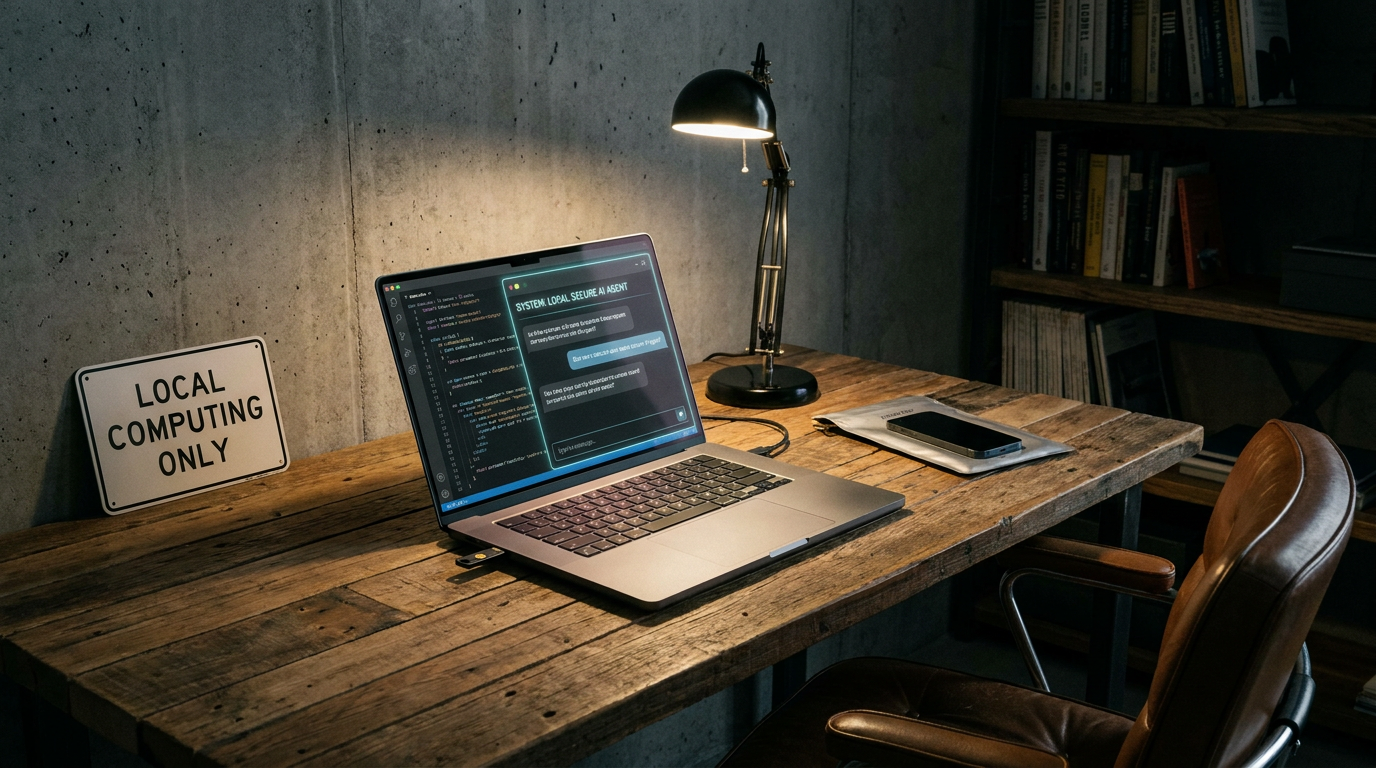
For professionals handling sensitive information, this offline capability is a game-changer. Lawyers summarizing case files, doctors organizing patient notes, and journalists analyzing leaked documents can now use AI assistance with zero risk of their data being intercepted, hacked, or used to train future commercial models by large tech companies.[3]

Beyond privacy, the financial incentives are driving massive consumer adoption. Once a user purchases a capable laptop, the cost of generating text, writing code, or summarizing documents drops to absolute zero. This frees consumers, students, and small businesses from compounding monthly software subscriptions that can quickly add up to hundreds of dollars a year.[1]
This ecosystem is fueled by a vibrant open-source community centered around platforms like Hugging Face. When researchers release a new open-weight model, the community immediately quantizes it, optimizes it for different hardware architectures, and makes it available for anyone to download within hours of its initial release.[5]
Despite these massive leaps, local AI is not without its limitations. While a laptop can easily draft emails, summarize PDFs, or help write code, it lacks the sheer computational brute force required for highly complex reasoning, advanced mathematics, or maintaining massive context windows over hundreds of pages of text.[6]

The future of personal computing is likely a hybrid approach. Everyday tasks, drafting, and sensitive data processing will happen instantly and privately on the local NPU, while the operating system seamlessly routes only the most complex, demanding queries to the cloud. For now, the ability to carry a world-class AI in a backpack without an internet connection remains one of tech's most empowering new realities.[1][4]
How we got here
Early 2023
The leak of Meta's LLaMA model sparks the open-source local AI movement.
Late 2023
The GGUF format standardizes how compressed models are distributed and run.
2024
The first wave of consumer 'AI PCs' featuring dedicated NPUs hits the market.
2025
Open-source local models begin rivaling proprietary cloud models in benchmark tests.
2026
Local AI execution becomes a baseline expectation for modern consumer laptops.
Viewpoints in depth
Privacy & Security Advocates
Champion local AI as the only secure way to utilize language models without exposing sensitive data.
For privacy advocates, the cloud-based AI model is fundamentally flawed because it requires users to hand over their most sensitive data—proprietary code, legal documents, and personal thoughts—to third-party servers. They argue that local AI is the only way to truly secure the benefits of artificial intelligence in fields like healthcare, journalism, and law. By keeping the compute strictly on-device, users eliminate the risk of data breaches, unauthorized training on personal data, and surveillance.
Hardware & Tech Industry
Focus on the performance benchmarks and the commercial push to upgrade consumers to a new generation of hardware.
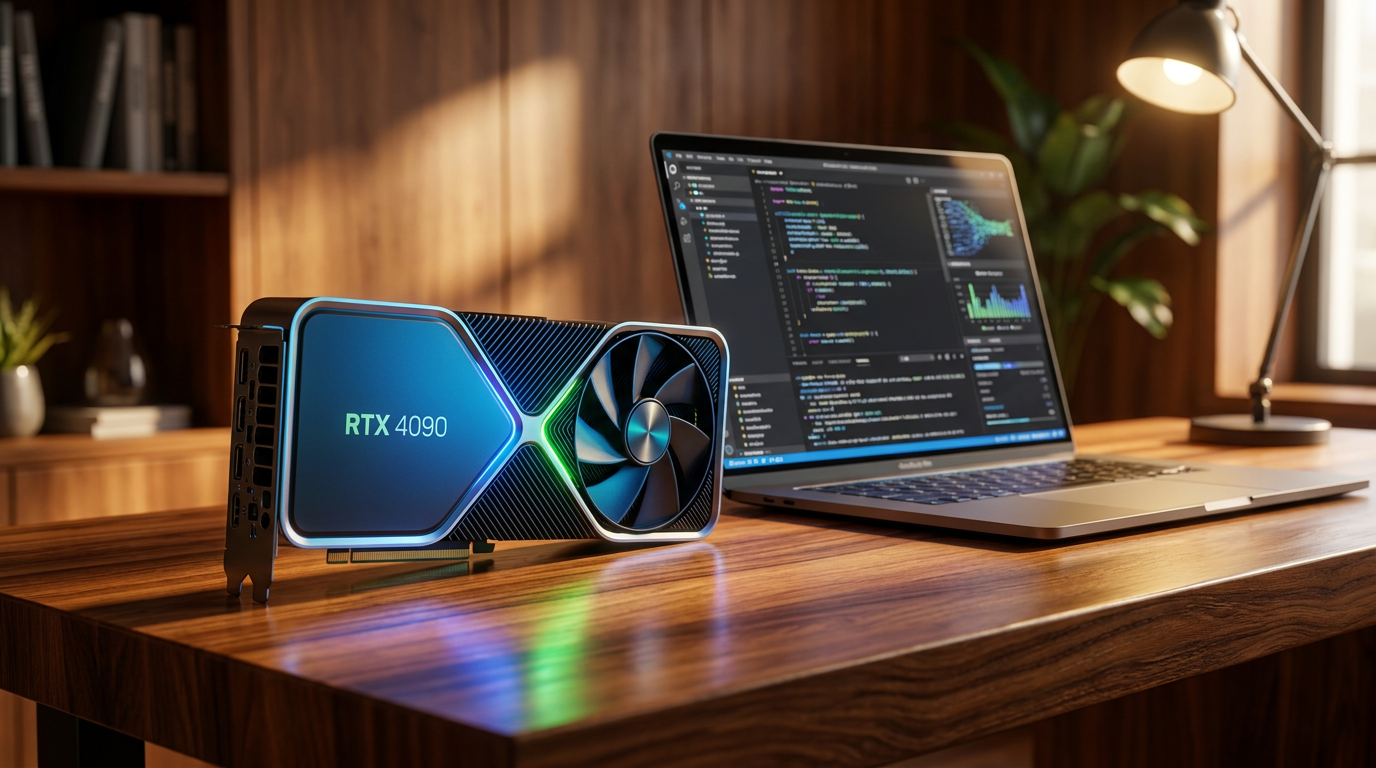
Hardware manufacturers and tech analysts view the local AI movement as the catalyst for the biggest PC upgrade supercycle in a decade. Their focus is on the rapid advancement of Neural Processing Units (NPUs) and hitting performance benchmarks like 40+ TOPS. For this camp, the narrative is about efficiency, battery life, and selling consumers on the idea that a laptop without dedicated AI silicon is fundamentally obsolete in the modern computing landscape.
Open-Source AI Community
Champion local models as a way to democratize artificial intelligence away from big tech monopolies.
The open-source community sees local AI as a necessary counterweight to the massive tech monopolies that control cloud-based models. They argue that if AI is to be the next major computing platform, its foundational models must be open, inspectable, and runnable by anyone, regardless of their budget. This camp focuses heavily on optimizing quantization techniques and building user-friendly tools that lower the barrier to entry for everyday users.
What we don't know
- Whether local models will eventually hit a hard ceiling in reasoning capabilities compared to massive cloud clusters.
- How quickly software demands will outpace the NPUs currently shipping in 2026 laptops.
Key terms
- NPU (Neural Processing Unit)
- A specialized hardware chip designed specifically to handle the complex mathematical operations required by artificial intelligence efficiently.
- Quantization
- A software compression technique that reduces the memory size of an AI model by lowering the precision of its internal numbers, allowing it to run on consumer hardware.
- TOPS (Tera Operations Per Second)
- A metric used to measure the performance of an NPU, representing how many trillions of mathematical operations the chip can perform in one second.
- GGUF
- A popular, standardized file format that packages an entire compressed AI model into a single file, making it easy to download and run locally.
Frequently asked
Do I need an internet connection to use local AI?
No. Once you download the model file and the application to run it, the AI operates entirely offline on your device's hardware.
Is local AI as smart as cloud models like ChatGPT?
While highly capable for drafting, summarizing, and coding, local models generally have smaller context windows and less advanced reasoning capabilities than massive cloud-based models.
What kind of computer do I need to run these models?
Most modern laptops with at least 16GB of RAM can run quantized models. Newer 'AI PCs' with dedicated Neural Processing Units (NPUs) will run them much faster and with better battery life.
Sources
Source coverage
6 outlets
3 viewpoints surfaced






[1]The VergeHardware & Tech Industry
The era of the AI PC is finally here, and it's entirely offline
Read on The Verge →[2]Ars TechnicaOpen-Source AI Community
How quantization makes massive LLMs fit on your laptop
Read on Ars Technica →[3]WiredPrivacy & Security Advocates
Why privacy advocates are championing the local AI movement
Read on Wired →[4]Tom's HardwareHardware & Tech Industry
Benchmarking the latest NPUs for local AI workloads
Read on Tom's Hardware →[5]Hugging FaceOpen-Source AI Community
The state of open-source local models in 2026
Read on Hugging Face →[6]arXivOpen-Source AI Community
Advances in Low-Bit Quantization for Large Language Models
Read on arXiv →

Every angle. Every day.
Get ai stories with full source coverage and perspective breakdowns delivered to your inbox.