
Trump Signs $70 Billion 'Secure America Act,' Guaranteeing ICE and CBP Funding Through 2029
President Trump has signed a $70 billion budget reconciliation package that fully funds federal immigration enforcement through the end of his term, bypassing Democratic demands for operational reforms.
By Factlen Editorial Team
- Federal Administration & Enforcement Backers
- Supporters argue the funding is essential to secure the border and end political obstruction.
- Oversight Advocates & Democrats
- Opponents view the legislation as a dangerous blank check that ignores recent civil rights abuses.
- Human Rights & Faith Organizations
- Advocates warn the lack of guardrails will lead to increased abuses and inhumane detention conditions.
- Municipal & Sanctuary Leaders
- Local officials oppose the explicit financial targeting of cities that refuse to cooperate with federal agents.
What's not represented
- · Rank-and-file ICE and CBP agents
- · Undocumented immigrants currently navigating the legal system
Why this matters
By securing ICE and CBP funding through 2029 via budget reconciliation, the administration has insulated its immigration enforcement agenda from future congressional standoffs. The law also explicitly directs hundreds of millions of dollars toward operations in 'sanctuary' cities that limit cooperation with federal authorities.
Key points
- President Trump signed the $70 billion Secure America Act, funding ICE and CBP through FY2029.
- The legislation was passed via budget reconciliation, allowing Republicans to bypass the Senate filibuster.
- ICE receives $38.5 billion, while Customs and Border Protection receives $22.6 billion.
- The bill includes $350 million specifically for ICE operations in 'sanctuary' jurisdictions that limit federal cooperation.
- Democrats and human rights groups strongly opposed the bill, citing a lack of oversight following recent deaths during ICE operations.
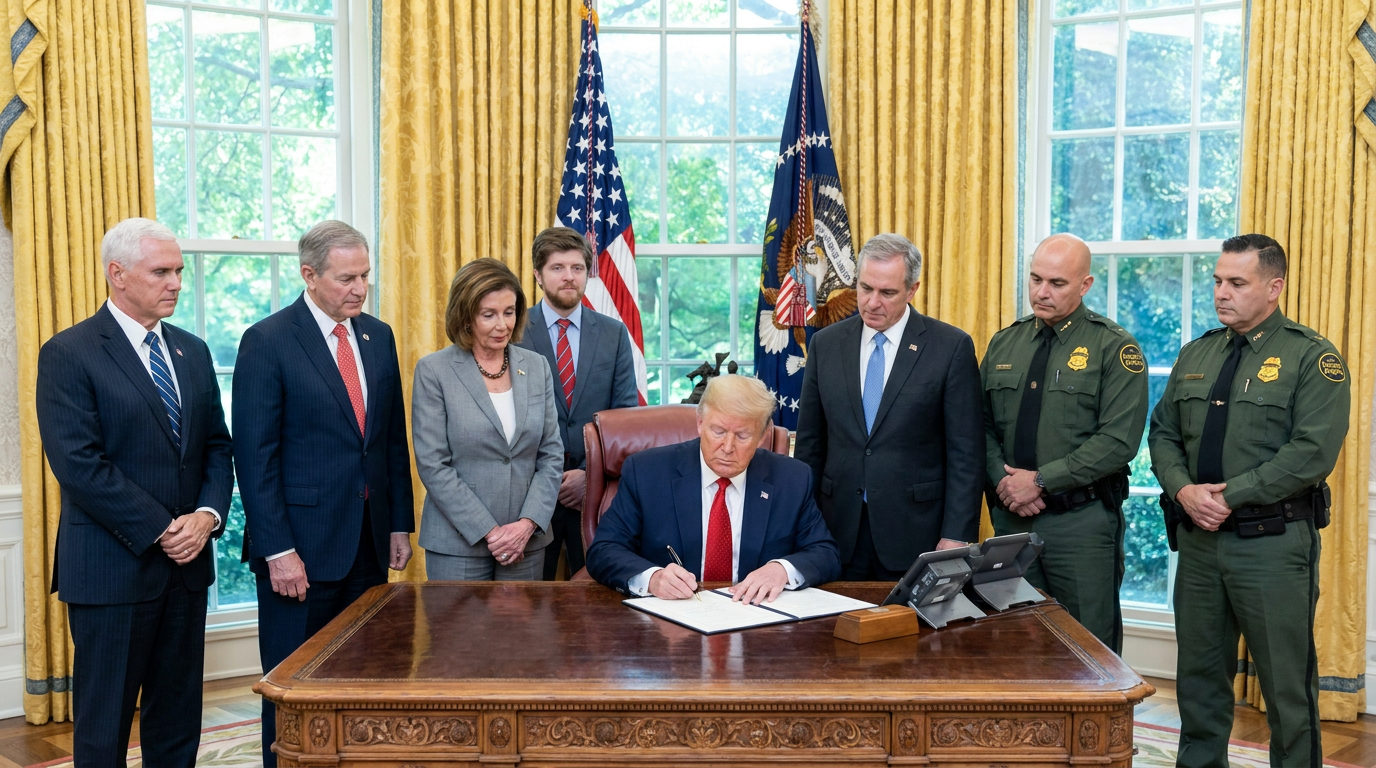
President Donald Trump has signed the Secure America Act, a massive $70 billion budget reconciliation package that guarantees funding for U.S. immigration enforcement agencies through the end of his term in 2029. The legislation effectively insulates the administration's border and interior enforcement agenda from future congressional standoffs, securing unprecedented financial resources for federal agents without the need for annual appropriations fights. The Oval Office signing marks the definitive end of a bitter legislative battle over immigration policy that previously triggered a partial shutdown of the Department of Homeland Security earlier this year.[1][2]
The bill's passage represents a significant procedural victory for congressional Republicans. By utilizing the budget reconciliation process—a legislative maneuver designed for spending and revenue measures—GOP leadership successfully bypassed the Senate's standard 60-vote filibuster threshold. This allowed the funding package to clear the upper chamber in a 52-47 vote on June 5, with only a simple majority required. Days later, on June 9, the House of Representatives narrowly approved the measure in a 214-212 vote that fell almost entirely along party lines, paving the way for the president's signature.[6]
The financial scope of the Secure America Act is unprecedented for a standalone enforcement package. The law allocates $38.5 billion directly to Immigration and Customs Enforcement (ICE) to hire, train, and deploy new personnel, including $7 billion earmarked specifically for Homeland Security Investigations agents. Meanwhile, Customs and Border Protection (CBP) will receive $22.6 billion to expand its ranks of border agents and support staff. An additional $3.5 billion is dedicated to deploying new surveillance technology, drones, and digital systems along the border, while $5 billion remains available for discretionary spending by the Homeland Security Secretary.[2][6]

This new wave of funding arrives on the heels of the $170 billion 'One Big Beautiful Bill Act' passed in the summer of 2025. Combined, the two legislative packages have fundamentally transformed the financial landscape of federal immigration enforcement. ICE, which historically operated on an annual budget of roughly $10 billion, is now the most heavily funded law enforcement agency within the federal government. The guaranteed funding stream through fiscal year 2029 ensures that the agencies can execute long-term strategic operations without the looming threat of budget cuts or continuing resolutions.[2]
Beyond general border security, the legislation takes direct aim at 'sanctuary' jurisdictions across the United States. The bill explicitly carves out $350 million for targeted interior enforcement operations in cities and states that refuse to sign 287(g) agreements. These agreements are federal partnerships that authorize local and state police officers to act as designated immigration deputies. By directing funds specifically toward non-cooperating areas, the federal government is signaling a highly aggressive posture toward municipalities that limit their communication and collaboration with federal immigration authorities.[3]
Beyond general border security, the legislation takes direct aim at 'sanctuary' jurisdictions across the United States.
For the administration and its congressional allies, the bill represents a definitive victory over Democratic resistance. House Speaker Mike Johnson celebrated the final vote as the end of the 'Democrat Department of Homeland Security shutdown,' arguing that the opposition can no longer 'take hostage' border security funding to force policy changes. Republican lawmakers have consistently argued that the funding is desperately needed to maintain order at the southern border and to support the agents tasked with enforcing the nation's complex immigration laws.[2][8]
During the Oval Office signing ceremony, President Trump framed the legislation as a necessary and urgent step to 'protect our homeland' and dismantle international criminal cartels. He praised federal immigration agents as 'heroes' who require unwavering federal support to execute their duties safely and effectively. The president also used the occasion to accuse congressional Democrats of attempting to 'throw open the borders' by previously blocking DHS appropriations, reiterating his commitment to removing undocumented immigrants with criminal records from the country.[1][8]
Democratic opposition to the massive funding package was deeply rooted in recent, highly publicized controversies surrounding federal enforcement tactics. Earlier in 2026, the deaths of two U.S. citizens—Alex Pretti and Renee Good—during federal immigration actions in Minneapolis sparked widespread public outrage and intense media scrutiny. Those tragic incidents prompted Democratic lawmakers to initiate a strict blockade on DHS funding, demanding that any new financial resources be tied directly to comprehensive operational reforms, increased transparency, and stricter independent oversight of federal agents operating in domestic communities.[2][5]

In response to the Minneapolis incidents, Democrats and civil rights groups demanded strict operational guardrails be codified into law. Their proposed reforms included absolute bans on racial profiling, severe restrictions on the use of masked or unidentified agents during neighborhood raids, and strict requirements for judicial warrants before agents could enter private property. However, because the Secure America Act was passed via budget reconciliation, it focused exclusively on funding allocations. None of the demanded civil rights reforms or accountability measures made it into the final legislative text.[4]
Immigration advocates and human rights organizations have strongly condemned the legislation, characterizing the $70 billion package as a dangerous 'blank check' that strips away essential oversight. Groups like Human Rights Watch and the American Immigration Council warn that flooding the agencies with unprecedented cash while actively ignoring accountability measures will inevitably lead to increased civil rights violations. Advocates predict a sharp rise in aggressive neighborhood sweeps, racial profiling incidents, and deteriorating conditions within the nation's rapidly expanding network of immigration detention centers.[3][4][7]

Municipal leaders are already bracing for the practical impact of the targeted interior enforcement funds. The U.S. Conference of Mayors issued a statement expressing 'deep concern' over the unprecedented expansion of federal operations within city limits. Officials in prominent sanctuary cities, including Portland Mayor Keith Wilson, have publicly vowed to maintain their policies of non-cooperation despite the looming threat of intensified federal raids. These local leaders argue that entangling local police in federal immigration disputes fundamentally erodes trust between immigrant communities and the law enforcement agencies sworn to protect them.[3]
With funding securely locked in through September 2029, the administration faces no immediate financial or legislative hurdles in executing its comprehensive immigration strategy. Border Czar Tom Homan signaled the administration's aggressive intent shortly after the bill's passage, promising that federal authorities will 'keep our foot on the gas and keep moving forward' with nationwide enforcement operations. As the new fiscal realities take hold, the battle over immigration enforcement will likely shift from the halls of Congress to federal courtrooms and the streets of America's sanctuary cities.[3]
How we got here
Summer 2025
Congress passes the $170 billion 'One Big Beautiful Bill Act,' significantly expanding the baseline budget for the Department of Homeland Security.
Early 2026
The deaths of two U.S. citizens during federal immigration actions in Minneapolis prompt Democrats to demand strict operational reforms for ICE.
January 2026
A partisan standoff over immigration enforcement oversight leads to a partial shutdown of the Department of Homeland Security.
June 5, 2026
The Senate passes the Secure America Act 52-47 using the budget reconciliation process.
June 9, 2026
The House passes the bill 214-212 along party lines, sending it to the president's desk.
June 10, 2026
President Trump signs the legislation into law, securing ICE and CBP funding through 2029.
Viewpoints in depth
Administration & Enforcement Backers
Supporters argue the funding is essential to secure the border and end political obstruction.
For the administration and its congressional allies, the Secure America Act is a necessary corrective to what they view as dangerous Democratic obstruction. Proponents argue that fully funding ICE and CBP through 2029 ensures that federal law enforcement can operate without the constant threat of government shutdowns or budget shortfalls. They emphasize that the resources will be used to combat human trafficking, dismantle criminal cartels, and remove undocumented immigrants with criminal records from the country.
Oversight Advocates & Democrats
Opponents view the legislation as a dangerous blank check that ignores recent civil rights abuses.
Congressional Democrats and civil rights organizations argue that flooding immigration enforcement agencies with $70 billion without implementing operational guardrails is deeply irresponsible. Pointing to the recent deaths of U.S. citizens during federal raids in Minneapolis, they argue that ICE and CBP require strict oversight, including bans on racial profiling and mandates for judicial warrants. They view the reconciliation package as an endorsement of aggressive, unchecked interior enforcement.
Sanctuary Jurisdictions
Local leaders are bracing for intensified federal operations in their communities.
Mayors and local officials in sanctuary jurisdictions are highly alarmed by the $350 million explicitly earmarked for operations in areas that refuse to sign 287(g) agreements. These leaders argue that local police should not act as federal immigration deputies, as it erodes trust between immigrant communities and local law enforcement. They view the targeted funding as a punitive measure designed to force compliance through the threat of intensified federal raids.
What we don't know
- How aggressively federal agents will deploy the $350 million earmarked specifically for operations in non-cooperating sanctuary cities.
- Whether civil rights organizations will successfully mount legal challenges to halt the targeted interior enforcement provisions.
- How the massive influx of funding will practically alter the daily operations and detention capacity of ICE over the next three years.
Key terms
- Budget Reconciliation
- A legislative process that expedites the passage of certain tax and spending bills by allowing them to pass the Senate with a simple majority, bypassing the 60-vote filibuster.
- 287(g) Agreement
- A federal program that delegates specific immigration enforcement authority to state and local law enforcement agencies.
- Sanctuary Jurisdiction
- A city, county, or state that limits its cooperation with federal immigration enforcement agents, often by refusing to hold individuals beyond their release date.
Frequently asked
Why was the bill passed through budget reconciliation?
Budget reconciliation allows certain spending bills to pass the Senate with a simple majority. This enabled Republicans to bypass the standard 60-vote filibuster threshold and pass the funding without Democratic support.
Does the legislation include new oversight rules for ICE?
No. Despite demands from Democrats and civil rights groups for reforms like banning racial profiling and requiring judicial warrants, the final bill does not include new operational guardrails.
How does the Secure America Act affect sanctuary cities?
The bill explicitly allocates $350 million for ICE operations in jurisdictions that refuse to sign 287(g) agreements, effectively targeting cities and states that limit cooperation with federal immigration authorities.
Sources
Source coverage
8 outlets
4 viewpoints surfaced








[1]The GuardianOversight Advocates & Democrats
Trump signs $70bn immigration act ensuring ICE funding through 2029
Read on The Guardian →[2]TIMEOversight Advocates & Democrats
What's in the $70 Billion Secure America Act?
Read on TIME →[3]Smart Cities DiveMunicipal & Sanctuary Leaders
Secure America Act expands ICE funding, puts new pressure on 'sanctuary' cities
Read on Smart Cities Dive →[4]Human Rights WatchHuman Rights & Faith Organizations
US: Immigration Funding Bill Ignores Abuse
Read on Human Rights Watch →[5]MPR NewsHuman Rights & Faith Organizations
ICE, Border Patrol getting $70 billion in funding. Advocates say it comes with little oversight
Read on MPR News →[6]BallotpediaFederal Administration & Enforcement Backers
Secure America Act
Read on Ballotpedia →[7]National Catholic ReporterHuman Rights & Faith Organizations
Trump signs $70 billion immigration enforcement bill despite bishops' pleas for reform
Read on National Catholic Reporter →[8]PBS NewsHourFederal Administration & Enforcement Backers
WATCH LIVE: Trump signs the $70 billion Secure America Act for immigration enforcement
Read on PBS NewsHour →



Every angle. Every day.
Get news politics stories with full source coverage and perspective breakdowns delivered to your inbox.