
The Complete Guide to Upgrading to an Induction Stove: Science, Costs, and Health Benefits
As home electrification accelerates, induction stoves are rapidly replacing gas ranges in kitchen remodels, driven by breakthroughs in cooking performance and new data on indoor air quality.
By Factlen Editorial Team
- Public Health Advocates
- Focus on the immediate health benefits of removing combustion from the kitchen.
- Energy & Efficiency Experts
- Prioritize the thermodynamic efficiency and climate impact of home electrification.
- Appliance Industry Analysts
- Evaluate the practical realities of cooking performance, installation, and maintenance.
What's not represented
- · Natural Gas Industry Representatives
- · Professional Chefs in Commercial Kitchens
Why this matters
Upgrading your stove is no longer just an aesthetic choice; it directly impacts your family's respiratory health, your home's energy efficiency, and your eligibility for hundreds of dollars in federal rebates.
Key points
- Induction stoves use electromagnetism to heat pans directly, making them up to 90% energy efficient.
- Switching from gas to induction eliminates indoor nitrogen dioxide emissions, which are linked to childhood asthma.
- Induction boils water 20% to 40% faster than gas and offers instant, precise temperature control.
- Upgrading from gas requires a dedicated 240-volt electrical circuit, which may necessitate a panel upgrade.
- The Inflation Reduction Act provides rebates up to $840 for eligible households making the switch.
For decades, the blue flame of a gas stove was the ultimate symbol of a serious home kitchen. But in 2026, the remodeling landscape has experienced a seismic shift. Driven by new health data, federal incentives, and significant leaps in appliance technology, induction cooking is rapidly becoming the gold standard for home renovations.[7]
The transition is not merely a design trend; it represents a fundamental change in how we heat our food. Traditional electric and gas stoves rely on thermal conduction—generating heat outside the pan and transferring it through the surface. Induction bypasses this entirely, using electromagnetism to turn the cookware itself into the heat source.[7]
As homeowners weigh the pros and cons of ditching gas, the conversation has expanded beyond culinary preference. The decision now sits at the intersection of public health, home infrastructure, and climate policy. Understanding the mechanics of induction is the first step to evaluating whether the upgrade makes sense for your kitchen.[7]
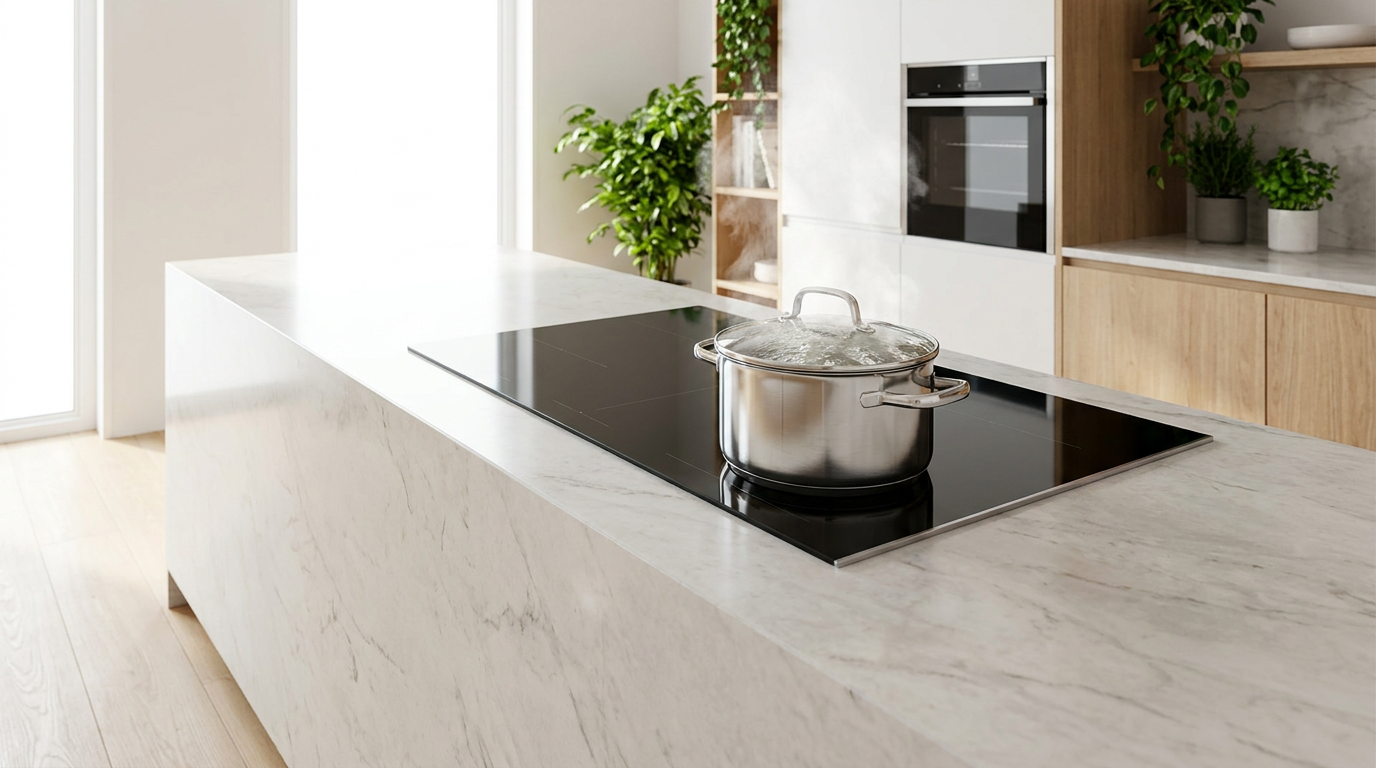
Beneath the smooth glass surface of an induction cooktop lies a tightly wound coil of copper wire. When the stove is turned on, an alternating electric current flows through this coil, generating a fluctuating magnetic field. This field penetrates the bottom of magnetic cookware, inducing swirling electrical currents—known as eddy currents—inside the metal.[1][2]

The electrical resistance of the iron in the pan converts these eddy currents directly into heat. Because the heat is generated inside the metal of the pot rather than on the glass surface below it, the thermodynamic efficiency is staggering. According to the U.S. Department of Energy, induction transfers about 85% to 90% of its energy directly to the food.[1]
By contrast, gas stoves are notoriously inefficient, converting only 30% to 40% of their energy into cooking heat, with the rest escaping into the surrounding kitchen air. This efficiency gap explains why induction can boil a pot of water 20% to 40% faster than a high-output gas burner, while keeping the kitchen significantly cooler during long cooking sessions.[1][4]
But the most urgent driver of the induction revolution is indoor air quality. For years, the combustion byproducts of gas stoves were largely ignored, but recent peer-reviewed studies have reframed the kitchen as a primary source of indoor pollution. Burning natural gas releases nitrogen dioxide (NO2), carbon monoxide, and fine particulate matter (PM2.5) directly into the living space.[3][5]
A landmark study led by scientists at the Columbia University Mailman School of Public Health quantified this impact in real-world conditions. Researchers monitored apartments in the Bronx, replacing gas stoves with induction models. They recorded a 56% reduction in average daily NO2 concentrations, noting that gas kitchens frequently exceeded outdoor air quality standards.[3]

The health implications of chronic NO2 exposure are severe, particularly for children. Research published by the Rocky Mountain Institute and peer-reviewed medical journals estimates that 12.7% of current childhood asthma cases in the United States are attributable to gas stove use. The pollutants irritate airways and exacerbate respiratory conditions over time.[5]
The health implications of chronic NO2 exposure are severe, particularly for children.
"We have seen these high pollution numbers in most apartments with gas stoves and inadequate ventilation," the Columbia researchers noted, emphasizing that even high-end range hoods often fail to capture all combustion gases. For households prioritizing wellness, eliminating the open flame is the most effective intervention.[3]
Beyond health and efficiency, induction has won over culinary skeptics through sheer performance. Historically, chefs preferred gas for its instant visual feedback and rapid temperature adjustments. However, modern induction ranges offer control that rivals or exceeds gas.[4][6]
Because the magnetic field responds instantly to the dial, induction can drop from a rolling boil to a delicate simmer in less than a second. There is no residual heat radiating from a heavy cast-iron grate to overcook a sauce. Consumer Reports testing consistently ranks induction models at the top of their performance charts for both high-heat searing and low-temperature holding.[4]
The technology also introduces a new paradigm of kitchen safety. Because the glass cooktop does not generate its own heat, it remains relatively cool to the touch—warmed only by the residual heat of the pan resting on it. If a burner is turned on without a magnetic pot present, no heat is generated at all, drastically reducing the risk of accidental burns or household fires.[1][2]

Despite these advantages, the transition to induction is not without friction. The primary hurdle for most homeowners is electrical infrastructure. A full-size induction range requires a dedicated 240-volt circuit with a 40- to 50-amp breaker. Homes built before 1990, or those currently wired only for gas, may lack the necessary panel capacity.[6]
Upgrading an electrical panel to accommodate an induction stove can add $1,000 to $3,000 to the installation cost, turning a simple appliance swap into a major electrical project. Appliance experts note that while the cooktops themselves are highly reliable, the complex electronics can be expensive to service out of warranty.[6]
To offset these upfront costs, the federal government has stepped in. Under the Inflation Reduction Act's Home Electrification and Appliance Rebate (HEAR) program, low- and moderate-income households can receive up to $840 toward the purchase of an induction stove, plus additional rebates for necessary electrical panel upgrades.[1]
Another practical consideration is cookware compatibility. Induction requires pots and pans with a ferrous (magnetic) bottom. Cast iron, carbon steel, and most modern stainless steel work perfectly. However, pure copper, aluminum, and glass cookware will not heat at all. The simplest diagnostic tool is a refrigerator magnet: if it sticks firmly to the bottom of the pan, it is induction-ready.[6]

There are also minor behavioral adjustments. Induction users must learn to trust the digital settings rather than a visual flame, and the sheer speed of the technology means cooks cannot walk away while waiting for oil to heat. Additionally, some users report a faint buzzing or humming sound when cooking on high power, a normal byproduct of the magnetic frequencies interacting with certain multi-ply pans.[4][6]
For individuals with pacemakers or insulin pumps, the electromagnetic fields (EMF) generated by induction stoves warrant a brief consultation with a cardiologist, though current research suggests the non-ionizing radiation is safe at normal cooking distances.[5]
Ultimately, the shift toward induction represents a rare alignment of environmental policy, public health, and consumer convenience. While the upfront electrical requirements demand careful planning, the daily reality of faster cooking, effortless cleanup, and pristine indoor air is convincing millions of homeowners to leave the flame behind.[7]
How we got here
1970s
Early induction cooktops are introduced to the consumer market but fail to gain traction due to high costs and low reliability.
2010s
Advances in power electronics make induction technology more affordable and robust, sparking popularity in Europe and Asia.
2022
Multiple peer-reviewed studies highlight the severe indoor air quality impacts of gas stoves, linking them to childhood asthma.
2023
The U.S. Inflation Reduction Act introduces substantial rebates for low- and moderate-income households to switch to electric appliances.
2026
Induction ranges become the preferred choice in premium kitchen remodels, driven by performance, safety, and health benefits.
Viewpoints in depth
Public Health Advocates
Focus on the immediate health benefits of removing combustion from the kitchen.
Medical researchers and environmental health organizations view the transition to induction primarily through the lens of respiratory health. They point to decades of data showing that gas stoves routinely push indoor nitrogen dioxide (NO2) and fine particulate matter (PM2.5) past safe outdoor limits. For this camp, the 12.7% of childhood asthma cases linked to gas stoves makes electrification an urgent public health intervention, not just a lifestyle upgrade.
Energy & Efficiency Experts
Prioritize the thermodynamic efficiency and climate impact of home electrification.
Government agencies and climate scientists emphasize the staggering efficiency gap between induction (up to 90% efficient) and gas (30-40% efficient). Because induction transfers electromagnetic energy directly into the cookware, it wastes virtually no heat to the surrounding air. This camp argues that widespread adoption of induction, supported by federal rebates, is a critical step toward decarbonizing residential buildings and reducing overall energy consumption.
Appliance Industry Analysts
Evaluate the practical realities of cooking performance, installation, and maintenance.
Reviewers and appliance technicians acknowledge the superior speed, precision, and safety of induction cooking, often ranking it above professional gas ranges. However, they caution homeowners about the hidden costs of retrofitting. Upgrading an older home to support a 40- or 50-amp dedicated circuit can cost thousands of dollars, and the complex electronic boards inside induction units can be expensive to repair out of warranty.
What we don't know
- How quickly local electrical grids will adapt to the increased load of widespread residential electrification.
- Whether future building codes will mandate induction in all new residential construction nationwide.
- The long-term repair costs of modern induction boards as they age past their warranty periods.
Key terms
- Electromagnetic Induction
- The process of using a magnetic field to generate electrical currents inside a conductive material, which creates heat directly within the cookware.
- Nitrogen Dioxide (NO2)
- A toxic gas produced by burning fossil fuels, including natural gas, which can irritate airways and exacerbate asthma.
- Thermal Conduction
- The traditional method of cooking where heat is generated by a flame or electric coil and transferred physically to the pot.
- Eddy Currents
- Swirling electrical currents induced inside the magnetic metal of a pan by the stove's magnetic field, creating the cooking heat.
Frequently asked
Do I need to buy all new pots and pans?
Not necessarily. Induction requires magnetic cookware like cast iron, carbon steel, or magnetic stainless steel. You can test your current pans by seeing if a refrigerator magnet sticks firmly to the bottom.
Will I need an electrician to install an induction range?
If you are switching from gas, yes. A full-size induction range requires a dedicated 240-volt electrical circuit with a 40- to 50-amp breaker, which may require a panel upgrade in older homes.
Are there government rebates available?
Yes. Under the Inflation Reduction Act, low- and moderate-income households can qualify for up to $840 toward an induction stove, plus additional funds for necessary electrical panel upgrades.
Is induction cooking safe for people with pacemakers?
Induction stoves generate a localized electromagnetic field. While generally considered safe at normal cooking distances, individuals with pacemakers or insulin pumps should consult their cardiologist before using one.
Sources
Source coverage
7 outlets
3 viewpoints surfaced







[1]U.S. Department of EnergyEnergy & Efficiency Experts
Making the Switch to Induction Stoves or Cooktops
Read on U.S. Department of Energy →[2]ENERGY STAREnergy & Efficiency Experts
Electric Cooking Products: Consider the Benefits of Induction
Read on ENERGY STAR →[3]Columbia University Mailman School of Public HealthPublic Health Advocates
Switching from Gas to Electric Stoves Cuts Indoor Air Pollution
Read on Columbia University Mailman School of Public Health →[4]Consumer ReportsAppliance Industry Analysts
Pros and Cons of Induction Cooktops and Ranges
Read on Consumer Reports →[5]Rocky Mountain InstitutePublic Health Advocates
Health Effects from Gas Stove Pollution
Read on Rocky Mountain Institute →[6]Yale ApplianceAppliance Industry Analysts
Induction vs. Gas Cooking: Which is Better?
Read on Yale Appliance →[7]Factlen Editorial Team
Synthesis by Factlen editorial team
Read on Factlen Editorial Team →
Every angle. Every day.
Get home stories with full source coverage and perspective breakdowns delivered to your inbox.