
The Office-to-Apartment Pipeline Hits a Record 90,000 Units as Cities Reimagine Downtowns
Driven by hybrid work and maturing commercial loans, developers are converting vacant office towers into residential housing at an unprecedented scale in 2026.
By Factlen Editorial Team
- Commercial Developers & Investors
- Focuses on the financial necessity of conversions due to maturing loans and the speed-to-market advantages over new construction.
- Urban Planners & Policymakers
- Views adaptive reuse as a critical tool to solve the housing shortage and revitalize empty downtown business districts.
- Architects & Builders
- Highlights the structural challenges of deep floor plates and the environmental benefits of preserving embodied carbon.
What's not represented
- · Existing Commercial Tenants
- · Local Retail Business Owners
Why this matters
As remote work leaves downtowns empty, converting offices into apartments solves two crises at once: revitalizing struggling local economies and providing desperately needed housing supply.
Key points
- The U.S. pipeline for office-to-apartment conversions reached a record 90,300 units in early 2026.
- Office buildings now account for 47% of all future adaptive reuse projects nationwide.
- New York City leads the country with over 16,000 units, driven by aggressive zoning reforms and tax abatements.
- Architects are solving the 'windowless core' problem by stacking residential amenities in the center of deep floor plates.
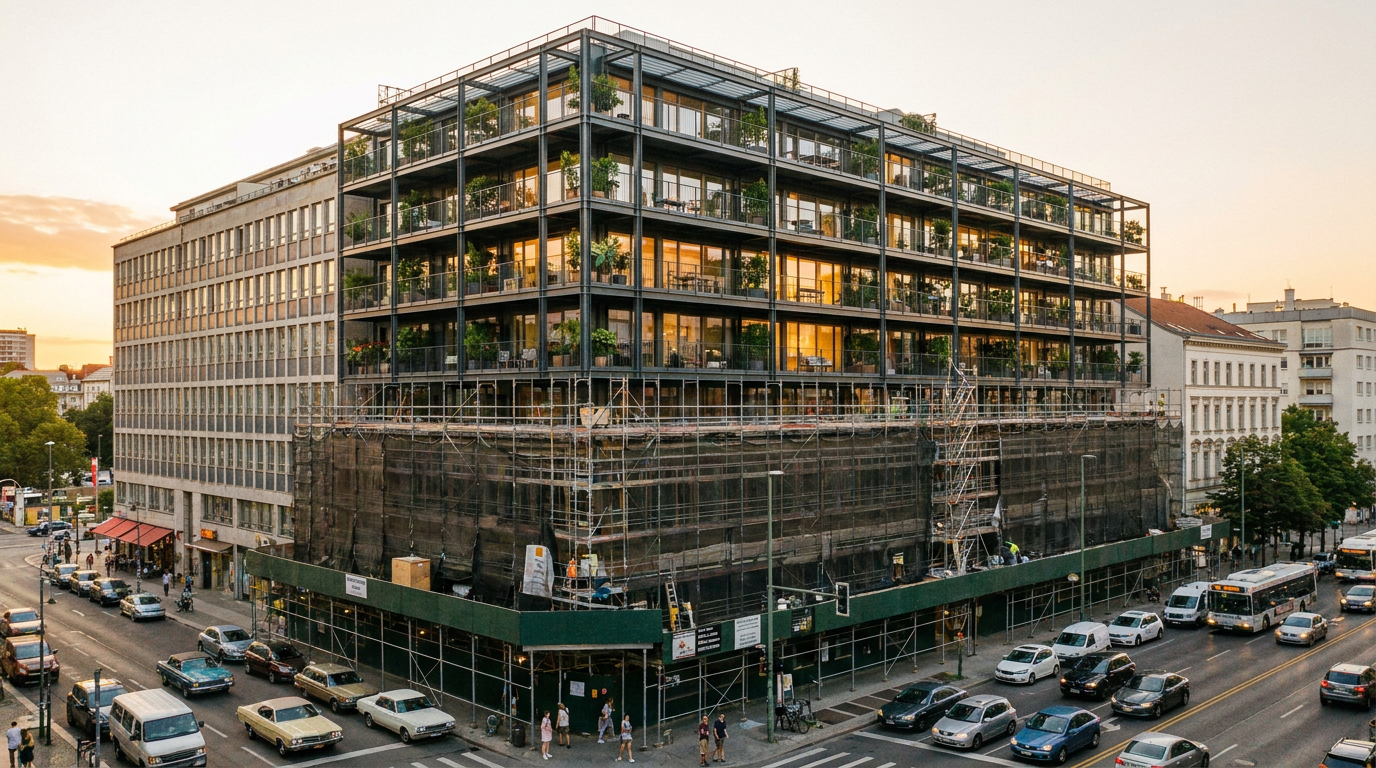
Six years after the pandemic permanently altered the American workplace, the hollowed-out downtown office building is finding a lucrative and transformative second act. Across the country, developers are executing a massive architectural pivot, transforming millions of square feet of obsolete commercial space into vibrant residential housing. It is a rare urban planning convergence that simultaneously addresses two of the decade's most stubborn crises: a glut of empty cubicles draining city tax revenues, and a severe shortage of apartments driving up the cost of living. By reimagining these concrete monoliths, cities are slowly turning 9-to-5 business districts into 24/7 neighborhoods.
The scale of this transformation has accelerated dramatically in the first half of 2026, moving from a niche architectural experiment to a mainstream development strategy. According to the latest data from Yardi Matrix, the number of office-to-apartment conversions in the national pipeline has surged to a record 90,300 units. That figure represents a massive 28 percent jump from just one year ago, and it is nearly four times larger than the conversion pipeline tracked in 2022. The sheer volume of units entering the market indicates that developers have finally cracked the code on financing and executing these complex renovations.[1][2]
Adaptive reuse is no longer just a preservation tool for historic landmarks; it has become the primary growth engine for the commercial real estate sector. Office buildings now account for 47 percent of all future adaptive reuse projects nationwide, steadily outpacing the conversion of aging hotels, industrial warehouses, and defunct shopping malls. As the stigma around living in former corporate spaces fades, renters are increasingly drawn to the unique architectural features these buildings offer, such as soaring ceiling heights, massive industrial windows, and central downtown locations that would be prohibitively expensive for new ground-up residential construction.[1][3]

The urgency driving this historic boom is largely financial, rooted in the shifting realities of commercial real estate debt. The market is currently staring down a massive maturity cliff, with roughly a third of all U.S. office loans—totaling more than $213 billion—set to mature by the end of 2027. Owners of underperforming, half-empty office towers are finding it nearly impossible to refinance these properties under current lending conditions. Consequently, they are left with few viable options: default and hand the keys back to the bank, sell the property at a steep loss, or adapt the asset for a completely new residential market.[4]
The underlying leasing fundamentals make the choice to convert incredibly stark for property owners. National office vacancy rates have hovered near a stubborn 20 percent since early 2025, and physical occupancy in many major metropolitan areas remains stuck at around 50 to 55 percent of pre-pandemic levels. That chronic underutilization has rendered millions of square feet financially unviable as traditional workspace. With corporate tenants continuing to downsize their footprints in favor of hybrid work arrangements, the traditional office market is unlikely to absorb this excess supply anytime in the near future, making residential conversion the most logical exit strategy.[4]
Geographically, the conversion wave is heavily concentrated in major coastal hubs where the housing shortage is most acute, with New York City leading the nation by a remarkably wide margin. Developers in New York currently have 16,358 conversion units underway, representing nearly 62 percent of all adaptive reuse activity in the metropolitan area. Standout mega-projects, such as the transformation of 111 Wall Street in the Financial District, are turning millions of square feet of outdated corporate infrastructure into thousands of modern apartments, fundamentally altering the skyline and the street-level culture of Lower Manhattan.[1][4]
New York's absolute dominance in the conversion space is not accidental; it is the direct result of aggressive, targeted policy intervention by city and state officials. The recent surge in projects follows the passage of the "City of Yes" zoning reforms, which drastically expanded the pool of eligible buildings by removing outdated commercial-only restrictions. Furthermore, the state's 467-m tax abatement offers up to a 35-year property tax exemption for projects that secure their change-of-use permits by June 2026. This has created a powerful ticking clock, incentivizing developers to fast-track their architectural plans and break ground immediately.[6]
Washington, D.C., and Chicago follow New York in the national rankings, with 8,479 and 4,360 units in the pipeline, respectively. In the nation's capital, developers are targeting massive, outdated federal and private office blocks near major transit hubs, aiming to inject life into downtown corridors that empty out after 5:00 PM. In Chicago, developers are leaning heavily into the city's historic architectural stock, converting 90-year-old towers in the Loop into mixed-use residential hubs. Many of these Midwestern projects are heavily subsidized by local governments, which mandate affordable housing set-asides in exchange for zoning variances and tax increment financing.[1][4]

Washington, D.C., and Chicago follow New York in the national rankings, with 8,479 and 4,360 units in the pipeline, respectively.
But the adaptive reuse trend is rapidly spreading far beyond the traditional gateway coastal cities. Mid-sized markets including Denver, Philadelphia, and St. Louis have all more than doubled their conversion pipelines over the past year, proving the model can work outside of ultra-high-rent districts. Meanwhile, Los Angeles is supporting a robust pipeline of over 4,300 units by expanding its pioneering Citywide Adaptive Reuse Ordinance. Originally designed in 1999 to revitalize downtown LA, the newly updated ordinance now allows for the conversion of commercial buildings as young as 15 years old across the entire city through streamlined administrative approvals.[1][5]
Despite the widespread enthusiasm from mayors and developers, turning a 1980s corporate headquarters into a modern apartment building is an immense architectural puzzle. Office buildings were fundamentally designed for sprawling, open-plan cubicle farms, resulting in massive, deep floor plates that stretch far from the exterior walls. Residential building codes, however, strictly require every legal bedroom to have an exterior window for natural light and emergency egress. You cannot simply draw a grid of apartments across a 20,000-square-foot floorplate without leaving dozens of units trapped in the dark interior.[3][6]
This geometric reality creates the infamous "windowless core" problem that plagues almost every conversion project. In a building with a deep floor plate, wrapping apartments around the glass perimeter leaves a massive, dark interior space in the center of the building that cannot legally or practically be used for housing. Furthermore, office buildings typically consolidate their plumbing, HVAC, and electrical systems in a single central core. Retrofitting these structures requires expensive, highly complex engineering to distribute individual water, waste, and ventilation lines outward to hundreds of newly built apartment kitchens and bathrooms.[6][7]
To solve the puzzle of the dark core, architects are getting incredibly creative with their interior programming. Design firms like Gensler are increasingly stacking residential amenities vertically through the windowless centers of these buildings. At projects like Franklin Tower in Philadelphia, developers activated the interior floor areas that couldn't support residential units by turning them into fitness centers, spin rooms, indoor basketball courts, movie theaters, and coworking spaces. By stacking these amenities in the dark core, developers can maximize the highly profitable perimeter space for sunlit apartments, turning a structural liability into a luxury selling point.[6]

Other urban planners and housing advocates are looking at alternative residential models entirely to make use of difficult floor plans. The Pew Research Center has advocated for converting these "problem buildings" into affordable co-living spaces. In a co-living model, tenants rent small, private bedrooms on the sunlit perimeter while sharing large, communal kitchens, bathrooms, and living areas located deeper in the building's interior. This dorm-style approach drastically reduces the per-unit development cost and plumbing requirements, allowing cities to stretch their housing subsidies further and provide affordable downtown living options for younger, middle-income workers.[7]
Beyond the financial and logistical hurdles, the conversion boom is being heavily championed by environmental advocates for its massive sustainability benefits. In the construction industry, the greenest building is always the one that is already built. According to the American Institute of Architects, renovating an existing structure saves between 50 and 75 percent of the embodied carbon emissions that would otherwise be generated by demolishing the site, hauling away the debris, and manufacturing new steel and concrete from scratch. For major real estate investment trusts, these carbon savings are a crucial metric for meeting their corporate ESG goals.[8]
For commercial developers, adaptive reuse also offers a critical "speed to market" advantage that ground-up construction simply cannot match. In the current economic climate, time is the enemy of return on investment. New construction requires lengthy entitlements, environmental reviews, zoning approvals, and land clearing before vertical construction can even begin. By repurposing an existing shell with the foundation, steel frame, and primary utilities already in place, businesses can shave months or even years off their project timelines, allowing them to open their doors and start generating rental revenue significantly faster than their competitors.[8]
Still, industry analysts caution against viewing conversions as a universal silver bullet for the housing crisis. According to the Conversion Feasibility Index—a proprietary tool that evaluates building age, floorplate shape, ceiling height, and transit accessibility—only a fraction of the nation's 1.9 billion square feet of office space is actually suitable for residential adaptation. Buildings with excessively deep cores, low ceilings, or asbestos contamination often require such extensive remediation that it remains cheaper to simply tear them down. Developers must conduct rigorous forensic investigations before committing to a project to avoid catastrophic cost overruns.[5]

Interestingly, the profile of the ideal conversion candidate is beginning to shift as the market matures. While early adaptive reuse projects focused almost exclusively on pre-war historic buildings with narrower footprints and operable windows, developers are increasingly targeting newer, more modern properties. Buildings constructed between the 1990s and 2010s now account for over 6 percent of future conversion projects, up from just 2 percent of completed ones. As the financial distress in the commercial sector deepens, even relatively modern glass-and-steel towers are finding their way onto the architectural drafting table.[3]
Ultimately, the 2026 conversion boom represents a fundamental rethinking of the American city and how its residents interact with the built environment. By dismantling the mid-century concept of the single-use business district—where streets empty out and businesses close the moment the clock strikes five—urban planners are slowly transforming hollowed-out commercial corridors into vibrant, 24/7 neighborhoods. It is a complex, expensive, and architecturally demanding process, but it proves that the most resilient and successful cities are those willing to continuously rewrite their own blueprints to meet the needs of the future.
How we got here
2020–2022
The pandemic normalizes remote work, causing physical office occupancy to plummet and sparking early discussions of adaptive reuse.
2023–2024
Office vacancy rates steadily climb toward 20%, while high interest rates stall new ground-up residential construction.
2025
Major cities like New York and Los Angeles pass sweeping zoning reforms and tax incentives to accelerate commercial-to-residential conversions.
Early 2026
The national pipeline of office-to-apartment conversions hits a record 90,300 units, representing nearly half of all adaptive reuse projects.
Viewpoints in depth
Commercial Developers' view
Conversions are a financial necessity driven by a massive wall of maturing commercial debt.
For developers and property owners, the math of adaptive reuse is increasingly dictated by the lending market. With over $213 billion in office loans maturing by 2027 and vacancy rates hovering near 20 percent, owners cannot refinance underperforming assets. Conversions offer a vital exit strategy that bypasses the lengthy entitlement and zoning delays of ground-up construction, providing a critical 'speed to market' advantage. However, developers stress that without municipal tax abatements—like New York's 467-m exemption—the high costs of retrofitting plumbing and HVAC systems make many projects financially unviable.
Urban Planners' view
Adaptive reuse is the key to transforming single-use business districts into resilient, 24/7 neighborhoods.
City officials and urban planners view the office vacancy crisis as a generational opportunity to correct the mid-century mistake of the single-use business district. By injecting thousands of residential units into downtown cores, cities can restore foot traffic for struggling ground-floor retailers, replace lost commercial property tax revenue, and chip away at the severe national housing shortage. Planners are actively rewriting zoning codes, such as Los Angeles' updated Adaptive Reuse Ordinance, to remove bureaucratic friction and encourage mixed-use development.
Architectural Designers' view
Conversions present unique structural puzzles but offer massive environmental benefits through preserved carbon.
Architects approach office conversions as complex geometric puzzles, primarily battling the 'deep floor plate' problem. Because residential codes require exterior windows for bedrooms, designers are forced to innovate, turning the dark, windowless cores of massive office buildings into stacked amenity spaces like gyms and theaters, or experimenting with co-living dorm models. Despite these hurdles, the architectural community heavily champions adaptive reuse for its sustainability; preserving a building's existing steel and concrete shell saves up to 75 percent of the embodied carbon emissions associated with new construction.
What we don't know
- Whether the pace of conversions will slow down once the June 2026 deadline for New York's 467-m tax abatement passes.
- How the influx of luxury and market-rate converted apartments will impact overall housing affordability in dense urban cores.
- The long-term performance and tenant satisfaction of co-living models in repurposed office spaces.
Key terms
- Adaptive Reuse
- The process of repurposing an existing building for a use other than what it was originally designed for, such as turning an office into apartments.
- Deep Floor Plate
- A building design where the distance from the exterior windows to the central core is very long, making it difficult to bring natural light into the interior.
- Embodied Carbon
- The total greenhouse gas emissions generated by the manufacturing, transportation, and installation of building materials during construction.
- Co-living
- A residential model where tenants rent private bedrooms but share communal kitchens, living areas, and bathrooms, often used to maximize space in difficult floor plans.
- Conversion Feasibility Index
- A weighted scoring system used by real estate analysts to evaluate an office building's structural and locational suitability for residential conversion.
Frequently asked
Why are so many offices being converted now?
A combination of persistent 20% office vacancy rates, hybrid work trends, and a wave of commercial loans maturing by 2027 is forcing owners to repurpose underperforming assets.
Can any office building become an apartment?
No. Buildings with massive, deep floor plates struggle to meet residential codes that require bedroom windows. Only a fraction of the U.S. office stock is structurally and financially viable for conversion.
What happens to the windowless center of these buildings?
Architects are increasingly turning the dark interior cores of large office buildings into stacked residential amenities, such as gyms, theaters, and coworking spaces.
Are these conversions environmentally friendly?
Yes. Adaptive reuse preserves the existing structure, saving between 50% and 75% of the embodied carbon emissions that would be generated by demolishing and building from scratch.
Sources
Source coverage
8 outlets
3 viewpoints surfaced








[1]CRE DailyCommercial Developers & Investors
Office conversions hit 90K units in 2026, led by New York
Read on CRE Daily →[2]Construction DiveArchitects & Builders
Office-to-housing conversions grew 28% last year
Read on Construction Dive →[3]The Real DealCommercial Developers & Investors
U.S. office-to-apartment conversions hits new high
Read on The Real Deal →[4]GlobeStCommercial Developers & Investors
Office-to-Apartment Conversions Hit Record High
Read on GlobeSt →[5]ConstructConnectUrban Planners & Policymakers
Adaptive Reuse Surge: Office-to-Residential Projects Nearly Quadruple Since 2022
Read on ConstructConnect →[6]GenslerArchitects & Builders
Trends to Watch: What Other Cities Can Learn From New York City's Conversion Boom
Read on Gensler →[7]Pew Research CenterUrban Planners & Policymakers
Converting Obsolete Offices to Small Co-Living Apartments Could Help Ease U.S. Housing Shortage
Read on Pew Research Center →[8]Pyramid ContractingCommercial Developers & Investors
Commercial Adaptive Reuse: Speed to Market and ROI
Read on Pyramid Contracting →
Every angle. Every day.
Get real estate stories with full source coverage and perspective breakdowns delivered to your inbox.