
Arctic Ocean Crosses Irreversible Chemical Tipping Point, Threatening Marine Food Web
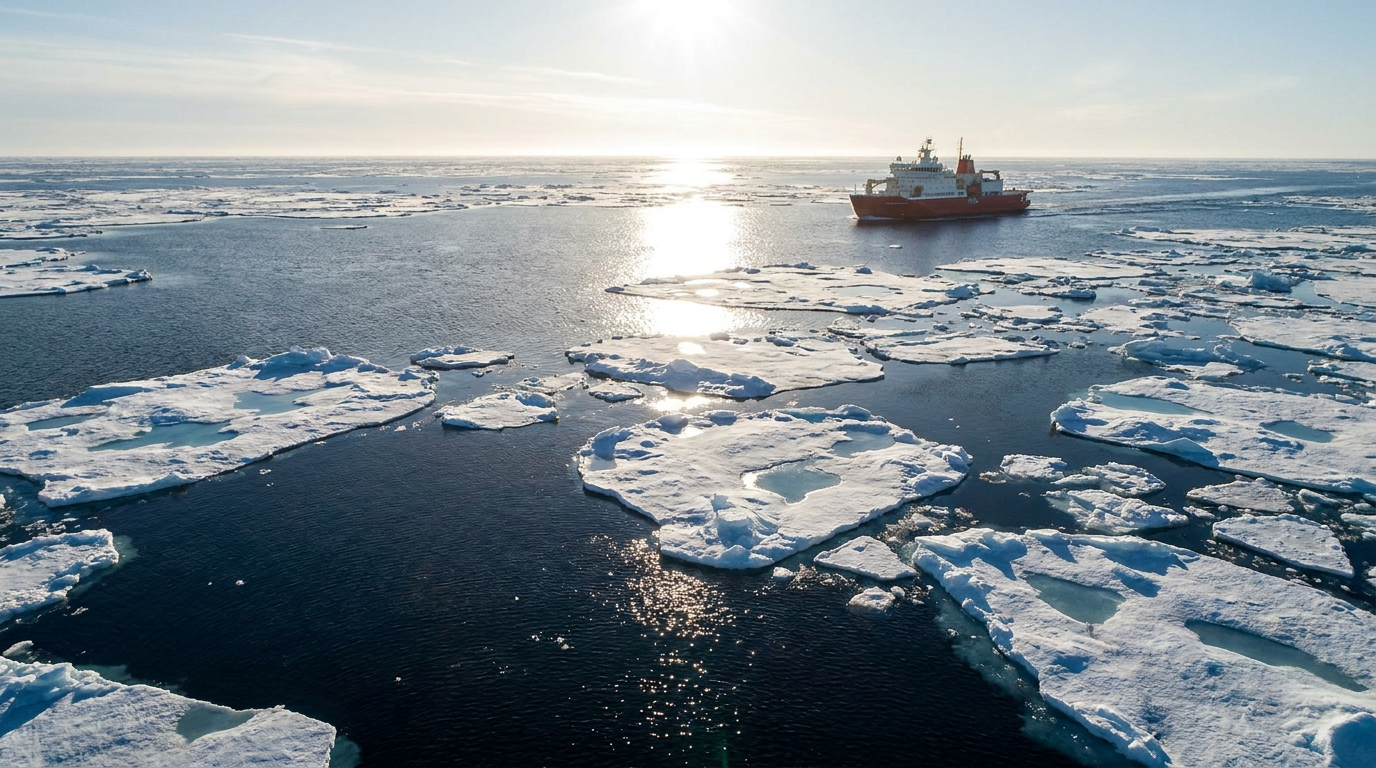
Decades of sea ice loss have triggered a hidden regime shift, stripping the Arctic Ocean of essential nutrients and permanently altering its capacity to sustain marine life.
By Factlen Editorial Team
- Marine Biogeochemists
- Focus on the irreversible chemical regime shift and the fundamental alteration of the ocean's nutrient cycles.
- Climate Modelers
- Emphasize the need to update global climate models to account for the Arctic's reduced capacity to sequester carbon.
- Fisheries & Ecosystem Monitors
- Concerned with the downstream impacts of nutrient starvation on commercial fish stocks in the North Atlantic.
- Factlen Editorial Synthesis
- Integrates the primary data with broader planetary boundary contexts to provide a comprehensive overview.
What's not represented
- · Indigenous Arctic Communities
- · Global Seafood Consumers
Why this matters
The Arctic Ocean has fundamentally changed how it processes nutrients, moving past a point of no return. This invisible chemical shift threatens to starve the marine food web from the bottom up, endangering global commercial fisheries and weakening the ocean's ability to absorb climate-warming carbon.
Key points
- The Arctic Ocean crossed a hidden chemical tipping point around 2009, shifting from a light-limited to a nitrate-limited ecosystem.
- Melting sea ice allowed more sunlight to penetrate the water, initially boosting plankton growth but ultimately supercharging nitrate-consuming bacteria.
- Bacterial denitrification is permanently removing roughly 12 teragrams of nitrogen annually from key Arctic shelf areas.
- The loss of foundational nutrients threatens the entire marine food web, from zooplankton to apex predators.
- Nutrient starvation in the Arctic will likely cascade southward, threatening major commercial fishing grounds in the North Atlantic.
- The shift toward smaller plankton species weakens the ocean's biological carbon pump, reducing its capacity to sequester atmospheric CO2.
The Arctic Ocean has fundamentally altered its chemical baseline, crossing a hidden tipping point that threatens the foundation of its marine food web and global climate stability. For decades, the visible narrative of Arctic climate change has been dominated by the rapid, highly publicized disappearance of surface sea ice. However, beneath the waves, a more insidious and far-reaching transformation has occurred: the ocean is rapidly losing nitrate. Nitrate is a vital, irreplaceable nutrient required to sustain the microscopic plankton populations that serve as the bedrock for all higher marine life. Without it, the entire ecosystem faces a structural collapse.[1][2]
Previously, scientific consensus held that the retreat of Arctic sea ice would actually supercharge ocean productivity and create a more vibrant ecosystem. The underlying logic was straightforward and widely accepted: less ice means more open water, which allows significantly more sunlight to penetrate the ocean surface during the summer months. This massive influx of solar energy was expected to fuel unprecedented, massive blooms of phytoplankton. Theoretically, this would strengthen the entire marine food web, supporting larger populations of fish and mammals, while simultaneously increasing the ocean's capacity to absorb atmospheric carbon dioxide.[3][4]
During the early stages of sea ice loss, empirical observations largely supported this optimistic theory. Phytoplankton growth did indeed surge across the region as light availability expanded into previously shaded waters. However, new comprehensive data reveals that this sunlight-driven boom triggered a catastrophic, unforeseen secondary mechanism. The Arctic ecosystem has now entered a fundamentally different phase where sunlight alone can no longer sustain historical growth rates. The foundational nutrients required for photosynthesis have been systematically exhausted, leaving the ocean bathed in light but starved of the chemical fuel needed for life.[1][5]
The biological mechanism driving this severe nutrient depletion is a process known as denitrification. As the initially supercharged populations of phytoplankton complete their life cycles and die, their cellular matter sinks in massive quantities to the shallow Arctic seafloor. There, they are broken down and decomposed by specialized benthic bacteria. In the process of digesting this unprecedented influx of organic material, these bacteria consume vast quantities of nitrate and oxygen from the surrounding water, effectively stripping the ocean of its most critical life-sustaining resources.[1][4]

A landmark study published in the peer-reviewed journal Communications Earth & Environment quantifies the sheer, staggering scale of this nutrient drain. Researchers identified the shallow waters of the Chukchi Sea and the East Siberian shelf as the primary geographic zones responsible for this chemical conversion. In these expansive shelf areas alone, the bacterial decomposition process is currently removing an estimated 12 teragrams of nitrogen from the water column annually. This represents a massive hemorrhage of nutrients that the ecosystem cannot naturally replace under current climatic conditions.[1][7]
This massive, continuous removal of nitrogen offsets a substantial portion of the fresh nutrients that naturally flow into the Arctic basin from the Pacific Ocean. By rigorously analyzing more than two decades of ocean sampling data collected from the Fram Strait—a critical oceanic passage where Arctic waters flow southward into the Atlantic—researchers were able to pinpoint the exact historical timeline of this devastating regime shift. The data paints a clear picture of an ecosystem that was pushed past its breaking point long before the scientific community fully realized what was happening.[3][7]
The historical data shows that nitrate concentrations in the Polar Surface Water dropped sharply and suddenly around the year 2009, and they have remained critically low ever since. The Arctic Ocean has officially transitioned from a 'light-limited' system—where growth was constrained by ice cover—to a 'nitrate-limited' system. Even with widespread open water and abundant summer sunlight, the microscopic plants at the base of the food chain are effectively starving. The fundamental rules governing biological productivity in the far north have been permanently rewritten.[1][3]

The Arctic Ocean has officially transitioned from a 'light-limited' system—where growth was constrained by ice cover—to a 'nitrate-limited' system.
The consequences of this chemical regime shift are profound and largely irreversible under our current global climate conditions. Because the vast majority of marine plankton cannot absorb raw nitrogen gas directly from the water, the bacterial conversion of nitrate permanently removes usable nutrients from the marine food web. Once the nitrate is converted into gas and released, it is lost to the biological cycle. The ocean cannot simply generate new nitrate to replace what the supercharged bacterial populations have consumed.[4][5]
"Even if sea ice were to increase temporarily, the Arctic nutrient system responds over much longer timescales," notes Marta Santos-García, a marine biogeochemist at the University of Edinburgh who co-led the groundbreaking research. Short-term recoveries in winter ice cover will not rapidly reverse the severe, systemic decline in nitrate inventories. The chemical inertia of the ocean means that even if global temperatures magically stabilized tomorrow, the Arctic ecosystem would remain trapped in this nutrient-starved state for generations.[3][4]
The biological impact of this foundational starvation is expected to ripple upward through every single trophic level of the marine environment. With significantly less nitrate available, phytoplankton populations will either shrink in total biomass or shift entirely toward smaller, less nutritious species. Consequently, more of the ocean's baseline energy will be trapped and recycled within microscopic bacterial loops, rather than being efficiently passed up the food chain to the zooplankton that serve as the primary food source for larger animals.[2][4]
This severe energy bottleneck directly threatens the larger, more complex animals that rely on a robust and reliable zooplankton population. This includes highly valuable commercial fish species, migratory seabirds, seals, and apex predators like whales and polar bears. The Arctic food web is effectively being hollowed out from the bottom up. As the base of the pyramid crumbles, the animals at the top are left highly vulnerable to starvation, population collapse, and increased competition for rapidly dwindling resources.[2][5]

The dire implications of this regime shift extend far beyond the isolated waters of the polar circle. The Arctic Ocean acts as a vital nutrient pump for ecosystems much further south. The severe depletion of nitrate in Arctic waters means that the ocean currents flowing out through the Fram Strait are carrying significantly fewer nutrients into the North Atlantic. This nutrient deficit directly threatens major commercial fishing grounds that rely heavily on this chemical export to sustain their own local food webs.[3][4]
Furthermore, this chemical shift severely compromises the Arctic Ocean's critical role in global carbon sequestration. The 'biological pump'—the natural process by which plankton absorb carbon dioxide at the surface and drag it to the ocean floor when they die—is steadily weakening. If nitrate scarcity forces a permanent, ecosystem-wide shift toward smaller plankton species, these lighter organisms will carry significantly less carbon to the deep ocean, leaving more heat-trapping gas in the atmosphere and accelerating the very warming that caused the crisis.[1][7]

This Arctic tipping point is part of a much broader, deeply concerning pattern of thermal and chemical saturation occurring across the world's oceans. Just as equatorial regions are experiencing unprecedented thermal saturation that fundamentally alters global weather patterns like El Niño, the polar oceans are hitting hard, unforgiving chemical limits. The Earth's marine systems, which have historically absorbed the brunt of human-caused climate change, are simultaneously losing their innate capacity to buffer the impacts of anthropogenic warming.[6][9]
Significant uncertainties still remain regarding the exact timeline of the downstream impacts. While the chemical shift in the Arctic is now clearly documented and understood, climate modelers and marine biologists are still working urgently to project exactly when and how severely the North Atlantic fisheries will experience the cascading effects of this nutrient deficit. What is absolutely certain, however, is that the Arctic Ocean has entered an alien, unprecedented state, and the global consequences are already in motion.[3][8]
How we got here
Pre-2000s
Arctic sea ice reliably shields the ocean surface, limiting sunlight but maintaining stable, light-limited phytoplankton growth.
Early 2000s
Accelerated sea ice melt allows unprecedented sunlight into shallow waters, triggering massive, temporary phytoplankton blooms.
2009
The Arctic Ocean crosses a chemical tipping point as nitrate concentrations in the Polar Surface Water drop sharply.
May 2026
Researchers publish definitive data confirming the regime shift to a nitrate-limited, irreversibly altered ecosystem.
Viewpoints in depth
Marine Biogeochemists
Focusing on the irreversible chemical mechanics of the regime shift.
For biogeochemists, the story is written in the isotopic signatures of the water itself. They emphasize that the Arctic has fundamentally transitioned from a system constrained by light to one constrained by nitrate. Their primary concern is the sheer scale of the denitrification process—removing 12 teragrams of nitrogen annually—which permanently alters the baseline chemistry of the polar oceans. They argue that this is not a temporary fluctuation, but a permanent regime shift that redefines how the Arctic ecosystem functions.
Climate Modelers
Working to integrate the weakened biological pump into global warming projections.
Climate modelers view this tipping point as a critical missing variable in global carbon budgets. Previously, models assumed that an ice-free Arctic might actually absorb more carbon due to increased surface productivity. The revelation that nitrate depletion is shifting the ecosystem toward smaller, less efficient plankton species means the ocean's 'biological carbon pump' is weaker than anticipated. Modelers are now urgently working to quantify how much less CO2 the Arctic will sequester in the coming decades.
Fisheries & Ecosystem Monitors
Tracking the downstream economic and biological fallout in the North Atlantic.
For those monitoring global fish stocks, the Arctic tipping point is an impending economic crisis. The Arctic Ocean exports vital nutrients southward through the Fram Strait, feeding the rich fishing grounds of the North Atlantic. Ecosystem monitors warn that hollowing out the base of the food web will inevitably lead to energy bottlenecks. They are currently scrambling to determine the lag time between this chemical depletion and the projected collapse of commercial fish populations that billions rely on for protein.
What we don't know
- The exact timeline for when nutrient starvation will trigger observable population collapses in North Atlantic commercial fish stocks.
- Whether any unknown microbial adaptations might eventually emerge to fix nitrogen back into the Arctic ecosystem.
- How this localized chemical shift will interact with other global ocean tipping points, such as the slowing of the Atlantic Meridional Overturning Circulation (AMOC).
Key terms
- Denitrification
- A microbial process where bacteria consume nitrate and convert it into nitrogen gas, permanently removing it from the usable marine food web.
- Phytoplankton
- Microscopic, plant-like organisms that live in the ocean and form the foundational base of the marine food chain.
- Biological Carbon Pump
- The ocean's natural mechanism for sequestering carbon, driven by plankton absorbing CO2 at the surface and sinking to the seafloor when they die.
- Trophic Level
- The position an organism occupies in a food web, ranging from primary producers like plankton up to apex predators like whales.
Frequently asked
Why doesn't more sunlight help the Arctic Ocean?
While more sunlight initially boosted plant growth, it ultimately supercharged seafloor bacteria that consume nitrate, stripping the water of the essential nutrients needed to sustain life.
Can this tipping point be reversed?
Scientists state the shift is irreversible under current climate conditions. Even if sea ice temporarily returns, the nutrient system operates on much longer timescales and cannot quickly recover.
How does this affect animals outside the Arctic?
The Arctic acts as a nutrient pump for the North Atlantic. Depleted Arctic waters mean fewer nutrients flow south, threatening the food supply for commercial fish stocks globally.
Does this impact climate change?
Yes. As nutrient scarcity forces a shift toward smaller plankton species, the ocean's ability to absorb carbon dioxide and drag it to the seafloor is significantly weakened.
Sources
Source coverage
9 outlets
4 viewpoints surfaced








[1]Communications Earth & EnvironmentMarine Biogeochemists
Sea ice loss drives a regime shift in Arctic Ocean nitrogen biogeochemistry
Read on Communications Earth & Environment →[2]New ScientistClimate Modelers
Arctic Ocean reaches tipping point that could be dire for marine life
Read on New Scientist →[3]University of EdinburghMarine Biogeochemists
Arctic Ocean ecosystem passed a tipping point around 2009
Read on University of Edinburgh →[4]LiveScienceFisheries & Ecosystem Monitors
Sea ice loss in the Arctic has triggered a critical tipping point that's destroying the food chain
Read on LiveScience →[5]ScienceDailyMarine Biogeochemists
Arctic Ocean Reaches Chemical Tipping Point As Melting Sea Ice Alters Nutrient Supply
Read on ScienceDaily →El Niño in a thermally saturated world
Read on Nature →[7]NCHStatsFisheries & Ecosystem Monitors
Arctic Ocean Reaches Chemical Tipping Point As Melting Sea Ice Alters Nutrient Supply
Read on NCHStats →[8]TechExploristClimate Modelers
An irreversible shift in the chemical make-up of the Arctic Ocean driven by climate change is disrupting the region's food chain
Read on TechExplorist →[9]Factlen Editorial TeamFactlen Editorial Synthesis
Synthesis by Factlen editorial team
Read on Factlen Editorial Team →

More in science
See all 6 stories →Cognitive Longevity
The Science of 'SuperAgers': How Some Brains Defy Cognitive Decline
8 sources

Coral Resilience
AI Mapping Identifies 166,000 Square Kilometers of Climate-Resilient Coral Reefs
7 sources
Brain Aging
Inside the Brains of 'SuperAgers': How Some 80-Year-Olds Maintain the Memory of a 50-Year-Old
7 sources

Quantum Matter
Physicists Are Freezing Quantum States to Create Entirely New Forms of Matter
7 sources
Every angle. Every day.
Get science stories with full source coverage and perspective breakdowns delivered to your inbox.