
How Virtual Production and AI Are Democratizing Indie Filmmaking
Independent filmmakers are utilizing AI pre-visualization and accessible LED volumes to shoot blockbuster-scale scripts on micro-budgets.
By Factlen Editorial Team
- Independent Filmmakers
- View virtual production as a democratizing tool that allows them to shoot ambitious scripts on micro-budgets.
- Production Technologists
- Focus on the software breakthroughs, celebrating how AI and real-time rendering have solved consistency issues.
- Traditional Craft Guilds
- Express concern over AI replacing human concept artists and the loss of physical filmmaking skills.
What's not represented
- · Location Scouts
- · Practical Set Builders
Why this matters
By drastically lowering the financial barriers to world-building, these technologies are leveling the playing field in Hollywood. Audiences will soon see a surge of highly imaginative, visually stunning independent films that previously would have been impossible to finance.
Key points
- Independent filmmakers are using LED volumes and AI to shoot blockbuster-scale scripts on micro-budgets.
- AI video models have solved 'temporal consistency,' allowing for accurate, animated pre-visualization.
- Virtual production forces directors to make all creative decisions upfront, eliminating expensive post-production fixes.
- The global virtual production market is projected to reach $3.3 billion in 2026, driven by smaller, accessible stages.
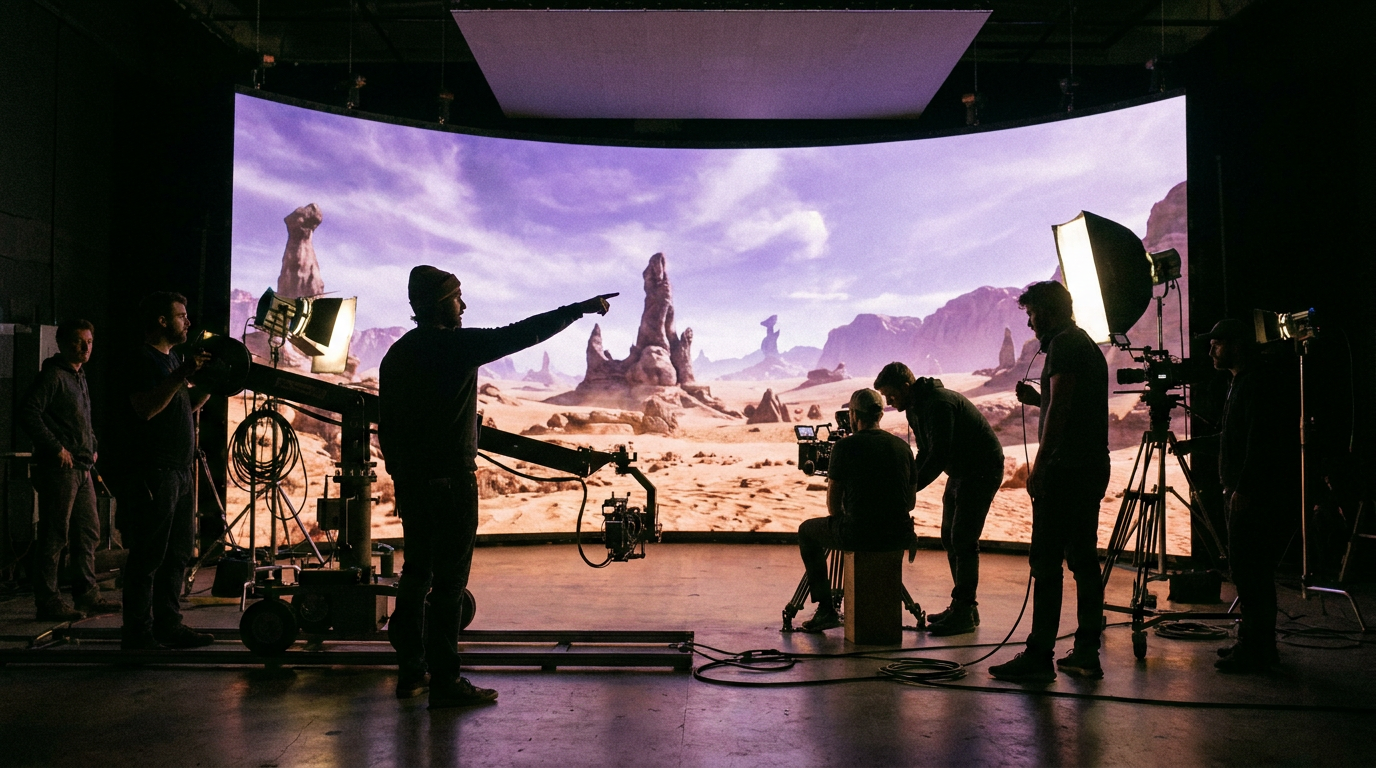
For the past several years, the defining image of high-end Hollywood production has been the "Volume"—a massive, glowing cavern of LED panels where studios shoot massive franchises like The Mandalorian. It was a technological marvel with a price tag to match, effectively walling off the next generation of filmmaking tools from anyone without a nine-figure budget. To the independent filmmaker, the Volume felt like an exclusive playground for the industry's elite, a tool that was fascinating to read about but financially impossible to actually rent.[1]
But in 2026, the walls of the studio lot have been breached. A rapid convergence of cheaper LED technology, real-time rendering engines, and breakthrough artificial intelligence has democratized the virtual production pipeline. Independent filmmakers are now utilizing these exact same workflows to shoot stylized period pieces, sprawling sci-fi, and intimate dramas on micro-budgets. The technology has scaled down from the blockbuster to the boutique, fundamentally altering the economics of independent cinema.[1][7]
This shift represents a complete rewiring of how movies are conceived and executed. Traditional indie filmmaking often meant writing "small"—limiting scripts to a few accessible locations, modern-day settings, and minimal visual effects. Today, accessible LED volumes are unlocking worlds of possibility outside the traditional studio system, proving that virtual production is no longer just for massive superhero tentpoles. Writers are being told they no longer have to cross out a scene just because it takes place on Mars or in 19th-century London.[4]
To understand this revolution, one must look at the two pillars of the new indie workflow: Dynamic Pre-Visualization (Pre-Vis) and the accessible LED Volume. The process begins long before a camera ever rolls, driven by a new generation of AI video models like OpenAI's Sora 2 Pro and Google's Veo 3.1. These tools have transformed the earliest stages of pre-production from a slow, expensive sketching process into an agile digital sandbox.[2]

Previously, AI video generation was plagued by "temporal consistency" issues—characters would morph, backgrounds would shift, and physics would break from frame to frame. By early 2026, these foundational models solved the consistency problem, allowing directors to generate photorealistic, multi-angle sequences that maintain exact physical traits across shots. The eradication of AI morphing has turned generative video from a novelty into a production-grade asset.[2]
This stability has effectively eradicated the traditional static storyboard for tech-forward productions. Instead of relying on hand-drawn sketches, indie directors now use AI to generate animated, highly accurate scene blocking. This "Dynamic Pre-Vis" serves as a living blueprint for the film, allowing the director, cinematographer, and production designer to see the "final" world during prep, drastically reducing the guesswork that usually plagues low-budget shoots.[2][6]
Once the digital blueprint is locked, the production moves to the LED Volume. Unlike traditional green screens—which require actors to perform in a void and leave the visual effects work for post-production—a Volume displays the computer-generated environment in real-time on massive, high-resolution screens directly behind the cast. The actors can see the world they are inhabiting, and the camera captures the final composite in-camera.[1][7]
Once the digital blueprint is locked, the production moves to the LED Volume.
These digital environments are powered by gaming software like Unreal Engine, which tracks the physical camera's movements and shifts the digital background's perspective perfectly in sync. If the director wants to move a virtual mountain, change the time of day from noon to golden hour, or adjust the weather, it takes a few keystrokes rather than hours of physical lighting adjustments and location moves.[1][4]

While major studios have used this tech for years, a new market of boutique virtual production stages has exploded across Los Angeles, London, and Berlin. The global virtual production market is projected to reach $3.3 billion in 2026, driven heavily by smaller, cost-effective LED wall configurations designed specifically for commercial and independent film productions. These smaller stages offer the same core technology without the massive overhead of a Disney-scale facility.[5]
Ironically, independent filmmakers are often better suited for the rigors of virtual production than major studios. In big-budget Hollywood, there is a pervasive habit of "kicking the can down the road"—shooting sloppy footage with the assumption that a massive visual effects team will fix the mistakes in post-production. The budget allows for indecision on set.[1]
Indie filmmakers do not have the luxury of a $30 million post-production safety net. Virtual production forces a discipline that industry veterans call "threading the eye of the needle." Directors must make all of their creative decisions upfront during the prep phase. Once they step onto the Volume stage, the environment is locked, and the budget is spent exactly where it belongs: on the screen.[1]
This rigorous, prep-heavy philosophy is already yielding ambitious projects. At the 2026 SXSW Film Festival, panels dedicated to "Virtual Production on Any Budget" highlighted how creators are using the tech to shoot queer horror-comedies and historical epics that would have been financially impossible a decade ago. The festival circuit is beginning to see the first wave of films born natively from this new workflow.[4]

One prominent case study is June July, an upcoming feature-length Western directed by Daniel Thron. The production is serving as a testbed for a new workflow dubbed "VidViz" (video visualization), which utilizes real-time ray tracing to carry the exact same digital assets from the AI pre-production phase all the way through the final shoot. The digital town built for the storyboard is the exact same town rendered on the LED wall.[3]
The creators behind June July view this technological shift as the dawn of a "New Hollywood." They draw direct parallels to the 1970s rebel filmmaking era, where a generation of independent auteurs used lighter, cheaper cameras to break away from the rigid studio system and redefine cinematic storytelling. Today, the rebellion is digital.[3]
However, the democratization of these tools is not without friction. The integration of AI into the pre-production pipeline has sparked intense debate regarding creative transparency and the displacement of traditional storyboard artists and concept designers. As AI takes over the initial visualization, traditional craft guilds are navigating how to protect their members in an increasingly automated pre-production ecosystem.[6][8]

Furthermore, while the cost of renting an LED Volume has plummeted, the upfront compute power required to generate high-fidelity Unreal Engine environments remains a significant barrier. A poorly optimized digital asset can crash a real-time render, bringing an indie shoot to a grinding, expensive halt. The technology requires a highly technical crew that understands both traditional cinematography and video game engine optimization.[1][7]
Despite these hurdles, the trajectory of the industry is clear. The financial barrier to entry for cinematic world-building has been permanently lowered. By combining AI-driven pre-visualization with accessible virtual production, independent filmmakers are no longer competing just on the strength of their dialogue—they are competing on the scale of their imagination, armed with the exact same tools as the biggest studios in the world.[7][8]
How we got here
2019
Disney's The Mandalorian popularizes the massive LED Volume for big-budget television.
2024
Early generative AI video models emerge but struggle with temporal consistency and morphing.
Early 2026
Advanced models like Sora 2 Pro and Veo 3.1 solve consistency issues, enabling reliable Dynamic Pre-Vis.
March 2026
SXSW panels highlight the explosion of indie films successfully utilizing virtual production on micro-budgets.
Viewpoints in depth
Independent Filmmakers
View virtual production as a democratizing force that unlocks ambitious storytelling.
For indie directors, the combination of AI pre-visualization and LED volumes is a great equalizer. Instead of rewriting scripts to fit a micro-budget—often resulting in single-location 'talking head' films—they can now execute sci-fi, historical, and fantasy concepts. They argue that the strict discipline required by virtual production (making all decisions in prep) actually suits the independent mindset better than the studio habit of fixing mistakes in post-production.
Production Technologists
Celebrate the software breakthroughs that solved consistency and tracking limitations.
Engineers and VFX supervisors emphasize that the true revolution of 2026 isn't just hardware, but software. The eradication of 'AI morphing' in models like Sora 2 Pro and the seamless integration of Unreal Engine with physical camera tracking have turned experimental tech into reliable, production-grade tools. They view this era as the final bridge between the physical and digital filmmaking worlds.
Traditional Craft Guilds
Express concern over the rapid automation of pre-production roles.
While acknowledging the benefits of LED volumes, traditional craft workers—particularly storyboard artists, concept designers, and location scouts—warn about the human cost of AI integration. They argue that relying on generative models for 'Dynamic Pre-Vis' bypasses the nuanced, collaborative art of human design, potentially homogenizing the visual language of independent films and displacing entry-level industry jobs.
What we don't know
- Whether the proliferation of accessible virtual production will lead to a homogenization of visual styles in independent cinema.
- How traditional Hollywood guilds will ultimately regulate the use of AI in pre-production and storyboarding.
- If the upfront compute and rendering costs will remain a barrier for the absolute lowest-budget micro-indies.
Key terms
- LED Volume
- A physical soundstage surrounded by massive, high-resolution LED screens that display computer-generated environments in real-time behind the actors.
- Dynamic Pre-Vis
- The use of AI video generators to create animated, highly accurate scene blocking and storyboards before filming begins.
- Temporal Consistency
- The ability of an AI video model to maintain a character's exact physical traits and background geometry seamlessly from one frame to the next.
- Real-Time Rendering
- The process of generating 3D computer graphics fast enough that they appear to update instantly as a physical camera moves.
Frequently asked
Does virtual production replace green screens?
Yes, in many cases. Instead of actors performing in front of a blank green screen to be replaced later, the final digital background is displayed on LED walls during the actual shoot.
How does AI help independent filmmakers?
AI tools allow indie directors to generate photorealistic storyboards and pre-visualize complex scenes for a fraction of the cost of hiring traditional concept artists.
Is virtual production cheaper than traditional filming?
While renting an LED stage has an upfront cost, it saves money by eliminating travel to multiple locations, reducing weather delays, and minimizing expensive post-production visual effects.
Sources
Source coverage
8 outlets
3 viewpoints surfaced








[1]No Film SchoolIndependent Filmmakers
Virtual Production: How the Same Tech in 'The Mandalorian' is Empowering Indie Filmmakers
Read on No Film School →[2]AI JournProduction Technologists
The 2026 AI Filmmaking Revolution: Beyond Basic Text-to-Video
Read on AI Journ →[3]The Creative + Tech OrbitIndependent Filmmakers
Virtual Production: 'June July' Filmmakers Test New “VidViz” Technique
Read on The Creative + Tech Orbit →[4]SXSWIndependent Filmmakers
Indie Film, Hollywood Tech: Virtual Production on Any Budget
Read on SXSW →[5]Global Market InsightsProduction Technologists
Virtual Production Market Size & Forecast 2026–2035
Read on Global Market Insights →[6]Data Bazaar DigitalProduction Technologists
AI Film Production: The Complete Guide for 2026
Read on Data Bazaar Digital →[7]Factlen Editorial TeamTraditional Craft Guilds
Synthesis by Factlen editorial team
Read on Factlen Editorial Team →[8]McKinsey & CompanyTraditional Craft Guilds
How AI is reshaping film and TV production
Read on McKinsey & Company →
Every angle. Every day.
Get entertainment stories with full source coverage and perspective breakdowns delivered to your inbox.