
Beyond Books: How the 'Library of Things' Became Essential Community Infrastructure
Public libraries and neighborhood nonprofits are rapidly expanding their lending catalogs to include power tools, camping gear, and electronics, saving residents millions while reducing environmental waste.
By Factlen Editorial Team
- Resource Sharing Advocates
- Argue that communal resource infrastructure is essential for environmental sustainability and household economic resilience.
- Community Organizers
- Focus on the social empowerment, skill-building, and neighborhood cohesion fostered by shared spaces.
- Public Library Administrators
- View non-traditional lending as a natural evolution of the library's core mission to provide equitable access to information and tools.
What's not represented
- · Traditional Retailers and Hardware Stores
- · Municipal Budget Planners
Why this matters
By shifting from individual ownership to community access, the 'Library of Things' model allows households to save thousands of dollars on rarely used equipment while drastically reducing the environmental impact of consumer manufacturing.
Key points
- The 'Library of Things' movement has expanded globally, allowing residents to borrow tools, electronics, and recreational gear.
- Sharing infrastructure saves community members significant money, with some local hubs reporting tens of thousands of dollars in avoided purchases.
- The model drastically reduces environmental waste by maximizing the lifespan and utility of manufactured goods.
- Public libraries are increasingly integrating non-traditional items into their catalogs to bridge the digital divide and foster community engagement.
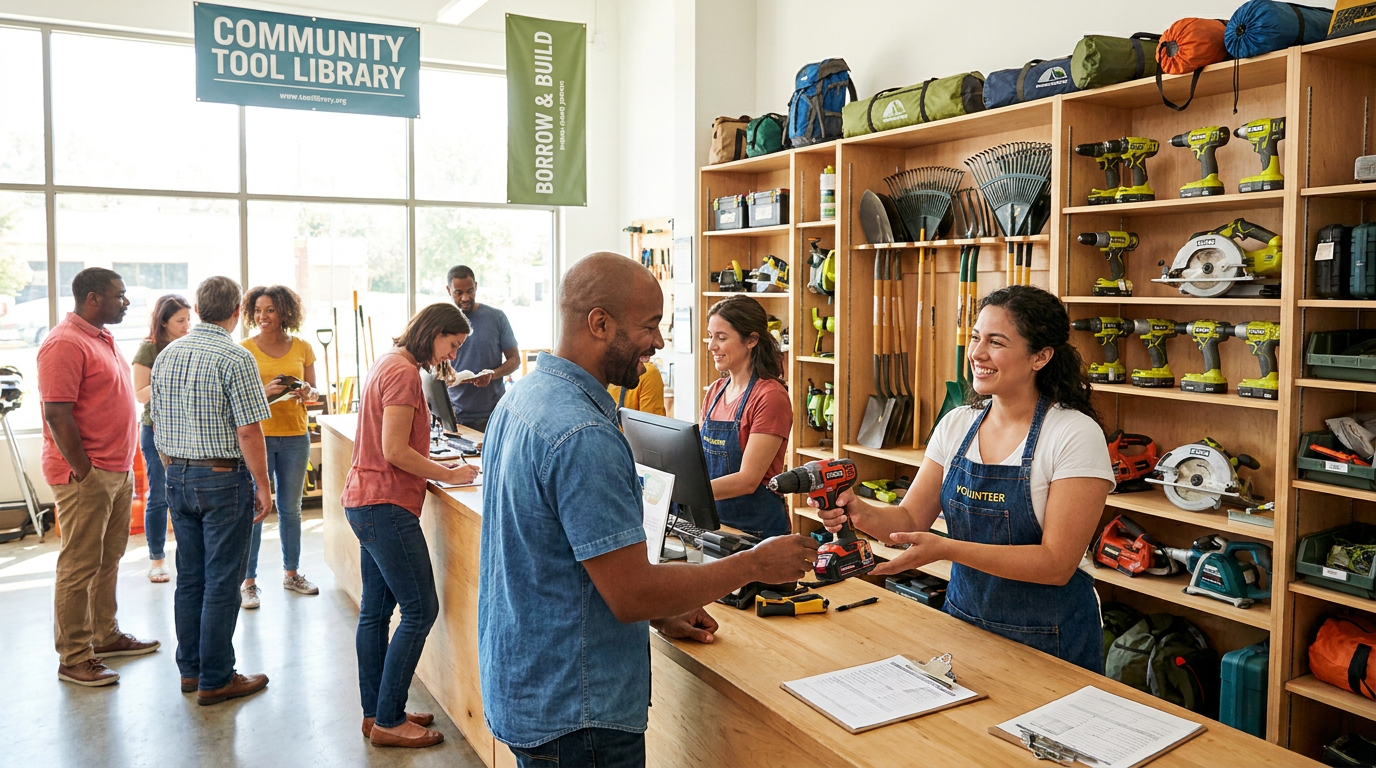
A patron walks into a local public library, approaches the circulation desk, and hands over their library card. But instead of leaving with a stack of hardcover novels, they walk out with a cordless power drill, a telescope, and a pasta maker. Across the globe, this scene has transitioned from a quirky novelty to a daily routine. The "Library of Things" movement has officially moved from the fringes of neighborhood activism into the core of municipal infrastructure.[8]
While the concept of lending tools dates back to the 1940s and saw a resurgence in the 1970s, the modern iteration has exploded in scale and scope. By 2026, thousands of formal and informal lending libraries are operating worldwide, supported by a growing network of public library systems and independent nonprofits. These organizations are fundamentally rethinking what it means to provide equitable access to resources.[6][8]
The philosophy driving this expansion is often summarized by a simple mantra popular among organizers: "You don't need a drill; you need a hole in the wall." Research frequently cited by sharing advocates notes that the average power drill is used for only about 12 minutes over its entire lifespan. For the rest of its existence, it sits idle in a garage or closet, representing trapped capital and wasted manufacturing resources.[3][7]

In an era marked by persistent inflation and high living costs, the economic relief provided by these libraries is substantial. Purchasing specialized, rarely used equipment—like a tile saw for a weekend renovation or a large tent for a single camping trip—places unnecessary strain on household budgets. Shared resource infrastructure acts as a buffer against this financial fragility, allowing residents to access what they need without incurring debt.[1]
The localized financial impact is striking. The Edinburgh Tool Library, Scotland's first tool-sharing community, recently reported that its Meadowbank hub saved members nearly £80,000 in avoided purchases over a single three-month period. Beyond the monetary savings, the organization also tracked a reduction of 16 metric tonnes of carbon dioxide emissions, illustrating the dual benefits of the model.[4]
Independent tool libraries are also achieving unprecedented institutional permanence. In Buffalo, New York, The Tool Library recently marked a major milestone by successfully raising $500,000 to purchase a permanent facility. Starting over a decade ago with just 50 tools and a dozen members, the social enterprise now houses an inventory of over 5,000 items and serves nearly 2,000 active members, proving the long-term viability of the community-funded model.[3]
Simultaneously, traditional public library systems are rapidly integrating "Things" into their catalogs. Organizations that support library professionals note that public libraries are uniquely positioned to host these collections. They already possess the cataloging software, the physical space, and, most importantly, the deep-seated trust of the communities they serve.[2]

Simultaneously, traditional public library systems are rapidly integrating "Things" into their catalogs.
The variety of items available for checkout has grown far beyond hammers and wrenches. Today's collections are highly tailored to local interests and needs. Patrons can borrow camping gear, board games, sewing machines, and specialized baking pans. In some regions, libraries lend out musical instruments, ranging from ukuleles and kalimbas to electronic drum sets and amplifiers.[6]
Digital inclusion is another major frontier for the movement. Recognizing that technology access is a critical determinant of economic opportunity, libraries have expanded their offerings to include Wi-Fi hotspots, laptops, and tablets. They also provide niche electronics like GoPros, digital scanners, and VHS-to-digital converters, allowing families to preserve memories without buying expensive, single-use hardware.[6]
The environmental implications of the Library of Things are profound. By pooling resources, communities drastically reduce the manufacturing demand for consumer goods. This circular economy approach minimizes the extraction of raw materials, cuts down on packaging waste, and diverts perfectly functional items from local landfills.[1][7]
Inventory sourcing itself is an exercise in community sustainability. Organizers estimate that up to 90 percent of the items in many tool libraries are donated by local residents. These donations frequently occur when individuals are downsizing their homes, clearing out estates, or simply decluttering, ensuring that valuable tools are redistributed rather than discarded.[7]

Beyond the physical items, these libraries serve as vital social hubs. They frequently host repair cafes, where volunteers help residents fix broken appliances, and offer skill-sharing workshops on everything from basic carpentry to bicycle maintenance. This educational component empowers individuals to become more self-reliant and counters the modern culture of disposable consumerism.[1][5]
The movement is also actively working to dismantle barriers in traditionally exclusive fields. Programs like the Women & Non-Binary Makers initiative in Edinburgh provide supportive, inclusive environments for individuals underrepresented in the trades. By offering access to tools alongside hands-on instruction, these spaces foster confidence and create a profound sense of belonging.[4]
Operating a Library of Things is not without its logistical hurdles. Administrators must navigate complex liability issues, draft comprehensive waiver systems, and ensure rigorous safety checks for power equipment. Furthermore, the model relies heavily on the dedication of staff and volunteers who possess the expertise to maintain and repair the inventory after repeated use.[2][5]

To reach underserved populations, organizers are pioneering new models of access. Innovations like mobile Share Sheds and automated lending kiosks are bringing resources directly to rural areas and affordable housing complexes. By decentralizing the collections, these initiatives ensure that transportation barriers do not prevent low-income residents from participating in the sharing economy.[1][4]
As the movement looks toward the future, its proponents envision a paradigm shift in urban planning. The ultimate goal is to establish shared resource infrastructure as a ubiquitous municipal service, as expected and accessible as public parks or water utilities. By transforming underused goods into collective assets, the Library of Things is quietly building more resilient, connected, and capable communities.[1][8]
How we got here
1943
The Grosse Pointe Public Library in Michigan establishes one of the first known tool lending programs to address wartime shortages.
1979
The Berkeley Tool Lending Library opens in California, becoming one of the longest-running continuous tool libraries in the world.
2013
The term 'Library of Things' gains widespread traction after a Sacramento Public Library program attracts national media coverage.
2021
The movement sees a massive surge in popularity as pandemic lockdowns drive interest in DIY projects, gardening, and home repair.
2026
Major independent tool libraries secure permanent facilities, and public library systems globally cement non-traditional lending as a core municipal service.
Viewpoints in depth
Resource Sharing Advocates
Argue that communal resource infrastructure is essential for environmental sustainability and household economic resilience.
This camp views the Library of Things not merely as a convenient perk, but as a necessary intervention against hyper-consumerism. Organizations like Shareable emphasize that the current model—where every household is expected to purchase and store rarely used equipment—creates financial fragility and massive environmental waste. By transitioning to a circular economy, they argue, communities can drastically reduce carbon emissions and manufacturing demand while freeing up household capital for essential needs.
Public Library Administrators
View non-traditional lending as a natural evolution of the library's core mission to provide equitable access to information and tools.
For library professionals, expanding into physical objects is a logical extension of their historical mandate. As digital media replaces physical books, administrators see the Library of Things as a way to maintain relevance and drive foot traffic. They highlight that public libraries already possess the cataloging infrastructure, community trust, and physical footprint required to manage complex lending systems, making them the ideal stewards for community-owned assets.
Community Organizers
Focus on the social empowerment, skill-building, and neighborhood cohesion fostered by shared spaces.
Operators of independent tool libraries emphasize the human element of resource sharing. For these organizers, the tools are often secondary to the community connections forged in the process. They point to repair cafes, DIY workshops, and inclusive maker spaces as critical venues for combating social isolation. By providing marginalized groups with the skills and equipment to improve their own living conditions, organizers argue that these libraries serve as engines for grassroots empowerment and neighborhood resilience.
What we don't know
- How traditional hardware retailers and consumer goods manufacturers will adapt their business models if community sharing reaches critical mass.
- Whether municipal governments will provide sustained, long-term funding to support the maintenance and staffing required for large-scale lending libraries.
Key terms
- Library of Things (LoT)
- A collection of non-traditional items—such as tools, electronics, and camping gear—available for community members to borrow.
- Circular Economy
- An economic system aimed at eliminating waste and the continual use of resources by sharing, leasing, reusing, repairing, and recycling existing materials.
- Repair Cafe
- Free meeting places where volunteers help community members repair broken household items, appliances, and clothing.
- Sharing Economy
- A socio-economic system built around the sharing of resources, often facilitated by community networks or digital platforms.
Frequently asked
What kinds of items can I borrow from a Library of Things?
Collections vary by location but typically include power tools, gardening equipment, camping gear, kitchen appliances, musical instruments, and electronics like Wi-Fi hotspots.
Are these libraries free to use?
Libraries operated by public library systems are usually free for cardholders. Independent nonprofit tool libraries often charge a low-cost annual membership fee, with subsidies available for low-income residents.
What happens if an item breaks while I am using it?
Most libraries understand that tools experience normal wear and tear. Patrons are generally not penalized for accidental breakage, though they may be charged a replacement fee if an item is lost or damaged due to negligence.
Can I donate my old tools to a local library?
Yes. Many tool libraries rely heavily on community donations. However, they typically require items to be in safe, working condition and ask that you check their current inventory needs before dropping items off.
Sources
Source coverage
8 outlets
3 viewpoints surfaced








[1]ShareableResource Sharing Advocates
Library of Things Toolkit: Building Shared Resource Infrastructure
Read on Shareable →[2]WebJunctionPublic Library Administrators
Library of Things examples and inspiration
Read on WebJunction →[3]The Tool LibraryCommunity Organizers
The Tool Library: Our Story and Future
Read on The Tool Library →[4]Places for PeopleCommunity Organizers
Celebrating a decade of Scotland's first tool-sharing Community
Read on Places for People →[5]Chicago Tool LibraryCommunity Organizers
Chicago Tool Library's 5-Year Milestone Campaign
Read on Chicago Tool Library →[6]WikipediaResource Sharing Advocates
Library of things
Read on Wikipedia →[7]GuelphTodayCommunity Organizers
Guelph Tool Library reaches major lending milestone
Read on GuelphToday →[8]Factlen Editorial TeamResource Sharing Advocates
Synthesis by Factlen editorial team
Read on Factlen Editorial Team →
Every angle. Every day.
Get community stories with full source coverage and perspective breakdowns delivered to your inbox.