
First Fully AI-Generated Feature Film Premieres at Tribeca, Shattering Production Barriers
A 75-minute docudrama about the Iranian protests, created entirely with artificial intelligence for just $2,000, has become the first synthetic live-action feature accepted at a major film festival.
By Factlen Editorial Team
- AI-Empowered Creators
- Independent artists who view AI as a democratizing force that shatters financial and political barriers.
- Traditional Cinema Purists
- Industry professionals and critics who believe synthetic media undermines the collaborative craft of filmmaking.
- Festival Curators
- Programmers who prioritize the emotional impact and cultural urgency of a story over the specific tools used to create it.
What's not represented
- · Below-the-line Hollywood crew members whose specific trades are bypassed by AI generation.
- · Iranian citizens currently living under the regime who are the subjects of the film's dramatization.
Why this matters
This breakthrough proves that feature-length filmmaking is no longer restricted to million-dollar studios. By allowing a lone creator to bypass both financial gatekeepers and authoritarian censorship for just $2,000, AI is fundamentally democratizing who gets to tell the world's most urgent stories.
Key points
- 'Dreams of Violets' is the first fully AI-generated live-action feature to premiere at a major film festival.
- The 75-minute docudrama about the 2026 Iranian protests was created in three months for just $2,000.
- Director Ash Koosha used AI to bypass censorship and protect the identities of actors who would otherwise face retaliation.
- The film's inclusion at Tribeca sparked backlash from traditional filmmakers concerned about job losses and artistic integrity.
- Critics are divided on the film's quality, noting its visual ambition but criticizing its 'uncanny valley' character movements.
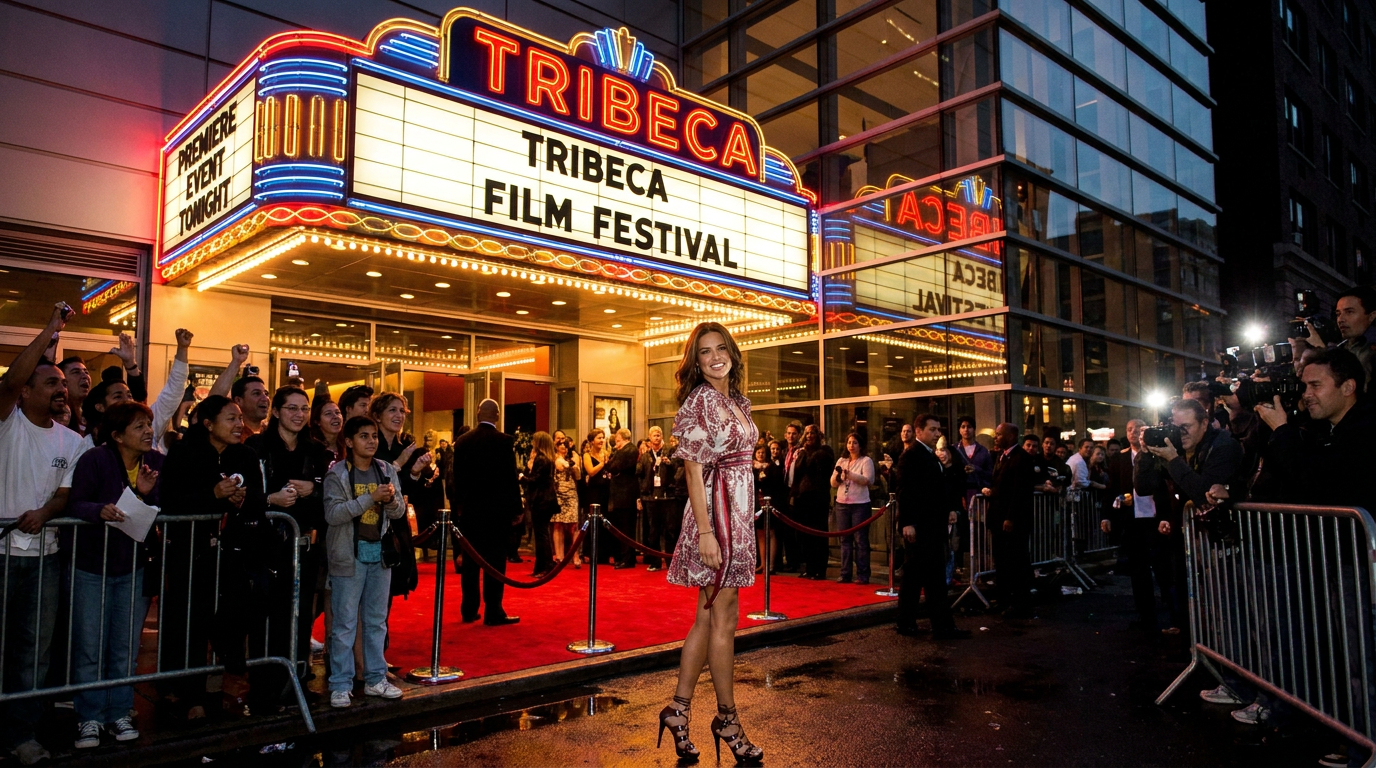
For decades, the barriers to entry in feature filmmaking have been rigidly defined by capital, geography, and studio greenlights. But at the 2026 Tribeca Film Festival, a 75-minute drama quietly shattered those historical constraints. 'Dreams of Violets', a harrowing docudrama chronicling the brutal January 2026 anti-government protests in Iran, made its world premiere on June 10. What makes the film a watershed moment for the industry is not just its timely subject matter, but its entirely synthetic genesis. It is the first fully AI-generated, live-action feature film to ever be accepted into the official competition lineup of a major international film festival.[1][2]
Directed by Iranian-British filmmaker Ash Koosha and produced by his brother Pooya Koosha, the film represents a radical departure from traditional production pipelines. There were no cameras, no physical sets, and no human actors on screen. Instead, the Koosha brothers utilized a suite of generative artificial intelligence tools to synthesize every frame, character, and environment from scratch. Operating under their AI studio, Fountain 0, the creators managed to compress what would normally be a multi-year, multi-million-dollar endeavor into a remarkably brief window. The entire 75-minute feature was completed in just three months, with a total production budget of approximately $2,000.[1][6]
The narrative of 'Dreams of Violets' is a fictionalized dramatization deeply anchored in real-world journalism, eyewitness accounts, and smuggled photographs from the recent Iranian uprisings. The film weaves together the interconnected stories of five civilians—including a surgeon treating wounded demonstrators and a young boy witnessing the violence from his window—who cross paths in a Tehran alleyway. International organizations estimate that the January crackdowns resulted in over 7,000 civilian casualties amidst a state-enforced communications blackout. By synthesizing the visuals, Koosha aimed to create a 'memorial film' for a tragedy that unfolded behind a wall of censorship.[2][3]

For Koosha, the decision to use artificial intelligence was born out of absolute necessity rather than mere technological curiosity. As an exiled filmmaker living in London, he had no physical access to Iran and no ability to safely shoot on location. Furthermore, casting real actors to portray dissidents in a film highly critical of the Iranian regime would have placed those individuals in severe danger of state retaliation. 'Because of the security issue, it would not be safe for the characters to even remotely resemble someone,' Koosha explained, noting that the AI pipeline allowed him to bypass the regime's censorship apparatus entirely.[1][3]
The technical execution of 'Dreams of Violets' relied on a complex stack of commercially available and proprietary AI models. The production team utilized Kling AI for the heavy lifting of video generation, Anthropic's Claude for script refinement and editing logic, and Google's Gemini for visual research and reference imagery. To solve the notorious continuity issues that plague AI video—where characters and backgrounds morph unpredictably between shots—Fountain 0 deployed its own custom software to ensure blocking and frame accuracy. Koosha also voice-acted all the roles himself, subsequently running his audio through AI voice-modulation tools to generate the distinct timbres of young women, elderly men, and children.[1][6]
The technical execution of 'Dreams of Violets' relied on a complex stack of commercially available and proprietary AI models.
The inclusion of an entirely synthetic film at Tribeca has predictably ignited a firestorm of controversy within the independent film community. Almost immediately after the festival announced its lineup, calls for a boycott began circulating online, with traditional filmmakers expressing outrage over the normalization of what critics derisively term 'AI slop.' Detractors argue that programming machine-generated content actively displaces human artists who spend years scraping together funding for their projects. The backlash taps into deep-seated anxieties across a Hollywood workforce that is already facing severe contractions and job losses in the wake of recent industry strikes and streaming realignments.[4][5]

Critics who attended the premiere were sharply divided on the film's aesthetic merits, highlighting the current limitations of generative video. Reviewers noted that while the film is visually arresting, it frequently falls into the uncanny valley. Characters occasionally move with an unnatural stiffness, and their facial expressions can feel wooden or disconnected from the heavy emotional weight of the dialogue. Some cinematic purists reported feeling alienated by the synthetic tears and flickering background details, arguing that the technology cannot yet replicate the lived-in, nuanced performances of human actors.[3][5]
Despite the aesthetic critiques, many industry observers acknowledge that the film's very existence forces a necessary conversation about the democratization of cinema. If a lone creator with a laptop and $2,000 can produce a feature-length film that looks roughly equivalent to a mid-budget studio production, the financial gatekeeping of Hollywood could be fundamentally altered. Koosha has pointed out that rendering 'Dreams of Violets' using traditional CGI would have cost millions of dollars. The AI workflow effectively allowed him to operate at the 'speed of news,' transforming raw current events into a finished cinematic narrative while the global conversation was still unfolding.[1][3]
Tribeca Festival co-founder Jane Rosenthal has staunchly defended the decision to program the film, framing it as an exploration of new creative frontiers rather than a replacement for human artistry. In a public statement addressing the backlash, Rosenthal argued that the film serves as a powerful example of how emerging technologies can be utilized as vehicles for deeply human storytelling. She emphasized that the festival was moved not merely by the technological achievement, but by the emotional immediacy and urgency of a story that provides a rare window into a heavily restricted global conflict.[2][4]

'Dreams of Violets' is not an isolated anomaly, but rather the vanguard of a gathering wave of synthetic media entering the mainstream. Earlier in the year, an AI action-adventure film titled 'Hell Grind' screened alongside the Cannes Film Festival, and fully AI-animated features have been circulating since 2024. However, Koosha's drama is the first to accrue genuine artistic credibility and secure a coveted spot in a top-tier festival competition. As generative models continue to improve at an exponential rate, the technical flaws that currently define the uncanny valley are expected to smooth out, leaving the industry to grapple with the profound philosophical implications of the medium.[1][4]
Ultimately, the legacy of 'Dreams of Violets' may have less to do with its specific frame-by-frame execution and more to do with the precedent it sets for marginalized creators. It proves that artificial intelligence can be leveraged as a tool of resistance, granting exiled artists, underfunded visionaries, and political dissidents the power to visualize stories that authoritarian regimes or risk-averse studios would prefer to keep hidden. As the technology matures, the definition of what constitutes a 'real' film will undoubtedly stretch, but the fundamental human drive to bear witness and share those experiences remains unchanged.[3][6]
How we got here
January 2026
Massive anti-government protests erupt across Iran, resulting in a severe state crackdown and communications blackout.
March 2026
Exiled filmmaker Ash Koosha begins production on 'Dreams of Violets' using a suite of generative AI tools.
May 2026
The Tribeca Film Festival announces the film's inclusion in its official lineup, sparking immediate industry backlash.
June 10, 2026
The film makes its world premiere in New York, becoming the first fully AI-generated live-action feature to screen at a major festival.
Viewpoints in depth
AI-Empowered Creators
Independent artists who view AI as a democratizing force that shatters financial and political barriers.
For exiled filmmakers and independent creators without studio backing, generative AI represents a profound leveling of the playing field. This camp argues that the technology allows marginalized voices to bypass traditional gatekeepers and tell stories that would otherwise be impossible to finance or too dangerous to film. They view the $2,000 budget of 'Dreams of Violets' not as a threat to the industry, but as proof that high-concept storytelling is no longer the exclusive domain of million-dollar studios.
Traditional Cinema Purists
Industry professionals and critics who believe synthetic media undermines the collaborative craft of filmmaking.
Many traditional filmmakers and critics argue that AI-generated cinema lacks the essential human soul required for deeply resonant art. They point to the 'uncanny valley' aesthetics—stiff movements, hollow expressions, and synthetic tears—as evidence that algorithms cannot replicate the nuanced, lived-in performances of human actors. Furthermore, this camp harbors deep anxieties about the economic impact of the technology, fearing that the normalization of 'AI slop' at major festivals will lead to widespread job displacement across the industry.
Festival Curators
Programmers who prioritize the emotional impact and cultural urgency of a story over the specific tools used to create it.
Festival organizers like Tribeca's Jane Rosenthal maintain that their primary mandate is to champion artists who push the boundaries of storytelling. From this perspective, AI is simply the latest evolution in a long history of cinematic innovation, akin to the transition from practical effects to CGI. Curators argue that if a synthetic film can successfully convey the emotional truth of a restricted global conflict and move an audience, it deserves a platform alongside traditionally produced cinema.
What we don't know
- How major Hollywood studios will respond to the rapidly dropping cost of feature-length AI production.
- Whether audiences will broadly accept the 'uncanny valley' aesthetics of synthetic actors in emotionally heavy dramas.
- If other top-tier film festivals like Cannes or Sundance will follow Tribeca's lead in accepting fully AI-generated features into official competition.
Key terms
- Generative AI Video
- Artificial intelligence systems that can create new, realistic video footage from text descriptions or still images.
- Uncanny Valley
- The unsettling feeling observers experience when a synthetic figure looks almost, but not perfectly, human.
- Blocking
- The precise staging and positioning of actors within a scene to ensure visual continuity and narrative flow.
- Docudrama
- A fictionalized film or television program that is based heavily on real-world events and journalistic accounts.
Frequently asked
What is 'Dreams of Violets' about?
It is a 75-minute docudrama that follows five civilians during the January 2026 anti-government protests in Iran.
Were any real actors used in the film?
No. Every character, environment, and frame was generated entirely by artificial intelligence, though director Ash Koosha provided the base voice acting.
Why didn't the director shoot it normally?
As an exiled filmmaker, Koosha could not safely film in Iran, and casting real actors to play dissidents would have put their lives at risk of state retaliation.
How much did the movie cost to make?
The entire feature was produced in three months for approximately $2,000 using commercially available AI tools.
Sources
Source coverage
6 outlets
3 viewpoints surfaced






[1]The GuardianAI-Empowered Creators
'The CGI would have cost millions. I spent $2,000.' Is Dreams of Violets AI slop – or the future of film-making?
Read on The Guardian →[2]The IndependentFestival Curators
AI-generated film 'Dreams of Violets' is set to premiere at Tribeca Film Festival
Read on The Independent →[3]TheWrapTraditional Cinema Purists
'Dreams of Violets' Review: An AI-Generated Movie Is Worrisome for All the Right Reasons
Read on TheWrap →[4]NBC NewsFestival Curators
Tribeca Film Festival premieres first fully AI-generated film 'Dreams of Violets'
Read on NBC News →[5]PetaPixelTraditional Cinema Purists
The AI Film 'Dreams of Violets' Is How You Get Me to Hate Movies
Read on PetaPixel →[6]Let's Data ScienceAI-Empowered Creators
Ash Koosha's 'Dreams of Violets' Premieres at Tribeca
Read on Let's Data Science →

Every angle. Every day.
Get entertainment stories with full source coverage and perspective breakdowns delivered to your inbox.