
2026 Rivian R2 vs. Tesla Model Y: The Midsize Electric SUV Comparison
As the electric vehicle market matures, buyers face a definitive choice between Rivian’s rugged, off-road-capable R2 and Tesla’s highly efficient, street-oriented Model Y Juniper update.
By Factlen Editorial Team
- Efficiency and Value Maximizers
- Prioritize maximum range, lower starting prices, and established daily-driving technology.
- Utility and Adventure Advocates
- Value ground clearance, cargo space, and off-road capability over pure aerodynamic efficiency.
- Automotive Market Analysts
- Focus on how these two models represent the maturing of the EV market into distinct consumer segments.
What's not represented
- · Traditional dealership advocates who prefer in-person buying experiences over the direct-to-consumer models used by both Tesla and Rivian.
- · Buyers requiring third-row seating, as the R2 is strictly a five-seater and the Model Y's optional third row is notoriously cramped.
Why this matters
For years, midsize electric SUV buyers had to accept whatever compromises early automakers offered. In 2026, the market has finally split into distinct philosophies—rugged utility versus aerodynamic efficiency—allowing consumers to buy an EV that actually matches their lifestyle.
Key points
- The 2026 EV market offers a clear choice between Rivian's rugged utility and Tesla's aerodynamic efficiency.
- The Rivian R2 features 9.6 inches of ground clearance and 90.1 cubic feet of cargo space.
- The Tesla Model Y Juniper update brings a quieter cabin, ventilated seats, and up to 357 miles of range.
- Tesla maintains a price advantage, with base models starting around $41,630 compared to Rivian's $45,000.
- Both vehicles now utilize the NACS port, granting equal access to the Supercharger network.
- The choice ultimately depends on whether a buyer prioritizes outdoor adventure or daily commuting value.
The midsize electric SUV segment has officially matured. For years, the Tesla Model Y dominated this space by default, offering an unmatched blend of range, software, and charging infrastructure. But 2026 marks a turning point. Automakers are no longer just trying to build a generic electric vehicle; they are building highly specialized machines tailored to distinct consumer lifestyles. The arrival of the Rivian R2 and the comprehensive "Juniper" update to the Tesla Model Y perfectly illustrates this shift. Buyers no longer have to compromise; they can choose between two fundamentally different philosophies of what an electric SUV should be.[3][7]
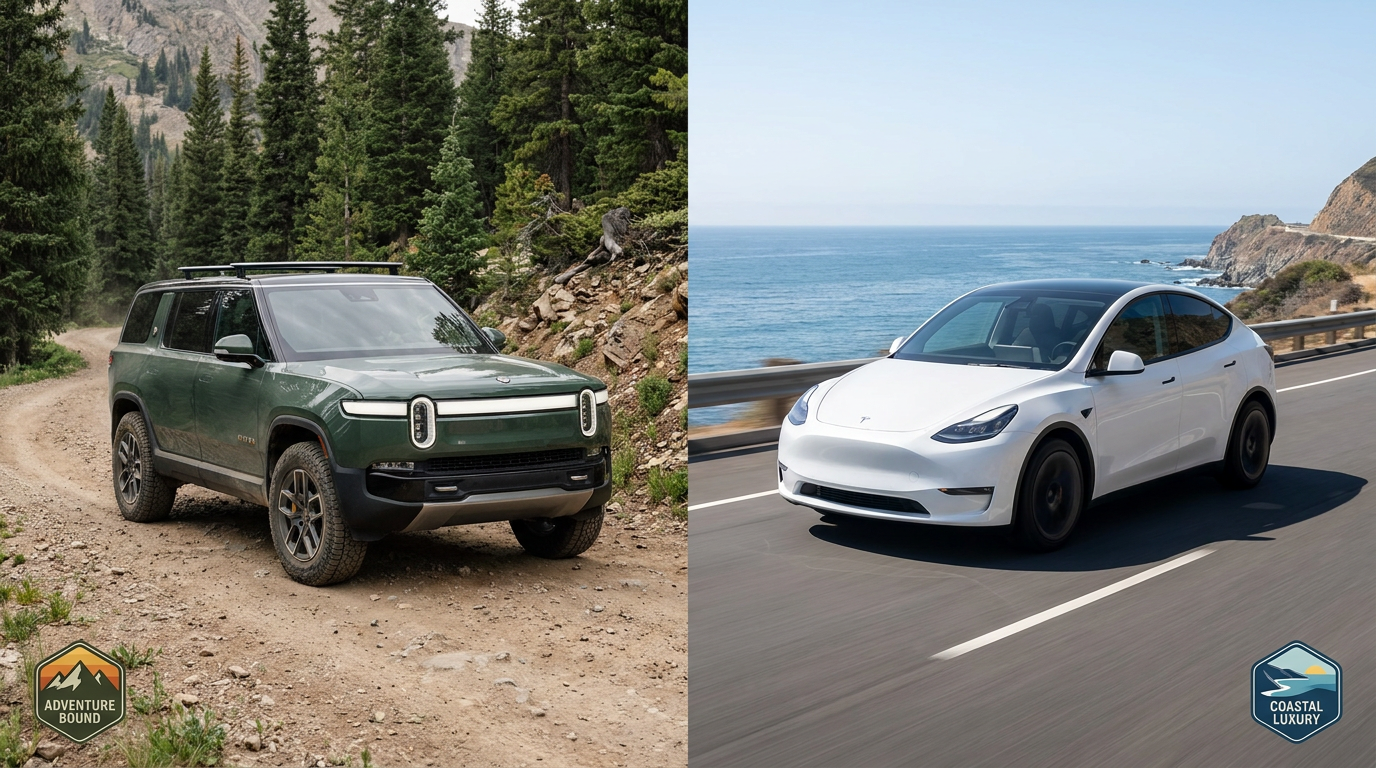
On one side of the showroom sits the 2026 Tesla Model Y. Benefiting from its significant Juniper refresh, the Model Y doubles down on its core strengths: aerodynamic efficiency, street-oriented performance, and a minimalist, tech-forward cabin. On the other side is the Rivian R2, a vehicle that deliberately sacrifices wind resistance in favor of boxy utility, massive ground clearance, and a rugged, go-anywhere persona. While they occupy roughly the same footprint in a parking lot, they are engineered for entirely different weekends.[1][2][5]
The case for the Rivian R2 centers on adventure and uncompromising utility. Rivian recognized that many SUV buyers actually want the traditional, upright proportions of a classic off-roader, not a teardrop-shaped crossover. The R2 delivers a commanding driving position, exceptional visibility, and a cabin designed to get dirty and be easily cleaned. It is built for drivers who regularly load up camping gear, navigate rutted forest service roads, or simply prefer the muscular stance of a traditional truck translated into the EV era.[3][4]
The case against the Rivian R2 involves its aerodynamic penalty and a slightly higher cost of entry. Pushing a tall, flat-nosed box through the air requires more energy. While Rivian has engineered impressive efficiency into the R2, it cannot match the sheer miles-per-kilowatt-hour of its sleeker rival. Furthermore, the R2 carries a price premium; the base model starts at $45,000, and the highly desirable Performance Launch Edition pushes past $57,000, making it a more expensive proposition for budget-conscious families.[1][3]
The evidence for the Rivian R2 lies in its hard numbers. It boasts a massive 9.6 inches of ground clearance—a full 60 percent more than the Model Y—paired with a 25-degree approach angle and a 26-degree departure angle. This makes it genuinely trail-capable. Inside, the boxy greenhouse translates to 90.1 cubic feet of total cargo space when the seats are folded and the frunk is included, offering 19 percent more storage than its Tesla counterpart. Even with its rugged shape, the Premium AWD model still achieves an EPA-estimated 330 miles of range.[1][4]

The case for the Tesla Model Y is built on unmatched efficiency, continuous refinement, and exceptional value. The 2026 Juniper update addresses nearly every historical criticism of the vehicle. Tesla has retuned the suspension for a far more absorbent ride, added extensive sound deadening to quiet the cabin, and introduced ventilated seats and a rear entertainment screen. It remains the undisputed champion of the daily commute, offering sports-car acceleration in a highly practical, aerodynamic package.[2][5][6]
The case against the Tesla Model Y comes down to ubiquity and physical limitations. It is the best-selling vehicle in the world, meaning it lacks the unique, head-turning appeal of a newer startup brand. More importantly, its 6.0 inches of ground clearance and sloping roofline severely limit its utility for serious outdoor enthusiasts. It is a street-oriented crossover that excels on pavement but risks underbody damage on anything rougher than a well-graded gravel driveway.[1][6]
The case against the Tesla Model Y comes down to ubiquity and physical limitations.
The evidence for the Tesla Model Y is anchored by its pricing and range metrics. The base RWD model starts at a highly competitive $41,630, significantly undercutting the Rivian. For those prioritizing distance, the Premium RWD variant delivers an impressive 357 miles of range on standard 19-inch wheels. In terms of efficiency, the Model Y achieves up to 134 MPGe combined, ensuring that owners spend less money on electricity over the lifespan of the vehicle.[2][5]

Trade-off analysis reveals that the choice between these two vehicles is rarely about which is objectively better, but rather which compromises a buyer is willing to accept. The Rivian R2 trades highway efficiency for interior volume. Its taller roofline means rear passengers enjoy a less claustrophobic experience, and the cargo area can swallow bulky, square items like dog crates or mini-fridges that simply will not fit beneath the Model Y's sloped rear hatch.[1][7]
Another critical trade-off involves the interior experience. The Tesla Model Y's Juniper update provides a serene, minimalist environment. The focus is entirely on the massive central touchscreen, and the new acoustic glass makes highway cruising incredibly peaceful. The Rivian R2, conversely, embraces a tactile, rugged aesthetic. It features durable materials, a roll-down rear window for hauling long items like surfboards, and a design language that feels more like premium outdoor gear than a Silicon Valley gadget.[4][5]

Charging infrastructure, once a massive advantage for Tesla, has become a neutral battleground. The 2026 Rivian R2 features a native NACS (North American Charging Standard) port, granting it seamless, adapter-free access to Tesla's sprawling Supercharger network. Both vehicles can charge from 10 to 80 percent in roughly 15 to 30 minutes depending on the station, effectively neutralizing range anxiety for road trips in either model.[3][5]
The Rivian R2 fits well when buyers prioritize an active outdoor lifestyle, require maximum cargo volume for gear, and want a vehicle with a distinctive, rugged personality. It is the ideal choice for drivers who actually intend to take their SUV to trailheads, campsites, or snowy mountain passes where ground clearance is non-negotiable. It also appeals to those who simply prefer the commanding view and aesthetic of a traditional truck.[1][4][7]
The Rivian R2 does not fit when the primary goal is maximizing commuting efficiency, or when the buyer is strictly bound by a $40,000 budget. Drivers who spend 95 percent of their time on smooth highways and prioritize the lowest possible cost-per-mile will find the R2's aerodynamic drag and higher starting price counterproductive to their needs.[3][7]
The Tesla Model Y fits well when buyers want the absolute best range per dollar, proven software integration, and a refined, street-oriented ride. It is perfect for suburban families, daily commuters, and tech enthusiasts who appreciate minimalist design and sports-sedan handling. The Juniper update makes it an incredibly comfortable long-distance cruiser that is exceptionally cheap to operate.[2][5][6]

The Tesla Model Y does not fit when drivers need to navigate rough terrain, require a tall cargo area for bulky items, or want a vehicle that stands out in a crowded parking lot. Its sloping roofline compromises ultimate utility, and its low stance makes it unsuitable for genuine off-road exploration.[1][6][7]
Ultimately, the 2026 EV landscape is better for having both of these vehicles. The Rivian R2 and the Tesla Model Y prove that the electric transition is no longer a one-size-fits-all endeavor. Whether a driver values the aerodynamic grace of the Model Y or the rugged capability of the R2, they can now purchase a zero-emission vehicle that perfectly aligns with how they actually live their lives.[3][7]
How we got here
March 2024
Rivian officially announces the R2 midsize SUV, targeting a $45,000 starting price.
Late 2025
Tesla begins rolling out the highly anticipated 'Juniper' refresh for the Model Y globally.
Spring 2026
Rivian begins deliveries of the R2 Performance Launch Edition to early reservation holders.
Mid 2026
Both the Rivian R2 and the refreshed Tesla Model Y are available for direct comparison in the US market.
Viewpoints in depth
Utility and Adventure Advocates
Drivers and reviewers who prioritize ground clearance, cargo volume, and off-road capability.
For this camp, the Rivian R2 is the EV they have been waiting for. They argue that traditional crossovers like the Model Y are essentially raised hatchbacks that fail to deliver true SUV utility. By offering 9.6 inches of ground clearance, a boxy rear hatch that can accommodate large dogs or camping gear, and a cabin built to withstand dirt and wear, the R2 fulfills the promise of a sport utility vehicle. They view the aerodynamic penalty as a worthwhile trade-off for a vehicle that can actually reach remote trailheads without scraping its undercarriage.
Efficiency and Value Maximizers
Consumers who focus on maximum range, lower starting prices, and proven daily-driving tech.
This perspective champions the Tesla Model Y, particularly with its Juniper refinements. They point out that 95 percent of SUV owners rarely leave paved roads, making massive ground clearance an unnecessary drain on battery efficiency. For these buyers, the Model Y's ability to deliver 357 miles of range and 134 MPGe combined makes it the undisputed logical choice. They argue that Tesla's lower starting price of $41,630, combined with its quieter cabin and superior highway ride, provides unmatched value for the reality of daily commuting.
Automotive Market Analysts
Industry observers tracking the maturation and segmentation of the electric vehicle market.
Analysts view this matchup as a sign of a healthy, maturing EV sector. In the early days of electrification, buyers had to accept whatever form factor an automaker could produce. Now, the market is segmenting exactly as the internal combustion engine market did decades ago. Analysts note that Rivian and Tesla are no longer just competing on battery specs; they are competing on brand identity and lifestyle alignment. This divergence—aerodynamic street cruisers versus boxy off-roaders—indicates that EVs are finally ready to serve every niche of the consumer market.
What we don't know
- How the base $45,000 Rivian R2's smaller battery pack will perform in real-world range tests once it launches.
- Whether Tesla will introduce further software-locked performance boosts for the Juniper update later in the year.
- How long wait times will be for the highly anticipated Rivian R2 Performance Launch Edition.
Key terms
- NACS (North American Charging Standard)
- The charging plug design originally developed by Tesla, now adopted by Rivian and most other automakers for seamless access to Superchargers.
- MPGe (Miles Per Gallon Equivalent)
- A metric used by the EPA to compare the energy efficiency of electric vehicles to traditional gas-powered cars.
- Approach and Departure Angles
- The maximum angles of a ramp or obstacle a vehicle can climb or descend without the bumpers scraping the ground.
- Frunk
- A front trunk; storage space located under the hood of an electric vehicle where an engine would traditionally sit.
Frequently asked
Which EV has more cargo space?
The Rivian R2 has significantly more space, offering 90.1 cubic feet of total storage compared to the Tesla Model Y's 76 cubic feet.
Can the Rivian R2 use Tesla Superchargers?
Yes, the 2026 Rivian R2 comes with a native NACS port, allowing it to plug directly into Tesla Superchargers without an adapter.
Which vehicle is faster from 0 to 60 mph?
Both are incredibly fast in their top trims; the Tesla Model Y Performance hits 60 mph in roughly 3.5 seconds, while the Rivian R2 Performance takes 3.6 seconds.
Is the Tesla Model Y cheaper than the Rivian R2?
Yes, the base Tesla Model Y starts at $41,630, while the base Rivian R2 starts at $45,000, with premium trims pushing higher.
Sources
Source coverage
7 outlets
3 viewpoints surfaced







[1]ElectrekUtility and Adventure Advocates
Rivian R2 vs Tesla Model Y: A dimension-by-dimension comparison
Read on Electrek →[2]Car and DriverEfficiency and Value Maximizers
2026 Tesla Model Y: Pricing, Specs, and Review
Read on Car and Driver →[3]EdmundsAutomotive Market Analysts
The Rivian R2 hits the heart of the EV market
Read on Edmunds →[4]Top GearUtility and Adventure Advocates
Rivian R2 US review
Read on Top Gear →[5]AutoblogEfficiency and Value Maximizers
2026 Tesla Model Y Review: The Juniper update arrives
Read on Autoblog →[6]CarwowAutomotive Market Analysts
Rivian R2 vs Tesla Model Y: which electric SUV is best?
Read on Carwow →[7]Factlen Editorial TeamAutomotive Market Analysts
Synthesis by Factlen editorial team
Read on Factlen Editorial Team →
Every angle. Every day.
Get automotive stories with full source coverage and perspective breakdowns delivered to your inbox.