
The 10,000-Step Myth: How Many Steps You Actually Need for Longevity
The famous 10,000-step daily goal was born from a 1960s marketing campaign, not medical science. Massive new meta-analyses reveal that significant cardiovascular and longevity benefits begin at less than half that number.
By Factlen Editorial Team
- Public Health Researchers
- Focus on lowering the barrier to entry to get sedentary populations moving.
- Fitness Optimizers
- Advocate for higher step counts and brisk intensity to maximize cardiovascular and metabolic health.
- Behavioral Psychologists
- Examine how step goals impact human motivation and the danger of all-or-nothing thinking.
What's not represented
- · Wheelchair users and adaptive athletes
- · Occupational workers with high mandatory step counts
Why this matters
Millions of people abandon their fitness goals because 10,000 steps feels unattainable on a busy workday. Understanding that life-saving cardiovascular benefits begin at just 2,300 steps relieves the anxiety of perfectionism and empowers people to embrace achievable, sustainable daily movement.
Key points
- The 10,000-step goal originated from a 1960s Japanese marketing campaign, not medical science.
- Cardiovascular health benefits begin at just 2,337 steps per day.
- The risk of dying from any cause drops significantly starting at 3,967 steps.
- Every additional 1,000 steps reduces the risk of all-cause mortality by 15%.
- For adults over 60, longevity benefits plateau between 6,000 and 8,000 steps.
- Accumulating steps offsets the health risks of sitting at a desk all day.
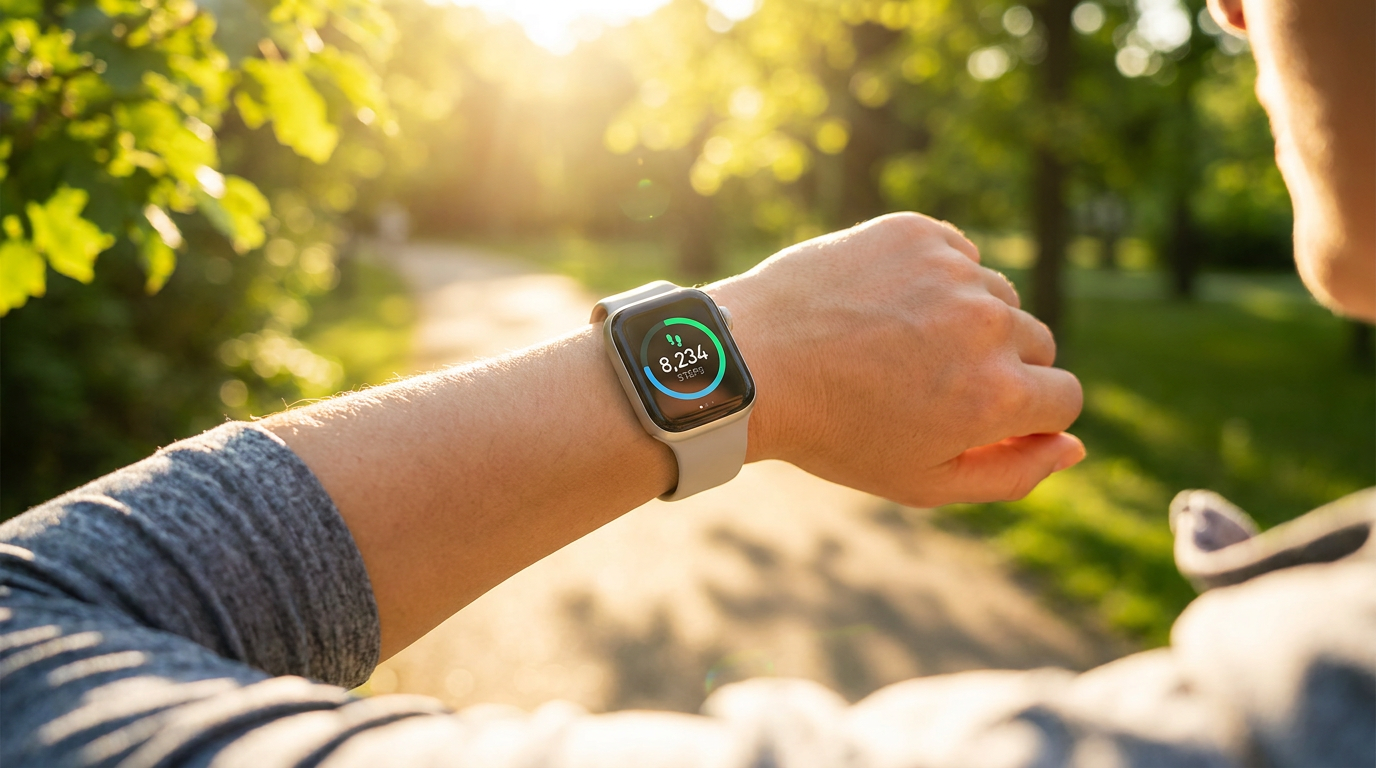
It is a familiar modern ritual: the vibration of a smartwatch at 9:00 PM, followed by a wave of guilt. The screen shows 6,200 steps, well short of the five-digit gold standard that fitness trackers, wellness influencers, and corporate wellness programs have championed for years. For millions, the 10,000-step goal is treated as a rigid medical commandment—the absolute baseline for a healthy human life.[6]
But the origins of this magic number did not emerge from a cardiology lab or a peer-reviewed medical journal. Instead, it was born in a 1960s marketing boardroom in Japan, designed to sell a new consumer gadget.[5]
Ahead of the 1964 Tokyo Olympics, a Japanese company capitalized on the national fitness craze by inventing one of the world's first wearable pedometers. They named the device the "Manpo-kei," which directly translates to "10,000 steps meter." The number was not chosen for its physiological benefits, but for its aesthetic elegance: the Japanese character for 10,000 (万) closely resembles a stick figure of a person walking.[2][5]
It was a brilliant marketing triumph that accidentally became global medical dogma. For decades, people assumed this round, satisfying number was the scientifically proven threshold for human health, baking it into the default code of every smartphone and wearable device on the market.[6]

Recently, however, massive epidemiological studies have finally put the 10,000-step rule to a rigorous scientific test. By tracking the actual health outcomes of hundreds of thousands of people over years of their lives, researchers have uncovered a reality that is profoundly uplifting for anyone who struggles to hit five digits.[1][4]
A landmark meta-analysis published in the European Journal of Preventive Cardiology examined data from nearly 227,000 people across 17 different studies. The researchers were not looking for an arbitrary goal; they wanted to find the actual "floor"—the minimum number of daily steps required to see a statistically significant health benefit.[1]
Their findings shattered the 10,000-step myth. The data revealed that the risk of dying from cardiovascular disease begins to significantly drop at just 2,337 steps per day. For context, many people achieve this simply by moving around their house and running a single errand.[1]
The data revealed that the risk of dying from cardiovascular disease begins to significantly drop at just 2,337 steps per day.
For all-cause mortality—the risk of dying prematurely from any cause whatsoever—the health benefits begin at 3,967 steps. In other words, a baseline of roughly 4,000 steps is enough to pull a person out of the high-risk "sedentary" category and into a state of active disease prevention.[1]

This does not mean people should stop walking once they hit 4,000. The researchers found a clear, powerful dose-response relationship: every additional 1,000 steps taken per day reduces the risk of all-cause mortality by a staggering 15 percent.[1]
Similarly, every extra 500 steps reduces cardiovascular mortality by 7 percent. The mantra among modern cardiologists has shifted away from "hit 10,000 or fail" to a much more encouraging message: "some is good, and more is better."[1]
But is there a ceiling where the benefits stop compounding? Research from the Harvard T.H. Chan School of Public Health tracked a cohort of older women and found that mortality rates progressively improved with more steps, but eventually leveled off at approximately 7,500 steps per day. Pushing to 10,000 provided no additional survival benefit for this demographic.[2]
Age plays a crucial role in these targets. For adults over 60, the longevity benefits generally plateau between 6,000 and 8,000 steps. For adults under 60, the optimal range sits slightly higher, with the maximum mortality reduction occurring between 8,000 and 10,000 steps.[2][4]

What if you are forced to sit at a desk all day? A 2024 study of 70,000 people published in the British Journal of Sports Medicine found that accumulating steps actively offsets the dangers of a highly sedentary lifestyle. Every step above 2,200 reduced the risk of early death, regardless of how much time the person spent sitting during the rest of the day.[3]
Furthermore, the intensity of the walk matters less than previously thought for baseline longevity. While brisk walking elevates the heart rate and improves aerobic fitness, studies show that simply accumulating the total volume of steps—even at a slow, meandering pace—delivers the bulk of the life-extending benefits.[2][4]
The psychological relief of these findings is immense. The all-or-nothing mentality surrounding the 10,000-step goal often causes people to experience the "abstinence violation effect," where falling short of a rigid target makes them feel like a failure, prompting them to abandon exercise entirely.[6]
By reframing the target—understanding that 4,000 steps is a biological victory and 7,500 is an optimal plateau for many—public health officials hope to encourage sustainable, lifelong movement without the daily guilt trip. Every step counts, and the threshold for success is much closer than we were led to believe.[6]
How we got here
1964
A Japanese company invents the 'Manpo-kei' pedometer ahead of the Tokyo Olympics, cementing the 10,000-step goal in popular culture.
2019
A Harvard study of older women reveals that mortality rates level off at approximately 7,500 steps per day.
August 2023
A massive meta-analysis of 227,000 people confirms that cardiovascular benefits actually begin at just 2,337 daily steps.
March 2024
Research in the British Journal of Sports Medicine shows that any steps above 2,200 help offset the health risks of a highly sedentary lifestyle.
Viewpoints in depth
Public Health Researchers
Focus on lowering the barrier to entry to get sedentary populations moving.
Public health officials argue that the 10,000-step goal is actually counterproductive for population health because it alienates the most vulnerable demographics. Their primary objective is moving individuals from 'sedentary' to 'lightly active,' as the steepest drop in mortality risk occurs in the first 4,000 steps. By promoting a lower, achievable threshold, they hope to secure massive population-wide reductions in heart disease without triggering the psychological defeat that causes people to abandon exercise entirely.
Fitness Optimizers
Advocate for higher step counts and brisk intensity to maximize cardiovascular and metabolic health.
While acknowledging that survival benefits begin at 2,300 steps, fitness optimizers and sports scientists point out that 'not dying early' is a low bar for physical health. This camp emphasizes that the absolute lowest risk for younger adults still hovers near the 9,000 to 10,000 mark. Furthermore, they argue that step volume alone ignores the metabolic benefits of higher-intensity cardiovascular work, urging people to incorporate brisk, heart-rate-elevating movement rather than just ambling to a step count.
Behavioral Psychologists
Examine how step goals impact human motivation and the danger of all-or-nothing thinking.
Psychologists view the 10,000-step phenomenon as a fascinating case study in human motivation. Round numbers provide a clean, satisfying cognitive target that gamifies daily behavior. However, they warn against the 'abstinence violation effect'—a cognitive trap where falling short of a rigid goal (e.g., hitting only 6,000 steps) feels like a failure, prompting the individual to give up entirely. This camp advocates for elastic goals, where 4,000 is the required baseline and anything above is a bonus.
What we don't know
- Whether extreme step counts (e.g., consistently over 20,000 steps a day) offer any hidden benefits or begin to cause joint degradation.
- Exactly how the benefits of step volume compare to dedicated resistance training for long-term longevity.
- The precise mechanism by which slow-paced walking offsets the metabolic damage of prolonged sitting.
Key terms
- All-cause mortality
- The risk of death from any cause within a specific population over a given period.
- Cardiovascular mortality
- Death specifically caused by diseases of the heart and blood vessels, such as heart attacks or strokes.
- Dose-response relationship
- A scientific principle where a change in the amount of an exposure (like daily steps) causes a corresponding change in the outcome (like health benefits).
- Meta-analysis
- A statistical analysis that combines the results of multiple scientific studies to identify overall trends and establish a stronger consensus.
Frequently asked
Do I need to walk 10,000 steps a day to be healthy?
No. Significant health benefits begin at just 4,000 steps a day, and cardiovascular benefits start at around 2,300 steps. While more is better, 10,000 is not a strict medical requirement.
Does the speed of my walking matter?
While brisk walking improves aerobic fitness and elevates the heart rate, studies show that simply accumulating the total volume of steps provides the bulk of the longevity benefits, regardless of your pace.
Where did the 10,000 step rule come from?
It originated from a 1964 Japanese marketing campaign for a pedometer called the 'Manpo-kei' (10,000 steps meter). The number was chosen because the Japanese character for 10,000 (万) resembles a walking person.
Is there a maximum number of steps where benefits stop?
For adults over 60, mortality benefits tend to plateau between 6,000 and 8,000 steps. For younger adults, the benefits level off between 8,000 and 10,000 steps.
Sources
Source coverage
6 outlets
3 viewpoints surfaced






[1]European Journal of Preventive CardiologyFitness Optimizers
The association between daily step count and all-cause and cardiovascular mortality: a meta-analysis
Read on European Journal of Preventive Cardiology →[2]Harvard T.H. Chan School of Public HealthPublic Health Researchers
Daily steps, even if well under 10,000, can reduce risk of early death
Read on Harvard T.H. Chan School of Public Health →[3]The GuardianFitness Optimizers
Every step above 2,200 steps a day reduces risk of early death, study finds
Read on The Guardian →[4]National Institutes of HealthPublic Health Researchers
Daily steps and all-cause mortality: an umbrella review
Read on National Institutes of Health →[5]University of QueenslandBehavioral Psychologists
Mythbusters: Do we really need 10,000 steps a day?
Read on University of Queensland →[6]Factlen Editorial TeamBehavioral Psychologists
Synthesis by Factlen editorial team
Read on Factlen Editorial Team →
Every angle. Every day.
Get meta stories with full source coverage and perspective breakdowns delivered to your inbox.