
The Arctic Ocean Has Crossed an Irreversible Chemical Tipping Point, Study Finds
Decades of sea ice loss have triggered a hidden chemical cascade, stripping the Arctic Ocean of a crucial nutrient and fundamentally altering its food web.
By Factlen Editorial Team
- Marine Biogeochemists
- Focus on the irreversible chemical shift from a light-limited to a nitrate-limited ocean.
- Ecosystem Forecasters
- Warn of the cascading impacts on marine food webs and commercial fisheries.
- Factlen Editorial Analysis
- Synthesizes the structural reality of the tipping point and its global implications.
What's not represented
- · Indigenous Arctic communities relying on local marine life for subsistence
- · Commercial fishing industry representatives in the North Atlantic
Why this matters
The collapse of the Arctic's foundational nutrient cycle threatens to starve the entire marine food web, from microscopic plankton to commercial fish stocks and whales. This irreversible shift not only endangers major North Atlantic fisheries but also weakens the ocean's ability to absorb carbon dioxide, accelerating global climate change.
Key points
- The Arctic Ocean crossed a critical biological tipping point in 2009, shifting from a light-limited to a nitrate-limited ecosystem.
- Melting sea ice has accelerated a microbial process that permanently removes essential nitrate from the marine environment.
- The resulting nutrient famine is forcing a shift toward smaller, less nutritious plankton species.
- This depletion threatens to starve the entire food web, impacting commercial fisheries, seabirds, and marine mammals.
- Researchers warn the chemical shift is irreversible under current climate conditions.
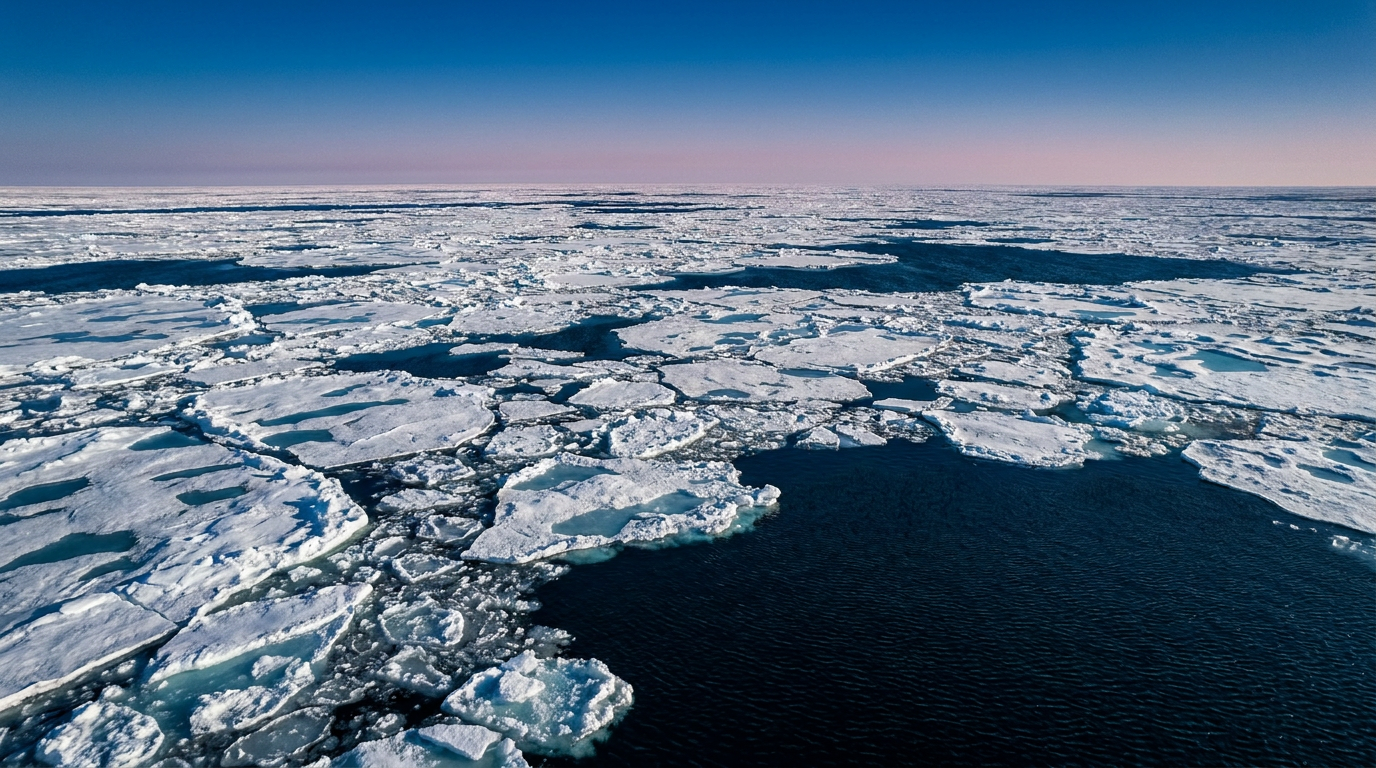
The Arctic Ocean has crossed a hidden, irreversible threshold. While public attention remains fixated on the physical disappearance of sea ice, a profound chemical cascade has fundamentally altered the region's marine ecosystem.[1][2]
According to a landmark study published in Communications Earth & Environment, the Arctic has shifted from an ecosystem limited by sunlight to one starved of nitrate—the foundational fertilizer required for marine life.[3][4]
This transition is not a future projection; researchers assert that the Arctic Ocean passed this critical biological tipping point in 2009.[2][5]
The mechanism behind this nutrient famine is a paradox of abundance. Historically, thick sea ice blocked sunlight, restricting the growth of phytoplankton, the microscopic organisms at the base of the food web.[1][3]
As climate change rapidly melted the ice, vast stretches of shallow coastal waters were exposed to intense solar radiation. Initially, this supercharged phytoplankton productivity, creating massive, temporary algae blooms.[2][5]

However, the Arctic Ocean is unique: nearly half of its area consists of shallow continental shelves. When these massive plankton blooms die, their organic matter sinks rapidly to the shallow seafloor.[3][4]
The decay of this organic material heavily depletes oxygen in the sediment. In these oxygen-poor conditions, marine microbes switch to consuming nitrate, converting it into inert nitrogen gas through a process called benthic denitrification.[4][5]
This microbial process effectively and permanently removes the crucial nutrient from the marine ecosystem, creating a severe deficit in the water column.[3][5]
This microbial process effectively and permanently removes the crucial nutrient from the marine ecosystem, creating a severe deficit in the water column.
The evidence for this regime shift comes from an exhaustive analysis of oceanographic data spanning two decades. Researchers focused on the Fram Strait, the primary marine bottleneck where Arctic waters drain into the North Atlantic.[2][4]
The data revealed a stark and steady decline in the nitrate levels of waters leaving the Arctic starting in 2009, perfectly coinciding with a drastic reduction in sea ice extent.[2][4]

The biological consequences of this nitrate depletion are severe. Phytoplankton proliferation is no longer controlled by how much sunlight reaches the surface, but by the severe lack of available nitrate.[2][3]
To survive in this nutrient-poor environment, the phytoplankton community is shifting toward smaller, less nutritious species that require fewer resources to reproduce.[2][5]
These smaller organisms are highly inefficient at transferring energy up the food web. Instead of nourishing larger creatures, more energy is simply recycled within microbial loops at the bottom of the ocean.[2][6]
This creates a trophic famine that propagates upward through every tier of the ecosystem, threatening zooplankton, commercial fish stocks, seabirds, and apex predators like whales and polar bears.[1][5]

The implications extend far beyond the Arctic Circle. The nutrient-depleted waters flowing out of the Fram Strait threaten to disrupt the ecological balance and commercial fisheries of the broader North Atlantic.[2][4]
Furthermore, the decline in plankton populations weakens the ocean's capacity to act as a global carbon sink. Plankton play a vital role in capturing atmospheric carbon dioxide through photosynthesis and sequestering it in the deep ocean.[2][4]
How we got here
Pre-2000s
Thick Arctic sea ice severely limits sunlight, making light the primary constraint on marine life.
Early 2000s
Accelerating sea ice loss exposes shallow coastal waters to intense sunlight, triggering massive phytoplankton blooms.
2009
The Arctic Ocean crosses a critical biological tipping point, shifting to a nitrate-limited ecosystem.
May 2026
A 20-year data analysis confirms the irreversible chemical shift and its cascading impacts on the food web.
Viewpoints in depth
Marine Biogeochemists
Focusing on the chemical mechanisms that have permanently altered the ocean's nutrient cycle.
Researchers analyzing the chemical composition of the Arctic emphasize that the ecosystem has undergone a fundamental regime shift. For decades, the primary constraint on Arctic marine life was light availability due to thick ice cover. Biogeochemists note that the system is now constrained by nitrate availability. Because the microbial process of benthic denitrification permanently removes nitrogen from the water column, scientists argue this chemical shift cannot be undone simply by cooling the surface waters, marking a permanent alteration of the polar environment.
Ecosystem Forecasters
Tracking the ripple effects of nutrient starvation up the food chain to commercial fisheries.
Marine biologists and fisheries experts are highly concerned about the trophic cascade triggered by this nutrient collapse. Their models indicate that as phytoplankton communities shift toward smaller, less energy-dense species, the carrying capacity of the entire Arctic food web shrinks. Forecasters warn that this 'famine' will inevitably propagate southward through the Fram Strait, potentially devastating commercial fish stocks in the North Atlantic and threatening the survival of apex predators that rely on energy-rich prey.
Climate Modelers
Evaluating the impact of reduced plankton populations on the ocean's ability to sequester carbon.
Climate scientists view the Arctic plankton collapse as a dangerous positive feedback loop. Phytoplankton are a crucial component of the biological carbon pump, capturing atmospheric CO2 and sequestering it in the deep ocean when they die. Modelers warn that as the Arctic Ocean becomes increasingly hostile to large plankton blooms, its efficiency as a global carbon sink will diminish, leaving more greenhouse gases in the atmosphere and further accelerating global warming.
What we don't know
- The exact timeline for when this nutrient collapse will critically impact specific commercial fish stocks in the North Atlantic.
- Whether marine mammals and seabirds can adapt their migratory or feeding patterns to survive on smaller, less energy-dense prey.
- The precise degree to which this plankton reduction will weaken the Arctic Ocean's overall carbon sequestration capacity.
Key terms
- Phytoplankton
- Microscopic, plant-like organisms that live in the ocean and form the foundational base of the marine food web.
- Benthic Denitrification
- A microbial process in the seafloor sediment where bacteria convert essential nitrate into inert nitrogen gas, removing it from the ecosystem.
- Trophic Cascade
- An ecological phenomenon where a change at the bottom of the food web (like plankton loss) triggers domino effects across all higher levels of predators.
- Fram Strait
- The primary ocean gateway between Greenland and Svalbard where Arctic waters flow southward into the North Atlantic.
- Biological Carbon Pump
- The ocean's biologically driven process of capturing carbon dioxide from the atmosphere and transporting it to the deep sea.
Frequently asked
What exactly is the Arctic tipping point?
In 2009, the Arctic Ocean shifted from an ecosystem limited by sunlight to one limited by nitrate, fundamentally altering its chemical makeup and food web.
How does melting ice reduce nutrients?
Melting ice allows more sunlight, causing massive plankton blooms. When these die and sink, their decay depletes oxygen in the seafloor, causing microbes to consume and destroy the ocean's nitrate.
Why is this shift considered irreversible?
The microbial process that removes nitrate operates on much longer timescales than ice formation. Even if sea ice temporarily recovered, the lost nutrients would not rapidly return.
How does this affect larger animals?
Without nitrate, only smaller, less nutritious plankton survive. This provides less energy to the zooplankton and fish that feed seabirds, whales, and polar bears.
Sources
Source coverage
6 outlets
3 viewpoints surfaced






[1]New ScientistEcosystem Forecasters
Arctic Ocean reaches tipping point that could be dire for marine life
Read on New Scientist →[2]Live ScienceEcosystem Forecasters
The Arctic Ocean has crossed a tipping point that is wreaking havoc on the region's food chain
Read on Live Science →[3]Communications Earth & EnvironmentMarine Biogeochemists
Sea ice loss drives a regime shift in Arctic Ocean nitrogen biogeochemistry
Read on Communications Earth & Environment →[4]University of EdinburghMarine Biogeochemists
Arctic food chain faces irreversible shift
Read on University of Edinburgh →[5]Oceanographic MagazineEcosystem Forecasters
Arctic ocean passes 'irreversible' chemical tipping point
Read on Oceanographic Magazine →[6]Factlen Editorial TeamFactlen Editorial Analysis
Synthesis by Factlen editorial team
Read on Factlen Editorial Team →
Every angle. Every day.
Get science stories with full source coverage and perspective breakdowns delivered to your inbox.