
OLED vs. Mini-LED in 2026: Which TV Technology Actually Wins?
The gap between OLED and Mini-LED televisions has closed significantly in 2026, shifting the buying decision from raw picture quality to room lighting and viewing habits.
By Factlen Editorial Team
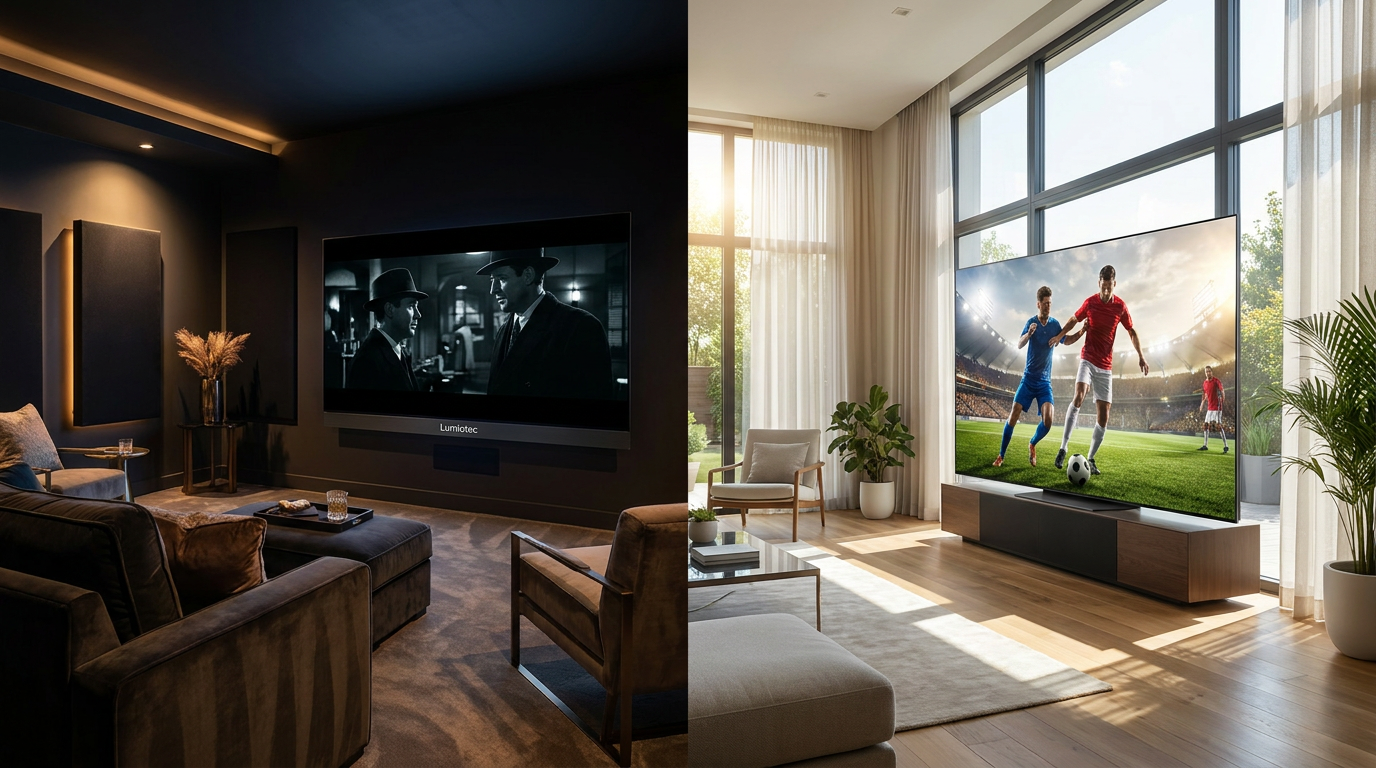
- Cinematic Purists
- Prioritize perfect black levels, infinite contrast, and motion clarity for dark-room movie viewing and gaming.
- Bright-Room Power Users
- Value massive peak brightness, zero burn-in risk, and large screen sizes for daytime viewing and sports.
- Hybrid Tech Analysts
- Focus on the convergence of the two technologies, noting that Tandem OLED and RGB Mini-LED have largely erased historical compromises.
What's not represented
- · Budget-conscious buyers seeking sub-$300 entry-level displays
- · Projector enthusiasts who prefer massive wall-sized images over traditional panels
Why this matters
Choosing the wrong television technology can leave you with a washed-out screen in a sunny living room or distracting light halos during a dark movie. Understanding the 2026 display landscape ensures you invest in the exact panel that matches your home's lighting and your daily viewing habits.
Key points
- The 2026 TV market is defined by the convergence of Tandem OLED and RGB Mini-LED technologies.
- OLED panels now utilize stacked layers to boost brightness while maintaining perfect pixel-level black levels.
- Mini-LEDs have adopted dedicated RGB backlights, pushing peak brightness past 4,000 nits and eliminating burn-in risk.
- OLED remains the definitive choice for dark home theaters and cinematic viewing.
- Mini-LED is the superior option for sunlit living rooms, daytime sports, and static productivity use.
The era of simple television buying is officially over. Walking into an electronics store in 2026 means navigating a minefield of marketing jargon, but the battle for the living room has distilled into two distinct, highly evolved technologies: Tandem OLED and RGB Mini-LED. For years, the dynamic was straightforward: OLED was the undisputed king of cinematic picture quality, while Mini-LED served as the brighter, more affordable alternative. Today, that performance gap has narrowed so dramatically that the decision is no longer about which technology is objectively superior, but rather which one belongs in your specific home.[1][2]
The context for this shift lies in massive manufacturing breakthroughs. OLED panels have adopted stacked "Tandem" layers, allowing them to boost peak brightness significantly without sacrificing their legendary black levels. Simultaneously, Mini-LEDs have introduced "Micro RGB" backlights—using dedicated microscopic red, green, and blue diodes rather than white light passed through color filters. This evolution allows modern Mini-LEDs to achieve unprecedented color accuracy and blistering brightness that challenges OLED's historical dominance in the premium market.[5][6]
The case for OLED centers entirely on pixel-level precision. Because an Organic Light-Emitting Diode display lacks a traditional backlight, every single pixel generates its own light and can turn off completely independently. This mechanical reality delivers an infinite contrast ratio and perfect black levels. When watching a movie set in deep space, the stars are piercingly bright, while the vacuum of space around them is pitch black, with zero light bleeding between the two.[3]
The case against OLED revolves around sustained full-screen brightness and the lingering, albeit reduced, risk of permanent image retention. While 2026 Tandem OLED models hit impressive peak highlights in small areas, their Automatic Brightness Limiters (ABL) still aggressively dim the screen when displaying large, bright scenes—like a hockey rink or a snow-covered landscape—to protect the organic compounds from overheating.[6]

The evidence for OLED's cinematic superiority remains robust. Laboratory testing confirms that OLED still dominates in dark-room environments. Panels certified under DisplayHDR True Black 600 achieve a black level floor of 0.0005 nits, creating a perceived contrast advantage that LCD-based panels simply cannot mathematically match. Furthermore, OLED's near-instantaneous pixel response times provide unmatched motion clarity, making it the gold standard for competitive gamers.[3][5]
The case for Mini-LED centers on brute-force brightness and environmental versatility. By clustering thousands of microscopic light-emitting diodes into independent local dimming zones behind the screen, these panels can overpower ambient sunlight and deliver blistering high-dynamic-range highlights without breaking a sweat. They are built to thrive in the brightest, most challenging living spaces.[4]
The case for Mini-LED centers on brute-force brightness and environmental versatility.
The case against Mini-LED focuses on its lack of true pixel-level control. Even with tens of thousands of dimming zones, a Mini-LED television is still illuminating clusters of pixels rather than individual ones. This can result in "blooming"—a faint, cloudy halo of light that appears around bright objects on dark backgrounds, such as white subtitles hovering over the black letterbox bars of a widescreen movie.[3]
The evidence for Mini-LED's dominance in bright spaces is undeniable. Real-world testing in 2026 shows that the latest RGB Mini-LEDs are hitting massive peak brightness levels exceeding 4,000 nits, while also achieving 100 percent coverage of the BT.2020 color space. Crucially, long-term reliability tests demonstrate that Mini-LEDs carry zero risk of permanent burn-in, making them the objectively safer choice for static user interfaces, video games with persistent HUDs, and all-day news broadcasts.[1][6]

The cost and sizing dynamic also heavily favors Mini-LED. While OLED manufacturing costs skyrocket exponentially past the 77-inch mark, Mini-LED technology scales much more affordably. In 2026, Mini-LED models are readily available in massive 98-inch and 115-inch sizes at surprisingly attainable price points, democratizing the ultra-large-screen home theater experience for consumers who previously would have needed a projector.[4]
Fits well when: OLED. An OLED television is the definitive choice when the display will live in a light-controlled room, a dedicated home theater, or a bedroom. It fits perfectly for cinephiles who watch movies in the dark, and for gamers who demand the absolute lowest input lag and pristine motion clarity without compromise.[2][5]
Does not fit when: OLED. It is a poor fit for sun-drenched living rooms with floor-to-ceiling windows, or for households that leave cable news networks with static lower-third graphics running for eight hours a day, where the risk of image retention and the frustration of screen glare will outweigh the benefits of perfect contrast.[6]
Fits well when: Mini-LED. A Mini-LED television fits exceptionally well in bright, open-concept living spaces where ambient daylight cannot be easily controlled. It is the ideal choice for daytime sports viewing, large-group watch parties, and users who want a massive 85-inch-plus screen without paying an exorbitant premium.[2][4]

Does not fit when: Mini-LED. It does not fit perfectly for absolute videophiles who watch moody, low-light cinema in pitch-black rooms, as the minor blooming around bright highlights can break the immersion that only perfect black levels can sustain.[3]
Ultimately, the 2026 market has eliminated the concept of a universally "better" television. The decision is no longer about which technology is superior in a vacuum, but rather which panel chemistry aligns with the specific lighting conditions of the room and the daily viewing habits of the household. Both technologies have reached a pinnacle of performance that guarantees a stunning visual experience.[1][5]
How we got here
2013
First commercial OLED TVs launch in the US, establishing a new standard for perfect black levels.
2021
Mini-LED technology enters the mainstream market, offering a brighter, high-contrast alternative to standard LCDs.
2024
QD-OLED and MLA technologies push OLED brightness past the 1,000-nit barrier for the first time.
2026
Tandem OLED and RGB Mini-LED architectures launch, closing the performance gap and pushing peak brightness to unprecedented levels.
Viewpoints in depth
Cinematic Purists
Advocates who prioritize perfect black levels and infinite contrast above all else.
For home theater enthusiasts and film purists, the conversation begins and ends with black levels. This camp argues that the true depth of an image comes from its contrast ratio, not its peak brightness. Because OLED pixels can turn off completely, they deliver a three-dimensional pop in dark scenes that Mini-LEDs cannot replicate without introducing blooming. They view OLED as the only acceptable choice for watching movies in a controlled, dark environment.
Bright-Room Power Users
Advocates who value massive peak brightness and zero burn-in risk for daytime viewing.
This perspective argues that most people do not watch television in pitch-black home theaters. For the average consumer with a sunlit living room, Mini-LED's ability to push past 4,000 nits of brightness is far more valuable than perfect black levels. Furthermore, this camp highlights that Mini-LED carries zero risk of permanent burn-in, making it the only logical choice for users who watch hours of news broadcasts with static graphics or leave their TVs on all day.
Hybrid Tech Analysts
Industry observers who focus on the convergence of the two technologies.
Analysts point out that the historical compromises of both technologies have largely been erased in 2026. Tandem OLED has solved the brightness issue for all but the sunniest rooms, while RGB Mini-LED has improved its local dimming algorithms to the point where blooming is nearly imperceptible to the average viewer. This camp advises consumers to stop worrying about which technology is 'better' and instead buy based on screen size, budget, and the specific lighting of their living space.
What we don't know
- Whether Tandem OLED structures will completely eliminate the long-term burn-in risk over a 10-year lifespan.
- If Micro-LED (a separate, ultra-premium technology) will eventually drop in price enough to render both OLED and Mini-LED obsolete.
Key terms
- OLED
- Organic Light-Emitting Diode; a display technology where each individual pixel generates its own light and can turn off completely to create perfect black.
- Mini-LED
- An LCD display technology that uses thousands of microscopic LEDs clustered into dimming zones behind the screen to provide high brightness and strong contrast.
- Blooming
- A visual artifact where a faint halo of light bleeds around a bright object displayed on a dark background, common on non-OLED displays.
- Nits
- A unit of measurement used to quantify the brightness of a display; higher numbers indicate a brighter screen.
- Contrast Ratio
- The difference in light intensity between the brightest white and the darkest black a display can produce.
Frequently asked
Is OLED burn-in still a problem in 2026?
It is significantly reduced thanks to Tandem OLED structures and better heat dissipation, but leaving static elements on the screen for many hours a day still poses a minor risk compared to Mini-LED.
What is Tandem OLED?
A new panel architecture that stacks multiple light-emitting layers, allowing the TV to achieve much higher brightness levels without sacrificing its perfect black levels.
What is RGB Mini-LED?
An evolution of Mini-LED that uses dedicated red, green, and blue microscopic LEDs rather than white light with color filters, resulting in massive brightness and 100% color volume.
Which TV is better for bright rooms?
Mini-LED remains the superior choice for sunlit rooms due to its higher sustained full-screen brightness and ability to overpower ambient glare.
Sources
Source coverage
6 outlets
3 viewpoints surfaced






[1]CNETHybrid Tech Analysts
These Are the Most Head-Turning TVs of CES 2026
Read on CNET →[2]Tom's GuideBright-Room Power Users
OLED vs Mini-LED: What's the difference and is one actually better?
Read on Tom's Guide →[3]RTINGSCinematic Purists
OLED vs Mini LED TVs (2026 Update)
Read on RTINGS →[4]What Hi-Fi?Bright-Room Power Users
Best Mini LED TVs 2026
Read on What Hi-Fi? →[5]Data Wire SolutionsCinematic Purists
Tandem OLED vs QD-OLED vs Mini-LED
Read on Data Wire Solutions →[6]KTC PlayHybrid Tech Analysts
Tandem OLED vs Mini-LED in 2026: Real HDR Performance
Read on KTC Play →

More in shopping
See all 5 stories →Skincare Tech
Do At-Home Red Light Therapy Masks Actually Work? The Clinical Evidence, Reviewed
7 sources
Retail Strategy
Amazon, Target, and Walmart Announce Overlapping June Mega-Sales, Moving 'Summer Black Friday' Earlier
7 sources

TV Tech
OLED vs. Mini-LED in 2026: Choosing the Right TV Panel for Your Living Room
8 sources
Every angle. Every day.
Get shopping stories with full source coverage and perspective breakdowns delivered to your inbox.