
OLED vs. Mini-LED in 2026: Which Premium TV Technology Wins?
While OLED panels still dominate in perfect contrast and motion clarity, 2026 Mini-LEDs have closed the gap with blinding brightness and zero burn-in risk. The right choice depends entirely on your room lighting and viewing habits.
By Factlen Editorial Team
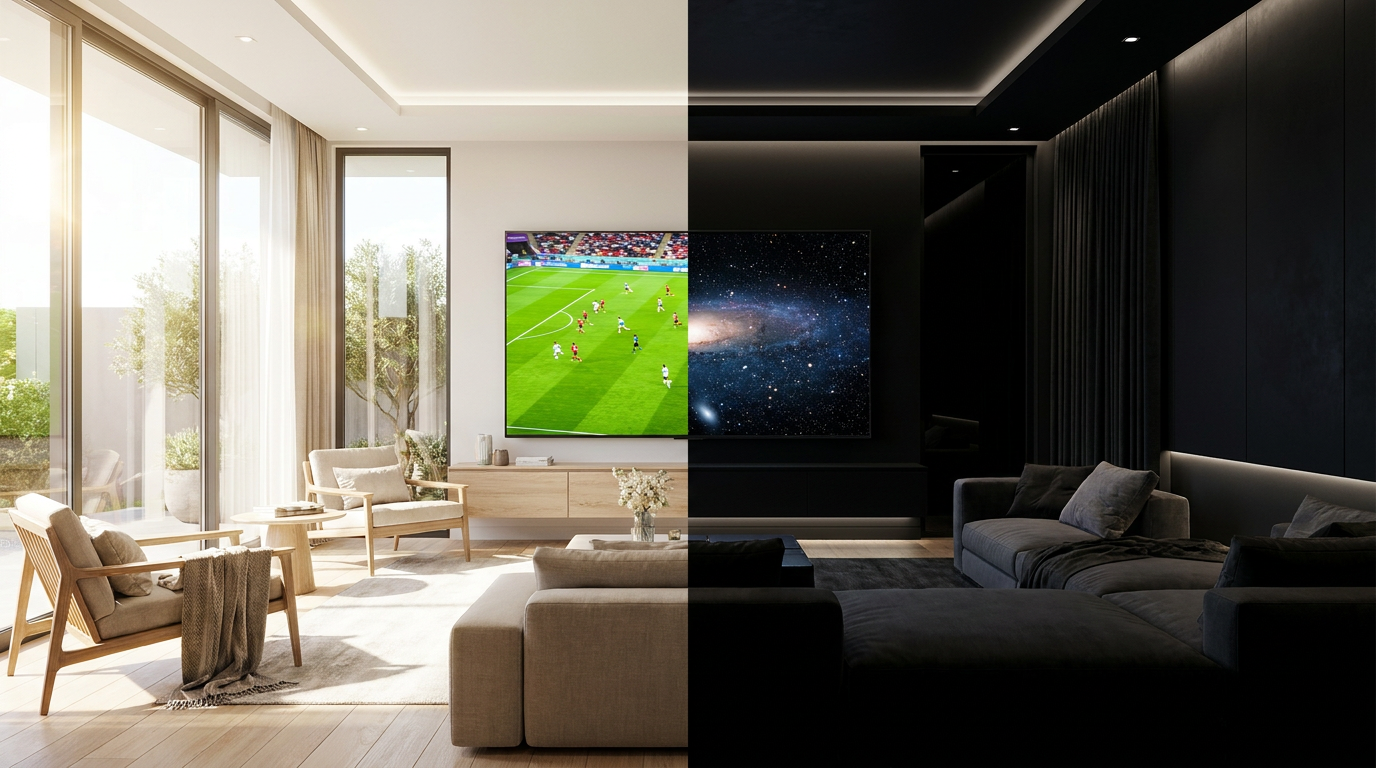
- Home Theater Purists
- Argues that perfect black levels and infinite contrast are the most important metrics for cinematic picture quality.
- Bright-Room Viewers
- Values sustained full-screen brightness and glare reduction for daytime sports and casual viewing.
- Productivity & PC Gamers
- Prioritizes static UI safety, text clarity, and anxiety-free all-day use without burn-in risk.
What's not represented
- · Budget TV Buyers
- · Projector Enthusiasts
Why this matters
Dropping thousands of dollars on a premium television is a major investment, and choosing the wrong panel technology for your specific room lighting can lead to frustrating glare or persistent anxiety over screen burn-in. Understanding the exact trade-offs between OLED and Mini-LED ensures you get the best possible daily experience for your money.
Key points
- OLED TVs offer perfect black levels and infinite contrast because each pixel emits its own light.
- Mini-LED TVs utilize thousands of backlight zones to achieve massive peak brightness and eliminate burn-in risk.
- 2026 OLED panels have significantly increased their brightness, but Mini-LED still wins in sun-drenched rooms.
- Mini-LED is the safer choice for PC monitor use and static UI, while OLED remains the king of motion clarity for gaming.
Buying a premium television in 2026 is a two-horse race that has never been closer. For years, the conventional wisdom in the display industry was simple: buy an OLED for a dark room, and buy an LED for a bright room. But as manufacturing techniques have advanced, the boundaries between these two flagship technologies have blurred. Today’s premium market is dominated by hyper-refined OLED panels and heavily engineered Mini-LED displays, both vying for the centerpiece of the modern living room. While they approach the physics of light generation from completely different directions, both promise stunning picture quality, vibrant colors, and next-generation gaming features. Choosing between them is no longer about finding the objectively best screen, but rather identifying which set of visual compromises best aligns with your specific viewing habits, room lighting, and budget.[7]
To understand the trade-offs, it is essential to look at how each technology generates an image. OLED, which stands for Organic Light-Emitting Diode, is a self-emissive technology. This means that every single pixel on the screen is its own independent light source. There is no backlight behind the screen; instead, millions of microscopic organic compounds illuminate individually when an electrical current is applied. Mini-LED, on the other hand, is an evolution of traditional LCD technology. It relies on a liquid crystal display layer to create the image and colors, which is then illuminated from behind by a backlight. The 'mini' refers to the size of the light-emitting diodes in that backlight, which are drastically smaller than traditional LEDs, allowing manufacturers to pack thousands of them behind the screen.[1][2]
The self-emissive nature of OLED gives it one undisputed superpower: perfect, infinite contrast. Because each pixel generates its own light, an OLED TV can simply turn off the power to specific pixels when it needs to display black. The result is a true, inky absence of light that creates a profound sense of depth and three-dimensionality. When watching a movie set in space, the stars pierce through a pitch-black background with absolute precision. Contrast is widely considered the most important foundational element of perceived picture quality, and in a light-controlled or dark room, OLED’s ability to place a blindingly bright pixel directly next to a completely deactivated pixel remains the gold standard of the industry.[1][3]

Mini-LED attempts to replicate this contrast through a system called local dimming. By grouping its thousands of tiny LEDs into specific zones, the TV’s processor can dim or turn off the backlight in dark areas of the picture while keeping the bright areas illuminated. Flagship 2026 Mini-LED models now feature upwards of 5,000 to 10,000 independent dimming zones, driven by sophisticated AI algorithms that analyze the image frame by frame. While this produces black levels that are vastly superior to older LED televisions, it still cannot match the pixel-level precision of OLED.[2][4]
Because a Mini-LED zone still illuminates a cluster of pixels rather than a single one, the technology is susceptible to a visual artifact known as blooming or haloing. When a bright object—like a streetlamp, a subtitle, or a spaceship—moves across a dark background, the backlight zone illuminating that object inevitably bleeds a small amount of light into the surrounding dark pixels. While modern algorithms have aggressively minimized this effect, eagle-eyed viewers will still notice a faint glow around high-contrast elements, particularly when viewing the screen from an off-center angle.[1][4]
Where Mini-LED surrenders the contrast crown, it aggressively takes the lead in sheer, unadulterated brightness. Because it relies on a robust inorganic backlight, a high-end Mini-LED television can push an astonishing amount of light. Top-tier 2026 models are capable of hitting peak HDR highlights of 5,000 nits or more. More importantly, they can sustain incredibly high brightness levels across the entire screen simultaneously. If you are watching a hockey game, a daytime football broadcast, or a brightly lit news studio in a sun-drenched living room with open blinds, a Mini-LED panel has the raw power to cut through the glare and deliver a punchy, vibrant image that refuses to wash out.[4][6]
OLED has historically struggled with brightness, but the 2026 landscape features massive leaps in organic panel engineering. The introduction of Tandem OLED—which stacks multiple light-emitting layers—and Micro Lens Array (MLA) 3.0 technology has dramatically increased the light output of flagship OLED sets. These modern panels can now reach peak HDR highlights of 2,000 to 2,800 nits in small windows, providing a spectacular, searing pop to explosions, reflections, and neon lights in cinematic content. For the vast majority of HDR movies and premium gaming, modern OLEDs are more than bright enough to deliver a breathtaking experience.[5][6]

OLED has historically struggled with brightness, but the 2026 landscape features massive leaps in organic panel engineering.
However, OLED still faces limitations when it comes to sustained, full-screen brightness. To protect the organic materials from overheating and degrading, OLED televisions employ an Auto Backlight Limiter (ABL). When a scene requires a massive amount of white light across the entire screen—such as a snowy landscape or a bright commercial—the ABL aggressively dims the overall image to manage thermals. Mini-LED suffers from no such limitation, allowing it to maintain a blindingly bright full-screen image indefinitely. For users who primarily watch TV during the day in rooms with large windows, this sustained brightness advantage makes Mini-LED the far more practical choice.[3][5]
When it comes to color performance, both technologies offer spectacular, wide color gamuts that cover the vast majority of the HDR spectrum. QD-OLED (Quantum Dot OLED) panels, favored by several major manufacturers, utilize a quantum dot layer to deliver unmatched color volume and saturation, particularly in dark and mid-tone scenes. Mini-LED also utilizes quantum dots to enhance its color reproduction, allowing it to push vibrant, punchy colors even at extreme brightness levels where older OLEDs might have looked slightly washed out. The choice here is largely subjective: OLED offers richer, deeper color depth, while Mini-LED provides explosive, high-luminance color impact.[1][2]
For competitive gamers, motion clarity is a critical metric, and OLED is the undisputed champion of this category. Because OLED pixels change state almost instantaneously, the technology boasts a pixel response time of roughly 0.03 milliseconds. This near-zero response time means that fast-panning camera movements, rapid character animations, and high-speed racing games remain perfectly sharp, with virtually no motion blur or ghosting behind moving objects. While high-end Mini-LEDs offer excellent 144Hz or even 240Hz refresh rates, the physical liquid crystals take slightly longer to transition, resulting in a minor but perceptible smear during the fastest on-screen action.[1][4]
Screen uniformity and viewing angles represent another clear victory for OLED. Because there is no backlight grid behind the screen, OLED panels display perfectly uniform colors across the entire display. Mini-LEDs, conversely, can sometimes exhibit the dirty screen effect—faint, uneven blotches or vertical banding that become visible when the camera pans across a uniform color, like a soccer pitch or a blue sky. Furthermore, OLEDs look identical from virtually any seating position in the room. Mini-LED panels, particularly those using Vertical Alignment LCD technology, will lose contrast, shift colors, and exhibit worse blooming when viewed from an off-axis angle.[2][4]

The most persistent anxiety surrounding OLED technology is the risk of permanent burn-in. Because the pixels are organic, they degrade slightly every time they are used. If a static image—such as a news channel ticker, a sports scoreboard, or a video game HUD—is displayed on the screen for thousands of hours, those specific pixels will degrade faster than the rest of the screen, leaving a permanent, faint ghost of the image behind. While 2026 thermal management, pixel-shifting algorithms, and automatic logo dimming have drastically reduced this risk for users who watch varied content, the fundamental chemical limits of organic emitters mean the risk is never truly zero.[1][5]
This burn-in risk makes Mini-LED the vastly superior choice for productivity, PC monitor use, and specific gaming habits. If you plan to connect a PC to your television to code, edit spreadsheets, or leave static windows open for eight hours a day, an OLED panel will eventually show uneven wear. Mini-LED’s robust inorganic backlight is entirely immune to burn-in, offering complete peace of mind for static content. Additionally, Mini-LEDs generally utilize a standard RGB subpixel layout, which renders sharp, clear text in operating systems like Windows. Some OLED panels use non-traditional subpixel structures that can cause slight color fringing around small text, making them less ideal for heavy reading.[1][5]
Finally, pricing and sizing dynamics heavily influence the buying decision, particularly in the ultra-large screen market. While 55-inch and 65-inch OLEDs have become highly competitive in price, manufacturing massive organic panels remains incredibly expensive. If you are looking to build a home theater around an 85-inch, 98-inch, or 100-inch display, Mini-LED dominates the value proposition. You can purchase a flagship, brilliantly bright 85-inch Mini-LED television for thousands of dollars less than an equivalent 83-inch OLED, making the backlit technology the undisputed king of the massive-format living room.[3][6]

Ultimately, the decision requires an honest assessment of your viewing environment and habits. The Factlen Editorial Team recommends OLED for cinephiles, home theater enthusiasts, and gamers who play in dim or light-controlled rooms. If your priority is watching 4K HDR movies exactly as the director intended, with infinite contrast, perfect black levels, and flawless motion clarity, OLED remains the pinnacle of display technology. It is a precision instrument designed for maximum visual impact in the right environment.[7]
Conversely, Mini-LED is the champion of the bright, multi-purpose living room. If your television sits opposite a wall of windows, if you primarily watch daytime sports and news, or if you want a massive 85-inch screen without taking out a second mortgage, Mini-LED is the definitive choice. It offers anxiety-free, all-day viewing with blinding brightness and zero risk of burn-in, making it the ultimate heavy-duty workhorse for the modern, sunlit home.[7]
How we got here
2013
LG introduces the first mass-market OLED TVs, establishing the benchmark for perfect black levels.
2019
Mini-LED technology enters the consumer market, offering a high-brightness alternative to OLED.
2022
QD-OLED (Quantum Dot OLED) launches, dramatically improving OLED color volume and brightness.
2024
Mini-LED zone counts explode, with flagship models crossing 5,000 individual dimming zones to reduce blooming.
2026
Tandem OLED and MLA 3.0 panels push OLED peak brightness past 2,500 nits, blurring the historical brightness divide.
Viewpoints in depth
Home Theater Purists
Advocates for the unmatched cinematic depth of self-emissive pixels.
For cinephiles and dark-room viewers, the argument begins and ends with contrast. This camp emphasizes that in a light-controlled environment, the absolute black levels of an OLED create a sense of depth and three-dimensionality that even the most advanced Mini-LED algorithms cannot replicate. They argue that the slight blooming inherent to backlit displays breaks the immersion of high-contrast cinematic scenes, making OLED the only true choice for watching films as the director intended.
Bright-Room Viewers
Prioritizes raw luminance and glare reduction for everyday living spaces.
This perspective points out that the vast majority of consumers do not watch television in pitch-black, dedicated theater rooms. They argue that Mini-LED's ability to sustain 1,000+ nits across the entire screen makes it far superior for daytime sports, news broadcasts, and casual viewing. By overpowering ambient light and window glare without triggering an Auto Backlight Limiter (ABL), Mini-LED provides a consistently punchier and more usable image for the reality of modern, sunlit homes.
Productivity & PC Gamers
Focuses on the practical anxieties of static content and text clarity.
For users who treat their display as a hybrid work and gaming monitor, the primary concern is longevity and usability. This camp argues that leaving spreadsheets, coding environments, or static game HUDs on screen for 8-12 hours a day makes OLED a stressful proposition due to burn-in risk. They champion Mini-LED for providing complete peace of mind, alongside superior text clarity thanks to standard RGB subpixel layouts that render operating system fonts smoothly.
What we don't know
- How exactly the long-term degradation curve of 2026 Tandem OLED panels will compare to older single-layer OLEDs after 20,000 hours of real-world use.
- Whether MicroLED technology will ever scale down in price enough to replace both OLED and Mini-LED in the consumer market before the end of the decade.
Key terms
- Blooming / Haloing
- A visual artifact where light bleeds into dark areas of the screen, common on backlit TVs when displaying bright objects on dark backgrounds.
- Nits
- A standard unit of measurement for screen brightness; higher numbers indicate a brighter display.
- Burn-in
- Permanent image retention caused by static elements, like logos or UI, degrading organic pixels over time.
- Local Dimming Zones
- Specific areas of a TV's backlight that can dim or turn off independently to improve contrast and black levels.
- Tandem OLED
- A 2026 panel architecture stacking multiple light-emitting layers to significantly increase brightness and lifespan.
Frequently asked
Will an OLED TV get burn-in from normal use?
For varied viewing like movies and different video games, modern 2026 OLEDs have excellent thermal management and pixel-shifting to prevent burn-in. However, using it as a PC monitor with static windows all day still carries a genuine risk.
Is Mini-LED the same as MicroLED?
No. Mini-LED uses tiny LEDs as a backlight for an LCD screen. MicroLED is a self-emissive technology like OLED but uses microscopic inorganic LEDs, though it remains prohibitively expensive for most consumers.
Which technology is better for a bright living room?
Mini-LED is generally the safer choice for bright rooms with lots of windows, as it can sustain much higher full-screen brightness to cut through glare without dimming the image.
Sources
Source coverage
7 outlets
3 viewpoints surfaced







[1]RTINGSHome Theater Purists
OLED vs Mini LED: Which Panel Technology Is Better?
Read on RTINGS →[2]TechRadarHome Theater Purists
OLED vs mini-LED: which TV tech is better?
Read on TechRadar →[3]CNETBright-Room Viewers
OLED vs. Mini-LED: The Two Best TV Technologies Compared
Read on CNET →[4]ZDNETBright-Room Viewers
OLED vs. Mini LED: Which TV is best for your living room?
Read on ZDNET →[5]KTCPlayProductivity & PC Gamers
The 2026 Tech Update: MLA 3.0 vs. RGB Mini-LED
Read on KTCPlay →[6]Data Wire SolutionsProductivity & PC Gamers
Best TVs for 2026: 10 OLED and Mini-LED Picks
Read on Data Wire Solutions →[7]Factlen Editorial TeamProductivity & PC Gamers
Synthesis by Factlen editorial team
Read on Factlen Editorial Team →

More in shopping
See all 84 stories →Retail Strategy
Amazon, Walmart, and Target Announce Competing Summer Deal Events for Late June
8 sources

Sustainable Fabrics
Decoding Sustainable Fabrics: The Real Trade-Offs Behind Tencel, Recycled Polyester, and Organic Cotton
7 sources

Display Tech
The 2026 Guide to Premium Television Displays: OLED and Mini-LED Trade-Offs
8 sources
Wearable Tech
The Evidence-Based Guide to Sleep Trackers: Do They Actually Work?
6 sources

Every angle. Every day.
Get shopping stories with full source coverage and perspective breakdowns delivered to your inbox.