
Next-Generation Geothermal Crosses the Commercial Threshold to Power the AI Boom
Enhanced Geothermal Systems (EGS) are moving from research pilots to commercial deployment in 2026, unlocking a massive source of 24/7 carbon-free baseload power. Driven by the energy demands of artificial intelligence, the technology adapts oil and gas drilling techniques to tap the Earth's heat anywhere on the planet.
By Factlen Editorial Team
- Clean Energy Advocates
- Argue that EGS is the critical missing baseload component needed to fully decarbonize the grid.
- Tech Industry & AI Developers
- View next-generation geothermal as the only scalable, firm power source capable of meeting explosive data center demand.
- Energy Policymakers
- Focus on the macroeconomic potential of EGS to provide energy security and repurpose fossil fuel workforces.
- Scientific Researchers
- Emphasize the immense engineering challenges, material limits, and subsurface risks that must be managed as the technology scales.
What's not represented
- · Local communities near drilling sites
- · Grid transmission operators
Why this matters
The transition to a fully clean energy grid has been stalled by the lack of 'firm' power that runs when the sun isn't shining and the wind isn't blowing. By making geothermal energy scalable anywhere, EGS provides the missing baseload piece required to power data centers, heavy industry, and millions of homes without carbon emissions.
Key points
- Fervo Energy's Cape Station in Utah is coming online in 2026, marking the first commercial-scale EGS plant in the U.S.
- EGS adapts horizontal drilling and fracking from the oil and gas industry to tap heat in dry, impermeable rock.
- Drilling costs have plummeted by 70%, bringing EGS closer to price parity with fossil fuels.
- Tech giants are heavily funding the sector to secure 24/7 clean baseload power for AI data centers.
- Future innovations aim to reach 400°C 'superhot' rock, which could increase power output tenfold.
The artificial intelligence revolution has a math problem: it is moving faster than the power grid can keep up. As tech giants race to build gigawatt-scale data centers, they are colliding with the physical limits of electricity generation. Solar and wind are too intermittent for facilities that must run around the clock, and nuclear plants take a decade to permit and build. This bottleneck has triggered a desperate search for "firm" clean energy—power that is carbon-free but always on.[2][10]
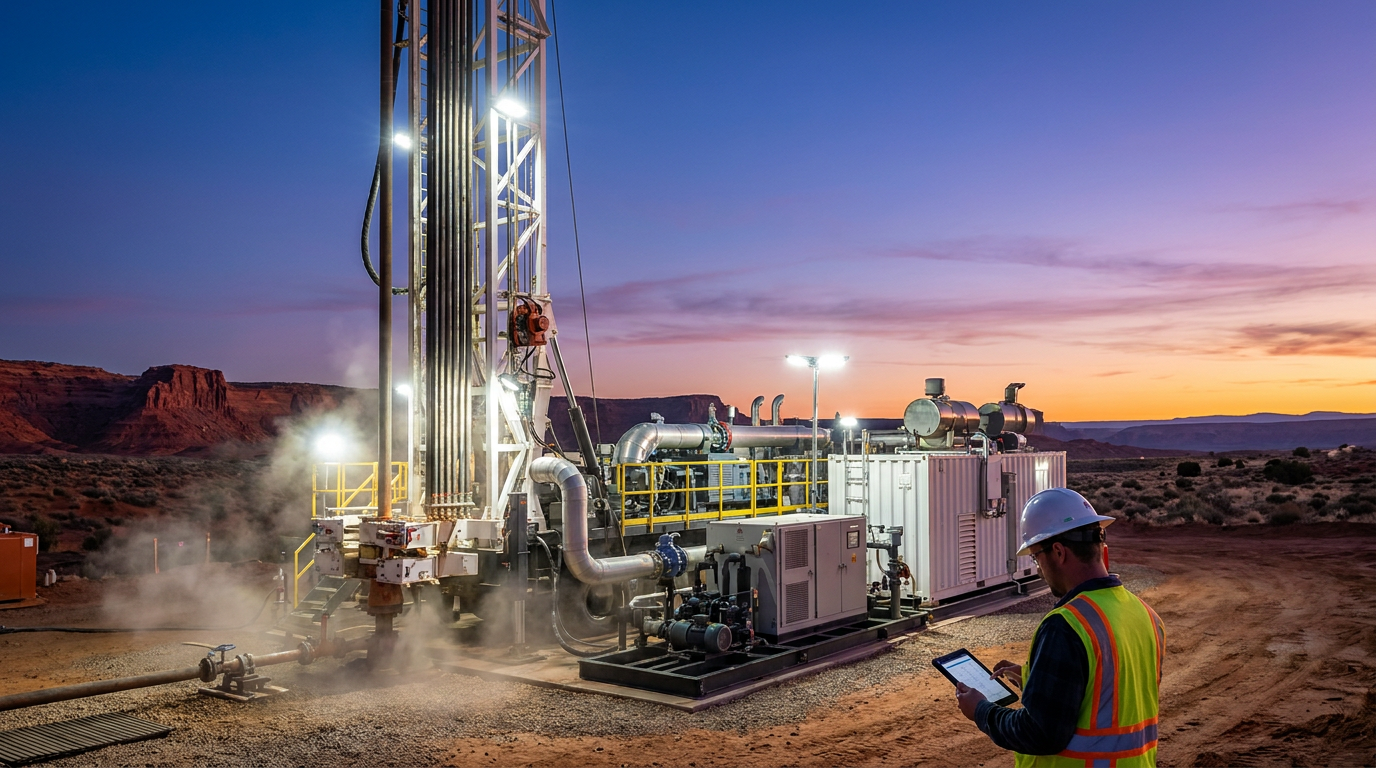
In June 2026, the clearest answer to that search is quietly powering up in the Utah desert. Fervo Energy's Cape Station is coming online as the first large-scale commercial Enhanced Geothermal System (EGS) in the United States. Initially delivering up to 53 megawatts of maximum capacity, the facility is scheduled to expand to 400 megawatts by 2028. It represents the moment a long-theorized technology finally crosses the threshold from research pilot to commercial reality.[1][2]
To understand why EGS is a breakthrough, one must look at the limitations of traditional geothermal energy. Conventional geothermal plants require a rare geological trifecta: subterranean heat, naturally occurring fluid, and permeable rock fractures to let that fluid circulate. Because these three elements rarely exist together outside of volcanic regions like Iceland or parts of California, geothermal has remained a niche contributor to the global energy mix.[3][6]
Enhanced Geothermal Systems rewrite the rules of geography. Instead of hunting for natural underground aquifers, EGS engineers target "Hot Dry Rock"—deep geological formations that possess immense heat but lack fluid or permeability. By artificially creating the necessary conditions in the subsurface, EGS theoretically allows geothermal power plants to be built almost anywhere on the planet, provided the drilling goes deep enough.[4][6]

The mechanism behind EGS borrows heavily from an unlikely source: the fossil fuel industry. Developers use horizontal drilling to bore deep into hot rock, then apply hydraulic fracturing—fracking—to create a network of permeable micro-fractures between an injection well and a production well. Water is pumped down the injection well, heated by the subterranean rock as it flows through the artificial fractures, and brought back to the surface to drive steam turbines.[3][4]
This technology transfer from shale oil and gas has dramatically accelerated EGS development. By adapting existing horizontal drilling rigs and sensor technologies, companies have bypassed decades of foundational research and development. Fervo Energy reported a staggering 70 percent reduction in drilling times between its early Nevada pilot and its current Utah production wells, fundamentally altering the economics of the technology.[3][5]
That cost reduction is the catalyst for the current boom. Historically, drilling accounted for more than half of a geothermal project's capital expenditure. By slashing those costs, EGS is rapidly approaching price parity with fossil fuels and battery-backed renewables. A recent analysis published in the Proceedings of the National Academy of Sciences estimated that EGS could soon provide electricity at less than $80 per megawatt-hour across 90 percent of the United States.[3][8]

Historically, drilling accounted for more than half of a geothermal project's capital expenditure.
The scale of the resource is staggering. The U.S. Energy Information Administration and Department of Energy estimate that EGS could unlock 90 gigawatts of economically viable capacity nationwide by 2050. Other models suggest the total extractable energy in the contiguous United States could exceed 5 terawatts—roughly four times the country's entire current electrical generating capacity.[1][8]
Tech companies, desperate for baseload power, are providing the capital to scale the industry. OpenAI CEO Sam Altman testified to Congress in 2025 that the abundance of AI would be strictly limited by the abundance of energy. In response, hyperscalers are signing massive power purchase agreements to underwrite EGS development. Fervo recently secured a 320-megawatt agreement with Southern California Edison, backed by a $462 million Series E funding round, proving the technology is now bankable.[2][5]
Beyond EGS, the industry is already pursuing the next frontier: Advanced Geothermal Systems (AGS). Unlike EGS, which relies on fracturing rock to let fluid flow through it, AGS uses a closed-loop architecture. It functions like a massive underground radiator, circulating a proprietary working fluid through sealed pipes embedded in the hot rock. Because no fluid interacts directly with the geology, AGS eliminates the risk of induced seismicity and requires zero water consumption.[3][6]
An even more ambitious target is Superhot Rock (SHR) geothermal. While current EGS plants operate at reservoir temperatures around 200°C to 250°C, SHR aims to drill deeper to reach rock exceeding 400°C. At these extreme temperatures, water enters a "supercritical" state where it behaves as both a liquid and a gas, capable of carrying exponentially more thermal energy to the surface.[6][7]

Tapping supercritical resources could increase the power output of a single well by a factor of ten, shrinking the surface footprint of power plants while maximizing yield. However, the engineering challenges are immense. Standard drilling equipment, sensors, and well casings simply melt or degrade at 400°C. Developing materials that can survive these hellish conditions is the primary focus of researchers at the MIT Energy Initiative and national laboratories.[7][10]
Recognizing the strategic importance of firm clean energy, the federal government has stepped in to accelerate development. The U.S. Senate's introduction of the bipartisan Next-Generation Geothermal Research and Development Act aims to fund the materials science required for supercritical drilling. Meanwhile, the Department of Energy's FORGE laboratory in Utah continues to serve as an open-source testing ground for new EGS techniques.[3][9]
Despite the momentum, EGS faces legitimate environmental hurdles. The hydraulic fracturing required to stimulate the rock can cause induced seismicity—small earthquakes. While developers use advanced seismic monitoring to manage the risk, and the quakes are generally too small to be felt at the surface, public perception remains a hurdle. Additionally, early-stage EGS requires significant water to prime the reservoir, a challenge in the arid Western states where the hottest shallow rock is located.[4][10]
The industry is actively engineering around these constraints. New patent filings reveal a shift toward using supercritical carbon dioxide instead of water as the primary working fluid in EGS reservoirs. This would not only eliminate the water requirement but could also serve as a carbon sequestration mechanism, permanently trapping CO2 underground while generating electricity.[4]

For grid operators and data center developers, the most appealing aspect of EGS might be its deployment speed. Unlike nuclear reactors, which take years to permit and build, modular EGS plants can be constructed in roughly 18 months once the drilling is complete. This rapid deployment cycle aligns perfectly with the aggressive timelines of AI infrastructure buildouts.[2]
As the Cape Station begins feeding electrons into the grid this summer, it marks a permanent shift in the energy landscape. Geothermal is no longer a geographical lottery restricted to volcanic hot springs. By engineering the subsurface, the energy sector has unlocked a virtually inexhaustible battery beneath our feet—one that could finally provide the firm, clean foundation the electrified economy requires.[1][10]
How we got here
2023
Fervo Energy successfully demonstrates commercial EGS viability at Project Red in Nevada.
2024
The U.S. Department of Energy publishes its liftoff report, projecting 90 GW of EGS capacity by 2050.
2025
Tech giants sign massive power purchase agreements to underwrite gigawatt-scale EGS development.
June 2026
The first phase of the Cape Station EGS plant comes online in Utah, delivering commercial power to the grid.
Viewpoints in depth
Clean Energy Advocates
EGS solves the intermittency problem of renewables.
For decades, the Achilles' heel of the clean energy transition has been intermittency. Solar and wind are cheap but unreliable, requiring massive battery deployments or natural gas peaker plants to keep the grid stable. Clean energy advocates view EGS as the ultimate solution: a zero-carbon baseload power source that can be deployed almost anywhere. By providing firm power, EGS allows the grid to fully decarbonize without sacrificing reliability.
Tech Industry & AI Developers
AI's growth is constrained by power; EGS is the fastest scalable firm power.
Hyperscale data centers require hundreds of megawatts of continuous power, making them incompatible with standard renewable deployments. Tech leaders recognize that without a massive influx of firm clean energy, the AI revolution will stall. They favor EGS because, unlike nuclear power which takes over a decade to permit and build, modular EGS plants can be constructed in just 18 months, aligning perfectly with the rapid pace of tech infrastructure buildouts.
Energy Policymakers
The shale revolution's tools are now the clean energy revolution's tools.
Policymakers see a unique macroeconomic opportunity in next-generation geothermal. Because EGS relies on horizontal drilling and hydraulic fracturing, it utilizes the exact same workforce, equipment, and supply chains as the oil and gas industry. This provides a seamless transition path for fossil fuel workers into the green economy, turning former oilfield engineers into the vanguard of the clean energy transition.
Scientific Researchers
Fracking for heat still carries subsurface risks and material limits.
While optimistic about the potential, geologists and materials scientists emphasize the immense engineering hurdles ahead. Pushing the technology toward 400°C Superhot Rock systems will require entirely new alloys and sensors, as current drilling equipment melts at those depths. Furthermore, researchers caution that the hydraulic fracturing required for EGS must be carefully managed to avoid triggering damaging induced seismicity in populated areas.
What we don't know
- Whether the extreme materials science challenges of 400°C Superhot Rock (SHR) geothermal can be solved economically.
- How quickly the U.S. electrical grid can build the transmission infrastructure needed to connect remote EGS plants to population centers.
- If the transition from water to supercritical CO2 as a working fluid will work efficiently at commercial scale.
Key terms
- Enhanced Geothermal Systems (EGS)
- A technology that generates geothermal electricity without the need for natural convective hydrothermal resources by artificially fracturing hot rock.
- Hot Dry Rock (HDR)
- Deep geological formations that possess immense heat but lack the natural fluid or permeability needed for traditional geothermal extraction.
- Baseload Power
- The minimum amount of electric power needed to be supplied to the electrical grid at any given time, requiring power plants that can run 24/7.
- Supercritical Fluid
- A substance at a temperature and pressure above its critical point, where distinct liquid and gas phases do not exist, allowing it to carry massive amounts of thermal energy.
- Induced Seismicity
- Minor earthquakes and tremors that are caused by human activity, such as fluid injection or extraction from the earth's crust.
Frequently asked
How is EGS different from traditional geothermal energy?
Traditional geothermal requires naturally occurring underground water and permeable rock. EGS artificially creates these conditions by fracturing hot, dry rock and pumping fluid through it, allowing plants to be built almost anywhere.
Can geothermal fracking cause earthquakes?
Yes, the hydraulic fracturing process can cause induced seismicity. However, developers use advanced monitoring to keep these micro-quakes too small to be felt at the surface.
Why are tech companies investing so heavily in geothermal?
Artificial intelligence data centers require massive amounts of electricity 24/7. Geothermal provides clean, carbon-free power that runs constantly, unlike intermittent solar and wind.
How much power could EGS eventually provide?
The U.S. Department of Energy estimates EGS could provide 90 gigawatts of capacity by 2050, enough to power tens of millions of homes.
Sources
Source coverage
10 outlets
4 viewpoints surfaced










[1]U.S. Energy Information AdministrationEnergy Policymakers
First large-scale enhanced geothermal power plant in the U.S. to come online in 2026
Read on U.S. Energy Information Administration →[2]Fervo EnergyTech Industry & AI Developers
Powering the AI Revolution with Next-Generation Geothermal
Read on Fervo Energy →[3]Information Technology and Innovation FoundationClean Energy Advocates
Advanced Geothermal Energy Is Ready to Scale
Read on Information Technology and Innovation Foundation →[4]PatSnap InsightsScientific Researchers
Enhanced Geothermal Systems Reaches Its Commercial Inflection Point
Read on PatSnap Insights →[5]Enki AI Energy ResearchTech Industry & AI Developers
Top 10 Enhanced Geothermal Systems Projects: Fervo Energy's $462 M Funding
Read on Enki AI Energy Research →[6]U.S. Department of EnergyEnergy Policymakers
Enhanced Geothermal Systems and Next-Generation Technologies
Read on U.S. Department of Energy →[7]MIT Energy InitiativeScientific Researchers
Next-generation geothermal energy: Promise, progress, and challenges
Read on MIT Energy Initiative →[8]Proceedings of the National Academy of SciencesScientific Researchers
The enormous potential of next-generation geothermal energy
Read on Proceedings of the National Academy of Sciences →[9]Clean Air Task ForceClean Energy Advocates
Bipartisan superhot rock legislation introduced in U.S. Senate
Read on Clean Air Task Force →[10]Factlen Editorial TeamScientific Researchers
Synthesis by Factlen editorial team
Read on Factlen Editorial Team →
Every angle. Every day.
Get guides stories with full source coverage and perspective breakdowns delivered to your inbox.