
Induction vs. Gas Stoves: The Complete 2026 Comparison
As induction technology matures and health concerns surrounding gas emissions grow, the debate over the best kitchen cooktop has shifted from culinary preference to a major household infrastructure decision.
By Factlen Editorial Team
- Health & Climate Advocates
- Prioritize eliminating indoor air pollutants and reducing household carbon footprints.
- Culinary Traditionalists
- Value the tactile control, visual feedback, and versatility of an open flame.
- Efficiency & Tech Enthusiasts
- Focus on the superior thermodynamics, rapid heating speeds, and modern safety features of magnetic cooking.
What's not represented
- · Renters unable to modify infrastructure
- · Commercial restaurant operators
Why this matters
Choosing between induction and gas is no longer just a culinary preference—it is a major infrastructure decision that directly impacts your household's energy bills, indoor air quality, and daily cooking time.
Key points
- Induction uses electromagnetism to heat pans directly, achieving up to 90% energy efficiency.
- Gas stoves lose over half their heat to the surrounding air but offer instant visual flame control.
- Studies link the nitrogen dioxide emitted by gas stoves to increased risks of childhood asthma.
- Upgrading to induction often requires a 240V electrical circuit, adding to the initial installation cost.
- Induction requires magnetic cookware like cast iron, while gas works with any heat-safe material.
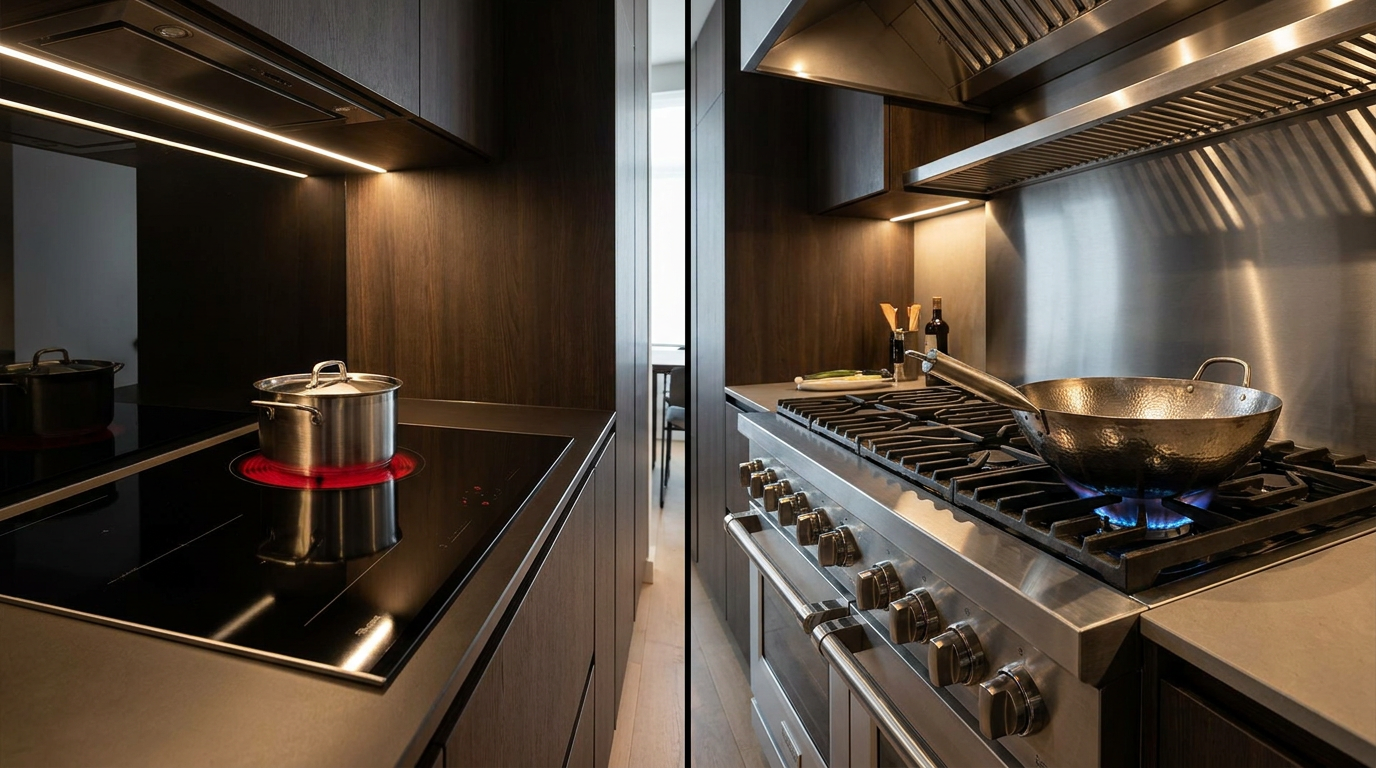
The great kitchen debate of 2026 has shifted from a matter of culinary preference to a major household infrastructure decision. For decades, the blue flame of a gas stove was the undisputed gold standard for serious home cooks. Today, however, induction technology has matured from a niche premium product into a thermodynamically superior powerhouse. As millions of households face appliance upgrades, the choice between gas and induction involves weighing upfront costs against long-term health, efficiency, and performance.[3]
To understand the trade-offs, it helps to look at the underlying physics of how each platform generates heat. Gas cooktops rely on combustion, burning natural gas or liquid propane to create an open flame that heats the air, the grates, and eventually the bottom of the cookware. Induction, by contrast, uses copper coils beneath a glass surface to generate an oscillating magnetic field. This field induces an electrical current directly inside the cookware itself, turning the pot or pan into its own heat source while the glass surface remains relatively cool.[5][7]
This fundamental difference in heat transfer creates a massive gap in energy efficiency. According to 2026 data, induction cooktops operate at an impressive 85 to 90 percent thermal efficiency. The vast majority of the electrical energy consumed goes directly into cooking the food. Traditional gas stoves, on the other hand, operate at just 32 to 55 percent efficiency, losing the majority of their energy to the surrounding environment.[1][8]

The inefficiency of gas means that roughly half of the energy consumed is lost as ambient heat, escaping around the sides of the pan and warming the kitchen. This not only wastes fuel but also forces household HVAC systems to work significantly harder during the summer months to cool the room. Induction’s targeted heating eliminates this waste, keeping kitchens noticeably cooler and more comfortable during heavy meal prep.[4][6]
When it comes to raw cooking speed, induction’s direct energy transfer gives it a decisive edge. Consumer testing consistently shows that induction cooktops can bring a pot of water to a rolling boil 20 to 50 percent faster than comparable gas burners. For busy households, this translates to shaving minutes off daily tasks like making pasta or boiling water for tea, accumulating into hours of saved time over a year.[1][6]

However, gas still holds distinct performance advantages for specific cooking styles. The visual feedback of an open flame allows for intuitive, instant temperature adjustments that many experienced chefs prefer. Gas is also the undisputed champion for traditional wok cooking, where flames can lick the sides of a round-bottomed pan, and for techniques that require charring ingredients directly over the fire—something a flat glass induction surface simply cannot do.[3][5]
The most significant shift in the 2026 cooktop debate centers on indoor air quality and household health. Gas combustion inherently produces a cocktail of byproducts, including nitrogen dioxide (NO2), carbon monoxide, and fine particulate matter (PM2.5). Recent comprehensive studies have shown that homes with gas stoves frequently exceed World Health Organization guidelines for indoor NO2 levels, especially during the winter months when windows are closed.[1][2]
The most significant shift in the 2026 cooktop debate centers on indoor air quality and household health.
The health implications of these emissions are increasingly hard to ignore. Meta-analyses have linked gas stove usage to a 32 to 42 percent increased relative risk of childhood asthma, alongside other respiratory irritations. Because induction relies entirely on electromagnetism, it produces absolutely zero indoor combustion emissions, making it the empirically validated choice for households prioritizing respiratory health and clean indoor air.[1][2]

Safety and maintenance also present a stark contrast. Induction surfaces cool down rapidly once the pan is removed, dramatically reducing the risk of accidental burns—a major selling point for families with young children. Furthermore, the flat glass surface of an induction range can be wiped clean in seconds, whereas gas stoves require the tedious disassembly and scrubbing of heavy cast-iron grates and burner caps to remove baked-on grease.[3][6]
From a financial perspective, the comparison requires looking beyond the sticker price. Gas cooktops generally maintain a lower upfront purchase cost, often running $500 to $1,000 less than premium induction models. However, gas systems have more moving parts—valves, igniters, and burner caps—that fail at higher rates than induction’s solid-state electronics, leading to more frequent professional maintenance calls.[1][3]
When factoring in the superior energy efficiency and lower maintenance requirements, induction often reaches a financial breakeven point within 3.5 to 4.5 years. After that period, the lower operating costs generate pure savings. However, the true cost of switching to induction heavily depends on a home's existing infrastructure, which can alter the math entirely.[1]
Installation compatibility is the biggest hurdle for buyers looking to make the switch. If a kitchen is already plumbed for gas but lacks a dedicated 240-volt electrical circuit, upgrading the electrical panel and running new wiring can add hundreds or even thousands of dollars to the induction installation cost. Conversely, homes already equipped with high-voltage electric outlets can adopt induction with a simple plug-and-play swap.[4]

Cookware compatibility is the final practical consideration. Because induction relies on magnetic fields, it only works with ferrous materials like cast iron, enameled cast iron, and magnetic stainless steel. Aluminum, copper, and glass pans will not heat up on an induction surface. Gas, by contrast, is universally compatible with any heat-safe cookware, meaning buyers switching to induction may need to budget for a new set of pots and pans.[3][7]
Ultimately, the decision comes down to matching the technology to the household's priorities. Induction fits perfectly when a buyer prioritizes energy efficiency, rapid heating, effortless cleanup, and the elimination of indoor air pollutants. It is the ideal choice for modernizing a kitchen, provided the home's electrical infrastructure can support it and the user is willing to adapt to digital controls.[4][6]
Conversely, gas remains a strong fit when a home already has established gas lines and upgrading the electrical panel is cost-prohibitive. It is also the necessary choice for culinary traditionalists who rely heavily on visual flame control, frequent high-heat wok cooking, or who possess a large collection of non-magnetic copper or aluminum cookware that they are unwilling to replace. It does not fit well, however, when indoor air quality is a primary medical concern.[3][4]
How we got here
1970s
Induction cooktops are first introduced to the consumer market, but high costs limit widespread adoption.
2010s
Component costs drop significantly, making induction a viable premium option for residential kitchens.
2022
Major health studies link gas stove emissions to a significant percentage of childhood asthma cases, sparking public debate.
2026
Induction reaches near price-parity in operating costs, accelerating the transition away from residential gas.
Viewpoints in depth
Health & Climate Advocates
Prioritize eliminating indoor air pollutants and reducing household carbon footprints.
This camp views the transition away from gas stoves as a public health imperative. Citing extensive data that links indoor nitrogen dioxide (NO2) and fine particulate matter to childhood asthma, advocates argue that burning fossil fuels inside the home is an outdated and dangerous practice. They emphasize that even when turned off, gas stoves can leak benzene and methane. For this group, the 85-90% thermal efficiency of induction is a secondary benefit to the primary goal of achieving zero indoor emissions and decarbonizing residential infrastructure.
Culinary Traditionalists
Value the tactile control, visual feedback, and versatility of an open flame.
Traditionalists argue that cooking is a sensory experience that relies heavily on visual cues. The ability to see a flame and instantly adjust its height provides a level of intuitive control that digital touchpads struggle to replicate. This camp also highlights the practical limitations of induction, noting that it cannot accommodate round-bottomed woks, cannot be used to char peppers directly on a grate, and renders expensive collections of copper and aluminum cookware entirely useless.
Efficiency & Tech Enthusiasts
Focus on the superior thermodynamics, rapid heating speeds, and modern safety features of magnetic cooking.
For tech-focused consumers and efficiency experts, the debate is settled by the math. They point to the fact that induction boils water up to 50% faster than gas while wasting virtually no heat into the surrounding kitchen. This group values the precision of digital temperature control, the safety of a cooktop that remains cool to the touch, and the ease of wiping down a flat glass surface. They view the required electrical upgrades as a one-time investment that pays long-term dividends in performance and lower HVAC cooling costs.
What we don't know
- How quickly local municipalities will expand bans on new natural gas hookups, which could force the transition to electric appliances regardless of consumer preference.
- Whether the long-term durability of modern induction control boards will ultimately match the multi-decade lifespan of mechanically simpler legacy gas stoves.
Key terms
- Thermal Efficiency
- The percentage of energy consumed by the appliance that is successfully transferred into the food being cooked.
- Electromagnetism
- The use of magnetic fields to induce an electric current directly within the cookware, generating heat without a flame.
- Nitrogen Dioxide (NO2)
- A harmful indoor air pollutant produced by burning natural gas, linked to respiratory irritation and asthma.
- NEMA 14-50
- A heavy-duty 240-volt electrical outlet standard required to power most full-size residential induction ranges.
Frequently asked
Do I need to buy all new pots and pans for induction?
Not necessarily. Any cookware with a magnetic base, including cast iron and most stainless steel, will work perfectly. Aluminum and copper will not.
Is induction cooking safe for people with pacemakers?
While the electromagnetic field is highly localized, individuals with pacemakers should consult their cardiologist, as some older devices can be sensitive to magnetic interference.
Will an induction cooktop work during a power outage?
No. Like all electric appliances, induction cooktops require grid power or a robust home battery backup system to operate.
Does gas cooking really cause asthma?
Studies show that the nitrogen dioxide (NO2) emitted by gas stoves increases the relative risk of developing childhood asthma by up to 42% if the kitchen lacks proper ventilation.
Sources
Source coverage
8 outlets
3 viewpoints surfaced








[1]Energy SolutionsHealth & Climate Advocates
Induction vs Gas Cooktops: The Definitive Health, Efficiency & Economic Analysis (2026)
Read on Energy Solutions →[2]Tap EcoHealth & Climate Advocates
Is induction or gas better for your health and the planet?
Read on Tap Eco →[3]Stahl KitchensCulinary Traditionalists
Induction vs Gas Cooktops: Which One Is the Better Choice in 2026?
Read on Stahl Kitchens →[4]SpanrEfficiency & Tech Enthusiasts
3 Key factors for Induction vs Gas Cooktops
Read on Spanr →[5]KitchenAidCulinary Traditionalists
Induction vs. Gas cooktops and ranges
Read on KitchenAid →[6]Home Gear RatingsEfficiency & Tech Enthusiasts
Induction vs Gas Cooktops: Choose the Better Stove for Home Cooks
Read on Home Gear Ratings →[7]Van Vreede'sEfficiency & Tech Enthusiasts
Induction vs. Gas and Electric Cooktops: Which is Best?
Read on Van Vreede's →[8]AT CookerEfficiency & Tech Enthusiasts
Induction vs Gas Stove Efficiency: 85-90% vs 40-55%
Read on AT Cooker →

More in shopping
See all 84 stories →Retail Strategy
Amazon, Walmart, and Target Announce Competing Summer Deal Events for Late June
8 sources

Sustainable Fabrics
Decoding Sustainable Fabrics: The Real Trade-Offs Behind Tencel, Recycled Polyester, and Organic Cotton
7 sources

Display Tech
The 2026 Guide to Premium Television Displays: OLED and Mini-LED Trade-Offs
8 sources

Premium TVs
OLED vs. Mini-LED in 2026: Which Premium TV Technology Wins?
7 sources

Every angle. Every day.
Get shopping stories with full source coverage and perspective breakdowns delivered to your inbox.