
How Virtual Power Plants Are Turning Homes Into the Grid's Best Defense
By networking home batteries, smart thermostats, and EV chargers, Virtual Power Plants are paying consumers to stabilize the grid and replace fossil fuels.
By Factlen Editorial Team
- Grid Operators & Utilities
- Focused on maintaining grid reliability, managing peak load, and deferring expensive infrastructure upgrades.
- Clean Energy Advocates
- View VPPs as the fastest path to retiring fossil-fuel peaker plants and maximizing renewable energy use.
- Consumer Participants
- Motivated by financial incentives, lower energy bills, and maintaining backup power resilience.
- VPP Aggregators
- Focused on scaling software platforms and removing regulatory barriers to market entry.
What's not represented
- · Traditional fossil-fuel power plant operators facing reduced run-times.
- · Low-income renters who cannot afford home batteries or EVs to participate.
Why this matters
Virtual Power Plants are turning everyday homes into active, revenue-generating assets for the energy grid. By networking smart thermostats and batteries, consumers are getting paid to prevent blackouts, lower electricity costs, and reduce the need for dirty fossil-fuel power plants.
Key points
- Virtual Power Plants (VPPs) aggregate decentralized devices like home batteries and smart thermostats to function as a single power plant.
- The Department of Energy estimates VPPs could save the U.S. grid $10 billion annually by 2030.
- Consumers who enroll their devices in VPPs receive financial compensation, often saving an average of $140 per year.
- VPPs provide a clean alternative to fossil-fuel peaker plants, deploying instantly to prevent blackouts during extreme weather.
On a scorching August afternoon, millions of air conditioners hum, electric vehicles charge in driveways, and data centers process endless streams of information. This synchronized surge in electricity demand pushes local power grids to their absolute limits. For decades, the only way utility companies could prevent rolling blackouts was to fire up "peaker plants"—expensive, highly polluting fossil-fuel generators that sit idle for most of the year just to handle these rare spikes.[1][2]
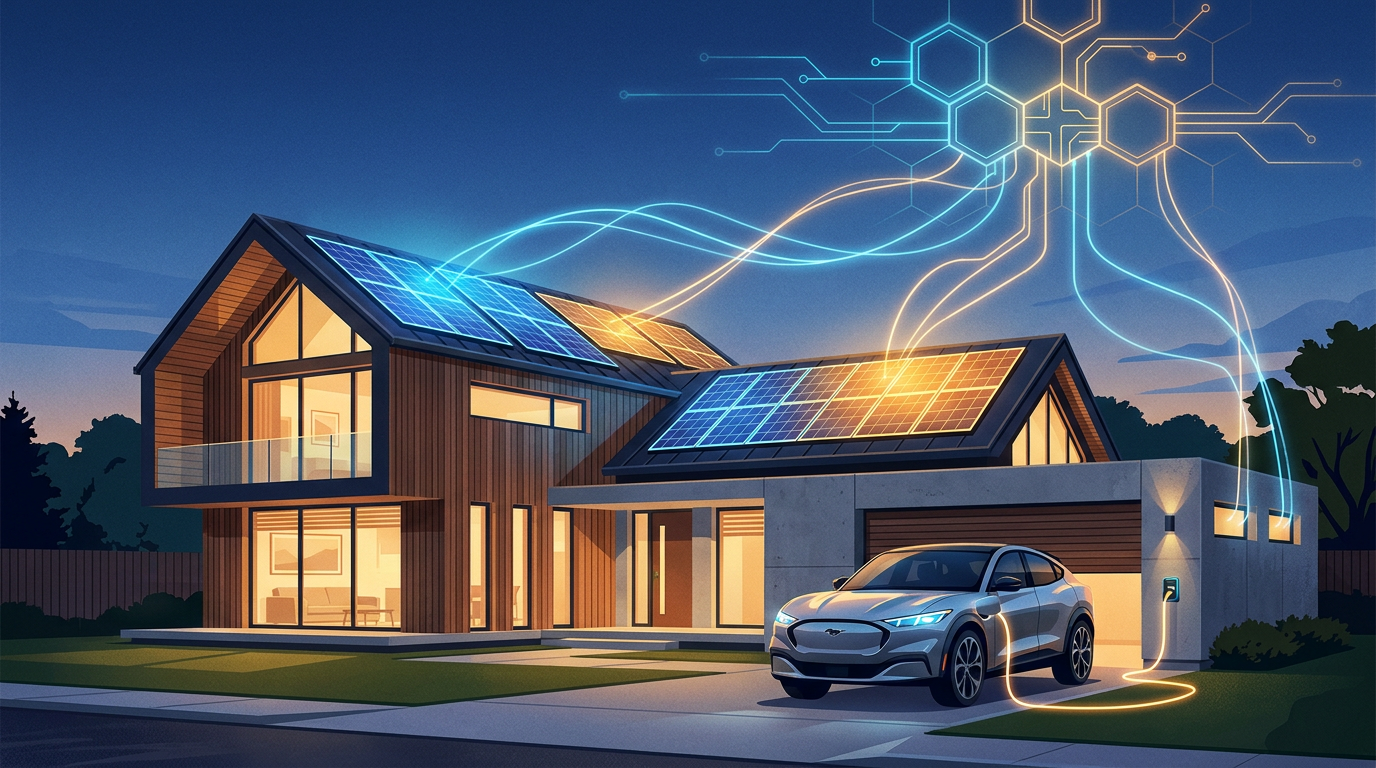
Today, a cleaner, cheaper, and vastly more decentralized solution is already sitting inside millions of American homes. It is called a Virtual Power Plant (VPP), and it is rapidly transforming passive electricity consumers into active, paid participants in the energy grid.[3][4]
A Virtual Power Plant is not a physical facility with smokestacks or cooling towers. Instead, it is a cloud-based network that aggregates thousands of Distributed Energy Resources (DERs). These resources include home batteries, rooftop solar panels, smart thermostats, electric vehicle chargers, and even smart water heaters.[1][5]
Alone, a single smart thermostat tweaking the temperature by one degree or a home battery discharging a few kilowatts is a drop in the bucket. But when specialized software pools the capacity of tens of thousands of these devices, their combined impact rivals the output of a traditional centralized power plant.[2][6]

The mechanism is entirely automated. When grid operators forecast a dangerous spike in demand, they send a digital signal to a VPP aggregator—often a third-party company or the utility itself. The aggregator's software instantly orchestrates a response across the network.[3][7]
In a fraction of a second, thousands of participating smart thermostats might bump up their set temperature by a single, barely noticeable degree, instantly shedding megawatts of load. Simultaneously, home batteries that charged from solar panels earlier in the day begin discharging their stored power directly into the grid.[4][5]
To the grid operator managing the regional transmission system, this synchronized reduction in demand and injection of supply looks and acts exactly like a gas peaker plant spinning up to full capacity. The grid stabilizes, the blackout is averted, and no new fossil fuels are burned.[1][2]
The financial implications of this shift are staggering. The U.S. Department of Energy estimates that deploying 80 to 160 gigawatts of VPP capacity by 2030—enough to serve up to 20% of peak national load—could save the grid $10 billion annually.[1]
These savings materialize because utilities can avoid building new, multi-billion-dollar power plants and defer costly upgrades to aging substations and transmission lines. A recent analysis found that a 400-megawatt VPP costs roughly $43 per kilowatt-year to operate, compared to $99 per kilowatt-year for a comparable natural gas peaker plant.[4]

But the most revolutionary aspect of VPPs is where that money goes. Instead of utility companies paying fossil-fuel conglomerates for emergency gas, they are paying everyday homeowners.[3][6]
But the most revolutionary aspect of VPPs is where that money goes.
Consumers who enroll their devices in a VPP are compensated for their grid services. Depending on the specific program and region, this compensation takes several forms: upfront rebates that heavily subsidize the purchase of a home battery, predictable monthly credits on utility bills, or direct cash payouts based on how much energy the home provided during a grid event.[3][5]
Research from the Rocky Mountain Institute suggests that active VPP participation can reduce a household's annual electricity costs by an average of $140, with battery owners often seeing significantly higher returns. During a recent heatwave in Vermont, a local utility's VPP network saved its customer base $3 million in a single week by avoiding peak wholesale energy prices.[2][4]
The industry is currently scaling through "Bring Your Own Device" (BYOD) programs. Rather than requiring utilities to install proprietary hardware, these programs allow customers to connect equipment they already own—like a Tesla Powerwall, a SolarEdge inverter, or a Google Nest thermostat—directly to the VPP network via an app.[5][7]

Beyond simply shaving peak demand, advanced VPPs are now providing complex "ancillary services" to the grid. Because batteries can discharge power in milliseconds, VPPs are incredibly effective at frequency regulation—the delicate, second-by-second balancing act required to keep the grid's alternating current stable at exactly 60 hertz.[2][7]
Despite the clear technological and economic benefits, the transition is not without friction. The primary hurdle is regulatory lag. Grid operators and public utility commissions are still operating on rules written for the 20th century, making it difficult for decentralized VPPs to compete fairly in wholesale energy markets.[1][6]
The Federal Energy Regulatory Commission (FERC) attempted to clear this bottleneck with Order 2222, a landmark ruling requiring regional grid operators to allow aggregated distributed resources to bid into energy markets. However, the implementation of this order has been slow, complex, and highly fragmented across different states.[2][6]

Consumer trust also remains a vital frontier. Some homeowners are understandably hesitant to hand over control of their expensive home batteries or climate control systems to a utility company. They worry about being left without backup power during a storm or experiencing discomfort during a heatwave.[3][6]
To counter this, modern VPP platforms are designed with strict guardrails. Homeowners can set hard limits—for example, instructing the software to never drain their battery below 20%—and they always retain the ability to push an "opt-out" button on their smartphone if they do not want to participate in a specific event.[3][5]
Ultimately, Virtual Power Plants represent a fundamental democratization of the energy system. As extreme weather events multiply and the electrification of cars and heating systems drives electricity demand to unprecedented heights, the grid can no longer rely solely on massive, centralized infrastructure.[1][4]
How we got here
Early 2000s
The concept of Virtual Power Plants emerges as a theoretical model for managing early renewable energy grids.
2020
FERC issues Order 2222, requiring regional grid operators to allow distributed energy resources to participate in wholesale markets.
2023
The U.S. Department of Energy releases its first 'Liftoff Report', identifying VPPs as a critical national energy priority.
2025
VPPs successfully prevent rolling blackouts during severe heatwaves in New England and California.
2026
The DOE updates its target, pushing to triple national VPP capacity to 160 GW by 2030 to meet surging AI and EV demand.
Viewpoints in depth
Grid Operators' view
VPPs are a critical, fast-deploying buffer against rising peak demand.
With data centers and the electrification of transport pushing peak demand to unprecedented levels, grid operators are struggling to build physical infrastructure fast enough. Transmission lines take a decade to permit and build. VPPs offer a 'non-wires alternative' that can be spun up in months, deferring billions in capital expenditures while keeping the grid stable during extreme weather.
Clean Energy Advocates' view
Decentralization is the fastest path to decarbonization.
Environmental groups point out that the dirtiest power on the grid comes from peaker plants—inefficient gas or coal generators that only run a few hundred hours a year. By using VPPs to shave peak demand, the grid can permanently retire these heavy polluters. Furthermore, VPPs allow the grid to absorb more intermittent wind and solar power by storing it in home batteries during the day and releasing it at night.
Consumer Participants' view
Energy should be a two-way financial street.
For decades, homeowners were passive ratepayers, sending money to a centralized monopoly. VPPs flip this dynamic, turning homes into revenue-generating assets. For consumers who have invested thousands of dollars in solar panels and batteries, VPPs drastically shorten the return on investment while providing the peace of mind that comes with personal backup power.
What we don't know
- How quickly regional grid operators will fully implement FERC Order 2222 to allow VPPs to compete in all wholesale markets.
- Whether upfront battery costs will drop enough to allow widespread VPP participation among lower-income households.
- How the cybersecurity landscape will evolve as millions of consumer devices become critical infrastructure for the national grid.
Key terms
- Virtual Power Plant (VPP)
- A cloud-based network of decentralized energy resources that are aggregated and controlled to function like a single traditional power plant.
- Distributed Energy Resources (DERs)
- Small-scale energy technologies located on the consumer's side of the meter, such as home batteries, solar panels, and smart thermostats.
- Peaker Plant
- A traditional power plant, usually powered by natural gas, that only runs during times of highest electricity demand.
- Demand Response
- Programs that pay consumers to reduce their electricity usage during periods of peak grid stress.
- FERC Order 2222
- A federal ruling that allows aggregated distributed energy resources to compete alongside traditional power plants in wholesale energy markets.
Frequently asked
Do I need a home battery to join a VPP?
Not necessarily. While batteries offer the highest payouts, many VPPs allow participation using just a smart thermostat, electric vehicle charger, or smart water heater.
Will the utility drain my battery completely during an event?
No. VPP programs allow homeowners to set reserve limits (e.g., keeping at least 20% charge for personal backup) and always offer an option to opt out of specific events.
How do I get paid for participating?
Compensation varies by program but typically includes upfront rebates for equipment, monthly capacity credits on your utility bill, or cash payouts based on performance.
Can VPPs really replace traditional power plants?
Yes. By aggregating enough small devices, a VPP can provide the exact same peak capacity and frequency regulation as a fossil-fuel peaker plant, often at less than half the cost.
Sources
Source coverage
7 outlets
4 viewpoints surfaced







[1]U.S. Department of EnergyGrid Operators & Utilities
Pathways to Commercial Liftoff: Virtual Power Plants
Read on U.S. Department of Energy →[2]Rocky Mountain InstituteClean Energy Advocates
Virtual Power Plants, Real Benefits
Read on Rocky Mountain Institute →[3]EnergySageConsumer Participants
What is a virtual power plant?
Read on EnergySage →[4]Solar Energy Industries AssociationClean Energy Advocates
How Virtual Power Plants Are Making the Grid More Affordable, Reliable, and Secure
Read on Solar Energy Industries Association →[5]TeslaVPP Aggregators
What is a Virtual Power Plant?
Read on Tesla →[6]Factlen Editorial TeamVPP Aggregators
Synthesis by Factlen editorial team
Read on Factlen Editorial Team →[7]SolarEdgeVPP Aggregators
What is a Virtual Power Plant (VPP)?
Read on SolarEdge →
Every angle. Every day.
Get energy stories with full source coverage and perspective breakdowns delivered to your inbox.