
How the LA 2028 Olympics Will Run Entirely on Existing Stadiums
Los Angeles will become the first Olympic host city since 1948 to build zero new permanent venues, utilizing a radical reuse strategy to solve the Games' historic 'white elephant' problem.
By Factlen Editorial Team
- Olympic Organizers & IOC
- Focused on proving the Games can be financially and environmentally sustainable.
- Urban Sustainability Advocates
- Focused on the strict execution of circular economy principles and carbon reduction.
- Sports Infrastructure Analysts
- Focused on the technical logistics of adapting existing venues for Olympic broadcast standards.
What's not represented
- · Local Los Angeles transit workers
- · Athletes adapting to non-traditional Olympic Village setups
Why this matters
For decades, hosting the Olympics has been a financial curse that left cities saddled with billions in debt and abandoned stadiums. By proving that a mega-event can be hosted entirely within existing infrastructure, Los Angeles is attempting to create a sustainable, financially viable blueprint that could save the future of the Olympic Games.
Key points
- Los Angeles 2028 will be the first Olympic Games since 1948 to build zero new permanent venues.
- The strategy relies on "radical reuse" of existing world-class arenas like SoFi Stadium, Intuit Dome, and the LA Memorial Coliseum.
- SoFi Stadium will be temporarily converted into the largest Olympic swimming venue in history, seating 38,000 spectators.
- The IOC's Agenda 2020+5 roadmap now encourages cities to adapt the Games to their existing infrastructure to prevent massive debt.
- LA28 has pledged to power all venues with 100% renewable energy and reuse 90% of temporary infrastructure materials.
- The primary logistical challenge will be executing a "transit-first" transportation plan in a notoriously car-centric metropolis.
For the better part of a century, the privilege of hosting the Olympic Games came with a staggering, often ruinous, price tag. Cities from Athens to Rio de Janeiro poured billions of dollars into constructing sprawling, state-of-the-art athletic complexes, velodromes, and aquatic centers. Yet, once the closing ceremonies concluded and the international crowds departed, host municipalities were frequently left with "white elephants"—massive, specialized arenas that cost millions to maintain and had little practical use for local residents.[2][6]
The financial hangovers of these mega-events triggered an existential crisis for the International Olympic Committee (IOC). By the late 2010s, democratic cities were actively voting against bidding for the Games, terrified by the prospect of bankrupting their public coffers for a two-week spectacle. The Olympic model was fundamentally broken, demanding a level of bespoke construction that was increasingly incompatible with modern urban economics and environmental realities.[2][6]
Enter Los Angeles. When the Olympic torch arrives in Southern California in July 2028, the city will attempt a radical departure from the historic norm. For the first time since the 1948 London Games—which were held in the austere aftermath of World War II—an Olympic host city will build exactly zero new permanent venues.[1][3]
Instead of pouring concrete, the LA28 organizing committee is executing a strategy of "radical reuse." Los Angeles is leveraging its unparalleled density of existing, world-class sports and entertainment infrastructure to host the 351 events on the Olympic docket. The city is effectively treating its entire metropolitan footprint as a pre-built Olympic Park, transforming the way a mega-event interfaces with its host environment.[1][4][5]

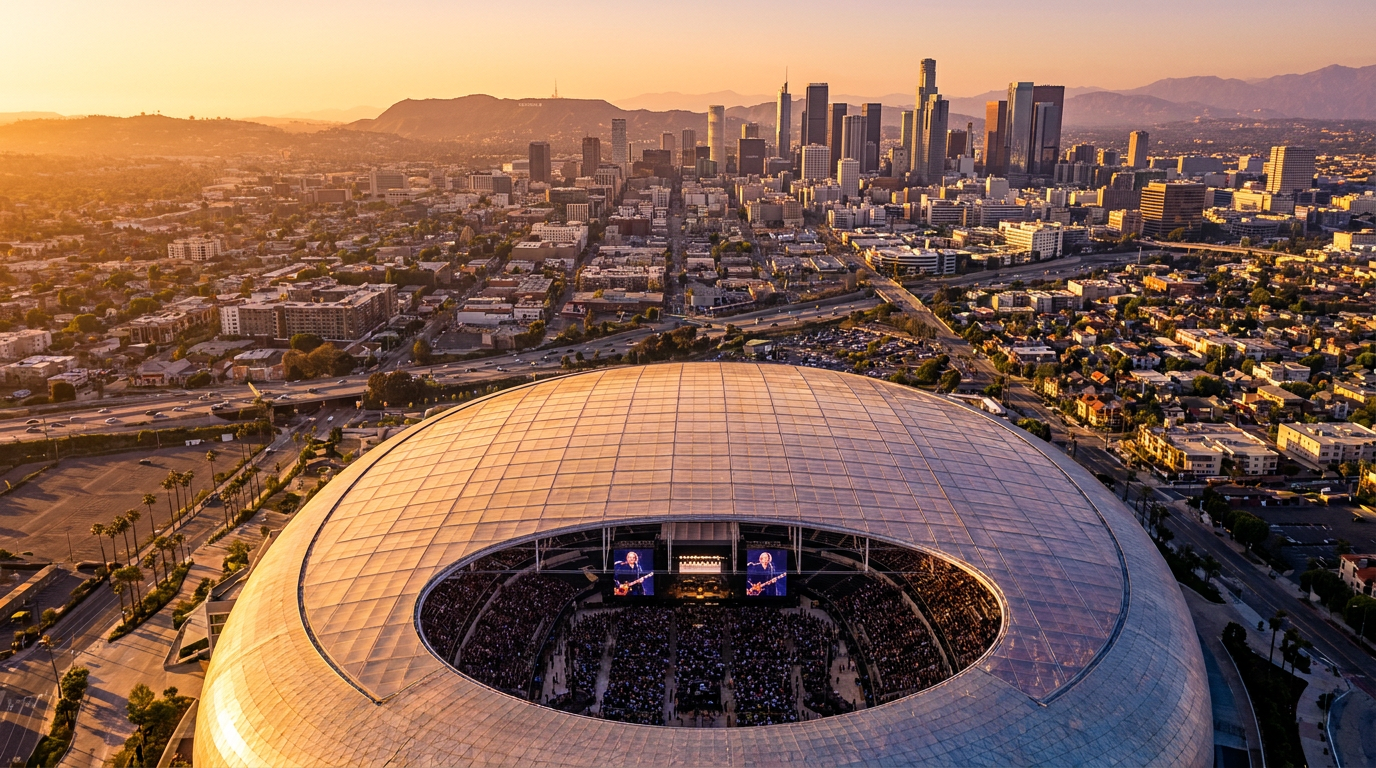
The crown jewel of this adaptive reuse strategy is SoFi Stadium in Inglewood. Originally opened in 2020 at a cost exceeding $5 billion, the architectural marvel serves as the home of the NFL's Rams and Chargers. For the 2028 Games, it will undergo a stunning metamorphosis to host the swimming competitions.[4][5]
By installing a temporary, modular Olympic-sized pool directly over the football turf, organizers will create the largest aquatic venue in Olympic history. With a seating capacity of 38,000 for the swimming events, SoFi Stadium will offer an unprecedented scale for a sport that typically takes place in intimate, purpose-built natatoriums of 10,000 to 15,000 seats.[4][5]
The surrounding Inglewood zone will also feature the Intuit Dome, the newly constructed, hyper-advanced arena built for the NBA's Los Angeles Clippers. Because the arena was completed in 2024, it was not even part of LA's original 2017 bid, but its inclusion provides the Games with what is arguably the most technologically sophisticated basketball facility on the planet.[4][5]

Downtown Los Angeles will serve as another major hub, utilizing the Crypto.com Arena for gymnastics and the Los Angeles Convention Center for fencing, judo, and wrestling. Meanwhile, BMO Stadium—the 22,000-seat home of Major League Soccer's LAFC—will host the Olympic debuts of flag football and the return of lacrosse.[4][5]
Perhaps the most poignant symbol of this sustainable approach is the Los Angeles Memorial Coliseum. Having served as the centerpiece of the 1932 and 1984 Games, the historic stadium will host track and field events once again in 2028. It will become the first stadium in human history to host three different Olympic Games, bridging a century of athletic achievement without requiring a single new foundation to be poured.[4][5]
Perhaps the most poignant symbol of this sustainable approach is the Los Angeles Memorial Coliseum.
This paradigm shift was not merely a local decision; it was mandated by a fundamental change in the IOC's governing philosophy. Recognizing that the old model was unsustainable, the IOC adopted "Olympic Agenda 2020+5," a strategic roadmap designed to adapt the Games to the host city, rather than forcing the host city to adapt to the Games.[2][6]
Agenda 2020+5 explicitly encourages host cities to prioritize existing and temporary infrastructure. Paris 2024 took the first major steps in this direction, utilizing existing or temporary structures for 95% of its venues. Los Angeles is pushing that metric to its absolute limit by eliminating permanent construction entirely.[2][3]

The environmental implications of this "no new build" policy are profound. Construction is traditionally the largest single contributor to an Olympic Games' carbon footprint. By eliminating the need to manufacture thousands of tons of steel and concrete, LA28 is drastically reducing its baseline emissions before a single athlete arrives.[3][6]
Beyond the stadiums, LA28 has committed to powering all venues with 100% renewable electricity. Furthermore, the organizing committee has pledged that 90% of the materials used for temporary infrastructure—such as the modular pools, seating grandstands, and overlay tents—will be reused or recycled after the closing ceremonies.[3][6]
The financial savings generated by avoiding mega-construction projects are being redirected toward human legacy. Because LA28 does not have to balance a multi-billion-dollar infrastructure budget, it has already invested $160 million into "PlayLA," an initiative providing affordable youth sports programming across the city. It represents the single largest investment in youth sports development in California's history.[1][3]

However, executing a distributed, existing-venue model across a sprawling metropolis presents immense logistical hurdles. Unlike centralized Olympic Parks where athletes and fans can walk between arenas, LA28 relies on a network of 24 different zones spread across Southern California.[4][5]
The most daunting challenge is transportation. Los Angeles is globally notorious for its car-centric culture and gridlocked freeways. To move millions of spectators, athletes, and media personnel efficiently, organizers are planning a "transit-first" Games, relying heavily on zero-emission shuttle buses and a rapidly expanding, though still incomplete, regional rail network.[3][5]
Urban planners and local residents remain cautiously optimistic but deeply concerned about the realities of moving Olympic-level crowds through the city's existing arteries. The success of the Games will hinge entirely on whether the region's transit infrastructure can handle the synchronized movement of hundreds of thousands of daily ticket holders.[5][6]

Additionally, while the venues themselves are existing, the temporary overlays required to bring them up to Olympic broadcast and security standards are massive undertakings. Ensuring that the supply chains for these temporary structures adhere to the promised circular economy principles will require rigorous oversight.[3][5][6]
Despite these logistical complexities, the Los Angeles model represents the most viable path forward for the Olympic movement. If LA28 can successfully deliver a spectacular, globally resonant event without leaving behind a trail of debt and empty concrete shells, it will fundamentally rewrite the rules of mega-event hosting.[2][3][6]
The 2028 Games are poised to prove that a city's existing cultural and athletic fabric is more than sufficient to host the world. In doing so, Los Angeles is not just preparing for a two-week festival of sport; it is attempting to save the Olympic Games from their own excess, offering a sustainable blueprint for the rest of the century.[1][2][6]
How we got here
Dec 2014
The IOC adopts Olympic Agenda 2020, beginning the shift toward sustainable, flexible hosting models.
Sep 2017
Los Angeles is officially awarded the 2028 Olympic Games after Paris secures 2024.
Sep 2020
SoFi Stadium opens in Inglewood, providing LA with a massive, state-of-the-art anchor venue.
Mar 2021
The IOC approves Agenda 2020+5, explicitly encouraging host cities to prioritize existing and temporary venues.
Jun 2024
LA28 announces venue updates, moving swimming to SoFi Stadium to create the largest aquatic venue in history.
Aug 2024
The Intuit Dome opens, adding another hyper-modern arena to the LA28 venue master plan.
Viewpoints in depth
Olympic Organizers & IOC
View the 'no new build' strategy as essential to the long-term survival of the Olympic movement.
For the International Olympic Committee and LA28 officials, the radical reuse of existing stadiums is a matter of existential survival. After seeing multiple democratic cities withdraw their Olympic bids over the last decade due to taxpayer revolt, the IOC realized the era of demanding bespoke, multi-billion-dollar Olympic Parks was over. By championing Agenda 2020+5, organizers argue they are creating a financially responsible, highly adaptable blueprint that will encourage a wider variety of global cities to host future Games without fear of economic ruin.
Urban Sustainability Advocates
Praise the elimination of permanent construction but remain vigilant about the true environmental cost of temporary infrastructure.
Environmental and urban planning experts widely applaud LA28 for avoiding the 'white elephant' stadium trap that plagued Athens and Rio. However, they caution that 'no new permanent venues' does not automatically equate to a zero-carbon event. Advocates point out that manufacturing, transporting, and assembling massive temporary structures—such as the 38,000-seat swimming overlay at SoFi Stadium—still carries a significant carbon footprint. They are pressing organizers to ensure strict adherence to the promise that 90% of temporary materials will genuinely enter a circular recycling economy post-Games.
Los Angeles Residents
Excited by the global spotlight but deeply concerned about the logistical realities of transit and traffic.
While local taxpayers are relieved that the city is not footing the bill for new stadiums, the primary concern among Angelenos is the day-to-day disruption of the Games. Los Angeles is a notoriously sprawling, car-dependent metropolis. Residents worry that the 'transit-first' plan—which relies on a fleet of zero-emission buses and an expanding but incomplete rail network—will buckle under the weight of hundreds of thousands of daily Olympic spectators, potentially gridlocking the region's already strained freeway system.
What we don't know
- Whether Los Angeles' regional transit network can successfully handle the synchronized movement of hundreds of thousands of daily spectators.
- The exact, finalized carbon footprint of manufacturing and transporting the massive temporary overlays required for the stadiums.
- How the distributed, 24-zone venue model will impact the traditional, centralized 'Olympic Park' atmosphere for athletes and fans.
Key terms
- White Elephant
- A massive, expensive stadium built specifically for a mega-event that is abandoned or underutilized after the event concludes.
- Agenda 2020+5
- The International Olympic Committee's strategic roadmap that prioritizes sustainability, cost-reduction, and the use of existing venues for host cities.
- Radical Reuse
- The strategy of aggressively repurposing existing buildings and infrastructure rather than constructing new facilities.
- Circular Economy
- An economic model focused on minimizing waste by ensuring materials are continuously reused, repaired, or recycled.
Frequently asked
Will Los Angeles build any new stadiums for the 2028 Olympics?
No. LA28 will be the first Olympic Games since 1948 to build zero new permanent venues, relying entirely on existing and temporary infrastructure.
Where will the swimming events be held?
Swimming will take place at SoFi Stadium, the home of the NFL's Rams and Chargers. A temporary modular pool will be installed, creating a 38,000-seat aquatic venue.
How is LA28 funding youth sports?
Because the city is saving billions by not building new stadiums, organizers have invested $160 million into 'PlayLA', a program providing affordable youth sports access across Los Angeles.
How will people get to the venues?
LA28 is planning a 'transit-first' Games, relying on an expanded regional rail network and a massive fleet of zero-emission shuttle buses to move spectators between the 24 venue zones.
Sources
Source coverage
6 outlets
3 viewpoints surfaced






[1]LA28 OfficialOlympic Organizers & IOC
LA28 Games Plan and Sustainability
Read on LA28 Official →[2]International Olympic CommitteeOlympic Organizers & IOC
From Paris 2024 to LA28: how the Olympic Movement is protecting the future of sport
Read on International Olympic Committee →[3]ASUENEUrban Sustainability Advocates
The ESG Blueprint of LA28: Transforming Global Sporting Events
Read on ASUENE →[4]nss sportsSports Infrastructure Analysts
All the venues of the Los Angeles 2028 Olympics
Read on nss sports →[5]TFC StadiumsSports Infrastructure Analysts
Inside LA28 Olympic Venues
Read on TFC Stadiums →[6]Factlen Editorial TeamUrban Sustainability Advocates
Synthesis by Factlen editorial team
Read on Factlen Editorial Team →


Every angle. Every day.
Get sports stories with full source coverage and perspective breakdowns delivered to your inbox.