
How the Gut Microbiome Influences Mood: The Emerging Science of Nutritional Psychiatry
Recent breakthroughs in microbiology reveal that the trillions of bacteria in the human digestive tract actively communicate with the brain, influencing mood, stress levels, and cognitive function. This explainer breaks down the mechanisms of the gut-brain axis and the evidence behind 'psychobiotics'.
By Factlen Editorial Team
- Nutritional Psychiatrists
- Argue that dietary intervention should be a foundational pillar of mental health treatment alongside traditional therapy and medication.
- Microbiome Researchers
- Focus on the molecular mechanisms of the gut-brain axis, urging caution against over-hyping commercial probiotic supplements until strain-specific data is robust.
- Integrative Dietitians
- Emphasize whole-food dietary patterns, such as high-fiber and fermented foods, over isolated supplements to cultivate a resilient microbiome.
What's not represented
- · Commercial Supplement Manufacturers
- · Traditional Psychiatrists skeptical of dietary interventions
Why this matters
Understanding the gut-brain connection empowers individuals to use daily dietary choices as a tangible tool for improving mental resilience and cognitive health, shifting the narrative of nutrition from purely physical weight management to holistic psychological well-being.
Key points
- The gut and brain communicate continuously via the vagus nerve and chemical messengers.
- Gut bacteria produce essential neurotransmitters, including 90% of the body's serotonin.
- "Psychobiotics" are specific bacterial strains and fibers that yield mental health benefits.
- High-fiber diets and fermented foods actively reshape the microbiome to support cognitive health.
- Nutritional psychiatry is meant to complement, not replace, traditional mental health treatments.
For decades, the fields of psychiatry and gastroenterology operated in entirely separate silos. Mental health was viewed strictly as a matter of brain chemistry, genetics, and psychological trauma, while the digestive system was treated as a simple biological engine for extracting nutrients and expelling waste. Today, that paradigm has been completely upended by a wave of microbiological research revealing that the human gut and the human brain are engaged in a constant, complex, and highly influential biochemical conversation.[4][5]
At the center of this conversation is the gut microbiome, an incredibly dense ecosystem of roughly 100 trillion microbial cells residing primarily in the large intestine. To put this scale into perspective, the human body contains more bacterial cells than human cells. These microscopic organisms do not merely hitch a ride; they are active participants in human physiology, digesting complex carbohydrates, synthesizing essential vitamins, and training the immune system. Crucially, researchers now understand that they also manufacture the very neurochemicals that dictate how we feel.[1][2]
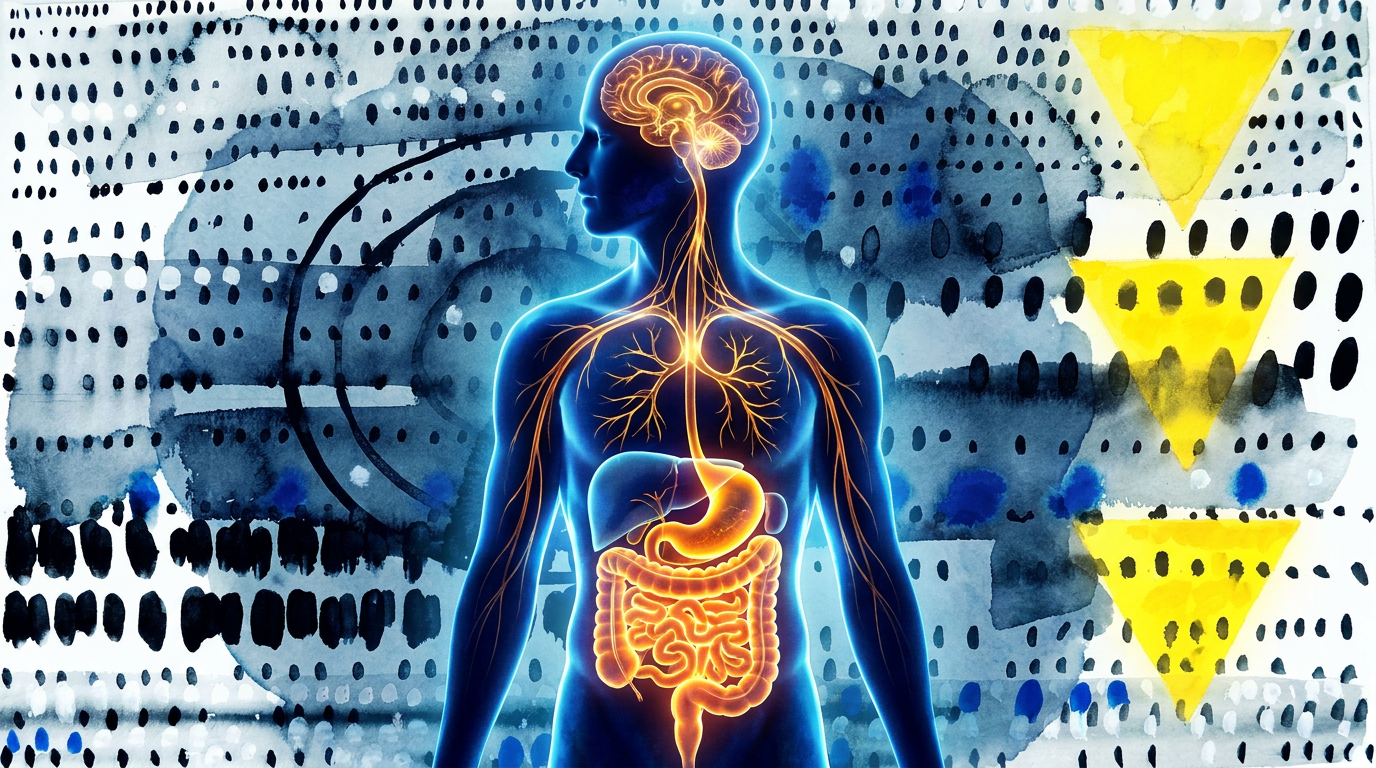
The physical infrastructure enabling this communication is known as the gut-brain axis. This bidirectional network links the central nervous system (the brain and spinal cord) with the enteric nervous system, a vast web of approximately 500 million neurons lining the gastrointestinal tract. This neural network is so extensive and operates with such autonomy that scientists frequently refer to it as the body's "second brain." It governs the mechanics of digestion independently, but it also continuously reports back to the skull.[1]
The primary physical highway for this reporting is the vagus nerve, a thick cable of nerve fibers extending from the brainstem all the way down to the abdomen. For years, medical science assumed the vagus nerve primarily carried instructions from the brain down to the organs. However, modern tracing techniques have revealed that roughly 80 percent of the nerve fibers in the vagus nerve are actually sensory, meaning they carry information upward from the gut to the brain, transmitting real-time data about the state of the microbiome.[1][3]

Beyond this physical neural connection, the gut and brain communicate chemically. The bacteria in our digestive tract are prolific chemical factories. When they ferment dietary fiber—the indigestible carbohydrates found in plants—they produce metabolic byproducts called short-chain fatty acids (SCFAs), such as butyrate, propionate, and acetate. These SCFAs are highly anti-inflammatory and have been shown to cross the blood-brain barrier, directly influencing neuroplasticity and protecting against neuroinflammation, a known driver of depressive symptoms.[3]
Beyond this physical neural connection, the gut and brain communicate chemically.
Perhaps the most startling discovery in nutritional psychiatry is the gut's role in producing neurotransmitters. Serotonin, the famous "feel-good" chemical targeted by standard antidepressant medications (SSRIs), is overwhelmingly manufactured in the digestive tract. An estimated 90 percent of the body's serotonin is produced by enterochromaffin cells in the gut, heavily regulated by the local bacterial population. The microbiome also produces significant quantities of dopamine, GABA (which regulates anxiety), and acetylcholine.[2][3]

This biochemical reality has given rise to the concept of "psychobiotics." Originally coined in 2013, the term describes live organisms that, when ingested in adequate amounts, produce a health benefit in patients suffering from psychiatric illness. The definition has since expanded to include prebiotics—the specific types of dietary fiber that feed these beneficial bacteria. Psychobiotic research investigates how specific strains of Lactobacillus and Bifidobacterium can blunt the body's cortisol response and reduce systemic anxiety.[3][5]
The clinical evidence supporting this mechanism has moved from animal models to human trials. The landmark SMILES trial, published in 2017, was one of the first randomized controlled trials to demonstrate that dietary intervention could effectively treat clinical depression. Patients with moderate to severe depression who were guided to adopt a modified Mediterranean diet—rich in whole grains, legumes, vegetables, and healthy fats—experienced significantly greater remission rates compared to a control group receiving only social support.[4]
The success of such dietary patterns lies in their ability to cultivate microbial diversity. A healthy microbiome is a diverse microbiome. Diets high in ultra-processed foods, refined sugars, and artificial emulsifiers tend to starve beneficial bacteria and promote the overgrowth of inflammatory strains. This state of imbalance, known as dysbiosis, compromises the intestinal lining (often called "leaky gut"), allowing endotoxins to enter the bloodstream and trigger a systemic immune response that eventually reaches the brain.[1][2]
Despite the immense promise of psychobiotics, researchers urge caution against viewing them as a standalone magic bullet. The microbiome is highly individualized, shaped by genetics, birth method, early childhood environment, and lifetime antibiotic use. A bacterial strain that alleviates anxiety in one individual might have a negligible effect on another. Furthermore, the commercial supplement industry has outpaced the science, heavily marketing probiotic pills that often lack the specific, clinically tested strains or the survivability to reach the lower intestine intact.[3][5]

Because of these variables, leading nutritional psychiatrists advocate for a "food-first" approach rather than relying on isolated supplements. Consuming a wide variety of plant fibers acts as a broad-spectrum fertilizer for the gut ecosystem. Additionally, incorporating fermented foods—such as kefir, kimchi, sauerkraut, and kombucha—introduces transient live cultures that help regulate the gut environment and reduce inflammation as they pass through the digestive tract.[2][4]

The integration of nutritional psychiatry into mainstream medicine represents a profound shift in how we approach mental health. It does not replace traditional therapies or life-saving psychiatric medications, but rather adds a powerful, accessible tool to the therapeutic arsenal. By recognizing that the brain does not exist in isolation, individuals can leverage their daily meals to actively cultivate an internal ecosystem that supports resilience, emotional stability, and long-term cognitive health.[4][5]
How we got here
2004
A landmark study shows germ-free mice exhibit exaggerated stress responses, sparking modern gut-brain research.
2013
The term 'psychobiotics' is officially coined by researchers Ted Dinan and John Cryan to describe bacteria with mental health benefits.
2017
The SMILES trial becomes the first randomized controlled trial to show dietary improvement can effectively treat clinical depression.
2024
Major meta-analyses confirm the bidirectional relationship between gut dysbiosis and anxiety disorders.
Viewpoints in depth
Nutritional Psychiatrists
Emphasize diet as a core pillar of mental health treatment.
This camp argues that the historical separation of psychiatry from nutrition was a fundamental error in medicine. Citing trials like SMILES, they advocate for prescribing dietary changes—specifically Mediterranean-style diets rich in fiber and omega-3s—as a first-line or adjunct treatment for depression and anxiety. They view the microbiome as a modifiable target for psychiatric intervention, arguing that therapy and medication are less effective when the brain is bathed in systemic inflammation originating from a dysbiotic gut.
Microbiome Researchers
Focus on molecular mechanisms and caution against commercial hype.
While deeply optimistic about the science, microbiologists often act as a moderating voice against the wellness industry's rapid commercialization of the gut-brain axis. They emphasize that microbiome research is still in its infancy regarding human applications. They point out that animal models do not always translate perfectly to humans, and they stress the need for large-scale, strain-specific human trials before definitively claiming that a specific probiotic pill can cure anxiety or depression.
Integrative Dietitians
Advocate for whole-food dietary patterns over isolated supplements.
Dietitians in this space focus on practical, sustainable implementation. Rather than waiting for the perfect psychobiotic pill to be developed, they encourage patients to focus on 'microbiome-friendly' eating patterns today. This involves increasing plant diversity (aiming for 30 different plant types a week) to provide a wide spectrum of prebiotics, and incorporating traditional fermented foods. They argue that whole foods provide a synergistic matrix of nutrients that isolated supplements simply cannot replicate.
What we don't know
- Which specific bacterial strains are most universally effective for distinct mood disorders.
- How individual genetics interact with microbiome composition to affect mental health outcomes.
- The exact dosage and survival rate of commercial probiotic supplements required to alter brain chemistry.
Key terms
- Gut-Brain Axis
- The two-way biochemical communication network connecting the gastrointestinal tract and the central nervous system.
- Psychobiotics
- Live bacteria (probiotics) or compounds that support them (prebiotics) which confer mental health benefits when consumed in adequate amounts.
- Enteric Nervous System
- A vast web of hundreds of millions of neurons lining the gastrointestinal tract, often referred to as the body's 'second brain.'
- Short-Chain Fatty Acids (SCFAs)
- Beneficial, anti-inflammatory compounds produced when gut bacteria ferment dietary fiber.
- Vagus Nerve
- The primary nerve connecting the brainstem to the abdomen, acting as the main physical highway for gut-brain signaling.
Frequently asked
Can eating yogurt cure clinical depression?
No. While fermented foods support a healthy microbiome, they are not a standalone cure for clinical depression. Nutritional psychiatry views diet as a powerful complementary tool, not a replacement for medical treatment.
What are the best foods for the gut-brain axis?
High-fiber plant foods (like beans, oats, and berries) act as 'prebiotics' to feed good bacteria. Fermented foods (like kefir, kimchi, and kombucha) introduce live beneficial cultures.
Are commercial probiotic pills effective for mood?
The evidence is mixed. While specific strains show promise in clinical trials, many over-the-counter supplements lack the targeted strains or the survivability to significantly impact mood, making whole foods a more reliable intervention.
Sources
Source coverage
5 outlets
3 viewpoints surfaced





[1]National Institutes of HealthMicrobiome Researchers
The Gut-Brain Axis: Influence of Microbiota on Mood and Mental Health
Read on National Institutes of Health →[2]Harvard T.H. Chan School of Public HealthNutritional Psychiatrists
The Microbiome and Nutritional Psychiatry
Read on Harvard T.H. Chan School of Public Health →[3]Nature Reviews MicrobiologyMicrobiome Researchers
Psychobiotics and the Manipulation of Bacteria-Brain Signals
Read on Nature Reviews Microbiology →[4]The Lancet PsychiatryNutritional Psychiatrists
Nutritional medicine as mainstream in psychiatry
Read on The Lancet Psychiatry →[5]Factlen Editorial TeamIntegrative Dietitians
Synthesis by Factlen editorial team
Read on Factlen Editorial Team →

More in health
See all 7 stories →Cardiorespiratory Fitness
The Evidence Behind VO2 Max and Zone 2 Training as Predictors of Longevity
0 sources

T1D Research
FDA Approves First Disease-Modifying Therapy for Children Recently Diagnosed With Stage 3 Type 1 Diabetes
0 sources

Gut-Brain Axis
The Gut-Brain Axis: How 'Psychobiotics' and Diet Are Reshaping Mental Health
0 sources
Type 1 Diabetes
FDA Approves Teplizumab for Children with Stage 3 Type 1 Diabetes, Preserving Natural Insulin Production
0 sources
Every angle. Every day.
Get health stories with full source coverage and perspective breakdowns delivered to your inbox.