
How SpaceX Executed the Largest IPO in History by Rewriting Wall Street's Rules
By bypassing traditional underwriting norms and leveraging a hybrid auction model, SpaceX raised a record-breaking $75 billion in its public debut. The landmark offering provides a massive liquidity event for venture backers and employees while establishing a new blueprint for mega-cap technology listings.
By Factlen Editorial Team
- Venture Capitalists
- View the IPO as a generational liquidity event that will unfreeze the tech investment ecosystem.
- Retail Investors
- Celebrate the democratic auction model that allowed everyday traders access to shares at the same price as institutions.
- Traditional Underwriters
- Concerned that SpaceX's successful bypass of standard IPO processes will encourage other unicorns to cut banks out of lucrative fees.
- SpaceX Employees
- Focused on the life-changing paper wealth generated by the listing, while navigating complex lock-up periods.
What's not represented
- · Competitor aerospace firms
- · Index fund managers
Why this matters
This landmark $75 billion liquidity event not only mints thousands of new millionaires but proves that mega-cap tech companies can successfully bypass traditional Wall Street gatekeepers. The capital unlocked will likely trigger a new wave of venture funding across the broader startup ecosystem.
Key points
- SpaceX raised $75 billion, shattering the previous IPO record held by Saudi Aramco.
- The company bypassed traditional Wall Street underwriters, saving an estimated $1.5 billion in fees.
- A hybrid Dutch auction model allowed retail and institutional investors to buy shares at the exact same clearing price.
- The massive liquidity event provides life-changing wealth for employees and unfreezes capital for venture backers.
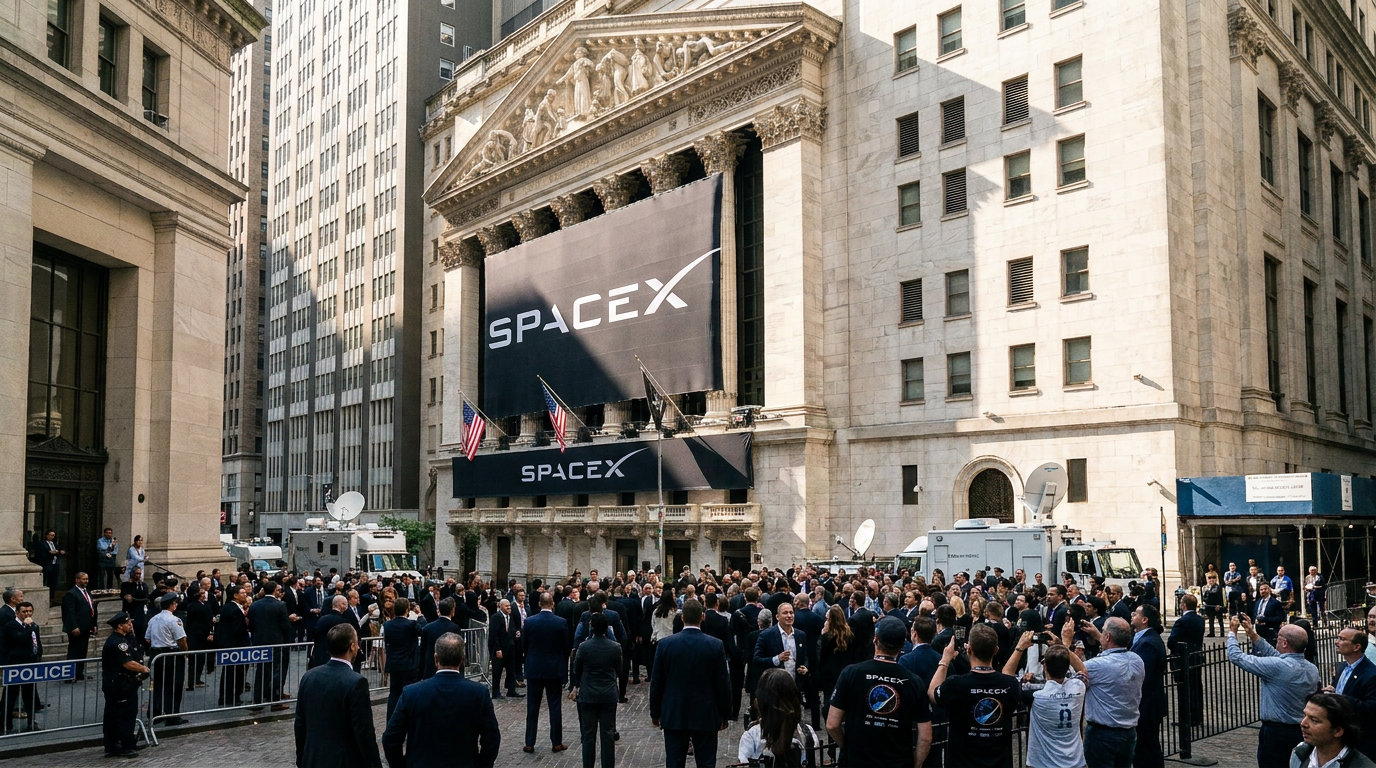
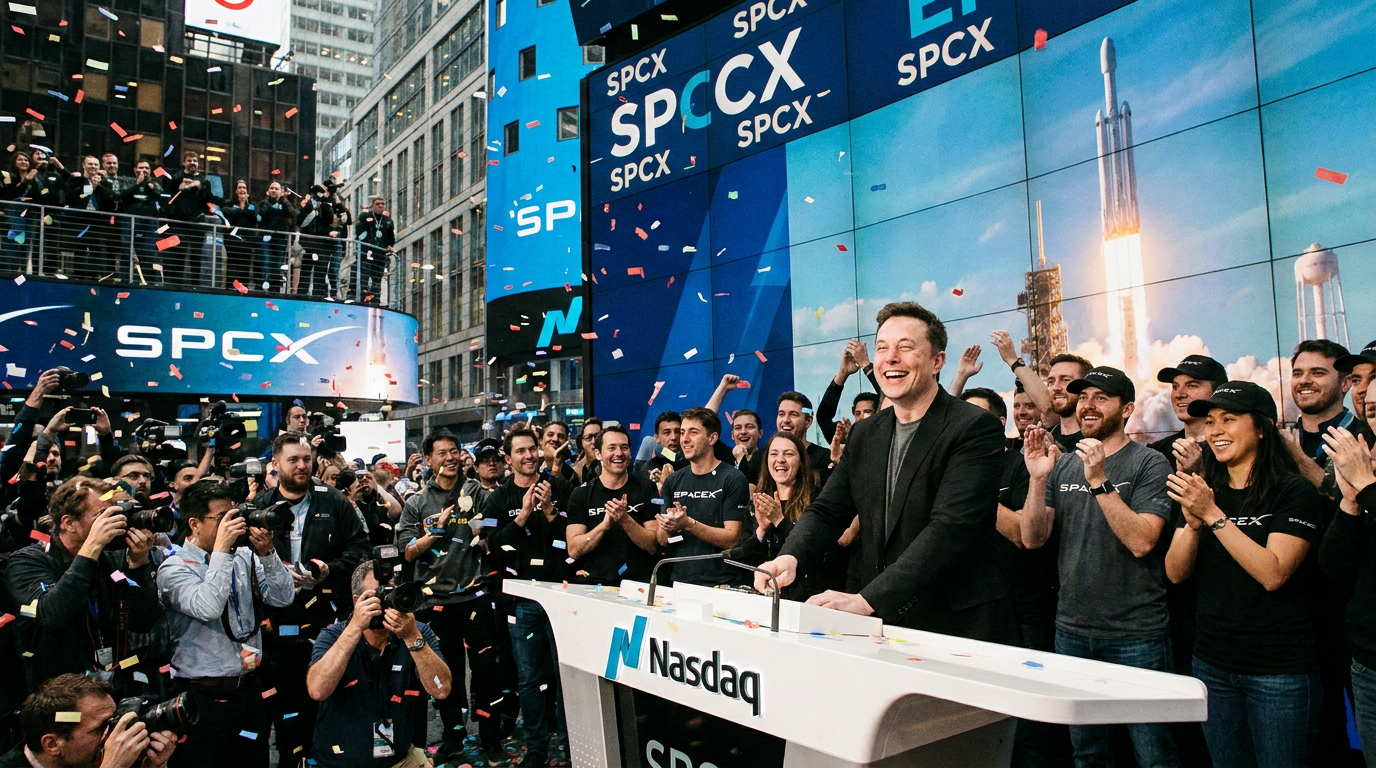
On a brisk June morning, the financial world watched as SpaceX executed the largest initial public offering in history, raising a staggering $75 billion. The aerospace manufacturer and satellite internet provider didn't just break records; it fundamentally rewrote the rules of how a mega-cap technology company transitions to the public markets. By bucking Wall Street norms, the company achieved what many analysts are calling a flawless debut.[1][2]
For years, venture capitalists and industry analysts speculated on when Elon Musk would allow public investors into his crown jewel. The resulting debut valued the company at an unprecedented $400 billion, easily eclipsing the previous IPO record held by Saudi Aramco's $29.4 billion raise. The sheer scale of the offering immediately cemented SpaceX as a cornerstone of modern institutional portfolios.[2][6]
But the size of the offering is only half the story. The mechanics of the listing have sent shockwaves through Wall Street's traditional power centers. Rather than embarking on a conventional roadshow orchestrated by a syndicate of investment banks charging hefty fees, SpaceX opted for a highly customized hybrid Dutch auction model.[4][5]
In a standard IPO, underwriters gauge institutional interest, set a price, and allocate shares primarily to preferred clients. This often results in a massive first-day "pop" that leaves money on the table for the company while enriching the banks' best clients. SpaceX's mechanism dismantled this structure, allowing both institutional giants and retail investors to submit blind bids for the number of shares they wanted and the price they were willing to pay.[5][7]

A central algorithm then aggregated these bids to find the highest price at which all $75 billion worth of shares could be sold—known as the "clearing price." Everyone who bid at or above this threshold received shares at that exact clearing price. This democratized access, ensuring that a retail investor in Ohio paid the exact same price per share as a massive sovereign wealth fund.[1][5]
The result was a remarkably stable first day of trading. Without the artificial scarcity engineered by traditional underwriters, the stock experienced a modest 4% fluctuation. This is a stark contrast to the volatile, double-digit swings typical of highly anticipated technology listings, proving that the auction mechanism accurately discovered the market's true demand.[2][7]
This stability was a bitter pill for traditional investment banks. By sidelining the major Wall Street institutions and acting largely as its own bookrunner, SpaceX saved an estimated $1.5 billion in traditional underwriting fees. Financial analysts note that this successful bypass could embolden other massive private companies, such as Stripe or Databricks, to adopt similar direct-to-market strategies.[4][6]

This stability was a bitter pill for traditional investment banks.
For the venture capital ecosystem, the SpaceX IPO represents a generational liquidity event. After a prolonged period of sluggish exit activity and high interest rates, the massive injection of capital back into the hands of early backers like Founders Fund and Andreessen Horowitz is expected to catalyze a new wave of early-stage investments across the tech sector.[3][6]
The wealth creation extends far beyond Sand Hill Road. Thousands of early and mid-level SpaceX employees, who have historically been compensated with generous stock options in lieu of top-tier cash salaries, experienced a life-changing financial milestone. For many engineers who spent years sleeping under their desks to meet launch deadlines, the IPO validates a decade of grueling work.[1][8]
Real estate markets in areas with heavy SpaceX footprints are already feeling the impact. In South Texas, near the company's Starbase facility, real estate agents report that the newly liquid paper wealth of SpaceX employees is theoretically enough to purchase every available home in the surrounding county, sparking conversations about local economic transformation.[1][8]

However, this newfound wealth is not instantly accessible. Like most public offerings, the SpaceX IPO includes a tiered lock-up period. Employees and early investors are restricted from selling their shares immediately, a mechanism designed to prevent a sudden flood of supply from crashing the stock price during its crucial first few months of public trading.[5][8]
The capital raised is earmarked for the company's most ambitious projects. A significant portion of the $75 billion will fund the continued rapid iteration of the Starship program, the massive fully reusable rocket designed to carry humans to Mars and establish a permanent lunar presence.[2][3]
Additionally, the funds will accelerate the deployment of the Starlink satellite internet constellation. Starlink has already proven to be a formidable revenue engine, and the new capital will allow for the launch of next-generation satellites capable of providing direct-to-cell service globally, threatening traditional telecom monopolies.[3][7]

While the execution of the IPO has been universally praised as a masterclass in corporate finance, the company now faces the relentless scrutiny of public markets. Quarterly earnings reports, public shareholder meetings, and the demand for consistent margin expansion will test a corporate culture that has historically thrived on moving fast and breaking things outside the public eye.[4][5]
Ultimately, the SpaceX IPO is more than just a massive financial transaction; it is a proof of concept. It demonstrates that a company with sufficient scale and brand power can dictate its own terms to the global financial system, rewarding its employees and early believers while funding the next frontier of human exploration.[1][6]
How we got here
2002
Elon Musk founds Space Exploration Technologies Corp. with the ultimate goal of colonizing Mars.
2008
SpaceX secures a crucial $1.6 billion NASA contract, saving the company from near-bankruptcy.
2020
The company successfully launches its first crewed mission to the International Space Station.
2024
Starship achieves full orbital success and recovery, proving the viability of the heavy-lift vehicle.
June 2026
SpaceX executes the largest IPO in history, raising $75 billion via a hybrid auction model.
Viewpoints in depth
Venture Capitalists
View the IPO as a generational liquidity event that will unfreeze the tech investment ecosystem.
For early backers like Founders Fund and Andreessen Horowitz, the SpaceX IPO is the ultimate vindication of patient capital. Venture capitalists argue that this massive liquidity event arrives at a critical time, injecting billions of dollars in returns back into limited partner (LP) accounts. This capital can now be recycled into the next generation of deep-tech and aerospace startups, effectively unfreezing an exit market that had been sluggish due to high interest rates.
Traditional Underwriters
Concerned that SpaceX's successful bypass of standard IPO processes will encourage other unicorns to cut banks out of lucrative fees.
Wall Street institutions view the SpaceX listing with a mixture of awe and deep concern. By acting largely as its own bookrunner and utilizing a Dutch auction, SpaceX deprived major banks of an estimated $1.5 billion in underwriting fees. Financial analysts at these institutions warn that while a company with SpaceX's massive brand power can pull this off, the model carries significant risks for lesser-known startups that rely on banks to market their shares and stabilize early trading.
Retail Investors
Celebrate the democratic auction model that allowed everyday traders access to shares at the same price as institutions.
Retail advocacy groups and individual investors have championed the SpaceX IPO as a triumph of market democratization. Historically, retail investors are locked out of the initial pricing of hot tech IPOs, forced to buy shares on the open market after institutional clients have already driven the price up. The hybrid auction model ensured that any retail investor willing to meet the clearing price received their allocation, fundamentally leveling the playing field.
What we don't know
- How the stock will perform once the initial employee lock-up periods expire and millions of new shares flood the market.
- Whether other massive private companies like Stripe or Databricks will successfully replicate this underwriter-free auction model.
- How the intense scrutiny of quarterly public earnings will impact SpaceX's historically secretive and fast-paced engineering culture.
Key terms
- Dutch Auction
- A public offering structure where the price of the shares is determined after taking in all bids to find the highest price at which the total allocation can be sold.
- Liquidity Event
- A financial transaction, such as an IPO or acquisition, that allows founders, employees, and early investors to cash out some or all of their equity.
- Underwriter
- An investment bank that manages a traditional public offering, assessing risk, setting the initial price, and selling the shares to institutional clients for a fee.
- Lock-up Period
- A predetermined window of time after an IPO during which company insiders and early investors are legally restricted from selling their shares.
Frequently asked
How much money did SpaceX raise?
SpaceX raised $75 billion in its initial public offering, making it the largest IPO in global financial history.
Why didn't SpaceX use a traditional IPO process?
The company opted for a hybrid Dutch auction to avoid paying massive underwriter fees to Wall Street banks and to prevent the artificial 'pop' that often leaves money on the table.
Can SpaceX employees sell their shares immediately?
No. Like most IPOs, employees and early investors are subject to a lock-up period, meaning they must wait a specified number of months before they can sell their stock on the open market.
What will SpaceX do with the $75 billion?
The capital is primarily earmarked for accelerating the development of the Starship rocket program for Mars exploration and expanding the Starlink satellite internet constellation.
Sources
Source coverage
8 outlets
4 viewpoints surfaced








[1]MarketWatchRetail Investors
How Elon Musk nailed the SpaceX IPO: 'I'm not sure that this could have gone much better'
Read on MarketWatch →[2]BloombergSpaceX Employees
SpaceX's $75 Billion Debut Shatters Global IPO Records
Read on Bloomberg →[3]TechCrunchVenture Capitalists
A historic payday: What the SpaceX IPO means for early venture backers
Read on TechCrunch →[4]The Wall Street JournalTraditional Underwriters
Wall Street Sidelined as SpaceX Dictates Terms of Mega-Listing
Read on The Wall Street Journal →[5]Financial TimesTraditional Underwriters
The mechanics behind SpaceX's unconventional public offering
Read on Financial Times →[6]PitchBookVenture Capitalists
Q2 2026 Venture Capital Exit Report: The SpaceX Effect
Read on PitchBook →[7]CNBCRetail Investors
Retail investors surge into SpaceX on opening day of trading
Read on CNBC →[8]ReutersSpaceX Employees
SpaceX employees see massive paper wealth following public listing
Read on Reuters →
More in finance
See all 8 stories →Wealth Transfer
How to Fund a Child's Retirement From Birth Using the 529-to-Roth Pipeline
0 sources

Cross-Border Payments
Stablecoins Quietly Reshape Global Remittances, Slashing Cross-Border Fees
0 sources

Assumable Loans
The 3% Mortgage Still Exists: How Assumable Loans Are Unlocking the 2026 Housing Market
0 sources

Retirement Planning
How the New 'Trump Accounts' Let Families Fund a Child's Retirement From Birth
0 sources

Every angle. Every day.
Get finance stories with full source coverage and perspective breakdowns delivered to your inbox.