
The Recovery-Adaptation Paradox: How Cold Plunging Affects Muscle Growth
Cold water immersion is highly effective for reducing acute muscle soreness, but new research confirms that plunging immediately after resistance training can actively sabotage long-term muscle growth.
By Factlen Editorial Team
- Sports Performance Analysts
- Prioritize acute recovery and the rapid restoration of power output for competing athletes.
- Clinical Physiologists
- Examine the systemic, cardiovascular, and neurological impacts of cold exposure beyond skeletal muscle.
- Hypertrophy Researchers
- Focus on how cold exposure blunts the molecular signals required for muscle growth.
What's not represented
- · Recreational gym-goers who plunge purely for mental health benefits
Why this matters
Understanding the precise timing of cold therapy ensures that athletes and fitness enthusiasts don't accidentally erase the muscle-building benefits of their workouts while trying to recover from them.
Key points
- Cold water immersion is highly effective at reducing delayed-onset muscle soreness and acute fatigue.
- Plunging immediately after resistance training blunts the molecular signals required for muscle hypertrophy.
- The optimal protocol for acute recovery is 10 to 15 minutes in water temperatures between 10°C and 15°C.
- Strength athletes should wait at least four to six hours post-workout before utilizing cold therapy.
- Endurance and team-sport athletes benefit most from immediate post-exercise cold immersion during competitive seasons.
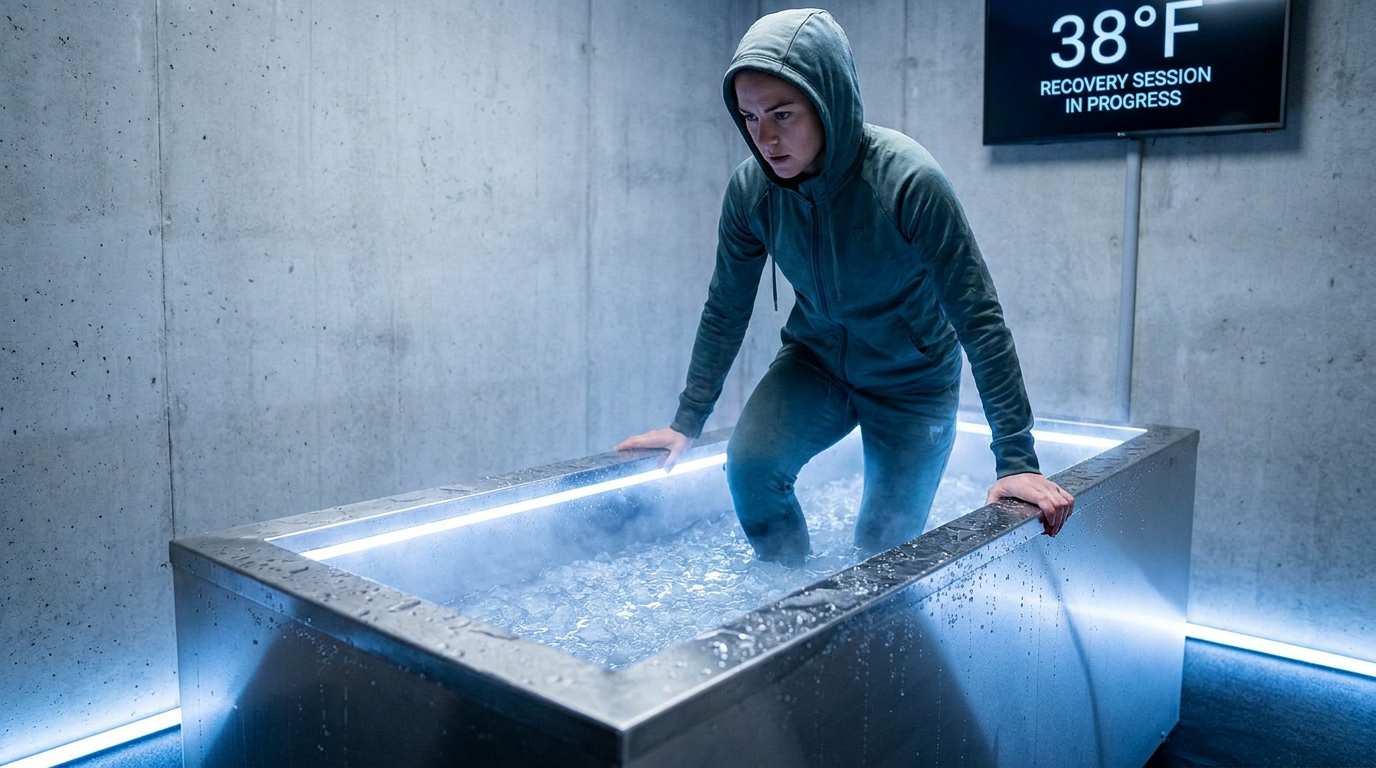
The sight of an athlete submerged to the neck in a tub of floating ice has become the defining image of modern fitness recovery. From elite training facilities to suburban backyards, cold water immersion (CWI)—commonly known as cold plunging—has transitioned from a niche punishment to a daily wellness staple.[6]
Proponents claim that a few minutes in near-freezing water can cure delayed-onset muscle soreness, flush out metabolic waste, and accelerate readiness for the next workout.[6]
However, as the practice has scaled, sports scientists and clinical physiologists have begun to uncover a significant caveat.[6]
The latest consensus reveals what researchers call the "Recovery-Adaptation Paradox": while cold water immersion is exceptionally effective at making you feel better in the short term, doing it at the wrong time can actively sabotage long-term muscle growth and strength gains.[6]

To understand this paradox, it is necessary to separate acute recovery from chronic adaptation. Acute recovery is about returning the body to its baseline state as quickly as possible.[6]
On this front, the science is overwhelmingly in favor of the ice bath. A massive 2025 systematic review and meta-analysis published in PLOS ONE, which evaluated 11 randomized controlled trials involving 3,177 participants, confirmed that cold water immersion reliably reduces delayed-onset muscle soreness (DOMS) and lowers systemic stress markers.[1]
A concurrent network meta-analysis in Frontiers in Physiology analyzed dozens of protocols and found that medium-temperature immersion—specifically between 10°C and 15°C (50°F to 59°F) for 10 to 15 minutes—produced the strongest outcomes for alleviating muscle fatigue, outperforming active recovery and compression garments.[2]

The mechanism driving this acute relief is vasoconstriction. When the body is exposed to severe cold, blood vessels rapidly narrow to preserve core temperature, which limits blood flow to the extremities and reduces acute inflammation in micro-torn muscle tissue.[5]
Once the athlete exits the water and begins to warm up, the vessels dilate, creating a flushing effect that helps clear metabolic waste products, such as creatine kinase, from the muscles.[5]
But this exact mechanism—the restriction of blood flow and the blunting of inflammation—is precisely what causes problems for athletes trying to build muscle mass.[6]
But this exact mechanism—the restriction of blood flow and the blunting of inflammation—is precisely what causes problems for athletes trying to build muscle mass.
Muscle hypertrophy, the process by which muscle fibers grow thicker and stronger, relies heavily on the acute inflammatory response triggered by resistance training. Inflammation signals the body to repair and reinforce the damaged tissue.[7]
A landmark 2025 study led by researchers at Maastricht University demonstrated that immersing limbs in near-freezing water immediately after heavy resistance training significantly reduces blood flow to the muscles for hours afterward.[3]
This prolonged vasoconstriction hinders the delivery of dietary amino acids to the muscle cells, directly impairing muscle protein synthesis.[3]

Furthermore, molecular analyses published in Physiological Reports have shown that cold water immersion suppresses the signaling of mTORC1—a crucial protein complex that drives muscle growth—and interferes with ribosome biogenesis, the cellular machinery responsible for building new proteins.[7]
In short, by aggressively cooling the tissue and stopping inflammation in its tracks, athletes are effectively turning off the biological signals that tell their muscles to grow larger and stronger.[6]
So, how should active individuals navigate this paradox? The scientific consensus dictates that cold plunge protocols must be strictly objective-dependent.[6]
For endurance athletes, CrossFit competitors, or team-sport players engaged in multi-day tournaments, acute recovery is the priority. When the goal is simply to perform at a high level again tomorrow, cold water immersion is a highly effective tool to mask fatigue and restore power output.[5]
Conversely, for bodybuilders, powerlifters, or anyone whose primary goal is hypertrophy, cold plunging immediately after a workout is counterproductive. Experts recommend waiting at least four to six hours after lifting weights before entering a cold plunge, or reserving cold therapy entirely for active rest days.[3]

Beyond muscle recovery, researchers are also scrutinizing the broader systemic effects of cold exposure. While the PLOS ONE meta-analysis noted improvements in heart rate variability and acute stress reduction, cardiovascular experts urge caution.[1]
A 2024 review in the Journal of Thermal Biology, alongside guidance from Harvard Health Publishing, emphasizes that the sudden shock of cold water places immense acute stress on the cardiovascular system, which can be dangerous for individuals with underlying heart conditions or rhythm abnormalities.[4][8]
Ultimately, cold water immersion is not a magic bullet, but rather a potent physiological lever. When pulled at the right time, it accelerates readiness and builds mental resilience; when pulled at the wrong time, it leaves hard-earned gains freezing in the water.[6]
How we got here
2015
Early studies begin to show that cold water immersion might blunt anabolic signaling after resistance training.
2022
Major meta-analyses confirm that CWI is superior to passive rest for restoring muscular power in endurance athletes.
2024
Research highlights the cardiovascular risks and the 'after-drop' effect of extreme cold exposure.
2025
Comprehensive systematic reviews establish the 'Recovery-Adaptation Paradox,' solidifying objective-dependent protocols.
Viewpoints in depth
Hypertrophy Researchers
Focus on how cold exposure blunts the molecular signals required for muscle growth.
This camp emphasizes the 'adaptation' side of the paradox. Researchers studying muscle protein synthesis argue that the acute inflammation caused by lifting weights is a necessary biological trigger. By artificially suppressing this inflammation with near-freezing water, athletes reduce blood flow and limit the delivery of amino acids to damaged tissue. Their primary recommendation is to separate cold therapy from resistance training by at least four to six hours.
Sports Performance Analysts
Prioritize acute recovery and the rapid restoration of power output for competing athletes.
For experts focused on team sports, CrossFit, and endurance events, the priority is getting the athlete ready for the next immediate bout of exercise. This camp highlights that cold water immersion reliably clears metabolic waste, reduces perceived fatigue, and lowers delayed-onset muscle soreness. They argue that the slight blunting of long-term hypertrophy is a worthwhile trade-off during a competitive season where acute readiness dictates success.
Clinical Physiologists
Examine the systemic, cardiovascular, and neurological impacts of cold exposure beyond skeletal muscle.
Medical professionals and clinical researchers look at the whole-body stress response induced by cold plunging. While they acknowledge the benefits of acute stress reduction and potential improvements in heart rate variability, they also caution against the cardiovascular shock of sudden immersion. This camp advocates for moderate temperatures (10–15°C) rather than extreme freezing, emphasizing that the dose makes the poison when it comes to thermal stress.
What we don't know
- The exact threshold at which cold exposure begins to blunt hypertrophy remains unclear, as most studies test extreme near-freezing temperatures rather than mild cooling.
- It is not yet fully understood how long-term, daily cold plunging affects baseline immune function over multiple years.
- The degree to which gender differences in thermoregulation alter the optimal temperature and duration for cold water immersion is still being actively researched.
Key terms
- Vasoconstriction
- The narrowing of blood vessels, which reduces blood flow and helps limit acute inflammation.
- Hypertrophy
- The biological process of increasing the size and thickness of muscle fibers, typically through resistance training.
- DOMS
- Delayed-Onset Muscle Soreness, the deep muscle ache that peaks 24 to 72 hours after unfamiliar or intense exercise.
- mTORC1
- A crucial protein complex in the body that acts as a primary signaling pathway for muscle protein synthesis and cell growth.
Frequently asked
How cold should a cold plunge be for recovery?
The scientific consensus points to a 'sweet spot' between 10°C and 15°C (50°F to 59°F). Temperatures colder than this do not offer additional muscle recovery benefits and may increase cardiovascular stress.
How long should I stay in the cold water?
Research indicates that 10 to 15 minutes is optimal for reducing muscle soreness. Shorter durations may not fully penetrate the tissue, while longer durations offer diminishing returns.
Will cold plunging destroy my muscle gains?
It won't destroy them entirely, but plunging immediately after lifting weights significantly blunts muscle protein synthesis. To protect your gains, wait at least four to six hours after resistance training.
Is cold water immersion good for endurance athletes?
Yes. For runners, cyclists, and team-sport athletes, cold plunging is highly effective at clearing metabolic waste and restoring power output for subsequent training sessions.
Sources
Source coverage
8 outlets
3 viewpoints surfaced








[1]PLOS ONEClinical Physiologists
Effects of cold water immersion on recovery and stress: A systematic review and meta-analysis
Read on PLOS ONE →[2]Frontiers in PhysiologySports Performance Analysts
Network meta-analysis of cold water immersion protocols for exercise-induced muscle damage
Read on Frontiers in Physiology →[3]Maastricht UniversityHypertrophy Researchers
Cold exposure post-exercise diminishes hypertrophic responses and protein absorption
Read on Maastricht University →[4]Harvard Health PublishingClinical Physiologists
The cold, hard facts about cold-water therapy
Read on Harvard Health Publishing →[5]Sports MedicineSports Performance Analysts
Effects of Cold Water Immersion on Physiological, Perceptual, and Performance Recovery
Read on Sports Medicine →[6]Factlen Editorial TeamClinical Physiologists
Synthesis by Factlen editorial team
Read on Factlen Editorial Team →[7]Physiological ReportsHypertrophy Researchers
Cold water immersion in recovery following a single bout resistance exercise suppresses mechanisms of miRNA nuclear export
Read on Physiological Reports →[8]Journal of Thermal BiologyClinical Physiologists
Cardiovascular effects of cold exposure in healthy people
Read on Journal of Thermal Biology →
Every angle. Every day.
Get fitness stories with full source coverage and perspective breakdowns delivered to your inbox.