
Algorithmic vs. Chronological Feeds: A Trade-Off Analysis of Meta's Ranking Systems
As Meta platforms like Instagram and Threads offer both AI-curated and time-based feeds, users face a choice between serendipitous discovery and finite digital consumption. Understanding the mechanics of each approach is key to optimizing your digital well-being.
By Factlen Editorial Team
- Algorithmic Discovery Advocates
- Argues that AI curation is essential for navigating information overload and surfacing high-quality content.
- Digital Wellbeing Researchers
- Focuses on the psychological impact of infinite, engagement-optimized scrolling and advocates for finite boundaries.
- Chronological Purists
- Believes users should have absolute control over their digital diets without machine interference.
What's not represented
- · Independent Content Creators
- · Social Media Advertisers
Why this matters
The choice between an algorithmic and chronological feed dictates not just what information you consume, but how much time you spend online and how it affects your mental health. Understanding these mechanics empowers you to take control of your digital diet rather than passively consuming what an AI selects.
Key points
- Algorithmic feeds use AI to maximize engagement, surfacing relevant content regardless of when it was posted.
- Chronological feeds display posts in strict time order, offering users predictability and a natural stopping point.
- Heavy reliance on algorithmic feeds is linked to increased screen time and negative mental health outcomes.
- Chronological feeds can become unmanageable if a user follows a large number of high-volume accounts.
- Experts recommend using algorithmic feeds for discovery and chronological feeds for intentional connection.
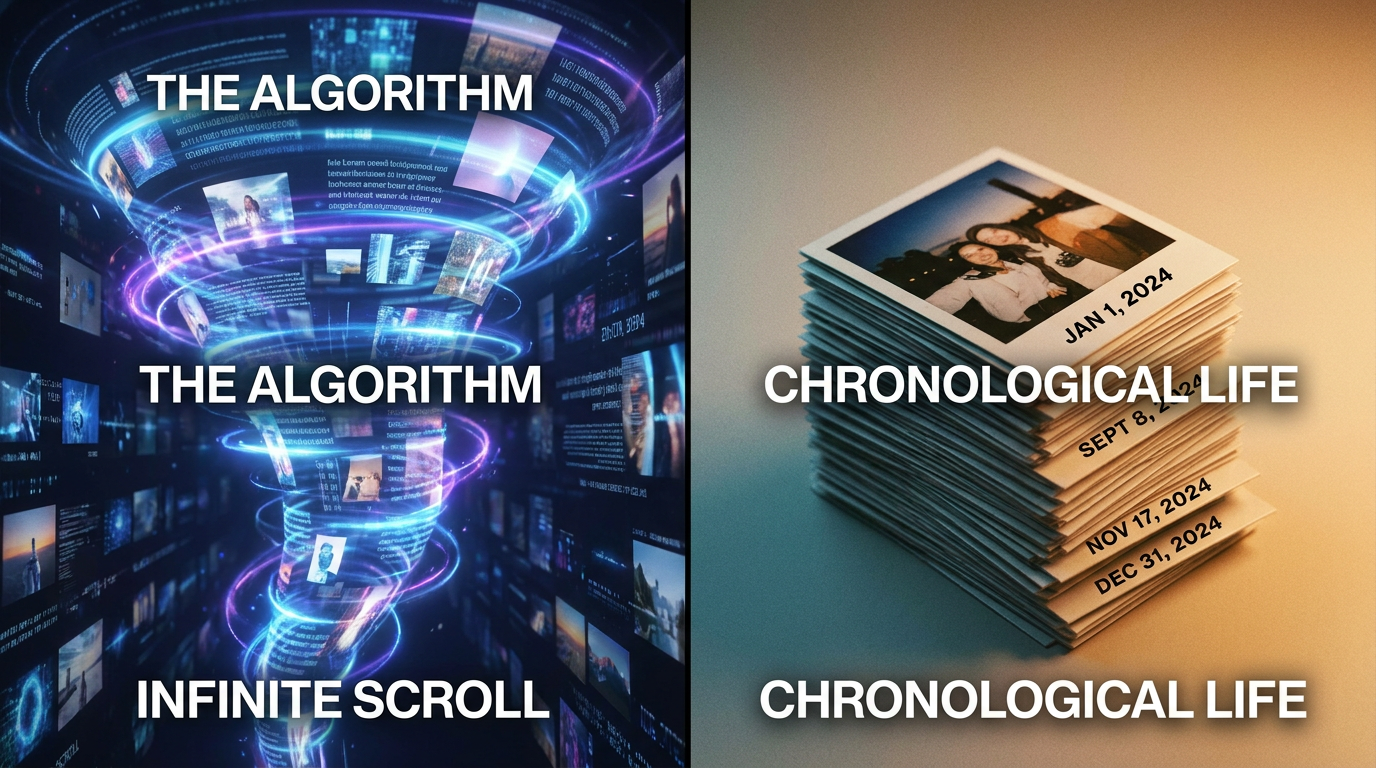
For billions of smartphone users, the moment they open a social media app initiates a silent, high-stakes sorting process. The choice between an algorithmic 'For You' feed and a chronological 'Following' feed represents fundamentally different philosophies of digital consumption. As platforms like Instagram and Threads increasingly offer users the ability to toggle between these two modes, understanding the mechanics behind them has become essential for digital well-being. This is no longer just a technical distinction for developers; it is a daily lifestyle choice that dictates what information users consume, how long they stay engaged, and ultimately, how they feel when they put their devices down.[8]
The evolution of feed ranking tells a story of competing priorities. In its early days, Instagram operated on a strict reverse-chronological model, where the newest posts appeared at the top. By 2016, the platform shifted to an algorithmic model, arguing that users were missing up to seventy percent of their friends' updates as follower counts grew. Recently, however, a wave of user demand for agency has forced a partial reversal. In 2023, Meta's text-based app Threads launched with an algorithmic feed but quickly added a chronological option after intense user pressure. Today, navigating these platforms requires a deliberate choice between machine-curated discovery and time-based reality.[2][4]
The case for the algorithmic feed rests heavily on its unparalleled ability to surface relevant, high-quality content regardless of when it was posted. Meta's artificial intelligence systems evaluate tens of thousands of data points—from engagement velocity to the specific formats a user lingers on—to predict what will keep them scrolling. For creators and businesses, this model offers a powerful discovery engine. Data indicates that on platforms like Threads, algorithmic ranking can deliver reach rates of eight to twelve percent for accounts with fewer than ten thousand followers, significantly outperforming strict chronological delivery.[3][4]
Furthermore, the evidence supporting algorithmic feeds points to overall user satisfaction and platform longevity. According to Meta executives, internal testing of chronological-only feeds consistently resulted in users spending less time on the app and reporting lower overall satisfaction. The algorithmic model ensures that a user logging in after three days away will immediately see the most compelling updates from their network, rather than a barrage of mediocre posts that happen to be five minutes old. In this view, the algorithm acts as an essential filter in an era of overwhelming information abundance.[4][8]

However, the case against algorithmic ranking is anchored in a growing body of psychological and behavioral research. Because these systems are optimized for engagement and retention, they inherently favor sensational, emotionally charged, or polarizing content. The infinite scroll of an algorithmic feed removes natural stopping cues, creating a dopamine-driven feedback loop that makes it difficult for users to disengage. Critics argue that this design prioritizes the platform's advertising revenue over the user's mental health, transforming social media from a tool for connection into an engine for compulsive consumption.[5][6]
The evidence against heavy reliance on algorithmic feeds is increasingly robust. A landmark ten-year longitudinal study by the Murdoch Children's Research Institute tracked nearly 1,200 adolescents and found a clear operational boundary for digital exposure. The research demonstrated that teenagers who consumed two or more hours of social media daily faced a significantly higher risk of experiencing elevated depressive symptoms and poorer subjective well-being. By pushing users past this two-hour threshold through frictionless, AI-curated content, algorithmic feeds directly contribute to the negative mental health outcomes observed in heavy users.[1][5]
Conversely, the case for the chronological feed centers on user agency, predictability, and finite consumption. A chronological feed operates on a simple, transparent rule: posts appear in the exact order they were published, with no machine learning intervention. This structure inherently respects the user's time. When a user scrolls past the last post they saw during their previous session, they reach a natural endpoint—they are 'all caught up.' This friction is a feature, not a bug, for those seeking to implement healthier digital habits and break the cycle of infinite scrolling.[5][6]
Conversely, the case for the chronological feed centers on user agency, predictability, and finite consumption.
The chronological model also fosters a different kind of digital community. The evidence supporting this approach highlights that it prevents platforms from playing favorites. If a user chooses to follow an account, they are guaranteed to see that account's content, provided they scroll far enough. This eliminates the 'algorithm anxiety' experienced by creators who worry their posts will be buried if they do not maximize immediate engagement. It allows for a quieter, more intentional social media experience that mirrors real-world chronology rather than optimized entertainment.[6][8]
Yet, the case against the chronological feed reveals its own set of structural flaws, particularly at scale. When feeds are sorted strictly by time, the system inherently rewards volume over quality. Accounts that post frequently—such as news organizations, professional influencers, or automated bots—can easily dominate a user's screen, burying infrequent but highly valuable updates from close friends. If a user follows hundreds of accounts, a chronological feed quickly becomes an unmanageable firehose of information, making it nearly impossible to extract meaningful signal from the noise.[4][8]

The evidence against a pure chronological approach is reflected in user behavior when the option is provided. Despite vocal demands for chronological feeds, platforms that offer both options often see the majority of users default back to algorithmic curation. Without the algorithm to surface the most engaging content, users frequently find chronological feeds boring or repetitive. The lack of discovery means users are trapped in their existing network, unable to organically find new creators, ideas, or communities that align with their evolving interests.[2][4]
Ultimately, evaluating these two models requires a nuanced trade-off analysis. Algorithmic feeds trade transparency and user control for high engagement, serendipitous discovery, and curated relevance. They are engineered to maximize the time spent on the platform by constantly adapting to user behavior. Chronological feeds trade that optimized entertainment for predictability, finite boundaries, and strict adherence to the user's explicit choices. They demand more active curation from the user but offer a safeguard against algorithmic manipulation.[7][8]
In practice, the algorithmic feed fits well when users are in a state of discovery or seeking passive entertainment. It is the ideal choice for finding new inspiration, exploring niche interests, or allowing the platform to surface the best content from a massive pool of creators. It also fits well for users who only check social media sporadically and want a 'highlight reel' of what they missed, ensuring that the most important or popular updates are waiting for them at the top of their screen.[3][8]
Conversely, the algorithmic feed does not fit well when users are feeling anxious, prone to doomscrolling, or actively trying to reduce their daily screen time. Because it is designed to eliminate stopping cues, it is a poor choice for late-night browsing or periods of low impulse control. It also fails users who need to see every update from a specific set of accounts, such as close family members or critical news sources, as the algorithm may arbitrarily decide those posts are not engaging enough to surface.[1][5]
The chronological feed fits well when users want to maintain a strict, intentional digital diet. It is highly effective for users who follow a carefully curated, small number of accounts and want to ensure they see every single post in context. It fits perfectly into a routine where a user checks their feed once a day, scrolls until they recognize previously seen content, and then closes the app. For those prioritizing mental health and finite consumption, the chronological toggle is an essential tool for reclaiming agency.[5][6]

However, the chronological feed does not fit well when a user follows thousands of accounts, as the sheer volume of posts renders the timeline useless. It is also ineffective for users looking to grow an audience, as their content will only be seen by followers who happen to be online at the exact moment they post. Ultimately, the healthiest approach to modern social media is not a rigid adherence to one model, but the mindful application of both—using the algorithm for discovery, and the chronological feed for connection and control.[4][8]
How we got here
2013
Instagram introduces its first algorithmic feed elements to prioritize relevant content.
2016
Instagram fully removes the chronological feed, sparking widespread user backlash.
2022
Instagram reintroduces a chronological 'Following' toggle after years of user requests.
July 2023
Meta launches Threads with a purely algorithmic 'For You' feed.
July 2023
Threads adds a chronological 'Following' feed following intense demands from early adopters.
June 2026
Researchers publish decade-long data linking heavy algorithmic social media use to depression.
Viewpoints in depth
Algorithmic Discovery Advocates
Argues that AI curation is essential for navigating information overload.
This camp points out that chronological feeds reward volume over quality, allowing frequent posters to dominate the screen. They cite data showing that users actually spend less time and report lower satisfaction when forced into chronological-only modes, as they miss out on discovering new creators and high-quality content from outside their immediate network.
Digital Wellbeing Researchers
Focuses on the psychological impact of infinite, engagement-optimized scrolling.
Researchers emphasize that algorithmic feeds are designed to remove stopping cues, creating a dopamine loop that leads to compulsive use. They point to longitudinal studies demonstrating that exceeding two hours of daily social media consumption significantly increases the risk of depressive symptoms, arguing that chronological feeds offer necessary friction and boundaries.
Chronological Purists
Believes users should have absolute control over their digital diets without machine interference.
This perspective argues that chronological feeds respect user agency by displaying exactly what the user opted into, in the order it happened. They view algorithmic curation as a manipulative tool designed to maximize corporate ad revenue rather than serve the user, advocating for transparent, time-based sorting as the only truly neutral way to consume information.
What we don't know
- Whether Meta will ever allow users to set the chronological feed as a permanent, sticky default.
- The exact weight Meta's AI assigns to different engagement metrics in 2026.
- How upcoming regulatory frameworks regarding 'addictive algorithms' might force changes to the For You feed.
Key terms
- Algorithmic Feed
- A timeline curated by artificial intelligence to show content predicted to maximize user engagement.
- Chronological Feed
- A timeline that displays posts strictly in the order they were published, from newest to oldest.
- Engagement Velocity
- The speed at which a post accumulates likes, comments, and shares immediately after being published.
- Dopamine Loop
- A neurological cycle where unpredictable rewards trigger dopamine release, encouraging continuous scrolling.
- Reach Rate
- The percentage of a platform's users or an account's followers who actually see a specific post.
Frequently asked
Why did platforms remove chronological feeds?
Platforms argued that as user networks grew, people were missing the majority of their friends' posts. Algorithmic feeds were introduced to surface the most relevant content and keep users engaged longer.
Does using a chronological feed improve mental health?
Research suggests that chronological feeds provide natural stopping points, which can help users limit their screen time. Keeping daily social media use under two hours is linked to better mental health outcomes.
Can I make my Instagram feed permanently chronological?
Both Instagram and Threads currently allow users to toggle to a chronological 'Following' feed, but they typically default back to the algorithmic 'For You' feed when the app is restarted.
Sources
Source coverage
8 outlets
3 viewpoints surfaced








[1]Neuroscience NewsDigital Wellbeing Researchers
Two Hours of Daily Social Media Linked to Teen Depression
Read on Neuroscience News →[2]BufferAlgorithmic Discovery Advocates
How the Threads Algorithm Works
Read on Buffer →[3]Post EverywhereAlgorithmic Discovery Advocates
Threads Algorithm Explained
Read on Post Everywhere →[4]Pulse AdvertisingAlgorithmic Discovery Advocates
Instagram's Algorithmic Feed Shift
Read on Pulse Advertising →[5]Cognito HealthDigital Wellbeing Researchers
Social Media and Mental Health: What the Research Shows
Read on Cognito Health →[6]The StarDigital Wellbeing Researchers
Making social media social again
Read on The Star →[7]PoynterChronological Purists
Meta's fact-checking and algorithm changes
Read on Poynter →[8]Factlen Editorial TeamChronological Purists
Synthesis by Factlen editorial team
Read on Factlen Editorial Team →
Every angle. Every day.
Get meta stories with full source coverage and perspective breakdowns delivered to your inbox.