
Gaming Giants Unite to Launch Universal Accessibility Standard Across All Consoles
Xbox, PlayStation, and Nintendo have jointly unveiled a cross-platform accessibility profile system, allowing players with disabilities to carry their custom control schemes and visual settings seamlessly across all major hardware.
By Factlen Editorial Team
- Accessibility Advocates
- Thrilled by the announcement, viewing it as the culmination of years of advocacy that validates disabled players as a core demographic.
- Industry Developers
- Relieved by the introduction of a standardized API, which will significantly reduce the redundant coding required to make games accessible.
- Mainstream Tech & Gaming Press
- Focused on the unprecedented nature of fierce hardware rivals collaborating on a shared system-level technology.
What's not represented
- · PC storefront operators (Valve, Epic Games)
- · Mobile game developers
Why this matters
For the estimated 400 million gamers with disabilities worldwide, this eliminates the exhausting process of manually reconfiguring controls and UI settings for every new game. A single cloud profile will now automatically adapt any supported title to their specific motor, visual, or auditory needs, removing a massive barrier to entry.
Key points
- Microsoft, Sony, and Nintendo have jointly announced a Universal Game Accessibility Standard (UGAS).
- The cloud-based system allows players to save their motor, visual, and auditory preferences universally.
- A unified API will let developers easily implement these settings without building bespoke menus.
- The initiative aims to eliminate the 'accessibility tax' and is scheduled to roll out in late 2026.
In an unprecedented moment of industry unity at Summer Game Fest 2026, fierce hardware rivals Microsoft, Sony, and Nintendo shared a single stage to announce the Universal Game Accessibility Standard (UGAS). The joint initiative promises to fundamentally change how players with disabilities interact with video games across all major platforms, marking a historic shift from proprietary walled gardens to a collaborative, player-first ecosystem.[1][7]
At its core, UGAS is a cloud-based profile system that allows players to save their specific motor, visual, and auditory preferences universally. Instead of manually reconfiguring button maps, subtitle sizes, and colorblind filters for every new title, a player's UGAS profile will automatically apply their exact needs the moment they boot up a supported game, regardless of whether they are playing on an Xbox, PlayStation, or Nintendo console.[2][4]
For decades, disabled gamers have faced what advocates call the "accessibility tax"—the exhausting, sometimes hours-long process of navigating complex menus just to make a new game playable. By standardizing these inputs at the system level, the new initiative aims to eliminate this barrier entirely, allowing players to jump straight into the action alongside their peers without the friction of endless trial-and-error configuration.[5]

The technical backbone of the initiative is a unified Application Programming Interface (API) that developers can hook into during production. Rather than building bespoke accessibility menus and control-mapping systems from scratch for every port, studios can map their game's actions to the UGAS framework, which then translates the player's cloud profile into the appropriate in-game commands instantly.[3][6]
The standard goes far beyond simple button remapping. It encompasses over 60 distinct accessibility parameters, including high-contrast visual modes, automated audio cues for visually impaired players, toggle-to-hold mechanics for those with motor fatigue, and cognitive aids like simplified user interface navigation. If a player specifies they need large yellow subtitles with a black background, every UGAS-compliant game will render them exactly that way by default.[4]
If a player specifies they need large yellow subtitles with a black background, every UGAS-compliant game will render them exactly that way by default.
The announcement has sent ripples of celebration through the disabled gaming community. Advocacy groups, who have spent years lobbying for piecemeal improvements on a game-by-game basis, are hailing the cross-platform collaboration as a dream realized. Many note that this move finally validates accessibility as a fundamental human right within digital spaces, rather than a niche feature that studios can opt out of.[5]

The collaboration between Microsoft, Sony, and Nintendo—companies that fiercely guard their proprietary ecosystems and rarely share technology—marks a historic shift in the traditional console wars. Executives from all three hardware giants emphasized during the presentation that accessibility should never be treated as a competitive advantage, but rather as a shared baseline required to push the entire medium forward.[1][7]
Independent developers are also breathing a sigh of relief following the announcement. Smaller studios often lack the budget and specialized personnel to implement comprehensive accessibility suites, but the standardized UGAS API will allow them to offer AAA-level accessibility features with a fraction of the development time and cost, democratizing inclusive design across the indie scene.[6]

The rollout is scheduled to begin in the fourth quarter of 2026, starting with massive system-level firmware updates for the Xbox Series X/S, PlayStation 5, and the Nintendo Switch ecosystem. Several major holiday releases have already pledged day-one UGAS compatibility, with legacy titles expected to receive integration patches throughout the following year.[1][3]
Ultimately, the Universal Game Accessibility Standard represents the maturation of the video game industry. By tearing down the walled gardens of accessibility and prioritizing the player's needs over platform exclusivity, the medium is taking a massive, tangible step toward ensuring that the joy, community, and artistry of gaming are truly open to everyone.[2][7]
How we got here
2018
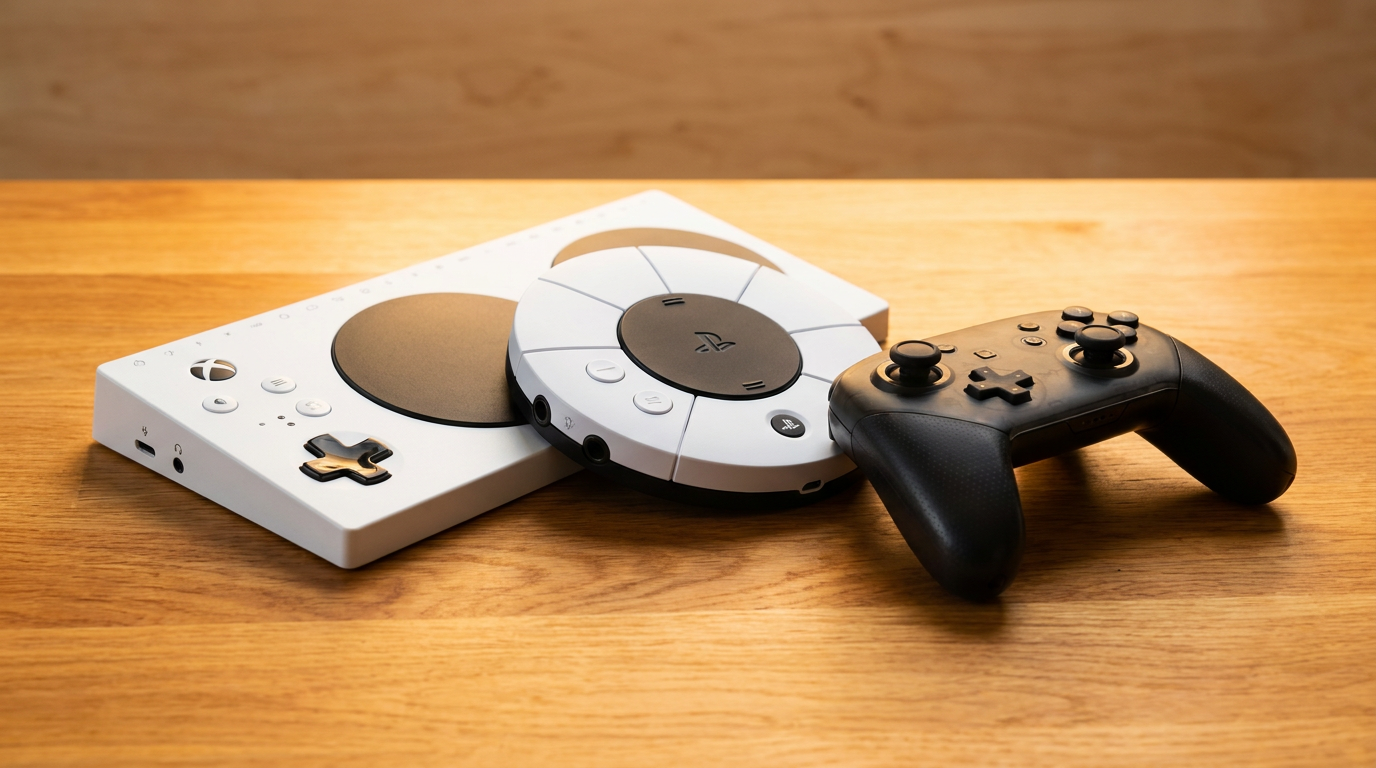
Microsoft releases the Xbox Adaptive Controller, kicking off a new era of hardware accessibility.
2023
Sony launches the PlayStation Access controller, expanding first-party accessible hardware options.
2025
Initial closed-door talks begin between the big three console manufacturers regarding a unified software standard.
June 2026
The Universal Game Accessibility Standard is publicly unveiled at Summer Game Fest.
Viewpoints in depth
Accessibility Advocates
Viewing the standard as a monumental victory that shifts the burden of configuration away from the player.
For years, disabled gamers and advocacy groups have fought for basic inclusion on a title-by-title basis, often finding that a game is unplayable at launch due to missing features. Advocates see UGAS as a paradigm shift that treats accessibility as a fundamental infrastructure requirement rather than an optional feature. However, they stress that the standard's success will ultimately depend on strict compliance and enforcement by the platform holders to ensure developers actually utilize the API.
Industry Developers
Relieved by the introduction of a unified API that streamlines the development process.
Game developers, particularly at smaller independent studios, have long expressed a desire to make their games more accessible but often lack the budget or technical expertise to build complex custom menus and control-mapping systems. By providing a single, standardized API that hooks directly into the console's operating system, developers can now implement robust accessibility features with significantly less redundant coding, freeing up resources to focus on core gameplay.
Hardware Manufacturers
Recognizing that accessibility is a shared responsibility that transcends platform exclusivity.
In an industry defined by fierce competition and proprietary ecosystems, the collaboration between Microsoft, Sony, and Nintendo is highly unusual. Executives from all three companies have publicly stated that while they will continue to compete on exclusive games and hardware power, accessibility must be treated as a non-competitive baseline. This unified front acknowledges that creating barriers for disabled players hurts the entire medium's growth and cultural impact.
What we don't know
- It remains unclear if major PC storefronts like Steam and the Epic Games Store will natively integrate the UGAS profile system.
- The extent to which older, legacy games will be patched to support the new API is still unknown.
Key terms
- UGAS
- Universal Game Accessibility Standard, the new cloud-based profile system for syncing player preferences across platforms.
- API
- Application Programming Interface, a set of rules that allows different software programs (like a game and a console's operating system) to communicate with each other.
- Accessibility Tax
- A term used by advocates to describe the extra time, effort, and frustration disabled players spend configuring settings before they can actually play a game.
- Motor Accessibility
- Features designed to help players with physical disabilities, such as custom button mapping, toggle-to-hold options, and reduced required reaction times.
Frequently asked
Will the UGAS profile cost money to use?
No. The Universal Game Accessibility Standard will be a free system-level feature integrated into Xbox, PlayStation, and Nintendo accounts.
Does this mean I can use an Xbox controller on a PlayStation?
Not natively. UGAS syncs your software preferences (like button mapping and visual settings), but hardware compatibility still depends on specific console adapters or officially licensed accessible controllers.
When will games start supporting this?
The system-level updates are targeted for Q4 2026, with several major holiday releases pledging day-one compatibility.
Sources
Source coverage
7 outlets
3 viewpoints surfaced







[1]IGNMainstream Tech & Gaming Press
Xbox, PlayStation, and Nintendo Announce Historic Cross-Platform Accessibility Standard
Read on IGN →[2]PolygonAccessibility Advocates
Why the new Universal Game Accessibility Standard is a massive win for disabled players
Read on Polygon →[3]EurogamerIndustry Developers
Summer Game Fest 2026's biggest surprise wasn't a game, but a unified accessibility API
Read on Eurogamer →[4]The VergeMainstream Tech & Gaming Press
How the 'UGAS' profile will automatically map your controls on any console
Read on The Verge →[5]Can I Play That?Accessibility Advocates
A dream realized: What the new unified accessibility profiles mean for our community
Read on Can I Play That? →[6]Game DeveloperIndustry Developers
Implementing the new Universal Game Accessibility Standard: What studios need to know
Read on Game Developer →[7]Washington PostMainstream Tech & Gaming Press
Rivals Microsoft, Sony, and Nintendo team up to make gaming accessible for everyone
Read on Washington Post →

More in entertainment
See all 5 stories →Cozy Gaming
How 'Cozy Gaming' Evolved From Niche Hobby to Clinical Mental Health Tool
0 sources

Pixar Animation
'Toy Story 5' Premieres to Critical Acclaim as Pixar Tackles the Screen-Time Era
0 sources

Toy Story 5
Toy Story 5 Premieres With Taylor Swift Original Song, Tackling the Modern Dilemma of Screen Time
0 sources
Every angle. Every day.
Get entertainment stories with full source coverage and perspective breakdowns delivered to your inbox.