
Solid-State Batteries: How the Next Generation of Power Works
After decades of research, solid-state batteries are moving from the laboratory to mass production in 2026, promising to double EV ranges and eliminate fire risks.
By Factlen Editorial Team
- Automakers & Battery Developers
- Focused on the transformative consumer benefits and aggressive commercialization timelines.
- Battery Scientists & Researchers
- Focused on the underlying chemistry, material stability, and the triumph over dendrite growth.
- Industry Analysts
- Focused on the economic realities, manufacturing costs, and the timeline for mass-market adoption.
What's not represented
- · Fossil Fuel Industry
- · Lithium-Ion Supply Chain Workers
Why this matters
Solid-state batteries eliminate the fire risks and range anxiety associated with current electric vehicles, promising cars that can travel over 600 miles on a single charge and recharge in just 10 minutes. As mass production begins in 2026, this technology is poised to fundamentally accelerate the global transition away from fossil fuels.
Key points
- Solid-state batteries replace flammable liquid electrolytes with stable solid materials like ceramics or polymers.
- The technology eliminates the risk of thermal runaway fires and allows for pure lithium metal anodes.
- Energy density is expected to double, pushing EV ranges past 1,000 kilometers on a single charge.
- Major automakers like Toyota and startups like GBT are beginning mass production in 2026.
- Initial solid-state vehicles will be premium models, with mass-market adoption expected closer to 2030.
For three decades, the lithium-ion battery has been the undisputed workhorse of the consumer electronics and electric vehicle revolutions. But as automakers push for longer ranges and faster charging times, the traditional lithium-ion architecture has begun to hit its chemical and physical limits. Now, after years of being dismissed as a technology that is perpetually "five years away," the industry is crossing a historic threshold. In 2026, the long-awaited solid-state battery is finally moving out of the laboratory and onto the factory floor, promising to fundamentally rewrite the rules of energy storage.[1][2]
The momentum behind this shift is accelerating rapidly, driven by major breakthroughs from legacy automakers and battery startups alike. Toyota has officially secured mass-production approval for its solid-state cells in Japan, with plans to begin manufacturing in 2026 and integrate them into flagship Lexus models by 2027. Simultaneously, China's Greater Bay Technology (GBT) recently announced that its first "A-sample" all-solid-state battery cells have successfully rolled off the production line. GBT is targeting gigawatt-hour-level mass production this year, signaling that the race to commercialize the technology is now a reality rather than a theoretical exercise.[5][6]
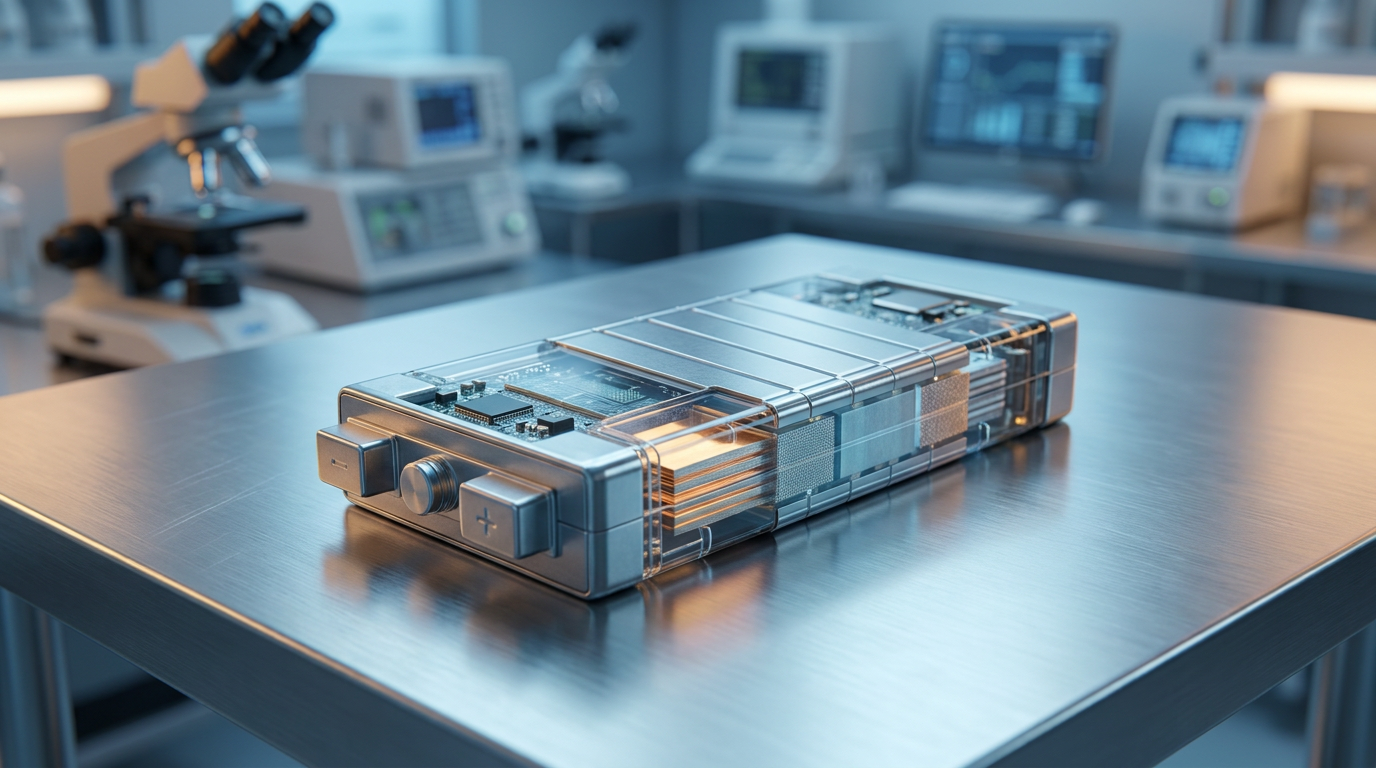
To understand why this transition is so monumental, it is necessary to look inside the battery cell itself. In a conventional lithium-ion battery, energy is generated and stored as lithium ions move back and forth between two electrodes—the cathode and the anode. These ions travel through a liquid or gel electrolyte, which acts as the conductive medium. A solid-state battery, as the name implies, replaces this volatile liquid with a solid electrolyte, typically composed of advanced ceramics, glass, or sulfide-based polymers.[1][2]

This single architectural swap solves the most persistent vulnerability of modern batteries: safety. The liquid electrolytes used in current lithium-ion cells are composed of lithium salts dissolved in organic solvents, making them inherently flammable. Under extreme stress, such as overcharging, severe impact, or high heat, this liquid can ignite and trigger a cascading thermal runaway event. By eliminating the flammable liquid, solid-state batteries drastically reduce the risk of fire and explosion.[1][4]
The thermal stability of solid electrolytes is vastly superior to their liquid counterparts. Comparative testing reveals that thermal events in solid-state systems do not begin until temperatures reach approximately 247 degrees Celsius. In contrast, conventional lithium-ion batteries can begin to experience thermal instability at just 90 degrees Celsius. Furthermore, if a solid-state cell is compromised, the heat release rate is significantly lower, meaning any potential failure develops much more slowly and with far less intensity.[4]
Beyond safety, the solid electrolyte unlocks the true "holy grail" of battery chemistry: the pure lithium metal anode. In current batteries, the anode is primarily made of graphite, a heavy and bulky material that safely absorbs lithium ions but does not actively generate energy. Solid-state technology allows engineers to remove the graphite entirely and use pure lithium metal, which boasts a specific capacity roughly ten times higher than graphite.[1][3]
The reason lithium metal anodes cannot be widely used in liquid batteries comes down to a microscopic phenomenon known as dendrites. During rapid charging, lithium ions can accumulate unevenly on the anode, forming sharp, needle-like metallic whiskers. In a liquid electrolyte, these dendrites grow unchecked until they puncture the separator dividing the anode and cathode, causing a catastrophic short circuit. Solid electrolytes, however, provide the mechanical strength and density required to physically block dendrite growth, safely enabling the use of lithium metal.[3]
The reason lithium metal anodes cannot be widely used in liquid batteries comes down to a microscopic phenomenon known as dendrites.
The combination of a solid electrolyte and a lithium metal anode results in a massive leap in energy density—the metric that dictates how much power a battery can store per kilogram of weight. Today's best-in-class lithium-ion batteries deliver an energy density of roughly 200 to 300 watt-hours per kilogram (Wh/kg). The first generation of commercial solid-state batteries launching in 2026 is targeting 400 to 500 Wh/kg, effectively doubling the energy capacity within the exact same physical footprint.[4][6]

For the electric vehicle driver, this doubling of energy density translates directly into unprecedented range and convenience. Automakers projecting the performance of their upcoming solid-state vehicles are citing numbers that rival or exceed the range of internal combustion engines. Toyota's initial solid-state battery is expected to deliver a driving range of roughly 1,000 kilometers (621 miles) on a single charge, with second-generation designs aiming for over 1,200 kilometers.[6][7]
Just as transformative as the range is the speed at which these batteries can be replenished. Because solid electrolytes are highly stable and resistant to the heat generated by rapid energy transfer, they can accept a charge at blistering speeds without degrading. Toyota claims its new architecture, paired with an 800-volt high-voltage platform, will allow a vehicle to charge from zero to 80 percent in just 10 minutes. GBT has reported similar extreme fast-charging capabilities in its prototype testing.[5][6]
The durability of solid-state cells also promises to alter the lifecycle economics of electric vehicles. Traditional lithium-ion batteries gradually lose capacity over thousands of charge cycles, leading to range degradation over a decade of use. Solid electrolytes are chemically and thermally more stable, significantly reducing this wear and tear. Toyota has stated that its solid-state batteries are being engineered with a target lifespan of 40 years while retaining 90 percent of their original capacity—a claim that, if realized, would mean the battery outlasts the physical chassis of the car several times over.[8]

While the automotive industry is the primary catalyst for this research, the implications extend far beyond passenger cars. The dramatic reduction in weight and the elimination of fire risks make solid-state batteries the critical enabling technology for electric vertical takeoff and landing (eVTOL) aircraft, which require immense power but cannot afford the weight penalty of liquid batteries. Similarly, the technology is poised to revolutionize e-bikes, portable electronics, and even medical implants, where compact, safe, and long-lasting power is paramount.[4][5]
Despite the imminent arrival of mass production, significant engineering and economic hurdles remain. Manufacturing solid-state batteries requires entirely new factory architectures and highly controlled environments to prevent moisture contamination during the lamination and pressing phases. Additionally, engineers are still refining the "interfacial resistance"—ensuring that the solid electrolyte maintains perfect, seamless contact with the solid electrodes as they slightly expand and contract during charging cycles.[3][7]
Because of these complex manufacturing requirements, the initial cost of solid-state batteries will be substantially higher than mature lithium-ion technology. When the first solid-state vehicles hit the road in 2027, they will almost certainly be high-end, premium models aimed at early adopters. Toyota, for instance, is prioritizing its initial 10-gigawatt-hour production capacity for its flagship Lexus line.[6][8]

However, the trajectory of the technology is clear. As production scales and the cost of materials like lithium sulfide decreases, economies of scale will take hold. Industry roadmaps project that by 2030, the cost of solid-state batteries will fall to a level where they can be integrated into mid-range, mass-market vehicles. After decades of anticipation, the solid-state era has finally arrived, promising to eliminate the final compromises of the electric transition.[6]
How we got here
1970s
First solid-state lithium/iodine batteries are developed and successfully used in medical pacemakers.
2010s
Automakers and startups begin heavy R&D into scaling solid-state chemistry for large electric vehicles.
2024
Greater Bay Technology sets extreme fast-charging records, proving the viability of new electrolyte composites.
Late 2025
Toyota officially secures mass-production approval for its sulfide-based solid-state cells in Japan.
2026
The first gigawatt-hour-scale production lines begin rolling out commercial solid-state battery cells.
2027
Toyota plans to debut its first mass-market solid-state batteries in flagship Lexus models.
Viewpoints in depth
Automakers & Battery Developers
Focused on the transformative consumer benefits and aggressive commercialization timelines.
Companies like Toyota, GBT, and QuantumScape view solid-state technology as the ultimate competitive moat in the EV transition. They emphasize the headline-grabbing specifications—1,200-kilometer ranges, 10-minute charging times, and decades-long lifespans. For these manufacturers, the narrative is about moving past the R&D phase and proving that gigawatt-hour-scale production is achievable today, positioning solid-state as the definitive successor to internal combustion.
Battery Scientists & Researchers
Focused on the underlying chemistry, material stability, and the triumph over dendrite growth.
The academic and research community views the 2026 milestones as the culmination of decades of painstaking materials science. Their focus remains on the microscopic victories: engineering solid electrolytes that are conductive enough to allow rapid ion flow, yet mechanically rigid enough to suppress lithium dendrites. While celebrating the shift to production, researchers remain highly focused on solving long-term material degradation and optimizing the interfacial resistance between the solid layers.
Industry Analysts
Focused on the economic realities, manufacturing costs, and the timeline for mass-market adoption.
Market analysts and supply chain experts offer a more pragmatic view of the solid-state revolution. While acknowledging the superior chemistry, they point out that building these batteries requires entirely new, highly controlled manufacturing environments that are incredibly expensive to scale. This camp argues that while solid-state will debut in luxury vehicles by 2027, traditional lithium-ion batteries will remain the dominant, cost-effective choice for the vast majority of global consumers well into the 2030s.
What we don't know
- Exactly how much the first generation of solid-state replacement battery packs will cost consumers out-of-warranty.
- Whether real-world driving conditions will perfectly match the 40-year lifespan claims achieved in laboratory settings.
- How quickly the global supply chain can scale the production of specialized solid electrolytes like lithium sulfide.
Key terms
- Solid Electrolyte
- A dense, non-flammable material—often made of ceramics, glass, or polymers—that allows ions to pass through it while blocking electrical currents.
- Energy Density
- A measure of how much power a battery can store relative to its weight, typically expressed in watt-hours per kilogram (Wh/kg).
- Dendrites
- Microscopic, needle-like metallic structures that can grow inside a battery during charging, potentially causing short circuits and fires.
- Lithium Metal Anode
- An advanced battery component made of pure lithium that stores vastly more energy than traditional graphite anodes, enabled by solid-state technology.
- Thermal Runaway
- A dangerous chain reaction inside a battery where overheating causes further temperature increases, often leading to a fire or explosion.
Frequently asked
Why are solid-state batteries safer than lithium-ion?
They replace the flammable liquid electrolyte found in current batteries with a stable, non-flammable solid material, drastically reducing the risk of fire and thermal runaway.
How fast can a solid-state battery charge?
Thanks to their high thermal stability, prototype solid-state batteries can safely accept extreme fast charging, with companies like Toyota targeting a 0 to 80 percent charge in just 10 minutes.
When will solid-state cars be available to buy?
Mass production is beginning in 2026, with the first vehicles—likely premium flagship models—expected to hit the consumer market in 2027.
Will solid-state batteries make electric cars cheaper?
Initially, they will be more expensive due to complex new manufacturing processes. However, as production scales toward 2030, economies of scale are expected to bring costs down to mass-market levels.
Sources
Source coverage
8 outlets
3 viewpoints surfaced







[1]Flash BatteryBattery Scientists & Researchers
What are solid-state batteries and how do they work
Read on Flash Battery →[2]Built InBattery Scientists & Researchers
What Is a Solid-State Battery? How Does It Work?
Read on Built In →[3]Volta FoundationBattery Scientists & Researchers
Solid State Batteries: The Holy Grail of Energy Storage
Read on Volta Foundation →[4]TO7 MotorAutomakers & Battery Developers
Solid-State Batteries 2026: The Breakthrough Changing EVs Forever
Read on TO7 Motor →[5]ElectrekAutomakers & Battery Developers
Solid-state EV batteries are coming sooner than expected after another breakthrough
Read on Electrek →[6]EEWorldAutomakers & Battery Developers
Toyota's solid-state battery has obtained mass production approval, with mass production in 2026
Read on EEWorld →[7]EV Infrastructure NewsAutomakers & Battery Developers
Toyota's Solid-State Battery Roadmap and 2026 Production Plans
Read on EV Infrastructure News →[8]InsideEVsIndustry Analysts
Toyota Says Its Solid-State Batteries Will Last 40 Years
Read on InsideEVs →

Every angle. Every day.
Get guides stories with full source coverage and perspective breakdowns delivered to your inbox.