
SpaceX Pulls Off Historic $75 Billion IPO, Valuing Space Giant at Over $2 Trillion
Elon Musk's aerospace company shattered records with the largest initial public offering in history, raising $75 billion and making Musk the world's first trillionaire. Shares surged 19% on their first day of trading, signaling massive investor appetite for the commercial space economy.
By Factlen Editorial Team
- Growth Investors
- Bullish on the long-term potential of the commercial space economy and AI integration.
- Value Analysts
- Cautious about the astronomical valuation given the company's current lack of profitability.
- Market Infrastructure Providers
- Focused on the technical execution and systemic impact of absorbing a $75 billion listing.
What's not represented
- · Retail investors priced out of the initial allocation
- · Legacy aerospace competitors
Why this matters
The blockbuster debut not only opens the commercial space and satellite internet sectors to everyday investors, but it also injects massive optimism into the broader stock market, setting a high bar for upcoming tech IPOs from AI giants.
Key points
- SpaceX raised a record-breaking $75 billion in its initial public offering, pricing shares at $135.
- Shares surged 19% on the first day of trading, pushing the company's valuation past $2 trillion.
- The massive listing made founder Elon Musk the world's first trillionaire.
- The capital will fund Starship development, Starlink expansion, and new space-based AI data centers.
- The successful debut sets a highly optimistic tone for upcoming tech IPOs from companies like OpenAI and Anthropic.
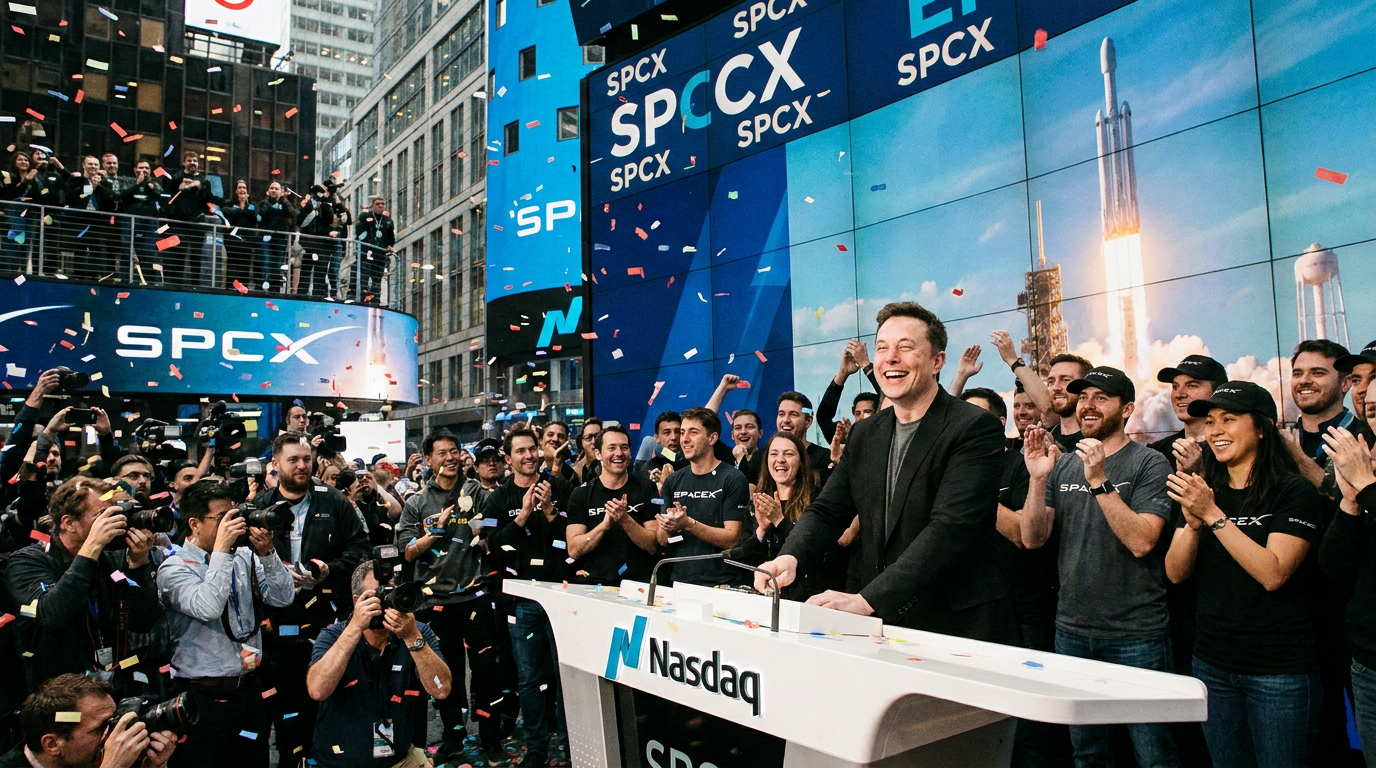
After nearly a quarter-century as a private enterprise, Space Exploration Technologies Corp. has officially entered the public markets, executing the largest initial public offering in global financial history. On Friday, executives rang the opening bell at the Nasdaq exchange in New York, accompanied by the playing of Elton John's "Rocket Man," signaling the start of a historic trading session. The highly anticipated debut of the Elon Musk-led aerospace giant shattered previous records, injecting a massive wave of optimism into the broader stock market.[6][4]
The sheer scale of the offering eclipsed anything Wall Street had previously absorbed. SpaceX priced its shares at $135 on Thursday evening, selling 555.56 million shares to raise a staggering $75 billion. This figure more than doubles the previous all-time IPO record of $29.4 billion, set by Saudi Arabia's state-owned oil company, Saudi Aramco, in 2019. The initial pricing valued the rocket and satellite manufacturer at $1.77 trillion before a single public trade was executed.[2][5]
When public trading commenced around midday on Friday under the ticker symbol "SPCX," investor appetite proved voracious. Shares opened at $150—well above the initial offering price—and surged as high as $176.52 during intraday trading. By the time the closing bell rang, the stock settled at $160.95, representing a 19% gain for the day. This first-day pop pushed SpaceX's total market capitalization past the historic $2 trillion threshold.[7][8]

The blockbuster listing had an immediate and profound impact on the wealth of its founder. With the surge in share price validating the company's astronomical valuation, Elon Musk, who controls roughly half of SpaceX's voting power, officially became the world's first trillionaire. Addressing cheering employees at the company's Starbase headquarters in Texas, Musk reflected on the milestone. "It is certainly hard to believe that a little company that started in a warehouse in El Segundo is now going public with the largest IPO ever," he remarked.[6][8][4]
The wealth generation extended far beyond the chief executive. The IPO served as a massive liquidity event for the company's workforce, turning an estimated 4,000 current and former SpaceX employees into millionaires overnight. Furthermore, industry analysts estimate that more than 400 early employees and executives achieved a net worth exceeding $100 million due to their stock holdings. In the local Texas community surrounding the Starbase facility, the sudden influx of liquid wealth has already begun reshaping the regional economy.[4][1]
The wealth generation extended far beyond the chief executive.
The $75 billion war chest is earmarked for a highly ambitious, capital-intensive roadmap. During a pre-IPO livestream, Musk outlined a "significant growth phase" designed to accelerate the company's core initiatives. Chief among these is the continued development of Starship, the fully reusable spacecraft intended for lunar missions and eventual Mars colonization. "Whoever you are watching this, SpaceX wants to be able to take you to the moon, take you to Mars and ultimately beyond," Musk told the audience on Friday.[5][8][7]

Beyond interplanetary travel, the capital will fuel the rapid expansion of Starlink, SpaceX's satellite internet constellation, which already serves millions of customers globally. More surprisingly, the company revealed plans to leverage its orbital infrastructure to build artificial intelligence data centers in space. This bold AI push follows SpaceX's recent integration with Musk's xAI venture, positioning the aerospace firm as a unique hybrid of space exploration, global telecommunications, and advanced artificial intelligence.[8][5][7]
The mechanics of the IPO itself defied Wall Street convention. Rather than offering the customary range of prices to gauge institutional interest, SpaceX presented underwriters with an unorthodox "take it or leave it" share price of $135. Despite this rigid structure, demand was overwhelmingly robust. Reports indicated that the offering was up to four times oversubscribed, with retail investors alone placing more than $100 billion in orders.[6][7]
Behind the scenes, the sheer volume of the transaction required unprecedented coordination among financial institutions. Wall Street exchanges, brokers, and clearinghouses spent weeks conducting intensive system testing to ensure their infrastructure could handle the blockbuster event. Industry veterans were keen to avoid a repeat of the technical glitches that marred Facebook's 2012 IPO, and the flawless execution of Friday's trading session was viewed as a major victory for modern market infrastructure.[2]
Despite the euphoric market reception, some financial analysts are urging caution regarding the company's fundamentals. While SpaceX generated an impressive $18.7 billion in revenue last year, the company remains unprofitable due to its massive research and development expenditures. Between the start of 2025 and March 2026, the firm reported losses of $8.7 billion. Value-focused experts point out that while SpaceX shares a $2 trillion valuation with tech giants like Alphabet and Apple, it lacks the $100 billion annual after-tax profits those mega-caps consistently produce.[7]

Nevertheless, the successful debut is being hailed as a bellwether for the broader technology sector. The U.S. IPO market, which had experienced bouts of volatility in recent years, is now expected to rebound sharply. Goldman Sachs has forecast that total IPO proceeds could quadruple to a record $160 billion in 2026. The flawless execution and strong pricing of the SpaceX offering have set a highly optimistic tone for the market.[2][4]
Most importantly, the SpaceX listing clears the runway for the next wave of highly anticipated mega-IPOs. With the space giant now successfully trading, Wall Street's attention is rapidly shifting to the artificial intelligence sector. Industry leaders OpenAI and Anthropic are both expected to launch their own initial public offerings later this year, and the robust appetite demonstrated for SpaceX suggests that investors remain eager to fund generation-defining technological leaps.[3][7]
How we got here
2002
Elon Musk founds Space Exploration Technologies Corp. with the goal of reducing space transportation costs.
Dec 2019
Saudi Aramco raises $29.4 billion, setting the previous global record for an initial public offering.
April 2026
SpaceX confidentially submits a draft registration statement to the SEC, signaling its intent to go public.
June 11, 2026
SpaceX prices its IPO at $135 per share, officially raising a record-breaking $75 billion.
June 12, 2026
Shares begin trading on the Nasdaq, surging 19% on the first day and pushing the company's valuation past $2 trillion.
Viewpoints in depth
Growth Investors
Bullish on the long-term potential of the commercial space economy and AI integration.
Growth-oriented investors view SpaceX's $2 trillion valuation not as a ceiling, but as a baseline for a company monopolizing the commercial space sector. They point to Starlink's rapidly expanding high-margin broadband revenue and the company's ambitious plans to deploy AI data centers in orbit as unprecedented growth levers. For this camp, traditional price-to-earnings metrics are irrelevant; they are investing in the infrastructure of a multi-planetary economy and the eventual commercialization of Mars.
Value Analysts
Cautious about the astronomical valuation given the company's current lack of profitability.
Traditional value analysts and institutional skeptics warn that the euphoria surrounding the IPO masks significant financial realities. Despite generating nearly $19 billion in revenue last year, SpaceX remains deeply unprofitable, burning through billions in research and development for its Starship program. This camp argues that valuing a cash-flow-negative aerospace manufacturer higher than highly profitable tech mega-caps like Alphabet or Meta exposes retail investors to severe downside risk once the initial hype subsides.
Market Infrastructure Providers
Focused on the technical execution and systemic impact of absorbing a $75 billion listing.
For exchanges, clearinghouses, and institutional brokers, the SpaceX IPO was primarily a massive stress test of modern financial infrastructure. This camp views the flawless execution of the $75 billion listing as a triumph of system modernization, proving that the markets can absorb unprecedented liquidity events without the technical failures that plagued earlier tech debuts. They see this success as a critical green light for upcoming mega-IPOs from AI giants like OpenAI and Anthropic.
What we don't know
- How quickly SpaceX can transition from heavy R&D spending to consistent profitability.
- Whether the broader market's enthusiasm will sustain the $2 trillion valuation over the coming months.
- How regulatory agencies will respond to SpaceX's plans to build AI data centers in orbit.
Key terms
- Initial Public Offering (IPO)
- The process by which a private company offers shares of its stock to the public for the first time, allowing everyday investors to buy ownership.
- Market Capitalization
- The total dollar value of a company's outstanding shares of stock, calculated by multiplying the current share price by the total number of shares.
- Underwriter
- Financial institutions, typically investment banks, that manage the IPO process, help set the initial share price, and sell the shares to institutional investors.
- Oversubscribed
- A situation in an IPO where the demand from investors for shares exceeds the total number of shares the company is offering.
Frequently asked
Can everyday investors buy SpaceX stock now?
Yes. As of June 12, 2026, SpaceX is a publicly traded company. Investors can purchase shares through standard brokerage accounts under the ticker symbol SPCX.
Is SpaceX a profitable company?
Currently, no. While SpaceX generated $18.7 billion in revenue last year, it operates at a loss due to the massive costs associated with researching and developing its Starship rocket and expanding the Starlink network.
What will SpaceX do with the $75 billion it raised?
The company plans to use the capital to fund its next major growth phase, which includes developing the Starship rocket for Mars missions, expanding the Starlink satellite internet constellation, and building space-based AI data centers.
Sources
Source coverage
8 outlets
3 viewpoints surfaced








[1]MarketWatchGrowth Investors
SpaceX employees now have enough wealth on paper to buy every home in this Texas city
Read on MarketWatch →[2]ReutersMarket Infrastructure Providers
SpaceX prices record $75 billion IPO at $135 a share
Read on Reuters →[3]AxiosMarket Infrastructure Providers
SpaceX raises $75 billion in its IPO
Read on Axios →[4]Los Angeles TimesValue Analysts
SpaceX is poised to make history with record $75-billion stock IPO
Read on Los Angeles Times →[5]Fox BusinessGrowth Investors
SpaceX IPO raises $75B in largest public market debut in history
Read on Fox Business →[6]The GuardianGrowth Investors
SpaceX makes biggest stock market debut in history
Read on The Guardian →[7]CBS NewsValue Analysts
SpaceX shares jump 19% in blockbuster IPO
Read on CBS News →[8]Zacks Investment ResearchValue Analysts
SpaceX IPO: What Investors Need to Know
Read on Zacks Investment Research →

Every angle. Every day.
Get finance stories with full source coverage and perspective breakdowns delivered to your inbox.