
Trump Signs $70 Billion 'Secure America Act' to Fund Immigration Enforcement Through 2029
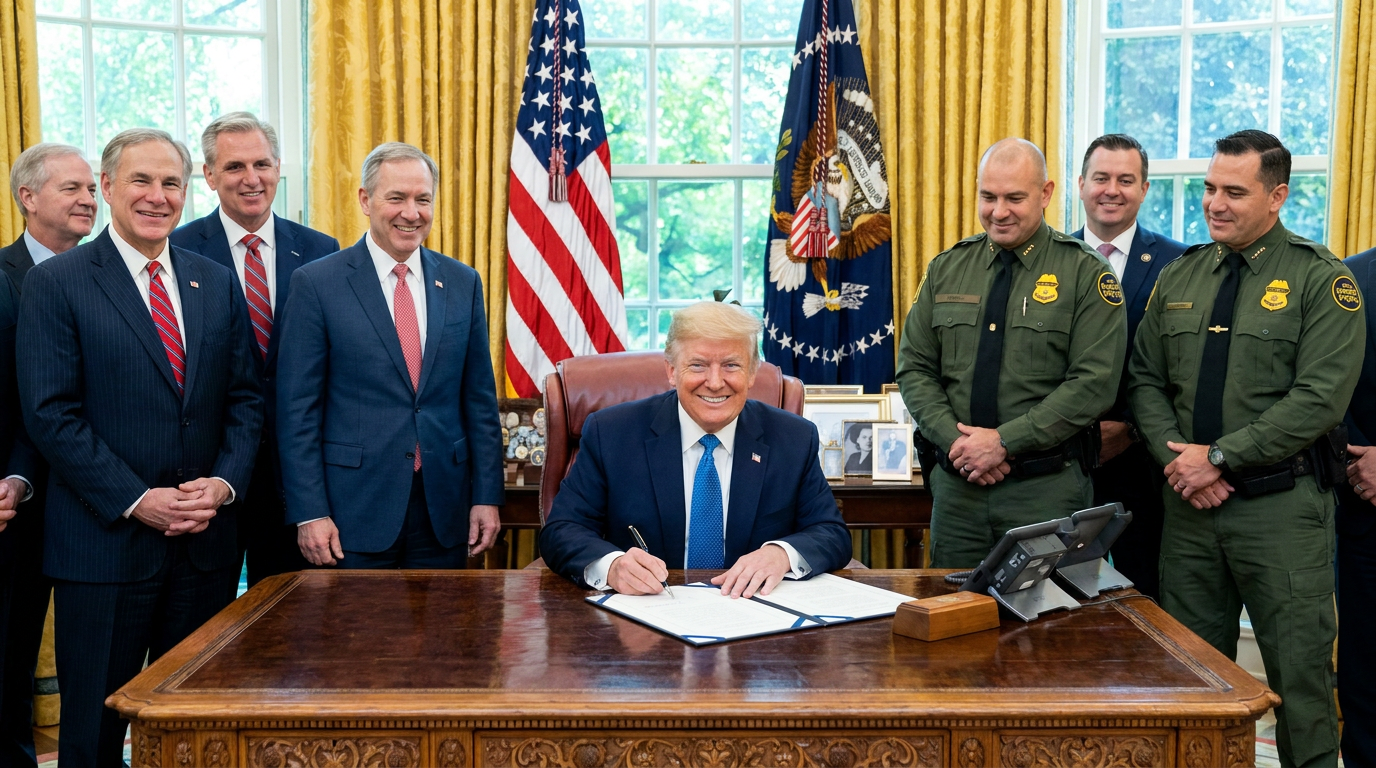
President Trump has signed a sweeping $70 billion budget reconciliation bill that bankrolls ICE and Customs and Border Protection through the end of his term, bypassing a Democratic blockade.
By Factlen Editorial Team
- Border Enforcement Advocates
- Argue the funding is essential to secure the border, combat cartels, and enforce immigration laws without partisan obstruction.
- Immigration & Civil Rights Advocates
- Warn the bill bankrolls mass deportations without necessary oversight or accountability for federal enforcement agencies.
- Municipal Leaders
- Express concern over targeted federal enforcement in sanctuary cities and the strain on local resources.
What's not represented
- · Border community residents
- · Undocumented immigrants currently residing in sanctuary cities
Why this matters
The legislation secures unprecedented funding for the administration's mass deportation agenda and border operations through 2029, effectively ending a historic 76-day shutdown of the Department of Homeland Security and authorizing aggressive new enforcement measures in "sanctuary" jurisdictions.
Key points
- President Trump signed the $70 billion Secure America Act, funding ICE and CBP through 2029.
- The bill passed via budget reconciliation, bypassing the Senate's 60-vote filibuster rule.
- The legislation ends a historic 76-day partial shutdown of the Department of Homeland Security.
- It includes $350 million specifically for enforcement operations in sanctuary jurisdictions.
- Democrats and immigration advocates heavily criticized the bill for lacking oversight and accountability measures.
President Donald Trump signed the "Secure America Act" into law on Wednesday, enacting a nearly $70 billion funding package that secures the financial future of U.S. immigration enforcement through the end of his second term. The legislation, passed via the budget reconciliation process, bypasses a months-long Democratic blockade and delivers a massive cash influx to U.S. Immigration and Customs Enforcement (ICE) and Customs and Border Protection (CBP).[1][4][5]
By utilizing budget reconciliation, Republicans were able to sidestep the Senate's standard 60-vote filibuster threshold, passing the measure with a simple majority. The Senate approved the bill 52-47 on June 5, with Senator Lisa Murkowski (R-Alaska) joining Democrats in opposition. The House followed suit on June 9 with a razor-thin 214-212 vote along party lines, with independent Representative Kevin Kiley voting against the measure alongside Democrats.[1][5]
The package allocates $38.5 billion to ICE—nearly four times its annual fiscal year 2025 budget—and $26 billion to CBP for border security operations. An additional $5 billion is directed to the broader Department of Homeland Security (DHS) for contingency and operational costs. The funds remain available through September 30, 2029, ensuring the administration's immigration agenda is bankrolled well beyond the 2028 election.[1][4][5]

The bill's passage resolves a bitter, months-long standoff over immigration policy that triggered a historic 76-day partial shutdown of the DHS earlier this year. Democrats had refused to advance regular appropriations without accountability reforms, following the deaths of two U.S. citizens, Alex Pretti and Renee Good, during roaming immigration patrols in Minneapolis in January.[1][5]
The bill's passage resolves a bitter, months-long standoff over immigration policy that triggered a historic 76-day partial shutdown of the DHS earlier this year.
One of the law's most contentious provisions earmarks $350 million specifically for enforcement operations in "sanctuary" jurisdictions—cities and states that refuse to participate in 287(g) agreements, which allow local police to collaborate with federal immigration authorities. The American Immigration Council noted the bill places a "substantial focus on enforcement against states and localities that do not participate in federal immigration enforcement."[2][4][6]
The White House celebrated the signing as a victory over "Democrats' political games," stating the funds will combat human trafficking, dismantle cartels, and secure the border. Border Czar Tom Homan promised immediate escalation following the bill's passage, stating, "You're going to see targeting increase, you're going to see arrests increase... we're going to keep our foot on the gas."[2][3]

Opponents warn the legislation removes essential oversight guardrails. House Minority Leader Hakeem Jeffries condemned the package, arguing it gives the administration a "$70 billion blank check, with no oversight, no accountability and no guardrails" for a "violent mass deportation machine."[1]
With funding secured, ICE is expected to rapidly expand its personnel, transportation logistics, and detention capacity. Meanwhile, legal experts and municipal leaders are preparing for an anticipated surge in interior enforcement operations, particularly in Democratic-led cities that limit cooperation with federal authorities.[2][4]
How we got here
January 2026
Two U.S. citizens are killed during roaming immigration patrols in Minneapolis, prompting Democrats to demand accountability reforms.
February 14, 2026
The Department of Homeland Security enters a partial shutdown after funding expires amid a partisan standoff.
April 30, 2026
The DHS reopens after a historic 76-day shutdown with a temporary bipartisan bill that excludes certain enforcement appropriations.
June 5, 2026
The Senate passes the Secure America Act 52-47 using the budget reconciliation process.
June 9, 2026
The House passes the bill 214-212 along party lines.
June 10, 2026
President Trump signs the Secure America Act into law.
Viewpoints in depth
The Administration's View
The White House views the funding as a necessary victory over partisan obstruction to secure the border.
Administration officials, including Border Czar Tom Homan, argue that the $70 billion package is essential to maintaining the operational tempo of federal immigration enforcement. They point to the funding as a mandate to increase arrests, expand detention capabilities, and dismantle transnational criminal organizations. The administration frames the legislation as a fulfillment of campaign promises to secure the border and end what they describe as dangerous "open-border policies" championed by Democrats.
Immigration Advocates & Democrats
Opponents argue the bill funds a mass deportation machine while stripping away crucial oversight.
Civil rights organizations and Democratic lawmakers warn that the Secure America Act provides a "blank check" to agencies that have historically struggled with accountability. Following the deaths of two U.S. citizens during an immigration patrol earlier in the year, advocates had demanded guardrails such as judicial warrants for private property arrests and bans on masked enforcement officers. They argue the reconciliation bill deliberately bypasses these necessary reforms, leaving vulnerable communities exposed to aggressive and unchecked federal policing.
Municipal Leaders
Local officials in sanctuary jurisdictions are bracing for targeted federal operations.
Mayors and local law enforcement in cities that limit cooperation with ICE are deeply concerned by the $350 million specifically earmarked for enforcement in their jurisdictions. Municipal leaders argue that aggressive federal operations in their communities undermine local public safety by eroding trust between immigrant populations and local police. They warn that the targeted funding will lead to increased federal raids, straining local resources and creating a climate of fear in major metropolitan areas.
What we don't know
- How quickly ICE will be able to scale up its personnel and detention facilities to utilize the new funding.
- Whether the targeted enforcement in sanctuary cities will face successful legal challenges from state and local governments.
Key terms
- Budget Reconciliation
- A legislative process that allows certain spending and tax bills to bypass the standard 60-vote filibuster threshold in the Senate, requiring only a simple majority to pass.
- 287(g) Agreements
- Partnerships that allow state and local law enforcement agencies to perform certain immigration enforcement functions under the supervision of ICE.
- Sanctuary Jurisdiction
- A city, county, or state that limits its cooperation with federal immigration enforcement agents in order to protect low-priority immigrants from deportation.
Frequently asked
What is the Secure America Act?
It is a $70 billion budget reconciliation bill signed by President Trump in June 2026 that funds U.S. Immigration and Customs Enforcement (ICE) and Customs and Border Protection (CBP) through September 2029.
How did the bill pass the Senate without 60 votes?
Republicans used the budget reconciliation process, a procedural tool that allows legislation related to spending and revenue to bypass the Senate filibuster and pass with a simple majority.
How does the bill affect sanctuary cities?
The legislation earmarks $350 million specifically for federal immigration enforcement operations in jurisdictions that refuse to cooperate with federal immigration authorities.
Sources
Source coverage
6 outlets
3 viewpoints surfaced





[1]The GuardianImmigration & Civil Rights Advocates
Trump signs $70bn immigration act ensuring ICE funding through 2029
Read on The Guardian →[2]Smart Cities DiveMunicipal Leaders
Secure America Act targets 'sanctuary' cities with $350M for ICE operations
Read on Smart Cities Dive →[3]White HouseBorder Enforcement Advocates
The Secure America Act Ends Democrat Obstruction— Fully Funds CBP, ICE and President Trump’s Border Security Agenda
Read on White House →[4]American Immigration CouncilImmigration & Civil Rights Advocates
Congress Uses Reconciliation to Pour Billions into Immigration Enforcement
Read on American Immigration Council →[5]Ballotpedia
Secure America Act of 2026
Read on Ballotpedia →[6]Rep. Jen KiggansBorder Enforcement Advocates
Kiggans Votes to Pass Secure America Act
Read on Rep. Jen Kiggans →


Every angle. Every day.
Get news politics stories with full source coverage and perspective breakdowns delivered to your inbox.