
How On-Device AI and NPUs Are Putting Privacy Back in Users' Hands
The era of cloud-only artificial intelligence is ending as Neural Processing Units (NPUs) allow laptops and phones to run powerful AI models locally, ensuring data privacy and offline capability.
By Factlen Editorial Team
- Privacy Advocates
- Focuses on the necessity of data sovereignty and keeping personal information off corporate servers.
- Enterprise IT Leaders
- Values the security, compliance, and offline productivity benefits that local AI brings to corporate fleets.
- Hardware Manufacturers
- Focuses on the performance metrics, battery efficiency, and dedicated NPU capabilities driving the next generation of consumer devices.
- Open-Source Developers
- Champions the democratization of AI through small language models and accessible local deployment tools.
What's not represented
- · Cloud Infrastructure Providers who stand to lose API revenue as inference moves to the edge.
- · Everyday consumers who may not understand the technical difference between cloud and local AI.
Why this matters
As artificial intelligence becomes deeply integrated into our daily lives, the shift to on-device processing ensures that users no longer have to sacrifice their privacy for convenience. By running AI locally, your personal data, corporate documents, and daily habits remain entirely in your control, fundamentally changing the power dynamic between tech giants and consumers.
Key points
- Modern smartphones and laptops are increasingly using Neural Processing Units (NPUs) to run AI tasks directly on the device.
- On-device AI ensures complete data privacy, as personal information and corporate data never have to be sent to a cloud server.
- Local processing eliminates network latency, allowing for near-instantaneous real-time translation and voice interactions.
- NPUs are highly energy-efficient, consuming significantly less power than traditional processors when running AI workloads.
- The future of AI is hybrid, with devices handling routine tasks locally while routing only the most complex queries to the cloud.
For years, artificial intelligence was strictly a cloud-bound phenomenon. You typed a prompt into a browser, the request traveled hundreds of miles to a massive data center, and the answer beamed back moments later. It was a miraculous workflow, but it came with inherent compromises: constant internet dependency, noticeable latency, and the reality that every personal query was processed on a distant corporate server. But in 2026, a quiet architectural revolution has flipped that model entirely. The era of edge computing and on-device AI has officially arrived, shifting the center of gravity away from the cloud and directly into the hands of users. Instead of relying on remote server farms, modern smartphones and laptops are now processing complex artificial intelligence tasks locally, fundamentally changing how we interact with our technology.[8]
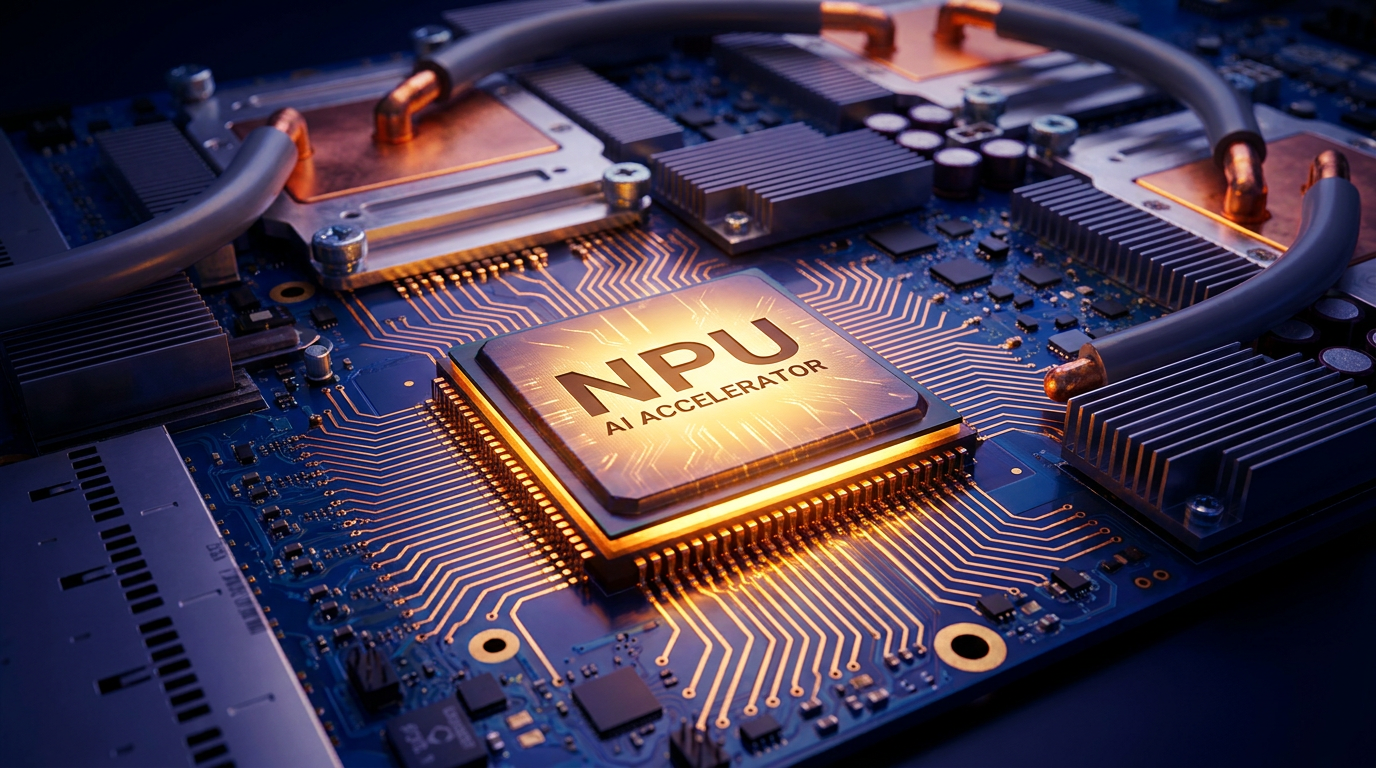
The catalyst for this massive shift is a specialized piece of hardware known as the Neural Processing Unit, or NPU. To understand its impact, it helps to look at the architecture of a modern computer. The Central Processing Unit (CPU) acts as the machine's generalist brain, capable of handling a wide variety of everyday tasks. The Graphics Processing Unit (GPU) is the visual artist, built to render high-resolution gaming environments and video. The NPU, however, is a dedicated specialist. It is engineered specifically to handle the complex mathematical operations—such as matrix multiplication and pattern recognition—that neural networks require to function. By offloading these specific tasks from the CPU and GPU, the NPU allows the entire system to run artificial intelligence applications with unprecedented speed and efficiency.[3]
This hardware has rapidly transitioned from a niche premium feature to an industry standard. Microsoft's Copilot+ PC initiative set a firm benchmark, mandating that certified devices include an NPU capable of at least 40 Trillion Operations Per Second (TOPS). This metric ensures the laptop has enough dedicated horsepower to run advanced AI features natively in Windows without stuttering. Apple has similarly embedded highly advanced Neural Engines into its custom silicon, forming the hardware foundation for "Apple Intelligence" across Macs, iPads, and iPhones. This widespread integration means that millions of consumer devices shipped in 2026 possess the raw computational power required to run sophisticated language and vision models entirely on their own.[1][2]

The most profound and immediate benefit of this local processing power is privacy. When artificial intelligence lives exclusively in the cloud, every voice command, drafted email, summarized meeting, and analyzed document must be transmitted over the open internet. This creates a massive surface area for potential data breaches and raises significant concerns about how tech companies use personal information to train future models. On-device AI elegantly eliminates this vulnerability. Because the data never leaves the physical hardware you own, there are no server logs, no API intercepts, and no opaque third-party processing agreements to worry about. Your data remains entirely sovereign.[5][8]
For enterprise IT leaders, healthcare professionals, and legal teams, this data sovereignty is a transformative breakthrough. Historically, these sectors were forced to block employees from using generative AI tools because uploading sensitive patient records, proprietary corporate code, or confidential legal briefs to a public cloud violated strict compliance regulations. With local inference, those barriers disappear. An AI assistant running on an NPU can summarize a highly classified defense document or analyze a patient's medical history without a single byte of data ever crossing the corporate firewall. Security is embedded directly into the system's architecture rather than relying on external policy enforcement.[2][5]
For enterprise IT leaders, healthcare professionals, and legal teams, this data sovereignty is a transformative breakthrough.
Apple's implementation of Apple Intelligence exemplifies this privacy-first philosophy at a consumer scale. The cornerstone of their approach is on-device processing, ensuring the operating system is deeply aware of a user's personal context—such as their schedule, messages, and photos—without actually collecting or hoarding that data. However, Apple recognized that some requests genuinely require the massive computational capacity of a data center. To bridge this gap, they developed "Private Cloud Compute." When a local device cannot handle a complex query, it routes the specific task to a secure server enclave where the data is processed statelessly and immediately destroyed, ensuring independent security researchers can verify that nothing is ever stored.[1]
Beyond the critical issue of privacy, local AI solves the persistent problem of latency. Cloud round-trips typically add 200 to 500 milliseconds of delay before a user sees the first word of a response. While half a second might sound trivial on paper, it is enough to make real-time translation, augmented reality overlays, or conversational voice interactions feel sluggish and unnatural. With an NPU handling the workload locally, models can generate tokens in under 20 milliseconds. This near-instantaneous processing enables seamless live captions, instant background blur on video calls, and real-time image generation that responds to a creator's brushstrokes without a hint of lag.[5][7]

Then there is the issue of connectivity and reliability. Cloud-based artificial intelligence is entirely dependent on a stable, high-speed internet connection. If you are working on a remote job site, flying on an airplane, or simply dealing with a localized network outage, cloud-dependent assistants immediately become useless. Local AI models, by contrast, are always available. Field workers in remote locations can use on-device AI to instantly pull up troubleshooting guidance for heavy machinery, and international travelers can translate foreign languages in real-time without hunting for a Wi-Fi hotspot or paying exorbitant cellular roaming fees.[6]
This offline capability is paired with remarkable energy efficiency, solving one of the biggest hurdles of mobile computing. Historically, forcing a traditional GPU to run artificial intelligence tasks would drain a laptop's battery life in a matter of hours, generating significant heat in the process. NPUs are purpose-built to avoid this exact scenario. Because their architecture is optimized specifically for neural networks, they consume 10 to 100 times less power for equivalent AI workloads. Hardware manufacturers report that offloading these background tasks to the NPU can extend a laptop's battery life by 15 to 20 percent, preserving power for the tasks that matter most.[3]

The software ecosystem has evolved at a blistering pace to take advantage of this new hardware. Open-source developers and AI researchers have pioneered a new class of "Small Language Models" (SLMs), such as Llama 3.2, Phi-4 mini, and Gemma 3. Through advanced compression techniques like quantization—which shrinks the mathematical precision of a model without sacrificing its critical reasoning capabilities—these SLMs now fit comfortably within the memory constraints of standard consumer laptops and smartphones. They deliver surprisingly robust intelligence without requiring a server farm.[4][5]
Deploying these local models is no longer restricted to software engineers and command-line experts. User-friendly platforms like Ollama and LM Studio have made running a local LLM as simple as downloading a standard desktop application. Users can select a model, install it with a single click, and immediately start chatting with an AI that lives entirely on their hard drive. This democratizes access to powerful artificial intelligence, removing the friction of monthly subscription fees and token costs while giving users total control over the software they run.[4]

Ultimately, the future of AI architecture in 2026 is decidedly hybrid. The smartest devices now act as intelligent traffic cops, seamlessly routing routine tasks—like summarizing emails, drafting quick text messages, and organizing local files—to the NPU for instant, private execution. Only when a query requires frontier-level reasoning or vast, up-to-the-minute world knowledge will the system escalate the request to the cloud. This hybrid approach offers the best of both worlds, ensuring that users no longer have to trade their privacy for convenience, putting the power of artificial intelligence firmly back where it belongs: on the device itself.[4][6][8]
How we got here
Late 2022
The generative AI boom begins, relying almost entirely on massive cloud data centers to process user requests.
Mid 2024
Microsoft announces the Copilot+ PC standard, requiring laptops to include an NPU capable of 40 TOPS for local AI processing.
Late 2024
Apple unveils Apple Intelligence, deeply integrating on-device AI and secure Private Cloud Compute across its ecosystem.
Early 2025
Highly capable Small Language Models (SLMs) mature, allowing developers to run robust AI locally via tools like Ollama.
2026
NPUs become standard in consumer devices, shifting the default architecture for routine AI tasks from the cloud to the edge.
Viewpoints in depth
Privacy Advocates
Focuses on the necessity of data sovereignty and keeping personal information off corporate servers.
For privacy advocates, the shift to on-device AI is the most important architectural correction in modern computing. They argue that the cloud-first era normalized a dangerous precedent where tech companies hoarded vast amounts of personal context—from voice recordings to private documents—under the guise of providing better AI services. By moving inference to the local NPU, users reclaim their data sovereignty. Advocates point out that when data never leaves the device, it is mathematically impossible for it to be intercepted in transit, logged on a server, or quietly used to train a company's future models.
Enterprise IT Leaders
Values the security, compliance, and offline productivity benefits that local AI brings to corporate fleets.
Enterprise IT leaders view local AI primarily through the lens of risk mitigation and operational efficiency. For years, Chief Information Security Officers had to aggressively block generative AI tools because uploading proprietary code or sensitive client data to public cloud models violated strict compliance frameworks like HIPAA or GDPR. On-device AI solves this policy problem architecturally. IT leaders emphasize that local models allow their workforce to benefit from AI summarization and coding assistance without exposing the company to regulatory fines or intellectual property leaks. Furthermore, the ability for field workers to access AI tools in low-connectivity environments directly boosts bottom-line productivity.
Open-Source Developers
Champions the democratization of AI through small language models and accessible local deployment tools.
The open-source community sees on-device AI as a crucial counterbalance to the monopolistic power of massive cloud providers. Developers in this camp focus on the rapid advancement of Small Language Models (SLMs) and quantization techniques that allow highly capable AI to run on consumer hardware. They argue that intelligence should not be a subscription service gated by API costs and internet connectivity. By building tools like Ollama and optimizing models to run on standard NPUs, this community is actively working to ensure that powerful artificial intelligence remains a decentralized, free, and universally accessible utility.
What we don't know
- It remains unclear how quickly software developers will update legacy applications to fully utilize NPU hardware.
- The exact performance ceiling of Small Language Models (SLMs) running on consumer hardware is still being tested.
- How regulatory bodies will treat hybrid AI architectures—where data moves dynamically between local and cloud processing—is still evolving.
Key terms
- NPU (Neural Processing Unit)
- A specialized hardware chip designed specifically to accelerate artificial intelligence and machine learning tasks efficiently.
- TOPS (Trillions of Operations Per Second)
- A performance metric used to measure how fast an NPU or other processor can handle artificial intelligence calculations.
- Local LLM
- A Large Language Model that is downloaded and run entirely on a user's personal device, requiring no internet connection.
- Quantization
- A compression technique that shrinks the size of an AI model so it can fit on consumer hardware, without losing its core capabilities.
- Edge Computing
- Processing data locally on the device where it is generated (the 'edge' of the network), rather than sending it to a centralized cloud server.
Frequently asked
Can my current laptop run local AI models?
It depends on its age and specifications. While older laptops can run small models using their CPU or GPU, newer devices (like Copilot+ PCs or Apple silicon Macs) feature dedicated NPUs that run AI much faster and without draining the battery.
Does on-device AI mean I don't need the internet anymore?
For routine AI tasks like summarizing a local document or translating live audio, yes. However, local models cannot browse the live web, so you still need the internet for real-time news, weather, or complex queries that require cloud processing.
Are local models as smart as massive cloud models like ChatGPT?
Not quite. Local models are highly optimized 'Small Language Models' that excel at specific, routine tasks. For highly complex reasoning, advanced coding, or vast world knowledge, massive cloud models still hold a significant advantage.
What exactly is an NPU?
A Neural Processing Unit (NPU) is a specialized chip built into modern computers and phones. Unlike a general-purpose CPU, it is designed specifically to handle the complex math required by artificial intelligence, doing so much faster and with far less power.
Sources
Source coverage
8 outlets
4 viewpoints surfaced







[1]ApplePrivacy Advocates
Apple Intelligence and privacy on iPhone
Read on Apple →[2]MicrosoftEnterprise IT Leaders
NPUs explained: How AI-ready hardware powers productivity
Read on Microsoft →[3]HPHardware Manufacturers
Why Everyone's Talking About NPUs: What They Do and Why They Matter
Read on HP →[4]AI MagicxOpen-Source Developers
On-Device AI in 2026: Running LLMs Locally on Your Phone, Laptop, and IoT Devices
Read on AI Magicx →[5]Fractal AIPrivacy Advocates
On-device AI: The Strategic Inflection
Read on Fractal AI →[6]RunAnywhereEnterprise IT Leaders
On-device AI inference research and infrastructure
Read on RunAnywhere →[7]Box UKHardware Manufacturers
How Laptops in 2026 Use Best NPUs for Better FPS, Streaming and Creator Workflows
Read on Box UK →[8]Factlen Editorial TeamOpen-Source Developers
Synthesis by Factlen editorial team
Read on Factlen Editorial Team →

Every angle. Every day.
Get ai stories with full source coverage and perspective breakdowns delivered to your inbox.