
How Mass Timber is Transforming Global Real Estate and Turning Buildings into Carbon Sinks
Engineered wood products like cross-laminated timber are replacing concrete and steel in high-rise construction, offering a scalable solution to the real estate industry's massive carbon footprint.
By Factlen Editorial Team
- Structural Engineers & Architects
- Focuses on the material's strength-to-weight ratio, prefabrication efficiency, and proven fire-resistance capabilities.
- Sustainable Developers
- Advocates for mass timber as a critical tool to decarbonize real estate portfolios and attract premium tenants.
- Risk & Financial Analysts
- Highlights the rapid market growth alongside the logistical hurdles of supply chains and commercial insurance.
What's not represented
- · Local Forestry Communities
- · Traditional Steel & Concrete Manufacturers
Why this matters
The construction industry accounts for roughly 11% of global greenhouse gas emissions. By replacing concrete and steel with engineered wood, cities can transform new high-rises from massive carbon emitters into active carbon sinks, fundamentally altering the environmental impact of urban growth.
Key points
- Mass timber utilizes engineered wood products like CLT to replace concrete and steel in structural load-bearing applications.
- The material drastically reduces a building's embodied carbon by permanently sequestering CO2 absorbed by the trees during their growth.
- Prefabricated timber panels allow for significantly faster construction timelines and require smaller on-site crews.
- Exposed timber interiors, known as biophilic design, are driving higher lease rates and attracting premium corporate tenants.
- The global mass timber market is projected to grow from $1.8 billion in 2025 to $6.8 billion by 2034.
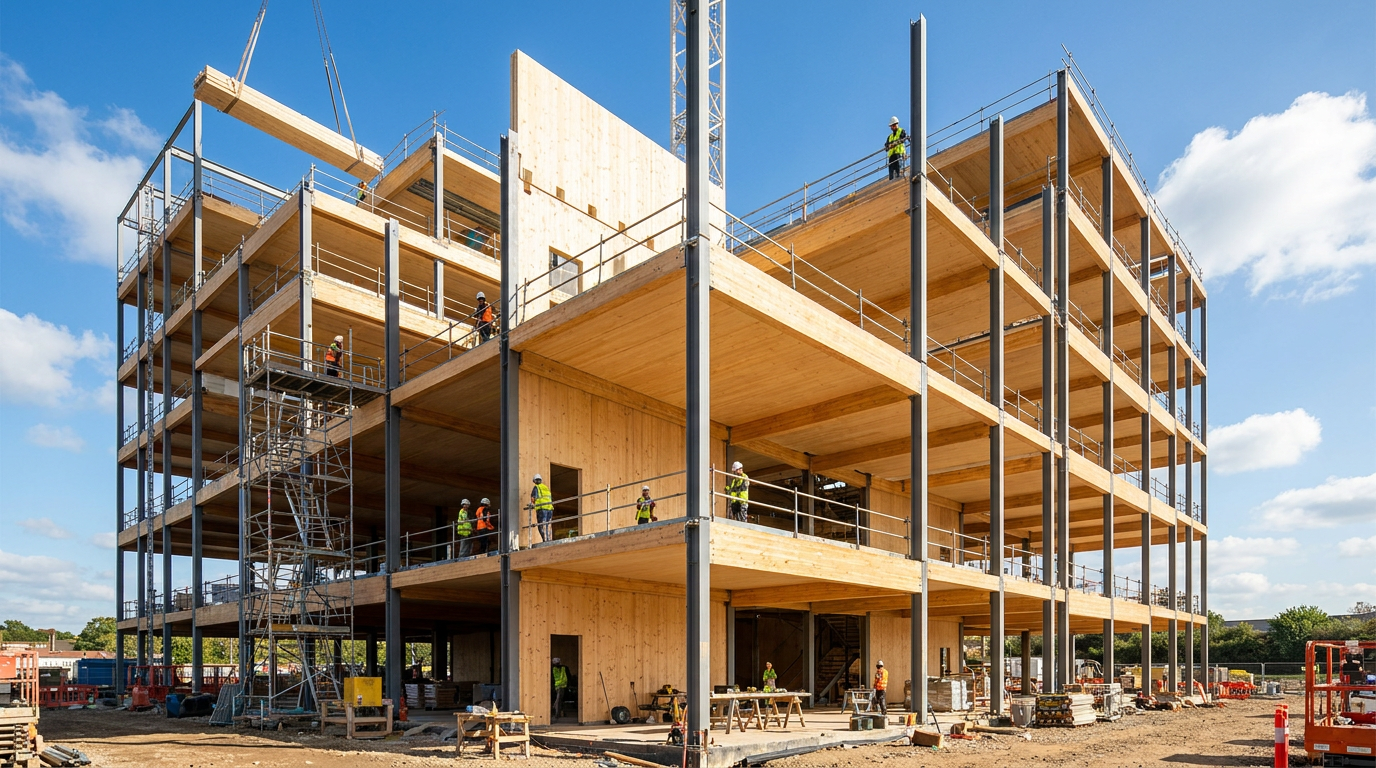
The skyline of Milwaukee is currently undergoing a transformation that has nothing to do with steel or concrete. Construction is rapidly advancing on Neutral Edison, a 31-story high-rise that will reach 362 feet by its topping-out in 2026. When completed, it will claim the title of the world's tallest mass timber building, surpassing another Milwaukee tower, the 25-story Ascent, which set the previous record in 2022. This Midwestern race to the sky is the most visible symptom of a profound shift in global real estate. Driven by aggressive climate targets and breakthroughs in material science, developers are increasingly abandoning traditional concrete and steel in favor of engineered wood.[1][3]
To understand this construction boom, one must look at the mechanism behind the material. "Mass timber" is not traditional lumber; it is a category of highly engineered wood products designed for massive structural load-bearing. The most common variant is cross-laminated timber (CLT), created by stacking layers of solid wood planks perpendicularly and bonding them under immense pressure. Another common component is glued-laminated timber (glulam), where the wood grain is aligned in a single direction to create massive beams and columns. Together, these engineered products offer a structural integrity that fundamentally changes what is possible to build with wood.[3][4]
This perpendicular grain structure gives CLT a strength-to-weight ratio that rivals reinforced concrete, while remaining up to five times lighter. Because the panels are manufactured off-site using precision computer-numerical-control (CNC) machines, they arrive at the construction site ready to be slotted together like a massive interlocking puzzle. This prefabrication drastically reduces construction timelines, minimizes neighborhood disruption, and requires significantly smaller on-site crews. For developers operating in dense urban environments, the ability to assemble a high-rise quietly and quickly is a massive logistical advantage.[4][9]

But the primary catalyst for the mass timber revolution is the urgent math of global emissions. The production of cement and steel for conventional construction accounts for roughly 11 percent of all global greenhouse gas emissions. As governments implement stricter environmental regulations, real estate developers and institutional investors are under mounting pressure from Environmental, Social, and Governance (ESG) mandates to decarbonize their portfolios. The global mass timber construction market, valued at $1.8 billion in 2025, is projected to surge to $6.8 billion by 2034 as capital flows toward sustainable alternatives.[4][7]
Mass timber flips the carbon equation by addressing "embodied carbon"—the massive volume of emissions generated before a building even opens its doors. As trees grow in sustainably managed forests, they naturally absorb carbon dioxide from the atmosphere through photosynthesis. When that wood is harvested and engineered into mass timber panels, the absorbed carbon remains locked inside the material for the lifetime of the structure. Instead of emitting massive amounts of carbon to forge steel beams and mix concrete, developers are effectively storing carbon inside the very walls of their buildings.[5][6]
The sequestration numbers are substantial and easily quantifiable for developers tracking their environmental impact. For every cubic meter of engineered wood used in a building, approximately 0.9 tons of carbon dioxide is permanently stored. A single large-scale mass timber commercial building can sequester thousands of tons of CO2, effectively transforming urban high-rises from carbon emitters into active carbon sinks. For institutional investors looking to achieve net-zero portfolios, these buildings offer a tangible, measurable climate solution that requires no speculative carbon-offset accounting, providing a transparent path to regulatory compliance.[5]

The sequestration numbers are substantial and easily quantifiable for developers tracking their environmental impact.
This environmental profile is highly attractive to corporate tenants, but the appeal extends beyond the carbon math. Mass timber buildings heavily feature "biophilic design"—the architectural practice of leaving the structural wood exposed in interior spaces to connect occupants with natural materials. Real estate analysts note that these exposed-timber offices and apartments consistently command higher lease rates and lease up faster than their conventional counterparts. The natural warmth, improved acoustics, and aesthetic appeal of wood translate directly into premium real estate valuations.[3][4]
The trend is distinctly global, reshaping skylines across multiple continents. In Sydney, Australia, the tech giant Atlassian is constructing a 42-story hybrid timber headquarters designed to drastically reduce embodied carbon while utilizing a steel exoskeleton. In northern Sweden, the 20-story Sara Kulturhus Centre was built using timber harvested from nearby regional forests, demonstrating how local supply chains can support massive civic infrastructure. From London to Tokyo, structural wood is becoming the material of choice for flagship corporate and cultural developments.[3][8]
Despite the immense momentum, the industry faces significant hurdles, most notably in the realm of commercial insurance. The underwriting market for builders' risk remains notoriously "hard," meaning premiums are high and coverage can be difficult to secure for unprecedented timber structures. Because mass timber high-rises are relatively new, insurance carriers lack the decades of actuarial data they rely on when evaluating concrete and steel buildings. Consequently, developers often have to approach multiple carriers to achieve full coverage through quota shares, adding financial friction to the early stages of massive projects.[6]
The most common concern raised by underwriters and the general public is fire safety. However, extensive testing has demonstrated that mass timber behaves very differently than light-frame wood used in suburban housing. When exposed to extreme heat, the outer layer of a massive CLT beam chars. This char layer acts as a natural insulator, protecting the inner core of the wood and allowing the building to maintain its structural integrity for hours, easily meeting or exceeding strict international fire codes.[4][9]

Supply chain constraints also pose a logistical challenge for the rapidly growing sector. While North America possesses vast, sustainably managed forest resources, the domestic manufacturing infrastructure for cross-laminated timber is still maturing. Many high-profile projects in the United States still rely on importing engineered panels from established European manufacturers, such as Austria's Stora Enso, which has been producing CLT for decades. However, regional production hubs are rapidly expanding in the Pacific Northwest and the American South to meet domestic demand, which will ultimately reduce transportation emissions and lower material costs.[1][7]
The ultimate ceiling for mass timber remains untested, and developers are eager to find out exactly how high engineered wood can safely go. As engineering confidence grows and building codes evolve to accommodate new materials, architectural firms are pushing boundaries further than ever before. In late 2024, Michael Green Architecture unveiled an ambitious proposal for a 55-story mass timber tower in Milwaukee. This massive mixed-use project would require over $700 million in investment and shatter all current height records, proving that timber can compete with steel on the grandest urban scales.[2]
Whether future structures routinely reach 55 stories or primarily serve to fill the mid-rise "missing middle" of urban housing, the trajectory of global real estate is clear. By turning the built environment into a vast carbon repository, mass timber offers one of the few truly scalable solutions to the construction industry's massive climate problem. As manufacturing capacity scales up globally and insurance markets adapt to the new risk profiles, the skylines of the future may very well be grown in the forest rather than forged in a furnace.[2][4][5]
How we got here
2019
Norway's Mjøstårnet building is completed, proving the viability of tall timber structures in Europe.
2022
The 25-story Ascent tower in Milwaukee is completed, becoming the world's tallest mass timber building.
2025
The global mass timber construction market reaches an estimated $1.8 billion valuation.
2026
Construction tops out on Neutral Edison in Milwaukee, set to break the height record at 31 stories.
Viewpoints in depth
Sustainable Developers' View
Advocates for mass timber as a critical tool to decarbonize real estate portfolios.
For developers and institutional investors, mass timber is primarily a solution to the real estate industry's massive carbon footprint. Facing strict ESG mandates and upcoming climate regulations, developers view engineered wood as the most viable way to eliminate 'embodied carbon' from new constructions. They also point to the economic upside: buildings with exposed timber interiors consistently attract premium corporate tenants and lease up faster due to the psychological benefits of biophilic design.
Structural Engineers' View
Focuses on the efficiency, precision, and safety of engineered wood.
Architects and engineers champion mass timber for its remarkable strength-to-weight ratio, which allows for lighter foundations and faster build times. Because components are milled off-site using precise CNC machinery, construction sites operate more like assembly lines with smaller crews. Engineers also actively work to dispel outdated myths about wood and fire, pointing to rigorous testing that proves thick timber beams char predictably, insulating their structural core and exceeding international fire safety codes.
Risk Analysts' View
Highlights the financial and logistical hurdles of scaling a new construction method.
While optimistic about the market's projected $6.8 billion growth, risk analysts and underwriters remain cautious. The insurance industry currently lacks the decades of actuarial data it relies on for concrete and steel, leading to a 'hard market' where securing builders' risk coverage for timber high-rises can be expensive and complex. Additionally, analysts warn that domestic supply chains in North America must mature rapidly to reduce reliance on European timber imports and keep project costs competitive.
What we don't know
- How quickly the commercial insurance industry will adapt its underwriting models to offer competitive builders' risk premiums for timber high-rises.
- Whether domestic North American manufacturing capacity can scale fast enough to eliminate the need for European timber imports.
- The exact long-term impact on global forest ecosystems if mass timber adoption scales to replace a majority of concrete construction.
Key terms
- Mass Timber
- A category of engineered wood products designed for massive structural load-bearing applications, replacing concrete and steel.
- Cross-Laminated Timber (CLT)
- A wood panel product made by gluing layers of solid lumber perpendicularly to one another to achieve immense structural strength.
- Embodied Carbon
- The total greenhouse gas emissions generated during the manufacturing, transportation, and construction phases of building materials.
- Biophilic Design
- An architectural approach that seeks to connect building occupants more closely to nature, often by incorporating exposed natural materials like wood and abundant natural light.
- Glulam
- Glued-laminated timber, an engineered wood product used primarily for structural beams and columns, made by aligning the wood grain in a single direction.
Frequently asked
Is mass timber safe in a fire?
Yes. During a fire, the outer layer of massive timber beams chars, which acts as an insulator and protects the structural core from failing, allowing it to meet strict fire codes.
Does mass timber contribute to deforestation?
When sourced responsibly, mass timber relies on sustainable forestry practices where new trees are continuously planted to replace harvested ones, maintaining the forest's carbon-absorbing capacity.
Is it cheaper to build with mass timber?
While the raw materials can sometimes cost more upfront, the prefabrication process drastically reduces construction time and labor costs, often making the overall project cost-competitive.
Sources
Source coverage
9 outlets
3 viewpoints surfaced









[1]Construction DiveSustainable Developers
World's tallest mass timber building breaks ground in Wisconsin
Read on Construction Dive →[2]The GuardianSustainable Developers
Milwaukee plans to build tallest timber building in the world
Read on The Guardian →[3]gb&d magazineStructural Engineers & Architects
The Top 25 Tallest Mass Timber Buildings in the World
Read on gb&d magazine →[4]TrellisSustainable Developers
Mass timber usage rises in U.S., European building construction
Read on Trellis →[5]ErgodomusStructural Engineers & Architects
The Role of Mass Timber in Carbon Sequestration
Read on Ergodomus →[6]WoodWorksRisk & Financial Analysts
Mass Timber Insurance Strategy Roadmap: 2025-2030
Read on WoodWorks →[7]Global Market InsightsRisk & Financial Analysts
Mass Timber Construction Market Research Report 2034
Read on Global Market Insights →[8]Under the Hard HatStructural Engineers & Architects
10 of the biggest mass-timber projects proving wood is the future
Read on Under the Hard Hat →[9]FSC InternationalStructural Engineers & Architects
T3 Bayside Phase 1 - The Largest Mass Timber Office Building
Read on FSC International →
Every angle. Every day.
Get real estate stories with full source coverage and perspective breakdowns delivered to your inbox.