
How Local AI Replaced the Cloud: Running Frontier Models on Your Laptop
Advances in mathematical compression and consumer hardware have made it possible to run powerful artificial intelligence models entirely offline, eliminating subscription fees and guaranteeing data privacy.
By Factlen Editorial Team
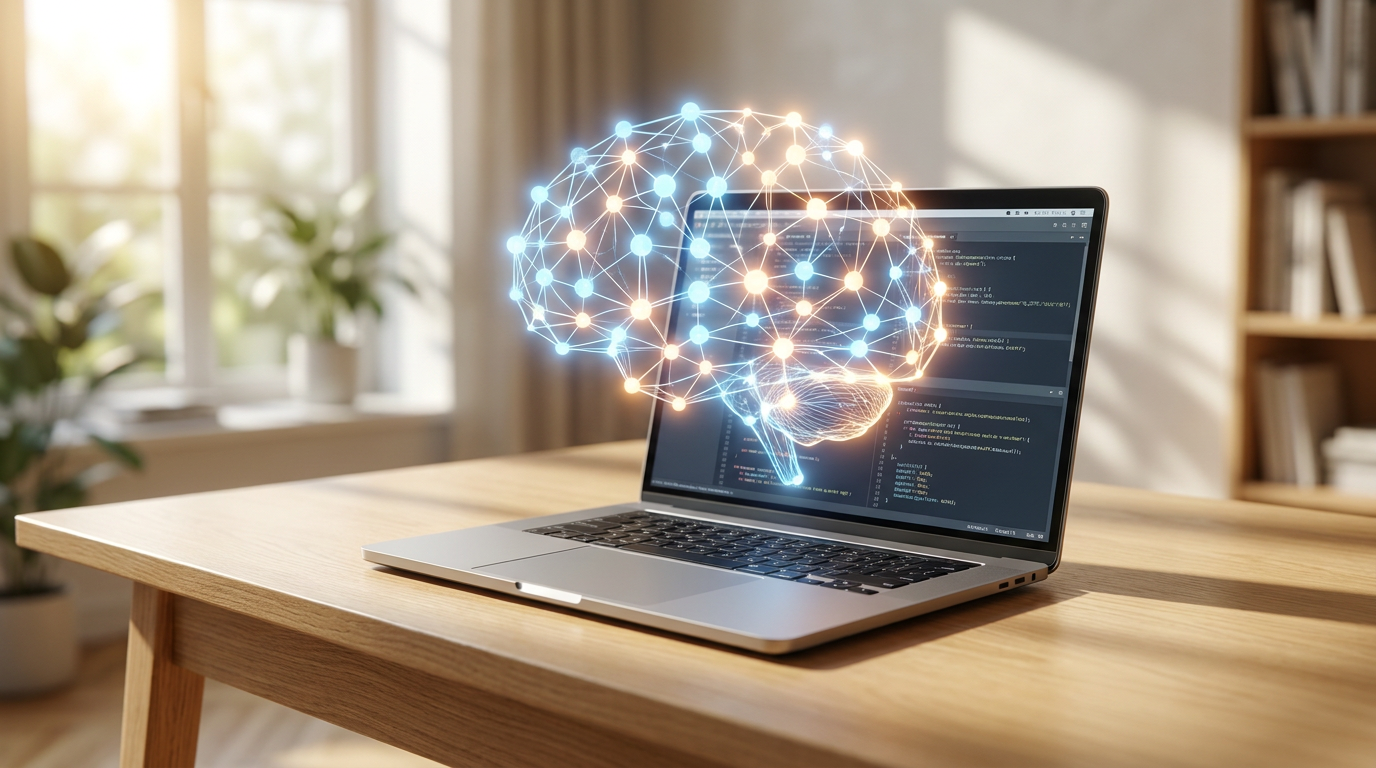
- Privacy & Open-Source Advocates
- Championing local AI as a fundamental return to user control and data sovereignty.
- Hardware Manufacturers & Builders
- Viewing the local AI boom as the catalyst for the next major consumer hardware super-cycle.
- Cloud AI Providers
- Maintaining that the true frontier of artificial intelligence will remain centralized in massive data centers.
What's not represented
- · Enterprise IT Security Officers
- · Regulators monitoring open-weight AI safety
Why this matters
By moving artificial intelligence from corporate cloud servers to your own hard drive, you eliminate monthly subscription fees, guarantee that your private data is never intercepted or used for training, and ensure your AI tools work flawlessly even without an internet connection.
Key points
- Running AI locally allows users to process sensitive data, documents, and code entirely offline, guaranteeing complete privacy.
- The combination of user-friendly software like Ollama and mathematical compression (quantization) has made local AI accessible to non-developers.
- By reducing model precision to 4-bit formats, massive AI models can now run comfortably on standard laptops with just 8GB of RAM.
- Modern 'AI PCs' feature dedicated Neural Processing Units (NPUs) that handle AI calculations efficiently without draining battery life.
- 2026 open-weight models like Llama 4 Scout and Gemma 4 offer reasoning and coding capabilities that rival paid cloud subscriptions.
For years, the artificial intelligence revolution has been tethered to the cloud. Accessing the most capable language models meant paying a monthly subscription, requiring a constant internet connection, and trusting massive tech corporations with your private data, medical questions, and proprietary code.[6]
But in 2026, a quiet rebellion has gone mainstream. The era of the mandatory cloud API is facing a formidable disruptor: your own computer. The local AI ecosystem has matured to the point where running a highly capable assistant on a standard laptop is no longer a fringe concept, but a practical daily reality.[2]
Running large language models (LLMs) locally—directly on consumer laptops and desktops—has transitioned from a frustrating hobbyist experiment into a seamless, everyday utility. Millions of users are now downloading frontier-class AI models and running them entirely offline, reclaiming their privacy and eliminating subscription fees.[1][2]
This shift is driven by a perfect storm of technological breakthroughs. Open-weight models have become astonishingly capable, software tools have abstracted away the command-line complexity, and hardware manufacturers have fundamentally redesigned consumer silicon to handle neural networks.[3][5]

The most immediate catalyst for this migration is privacy. When a user types a prompt into a cloud-based AI, that text is transmitted to a server farm. For regulated industries like healthcare and law, or for developers working on unreleased software, this data exposure is a non-starter.[1]
Local AI solves the privacy problem through physics: the data physically never leaves the device. A local model acts like a downloaded record, and the software on your computer is the record player. You can turn off your Wi-Fi, disconnect your router, and the AI will still summarize a 50-page legal brief or write a Python script with zero latency.[1][6]
The software layer has undergone a radical simplification. Just two years ago, running a local model required navigating complex Python environments, managing dependencies, and troubleshooting obscure terminal errors that locked out non-technical users.[2]
Today, tools like Ollama and LM Studio have turned local AI into a standard desktop application. Users simply download the software, browse a built-in directory of models, and click install. The application automatically detects the system's hardware, configures the optimal settings, and provides a chat interface that feels indistinguishable from a web-based AI assistant.[1][2]
Today, tools like Ollama and LM Studio have turned local AI into a standard desktop application.
But the true magic trick that makes local AI possible on consumer hardware is a mathematical compression technique known as quantization. Without it, the hardware requirements for modern AI would remain astronomically high.[4]
AI models are essentially massive grids of numbers, called parameters. A model with 70 billion parameters traditionally stores each number in a high-precision 16-bit format. In this uncompressed state, the model requires a staggering amount of memory—often exceeding 140 gigabytes—which restricts it to expensive data center servers.[4]

Quantization intentionally reduces the precision of these numbers, rounding them down to 8-bit or even 4-bit integers. Think of it like compressing a massive, uncompressed RAW photograph into a high-quality JPEG. You lose a microscopic amount of detail, but the file size shrinks dramatically.[4]
By utilizing 4-bit quantization, a massive model's memory footprint is reduced by roughly 75%. This compression allows a highly capable 8-billion parameter model to run comfortably on a standard laptop with just 8 gigabytes of RAM, suffering almost zero perceptible loss in conversational quality.[4]
Hardware manufacturers have rushed to meet this new demand, sparking the rise of the AI PC. In 2026, both Intel and AMD, alongside Apple's M-series chips, have integrated specialized silicon called Neural Processing Units (NPUs) directly into their consumer processors.[2][6]
While traditional CPUs are built for general tasks and GPUs are designed for heavy graphical rendering, NPUs are purpose-built for the specific mathematical operations required by AI inference. They handle these calculations with remarkable efficiency, allowing a laptop to run background AI tasks—like live audio transcription or local document search—without draining the battery or spinning up loud cooling fans.[6]

The models themselves have also evolved to target consumer hardware. Tech giants and open-source collectives are releasing highly optimized, smaller models specifically designed for local deployment, recognizing that the future of AI is hybrid.[3][5]
Meta's Llama 4 Scout, Google's Gemma 4, and Microsoft's Phi-4-mini are engineered to punch far above their weight class. These models routinely match or beat the performance of 2024's massive cloud models on coding, reasoning, and writing benchmarks, despite being a fraction of the size.[3][5]

The cloud will not disappear; massive data centers will always be required to train new models and run the absolute cutting-edge, trillion-parameter systems needed for complex scientific reasoning and advanced agentic workflows.[1][6]
But for the daily, practical tasks that define modern knowledge work—drafting emails, analyzing spreadsheets, summarizing PDFs, and writing boilerplate code—the cloud is no longer a requirement. The supercomputer has moved to the desk, giving users an AI assistant that is free, private, and entirely their own.[1][2]
How we got here
Early 2023
Local AI is largely restricted to hobbyists with expensive, multi-GPU desktop setups.
Late 2023
The introduction of the GGUF format and advanced quantization makes it possible to run compressed models on Apple Silicon and standard PCs.
2024
Tools like Ollama and LM Studio launch, abstracting away command-line complexity into simple desktop applications.
2025
Hardware manufacturers begin heavily integrating Neural Processing Units (NPUs) into consumer laptops, launching the 'AI PC' era.
Mid 2026
Highly optimized models like Llama 4 Scout and Gemma 4 bring frontier-class reasoning to standard 8GB and 16GB consumer devices.
Viewpoints in depth
Privacy & Open-Source Advocates
Championing local AI as a fundamental return to user control and data sovereignty.
For privacy advocates and the open-source community, the shift to local AI is about much more than saving a monthly subscription fee. They argue that sending sensitive personal data, proprietary corporate code, or medical queries to centralized cloud providers creates unacceptable security vulnerabilities. By running models locally, users guarantee that their data never traverses the internet. This camp also emphasizes censorship resistance and digital autonomy, viewing local open-weight models as a safeguard against corporate platforms changing their rules, deprecating older models, or experiencing service outages.
Hardware Manufacturers & Builders
Viewing the local AI boom as the catalyst for the next major consumer hardware super-cycle.
Chipmakers and system builders see local AI as the most compelling reason for consumers to upgrade their hardware in a decade. This camp is heavily focused on the architectural shift toward Neural Processing Units (NPUs) and unified memory systems. They argue that as software developers increasingly build AI features directly into everyday applications—from video editors to word processors—dedicated on-device AI silicon will become as essential as a standard GPU. Their evidence points to the rapid adoption of quantization techniques, which have proven that consumer-grade hardware can deliver enterprise-grade AI performance without melting the chassis.
Cloud AI Providers
Maintaining that the true frontier of artificial intelligence will remain centralized in massive data centers.
While acknowledging the utility of local models for basic summarization and drafting, cloud AI providers argue that the most transformative AI applications require compute power that will never fit on a desk. They point out that training new models, running trillion-parameter architectures, and executing complex, multi-step reasoning agents demand massive clusters of specialized hardware. From their perspective, local AI is a useful edge-computing complement, but the heavy lifting of artificial general intelligence (AGI) will inherently remain a cloud-based service.
What we don't know
- It remains unclear if local consumer hardware will be able to keep pace with the memory demands of future multi-modal models that process heavy video and audio streams natively.
- The long-term business model for companies releasing open-weight models for free local use is still evolving, raising questions about the sustainability of frontier-class open AI.
Key terms
- Quantization
- A compression technique that reduces the precision of an AI model's internal numbers, shrinking its file size and memory footprint with minimal quality loss.
- NPU (Neural Processing Unit)
- A specialized computer chip designed specifically to run AI tasks efficiently without draining battery life.
- GGUF
- The standard file format used in 2026 for running quantized AI models locally on consumer hardware.
- VRAM (Video RAM)
- The dedicated memory on a graphics card, which is often the primary bottleneck for running large AI models quickly.
- Parameters
- The internal variables (often measured in billions) that an AI model uses to make predictions and generate text.
Frequently asked
Do I need a high-end gaming PC to run AI locally?
No. While a dedicated GPU speeds up generation, modern tools use quantization to run highly capable models on standard laptops with just 8GB of RAM.
Is local AI as smart as cloud-based models like ChatGPT?
For everyday tasks like drafting emails, summarizing documents, and basic coding, 2026 local models are highly competitive. However, massive cloud models still win on complex, multi-step reasoning.
Does running AI locally drain my laptop's battery?
Running heavy models on a GPU consumes significant power. However, newer 'AI PCs' use efficient Neural Processing Units (NPUs) to handle background AI tasks with minimal battery impact.
Is my data completely safe when using local AI?
Yes. The primary benefit of local AI is that the model lives entirely on your hard drive. Your prompts and documents never leave your device, ensuring complete privacy.
Sources
Source coverage
6 outlets
3 viewpoints surfaced






[1]AI Thinker LabPrivacy & Open-Source Advocates
What running AI models locally actually means in 2026
Read on AI Thinker Lab →[2]TechsyHardware Manufacturers & Builders
How to Run LLMs Locally: Hardware, Tools, and Models [2026]
Read on Techsy →[3]Overchat AIHardware Manufacturers & Builders
Best Local LLMs in 2026: Complete Guide
Read on Overchat AI →[4]Local AI MasterHardware Manufacturers & Builders
Quantization in 2025: Fit Bigger Models on Everyday Hardware
Read on Local AI Master →[5]Hugging FacePrivacy & Open-Source Advocates
The Best Open Source LLM Models to Run Locally in 2026
Read on Hugging Face →[6]Factlen Editorial TeamCloud AI Providers
Synthesis by Factlen editorial team
Read on Factlen Editorial Team →
Every angle. Every day.
Get ai stories with full source coverage and perspective breakdowns delivered to your inbox.