
How Hydrogen Trains Work: The Push to Decarbonize Rail
Hydrogen fuel cell trains offer a zero-emission alternative to diesel on non-electrified routes, but they face stiff competition from rapidly improving battery technology.
By Factlen Editorial Team
- Rail Vehicle Manufacturers
- Advocate for a mixed-fleet approach, offering both hydrogen and battery platforms depending on the specific route topology.
- Hydrogen Infrastructure Developers
- View rail as an ideal anchor customer to justify the massive investments needed to build regional green hydrogen hubs.
- Cost & Efficiency Pragmatists
- Argue that battery-electric trains are cheaper to maintain and more energy-efficient, relegating hydrogen to niche applications.
What's not represented
- · Local communities living near rail yards who would benefit from the elimination of diesel noise and particulate pollution.
- · Energy grid operators managing the electrical load required for large-scale hydrogen electrolysis.
Why this matters
While rail is already highly efficient, thousands of miles of track globally still rely on polluting diesel engines. Hydrogen technology provides a viable path to completely eliminate tailpipe emissions from the rail network without the massive expense of stringing overhead wires.
Key points
- Hydrogen trains use fuel cells to generate electricity, emitting only water vapor.
- They operate as hybrids, using batteries to handle peak acceleration loads.
- A single tank of hydrogen provides a range of up to 1,000 kilometers.
- Battery trains are increasingly preferred for shorter routes due to lower maintenance costs.
- Hydrogen remains the leading zero-emission solution for long, non-electrified rural lines.
For decades, rail has been the poster child for clean mass transit, yet a surprisingly large share of the global network still relies on diesel locomotives. On regional branch lines and rural routes where installing continuous overhead electric wires is prohibitively expensive, diesel has long been the only practical option.[1]
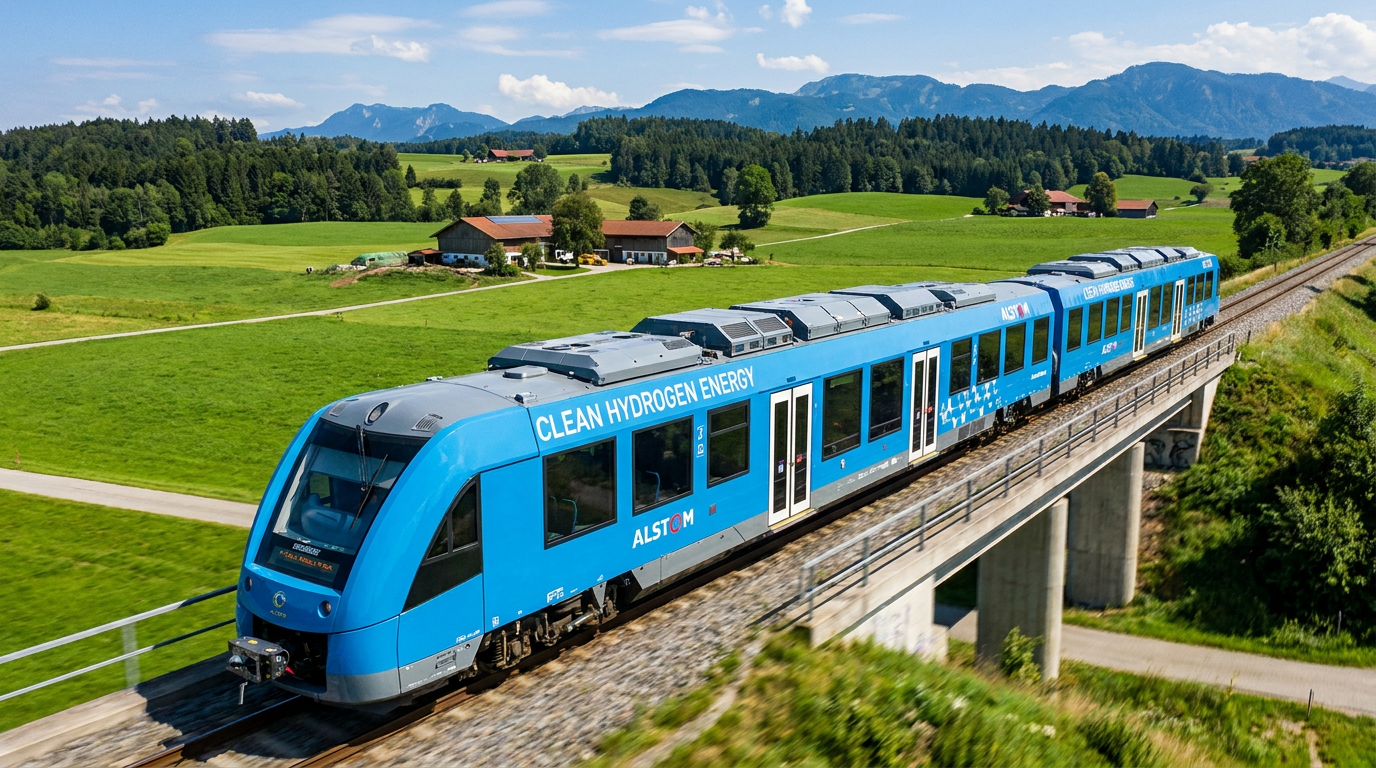
Enter "hydrail"—hydrogen-powered trains designed to bridge this gap. Over the past few years, models like Alstom's Coradia iLint and Siemens' Mireo Plus H have moved from concept to commercial reality, promising the smooth, quiet performance of an electric train without the need for overhead infrastructure.[3][6]
But how exactly does a hydrogen train work? The core mechanism is not combustion. Instead, these trains use hydrogen fuel cells, which generate electricity through a continuous electrochemical reaction.[2][3]
Inside the fuel cell, hydrogen gas—stored in high-pressure tanks on the train's roof—is combined with oxygen drawn from the ambient air. This process, essentially reverse electrolysis, splits the hydrogen molecules into electrons and protons.[1][2]
The electrons are forced through a circuit, creating an electrical current that drives the train's traction motors. The only byproduct of this entire process is water vapor and heat, completely eliminating the carbon dioxide, nitrogen oxides, and particulate matter associated with diesel engines.[1][2]

In practice, modern hydrogen trains are actually hydrogen-battery hybrids. The fuel cell provides a steady, continuous baseline of power, which is highly efficient for cruising at a constant speed.[1][4]
However, rail traction is highly dynamic. Trains require massive surges of energy to accelerate from a standstill or climb steep gradients. To handle these transient peaks, the fuel cell continuously charges an onboard lithium-ion or lithium-titanate battery.[1]
This battery pack also captures kinetic energy during regenerative braking, storing it for the next acceleration phase. By decoupling the fuel cell from the immediate, fluctuating demands of the throttle, the hybrid system maximizes the lifespan and efficiency of the fuel cells.[1][2]
This battery pack also captures kinetic energy during regenerative braking, storing it for the next acceleration phase.
The primary advantage of hydrogen over pure battery-electric trains is range and refueling speed. A hydrogen train can travel up to 1,000 kilometers on a single tank, matching the operational range of a traditional diesel locomotive.[3][7]
Refueling takes roughly 15 minutes, allowing the train to return to service almost immediately. For long rural routes or intensive timetables where trains cannot afford to sit idle for hours to recharge, hydrogen offers a seamless operational swap for diesel.[3][7]

Yet, the technology is not without its hurdles. The most significant challenge lies outside the train itself: the hydrogen supply chain. For hydrail to be truly green, the hydrogen must be produced via electrolysis powered by renewable energy, rather than extracted from fossil fuels.[1][2]
Currently, green hydrogen infrastructure is sparse, and transporting the fuel to rail depots adds logistical complexity and cost. In some early deployments, operators faced challenges securing reliable, cost-effective hydrogen supplies, prompting temporary returns to older diesel models.[5][6]
Maintenance is another critical factor. Hydrogen fuel cells are complex electrochemical devices that degrade over time. Manufacturers note that fuel cell stacks may require replacement every few years, depending on usage patterns.[4][7]
Furthermore, the high-pressure hydrogen storage tanks require rigorous safety inspections, adding to the lifecycle costs compared to the relatively simpler architecture of battery-electric trains.[7]
This has sparked a fierce technological rivalry between hydrogen and battery trains. On routes shorter than 80 to 100 kilometers, battery trains are increasingly winning out. They can charge rapidly at terminal stations or draw power from short stretches of overhead wires.[1][7]

Because battery trains avoid the energy losses associated with producing, compressing, and converting hydrogen, they are inherently more energy-efficient from "well to wheel."[1][7]
However, on long, continuous non-electrified lines, or in heavy-duty freight yard operations where locomotives run continuously, batteries simply cannot store enough energy without becoming prohibitively heavy. Here, hydrogen remains the premier zero-emission solution.[4][5]
Ultimately, the future of rail decarbonization is not a winner-take-all battle between hydrogen and batteries. Instead, it is about deploying the right tool for the right corridor. As both technologies mature, they will work in tandem to finally retire the diesel engine and push rail transport into a fully zero-emission era.[4][8]
How we got here
2016
Alstom unveils the Coradia iLint, the world's first hydrogen fuel cell passenger train.
2018
The first pre-production hydrogen trains enter passenger service in Germany.
2023
Siemens Mobility debuts the Mireo Plus H hydrogen demonstrator train.
2025
Freight operators like CPKC begin mainline testing of high-powered hydrogen locomotives.
Viewpoints in depth
Hydrogen Advocates
Argue that hydrogen is the only viable 1:1 replacement for diesel on long routes.
Proponents emphasize that hydrogen's high energy density allows trains to travel up to 1,000 kilometers on a single tank, matching the operational profile of diesel. They argue that for long rural routes or intensive timetables where trains cannot afford to sit idle for hours to recharge, hydrogen offers a seamless operational swap. Furthermore, they view rail as an ideal 'anchor customer' to justify the massive investments needed to build regional green hydrogen hubs.
Battery-Electric Proponents
Emphasize that battery trains are more energy-efficient and cheaper to maintain.
Critics of hydrogen point out that battery-electric trains are inherently more energy-efficient from 'well to wheel,' as they avoid the energy losses associated with producing, compressing, and converting hydrogen. They argue that on routes shorter than 100 kilometers, battery trains are the superior choice. Additionally, they highlight that hydrogen fuel cells require complex maintenance and frequent replacement, making battery trains cheaper over their lifecycle.
Freight Operators
Focus on the heavy-duty demands of freight and the logistical hurdles of hydrogen.
Freight operators acknowledge that batteries struggle with the immense weight and continuous energy demands of long-haul freight. While hydrogen shows promise for yard operations and local duty-cycles, industry leaders caution that the infrastructure costs and fuel logistics remain significant hurdles. They stress that until green hydrogen becomes cheaper and more widely available, diesel will remain difficult to displace on transcontinental freight routes.
What we don't know
- How quickly green hydrogen production and refueling infrastructure can scale to support widespread rail adoption.
- Whether future advancements in battery density will eventually encroach on hydrogen's long-range advantage.
Key terms
- Hydrail
- A broad term for any rail vehicle that uses hydrogen as a fuel source, typically via fuel cells.
- Fuel Cell
- An electrochemical device that combines hydrogen and oxygen to produce electricity, with water and heat as the only byproducts.
- Regenerative Braking
- A system that captures the kinetic energy usually lost during braking and stores it in a battery for later use.
- Green Hydrogen
- Hydrogen produced by splitting water via electrolysis, powered entirely by renewable energy sources like wind or solar.
Frequently asked
Do hydrogen trains burn fuel like a diesel engine?
No. Most hydrogen trains use fuel cells to generate electricity through a chemical reaction, rather than combusting the hydrogen.
Are hydrogen trains safe?
Yes. While hydrogen is highly flammable, the trains are designed with robust, high-pressure carbon-fiber tanks and advanced leak-detection systems that meet strict railway safety standards.
Why not just use battery trains?
Battery trains are excellent for shorter routes, but they struggle with the weight and energy requirements of long, continuous journeys where hydrogen's higher energy density excels.
Sources
Source coverage
8 outlets
3 viewpoints surfaced








[1]IlluminemHydrogen Infrastructure Developers
Hydrogen vs batteries: The future of zero-emission rail
Read on Illuminem →[2]TWI GlobalHydrogen Infrastructure Developers
How Do Hydrogen Powered Trains Work?
Read on TWI Global →[3]MDPICost & Efficiency Pragmatists
Hydrogen-Powered Trains: Technology, Safety, and Economic Perspectives
Read on MDPI →[4]RailmarketRail Vehicle Manufacturers
Siemens Mobility on the future of hydrogen and battery trains
Read on Railmarket →[5]Electric Hybrid Vehicle TechnologyCost & Efficiency Pragmatists
CSX evaluates hydrogen fuel cell and battery-electric locomotives
Read on Electric Hybrid Vehicle Technology →[6]Trains.comRail Vehicle Manufacturers
Hydrogen trains face infrastructure and operational hurdles
Read on Trains.com →[7]HydrogenInsightCost & Efficiency Pragmatists
Hydrogen trains are more complex to maintain than battery equivalents, warns Stadler
Read on HydrogenInsight →[8]Factlen Editorial TeamRail Vehicle Manufacturers
Synthesis by Factlen editorial team
Read on Factlen Editorial Team →
Every angle. Every day.
Get automotive stories with full source coverage and perspective breakdowns delivered to your inbox.