
How Deliberative Polling is Curing Political Polarization
A robust body of evidence demonstrates that when citizens are given balanced information and the space to discuss trade-offs, intractable partisan divisions consistently dissolve.
By Factlen Editorial Team
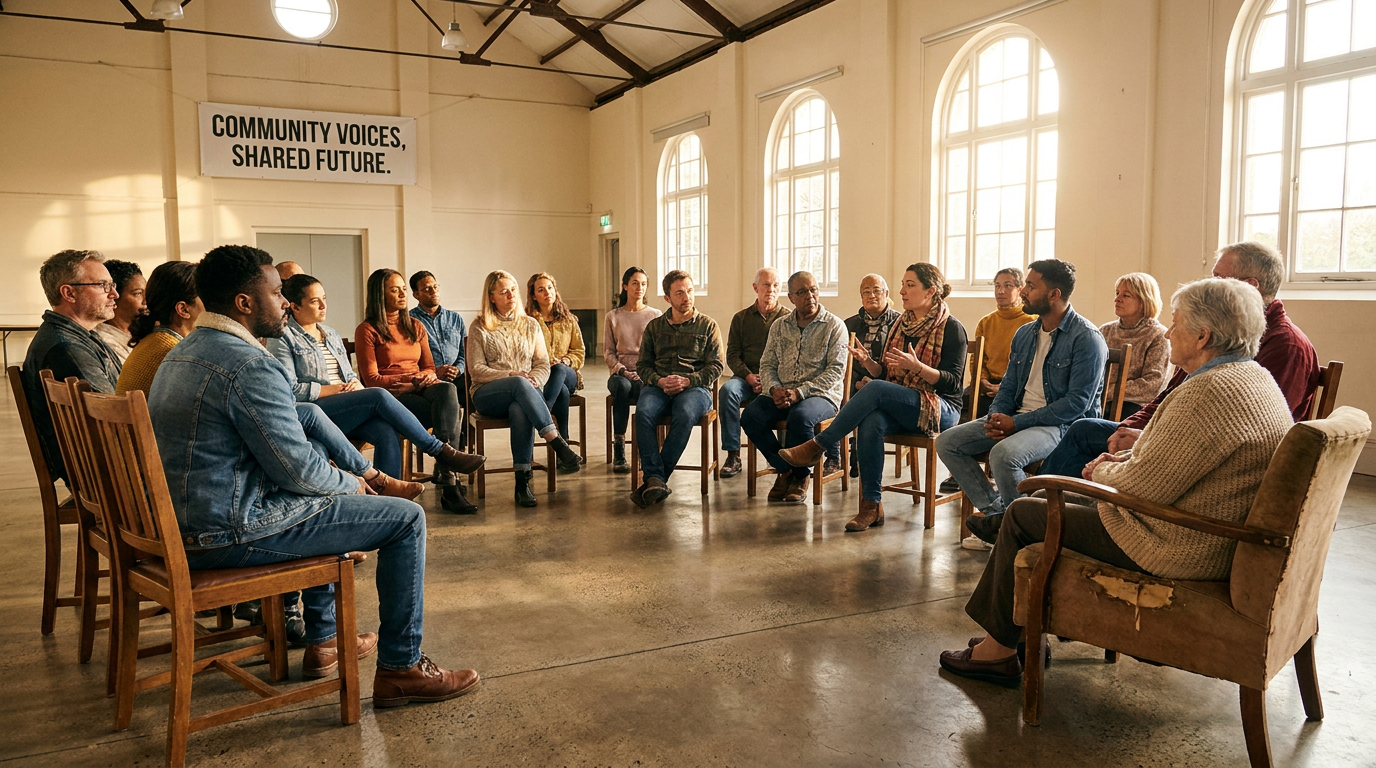
- Deliberative Democracy Advocates
- Argue that structured deliberation reveals the true, informed will of the people and is the antidote to partisan polarization.
- Institutional Policymakers
- View deliberative polling as a practical tool to gain public legitimacy for complex trade-offs and bypass legislative gridlock.
- Algorithmic Skeptics
- Warn that using AI to scale deliberation might artificially force consensus and erase the necessary friction of democratic disagreement.
What's not represented
- · Voters who refuse to participate in structured civic engagement
- · Partisan media executives who profit from affective polarization
Why this matters
Traditional polling often amplifies our deepest divisions by capturing uninformed, snap judgments. Deliberative polling offers a proven, scalable blueprint for curing political polarization by measuring what citizens actually want when they are given the facts and the space to listen to one another.
Key points
- Deliberative polling measures public opinion after citizens review balanced materials and discuss the issues.
- Empirical evidence shows the process significantly reduces affective polarization across party lines.
- Even in highly homogeneous groups, structured deliberation prevents ideological echo chambers from forming.
- The methodology provides policymakers with nuanced, actionable data rather than binary partisan demands.
- Recent initiatives are successfully scaling the process using digital platforms and AI-assisted moderation.
- Critics warn that using AI to force consensus could erase the productive friction necessary for democracy.
Traditional public opinion polling is facing a crisis of utility. Standard surveys capture snap judgments, often fueled by partisan media echo chambers, creating an illusion of intractable national division. These top-of-mind polls measure what citizens think when they are distracted, uninformed, or reacting to the latest outrage cycle, rather than capturing their considered beliefs.[7]
Over the last decade, a robust body of evidence has emerged supporting an alternative methodology known as Deliberative Polling. Pioneered by political scientists at Stanford University, the core premise is to measure what the public would think if they had the time, resources, and environment to deeply understand a complex issue.[1]
The methodology operates on a strict, multi-step protocol. It begins by recruiting a random, highly representative sample of the population and administering a baseline survey on a set of policy questions. This establishes the standard snapshot of public opinion that dominates traditional news cycles.[7]
The intervention then begins. Participants are provided with carefully balanced, vetted briefing materials that outline the strongest arguments for and against various policy proposals. They are subsequently brought together—either physically or virtually—for days of structured, focused engagement.[1]
During this gathering, citizens are placed in small, moderated groups to discuss the trade-offs of each policy. They then have the opportunity to question competing experts and policymakers directly. Finally, they take the exact same survey again in private. The delta between the baseline poll and the final poll is known as the deliberative effect.[1]

The evidence that structured deliberation reliably reduces affective polarization is exceptionally strong. In the 2025 "America in One Room: Pennsylvania" experiment, a representative sample of 175 registered voters was gathered to deliberate on 65 distinct policy proposals spanning local and national issues.[1]
The results demonstrated that when voters are given the space for informed, civil conversation, they consistently depolarize on issues that cable news narratives frame as hopeless partisan battles. Participants emerged with considered judgments and reported significantly greater respect for those with whom they disagreed, proving that the electorate's divisions are not as intractable as they appear.[1]
Crucially, this depolarizing effect holds even in highly homogeneous environments. A common fear in political science is the law of group polarization, which suggests that homogeneous groups naturally become more extreme when they talk to one another. However, peer-reviewed data indicates that structured deliberation bypasses this trap.[2]
A study published in the Michigan Journal of Community Service Learning analyzed a deliberative polling event involving hundreds of college students. Despite the sample being overwhelmingly liberal—a demographic prone to ideological echo chambers—participants demonstrated immense moderation potential.[2]
A study published in the Michigan Journal of Community Service Learning analyzed a deliberative polling event involving hundreds of college students.
The data revealed statistically significant drops in affective polarization across the board. Democrats in the study saw their affective polarization score drop by 4.3 points, while the smaller cohort of Republicans saw a 3.4-point decrease. The structured nature of the deliberation prevented the group from spiraling into ideological extremes.[2]

Beyond simply making citizens feel better about one another, deliberative polling produces actionable, nuanced policy rather than binary gridlock. Traditional public participation exercises, such as open town halls, are often adversarial and attract only the most vocal, uncompromising partisans.[3]
The Westminster Foundation for Democracy notes that deliberative processes, by contrast, create spaces for learning and the development of informed recommendations. Because the participants understand the trade-offs involved, they frequently support nuanced solutions rather than blanket bans or extreme mandates, giving policymakers the legitimacy to make hard choices.[3]
Historically, the primary weakness of deliberative polling was its cost and logistical complexity, but recent initiatives prove the model is successfully scaling through digital platforms. By moving the methodology online, researchers can reach thousands of citizens simultaneously without sacrificing the quality of the discourse.[4]
The Carnegie Endowment highlights the "Engaged California" program, deployed in 2025, which integrated digital deliberative tools to help citizens affected by wildfires shape government response and efficiency measures. The program successfully integrated learnings from citizens' assemblies across Europe and the United States.[4]

Similarly, a 2024 study by the Poverty Action Lab tested online civic education and out-group deliberation during the Mexican presidential election. The research found that digital delivery of these deliberative methods successfully increased participants' willingness to engage in pro-democratic behaviors, such as voting and volunteering as poll workers.[5]
However, there is significant uncertainty regarding whether artificial intelligence can safely moderate these democratic processes. As deliberative polling scales, developers have introduced AI-assisted moderation platforms, such as the experimental Habermas Machine, sparking intense debate over their democratic validity.[6]
Critics point out that AI systems are fundamentally optimization engines. In the case of the Habermas Machine, the algorithm was designed to synthesize group views and move participants toward agreement, treating consensus as the ultimate metric of a successful deliberation.[6]
Political scientists warn that this represents a dangerously narrow conception of democracy. Legitimate non-agreement and productive friction are essential components of a healthy public sphere. If an algorithm forces consensus, it risks silencing minority dissent and erasing the very trade-offs that deliberation is meant to highlight.[6]

Despite the uncertainties surrounding algorithmic moderation, the foundational evidence for human-centric deliberative polling is robust. It proves that the American electorate—and electorates globally—are not inherently intractable or hopelessly divided by nature.[7]
Instead, citizens are simply operating in an information architecture that currently rewards division. By institutionalizing deliberative practices, democracies have a proven, evidence-backed mechanism to replace reflexive outrage with informed consent, offering a highly optimistic path forward for civic engagement.[7]
How we got here
1988
Political scientist James Fishkin pioneers the concept of Deliberative Polling to address the shortcomings of traditional public opinion surveys.
2019
Stanford University hosts the first 'America in One Room' event, gathering over 500 voters to deliberate on major national issues.
2021
The 'Shaping Our Future' experiment demonstrates that deliberative polling can successfully depolarize highly homogeneous groups of college students.
2024
The Poverty Action Lab successfully tests online civic education and out-group deliberation during the Mexican presidential election.
2025
The 'America in One Room: Pennsylvania' experiment proves that voters can consistently depolarize on intractable state and national issues.
Viewpoints in depth
Deliberative Democracy Advocates
Researchers and civic organizations who believe structured deliberation is the cure for political polarization.
This camp, anchored by institutions like Stanford's Deliberative Democracy Lab, argues that traditional polling is fundamentally flawed because it measures snap judgments based on low information. They point to decades of empirical data showing that when citizens are given balanced briefing materials and the opportunity to discuss issues respectfully, they consistently moderate their views. To these advocates, the public is not inherently polarized; rather, the current media and political architecture incentivizes and amplifies division. Deliberative polling is seen as the necessary infrastructure to capture the 'considered will' of the electorate.
Algorithmic Skeptics
Technologists and political scientists warning against the automation of democratic consensus.
As deliberative polling attempts to scale globally using artificial intelligence, this camp raises significant ethical and structural concerns. They argue that AI models, such as the experimental Habermas Machine, are inherently optimization engines that treat consensus as the ultimate metric of success. Skeptics warn that democracy requires productive friction and that non-agreement is a perfectly legitimate outcome of public discourse. By using code to synthesize group views and push participants toward agreement, they fear that AI moderators will silently erase minority dissent and the vital trade-offs that make democratic deliberation meaningful.
What we don't know
- Whether the depolarizing effects of a deliberative poll persist months or years after the event concludes.
- How to incentivize mass participation in deliberative processes without offering significant financial compensation.
- Whether AI moderators can be programmed to safely manage democratic friction without artificially forcing consensus.
Key terms
- Deliberative Polling
- A public consultation method where a representative sample of citizens is surveyed on an issue both before and after engaging in structured, informed discussion.
- Affective Polarization
- The tendency of citizens to intensely dislike and distrust members of opposing political parties, regardless of specific policy disagreements.
- Law of Group Polarization
- A sociological theory suggesting that when people with similar views talk to one another, their opinions tend to become even more extreme.
- Sortition
- The use of random selection to populate an assembly or deliberative body, ensuring a statistically representative cross-section of the public.
Frequently asked
What is the difference between traditional polling and deliberative polling?
Traditional polling measures citizens' immediate, top-of-mind reactions to an issue, often when they have little background information. Deliberative polling measures what citizens think after they have reviewed balanced briefing materials, discussed the issue with peers, and questioned experts.
Does deliberative polling actually change people's minds?
Yes. Empirical studies consistently show that participants moderate their views and experience a significant decrease in affective polarization—meaning they harbor less animosity toward those in opposing political parties.
How are participants chosen for a deliberative poll?
Participants are selected through rigorous scientific random sampling to ensure the group accurately reflects the demographic, cultural, and political makeup of the broader population.
Can deliberative polling be done online?
Yes. While traditionally held in person over a weekend, recent experiments in California, Mexico, and at various universities have successfully utilized digital platforms to conduct deliberations at scale.
Sources
Source coverage
7 outlets
3 viewpoints surfaced






[1]Stanford UniversityDeliberative Democracy Advocates
America in One Room: Pennsylvania Results
Read on Stanford University →[2]Michigan Journal of Community Service LearningDeliberative Democracy Advocates
How College Students Can Depolarize: Evidence for Political Moderation Within Homogeneous Groups
Read on Michigan Journal of Community Service Learning →[3]Westminster Foundation for DemocracyDeliberative Democracy Advocates
Deliberative democracy can lead to better policy outcomes
Read on Westminster Foundation for Democracy →[4]Carnegie Endowment for International PeaceInstitutional Policymakers
Deliberating Democracy in California
Read on Carnegie Endowment for International Peace →[5]The Abdul Latif Jameel Poverty Action LabInstitutional Policymakers
Decreasing Polarization and Instilling Civic Values at Scale
Read on The Abdul Latif Jameel Poverty Action Lab →[6]Noema MagazineAlgorithmic Skeptics
Democracy Needs Friction To Function
Read on Noema Magazine →[7]Factlen Editorial Team
Synthesis by Factlen editorial team
Read on Factlen Editorial Team →
Every angle. Every day.
Get data analysis stories with full source coverage and perspective breakdowns delivered to your inbox.