
How Bidirectional Charging is Turning EVs into Mobile Power Plants
Vehicle-to-grid (V2G) and vehicle-to-home (V2H) technologies are reaching mainstream adoption in 2026, allowing electric vehicles to power houses and stabilize the electrical grid. This explainer breaks down how the technology works, the economic benefits for drivers, and the regulatory hurdles that remain.
By Factlen Editorial Team
- Grid Operators & Utilities
- Viewing EVs as a massive, distributed battery network to stabilize the grid.
- Consumer Advocates
- Focusing on energy independence, backup power, and household savings.
- Hardware & Auto Manufacturers
- Racing to standardize technology and monetize new energy services.
What's not represented
- · Fossil fuel peaker plant operators
- · Apartment dwellers without dedicated home charging
Why this matters
For decades, cars have been depreciating assets that sit idle 95% of the time. Bidirectional charging flips that equation, allowing consumers to use their vehicles as massive home backup batteries during outages and potentially earn passive income by selling stored energy back to the grid.
Key points
- Bidirectional charging allows EVs to send stored energy back to homes (V2H) or the electrical grid (V2G).
- Major automakers are making bidirectional capabilities a standard feature on new 2026 models.
- A typical electric truck holds nearly ten times the energy of a standard stationary home battery.
- Grid operators can aggregate plugged-in EVs into 'Virtual Power Plants' to prevent blackouts during peak demand.
- Hardware costs and utility regulations remain the primary hurdles to widespread consumer adoption.
For decades, the personal automobile has been a depreciating asset that sits parked and idle for roughly 95 percent of its life. But the transition to electric vehicles is fundamentally altering that equation. An EV is not just a mode of transportation; it is a massive, high-capacity lithium-ion battery on wheels. Until recently, the flow of electricity into those batteries has been a one-way street. Now, a technological shift known as bidirectional charging is turning those idle vehicles into mobile power plants capable of running homes, powering job sites, and stabilizing the global electrical grid.[9]
The year 2026 marks a tipping point for this technology. What was once a niche feature relegated to a handful of flagship models and pilot programs is rapidly becoming a standard industry specification. Major automakers, including Tesla, General Motors, Ford, and Kia, are rolling out bidirectional capabilities across their broader EV lineups. As the hardware reaches critical mass, consumers and utility companies alike are waking up to the realization that the millions of EVs hitting the roads represent a vast, untapped distributed energy resource.[2][6]
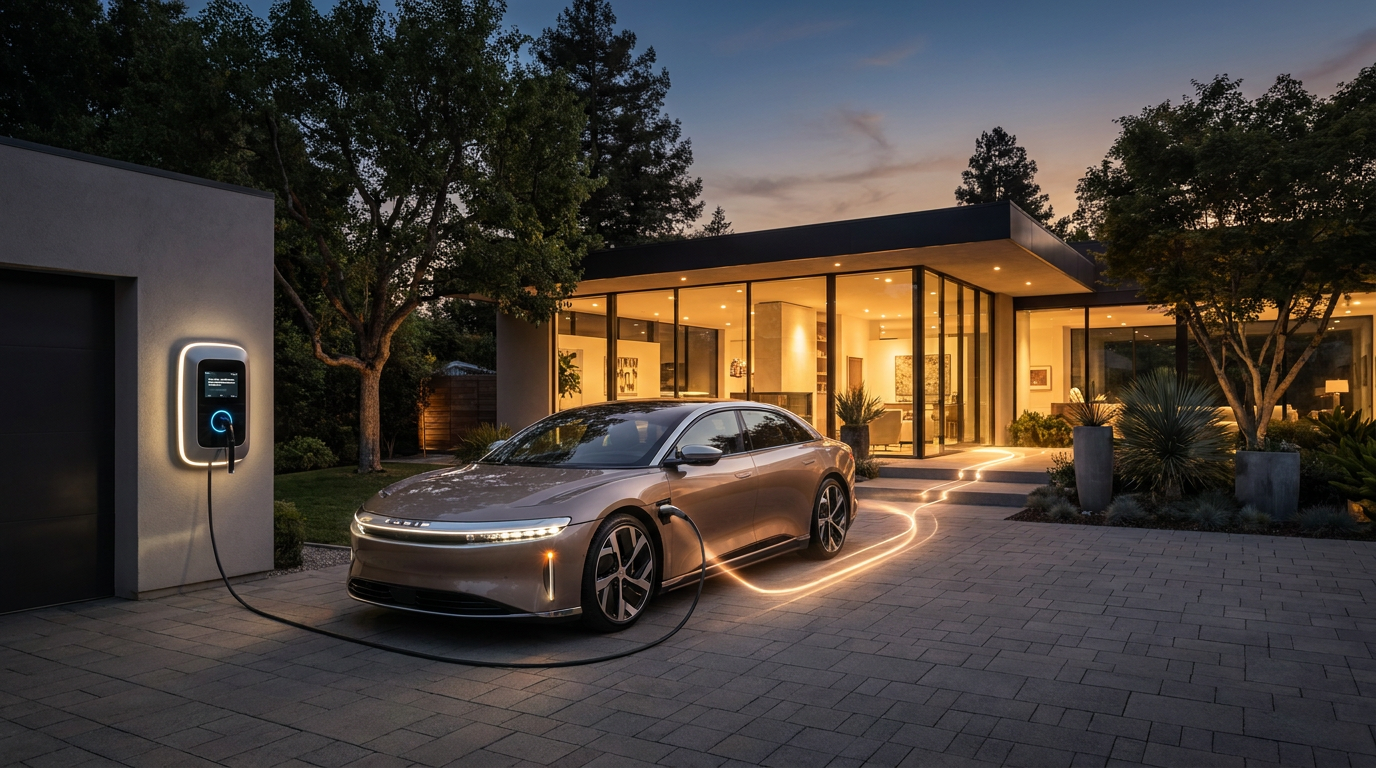
At its core, bidirectional charging is exactly what it sounds like: the ability to move electricity in two directions. Traditional, unidirectional EV chargers act simply as a hose, taking alternating current (AC) from the grid and passing it to the vehicle. The car's onboard converter then changes that AC power into direct current (DC) to store it in the battery. To reverse that flow, the energy must be pulled out of the battery and converted back into AC power that a home's electrical panel or the broader grid can actually use.[3]
This requires specialized hardware. Bidirectional chargers contain sophisticated internal inverters that handle the DC-to-AC conversion outside the vehicle. They also require an automatic transfer switch or a smart home gateway. This gateway acts as a traffic cop; if the broader power grid goes down, the switch physically isolates the house from the utility lines. This ensures that the power flowing from the car into the home doesn't back-feed into the neighborhood grid, which could electrocute utility workers trying to repair the lines.[3][5]

The technology is generally categorized into three distinct use cases, often grouped under the umbrella term "V2X" (Vehicle-to-Everything). The simplest is Vehicle-to-Load (V2L), which uses built-in outlets on the car itself to power individual appliances, power tools, or camping equipment directly from the vehicle's battery. While convenient, V2L does not integrate with a building's electrical system.[4][6]
The most immediate and tangible benefit for consumers is Vehicle-to-Home (V2H). In a V2H setup, the EV acts as a whole-home backup generator. When a storm knocks out the power, the bidirectional charger automatically detects the drop in grid voltage and seamlessly switches the house over to the car's battery. For homeowners living in areas prone to rolling blackouts or severe weather, this provides profound energy security without the noise and emissions of a gas generator.[4][6]
The sheer scale of energy stored in an EV dwarfs traditional home backup solutions. A standard stationary home battery, such as a Tesla Powerwall, holds roughly 13.5 kilowatt-hours (kWh) of energy—enough to run a house for about eight to twelve hours. By contrast, a large electric pickup truck like the Ford F-150 Lightning boasts a 131 kWh battery. That single vehicle can back up a typical American home for three to ten days, depending on usage and climate control needs.[5]

The sheer scale of energy stored in an EV dwarfs traditional home backup solutions.
The third and most ambitious application is Vehicle-to-Grid (V2G). While V2H isolates the home, V2G synchronizes the vehicle with the local utility company, allowing the car to push stored electricity back into the public grid during times of peak demand. This transforms the EV from a passive consumer of electricity into an active participant in the energy market.[1][4]
For grid operators, V2G is a game-changer. Electricity must be consumed the exact second it is generated, making grid management a constant, high-stakes balancing act. When demand spikes—such as during a summer heatwave when millions of air conditioners turn on simultaneously—utilities traditionally fire up expensive, highly polluting natural gas "peaker" plants. With V2G, utilities can instead draw a small amount of power from thousands of plugged-in EVs simultaneously. This network of cars acts as a "Virtual Power Plant" (VPP), instantly injecting clean energy into the grid to prevent blackouts.[1][8]
V2G also solves one of the biggest hurdles in the renewable energy transition: the intermittency of solar and wind power. Solar panels generate the most electricity in the middle of the day, precisely when demand is relatively low and most cars are parked at offices or in driveways. EVs can soak up this abundant, cheap solar energy during the day. Then, when the sun sets and evening demand peaks, those same cars can discharge that stored green energy back to the grid.[2][4]
For the EV owner, participating in V2G or V2H programs unlocks significant economic benefits through energy arbitrage. Drivers can program their smart chargers to buy electricity from the grid in the middle of the night when rates are rock-bottom. During the expensive evening peak, the home runs entirely off the car's battery, or the owner sells the stored power back to the utility at a premium. Over time, these daily micro-transactions can substantially offset the cost of charging the vehicle.[1][5]

Despite the immense promise, mass adoption still faces significant hurdles in 2026. The upfront hardware costs remain a barrier. Installing a bidirectional charger and the necessary home transfer equipment currently costs between $1,500 and $8,000, depending on the home's existing electrical panel. While government incentives, such as the U.S. Section 30C tax credit offering up to $1,000 for charger installations, help soften the blow, the initial investment is still steep for the average consumer.[5]
Regulatory red tape also continues to slow deployment. In many regions, the technology has been trapped in "pilot purgatory." For example, out of 1.65 million registered EVs in Germany in early 2025, only an estimated 166,000 were capable of bidirectional charging, and participation was heavily penalized by double grid fees that charged owners both when they pulled power and when they pushed it back. Utilities must also individually approve grid-tied systems, leading to a patchwork of local regulations that complicates nationwide rollouts.[7]
Furthermore, consumers frequently voice concerns about battery degradation. Lithium-ion batteries degrade based on the number of charge and discharge cycles they endure. Owners worry that using their $50,000 vehicle to stabilize the neighborhood grid will prematurely wear out the battery and void the warranty. To combat this, automakers and software providers are implementing strict battery management protocols. These systems limit V2G discharges to a shallow percentage of the battery's total capacity, ensuring that grid participation has a negligible impact on the vehicle's long-term lifespan and driving range.[5][9]

To ensure seamless communication between the vehicle, the charger, and the grid, the industry is rallying around a universal digital standard known as ISO 15118-20. This protocol acts as a secure digital handshake, allowing the hardware to negotiate power flows and financial transactions automatically. Mandates requiring this standard on new public and private chargers are set to take effect across key markets in 2027, laying the final groundwork for a fully interoperable ecosystem.[5][7]
As these regulatory and technical barriers fall, the line between the automotive industry and the energy sector is permanently blurring. Bidirectional charging is proving that the electric vehicle transition is not just about replacing the internal combustion engine; it is about fundamentally rewiring how society generates, stores, and consumes power. By turning millions of parked cars into a dynamic, distributed energy network, V2G technology is paving the way for a more resilient, efficient, and renewable electrical grid.[8][9]
How we got here
2022
Ford launches the F-150 Lightning with Intelligent Backup Power, bringing V2H to the mainstream US market.
2024
France becomes the first country to enable commercial V2G technology, allowing Renault 5 owners to sell surplus power.
Jan 2025
Germany reports 166,000 EVs capable of bidirectional charging, though regulatory hurdles limit grid participation.
2026
Major automakers begin rolling out bidirectional charging as a standard feature across their EV lineups.
Jan 2027
Upcoming mandate requires all newly installed public chargers in key European markets to support ISO 15118-20 for bidirectional communication.
Viewpoints in depth
Grid Operators & Utilities
Viewing EVs as a massive, distributed battery network to stabilize the grid.
For utility companies, the transition to renewable energy presents a massive storage problem: solar produces too much power midday and not enough during the evening peak. Grid operators view bidirectional EVs as a decentralized solution. By aggregating thousands of plugged-in cars into 'Virtual Power Plants' (VPPs), utilities can tap into gigawatts of stored energy instantly, reducing the need to fire up expensive and polluting natural gas peaker plants. Their primary focus is establishing the software protocols and regulatory frameworks to control this energy flow safely.
Consumer Advocates
Focusing on energy independence, backup power, and household savings.
Consumer groups champion bidirectional charging as a tool for household resilience. With extreme weather driving an increase in power outages, Vehicle-to-Home (V2H) technology offers a lifeline, allowing families to keep refrigerators running and lights on for days without buying a separate, expensive home battery or a noisy gas generator. Furthermore, advocates emphasize the financial benefits of energy arbitrage—buying cheap off-peak power and running the house off the car during expensive peak hours—effectively lowering the total cost of EV ownership.
Hardware & Auto Manufacturers
Racing to standardize technology and monetize new energy services.
Automakers are shifting from simply selling cars to becoming energy management companies. By making bidirectional hardware standard, companies like Ford, GM, and Tesla are adding immense value to their vehicles. However, manufacturers are also cautious about battery warranties. Because frequent discharging to the grid (V2G) increases the number of cycles a battery endures, automakers are implementing strict software limits to ensure that grid participation doesn't prematurely degrade the vehicle's primary function as transportation.
What we don't know
- How quickly local utility companies will standardize the approval process for grid-tied bidirectional chargers.
- The exact long-term impact of daily V2G cycling on the lifespan of next-generation solid-state EV batteries.
Key terms
- Bidirectional Charging
- Technology that allows an electric vehicle charger to both send power to the car's battery and pull power from it.
- V2H (Vehicle-to-Home)
- A setup where an electric vehicle discharges its battery to power a single house, typically during an outage or peak pricing hours.
- V2G (Vehicle-to-Grid)
- A system where electric vehicles send stored energy back into the broader electrical grid to help utilities balance supply and demand.
- Inverter
- A device inside a bidirectional charger that converts the direct current (DC) from the car's battery into the alternating current (AC) used by homes and the grid.
- Virtual Power Plant (VPP)
- A cloud-based network of decentralized energy resources—like thousands of plugged-in EVs—that work together to supply power to the grid just like a traditional power plant.
- ISO 15118-20
- The international digital communication standard that allows electric vehicles and charging stations to securely negotiate bidirectional power flow.
Frequently asked
Will bidirectional charging degrade my EV battery?
Frequent charging and discharging can add wear to a battery. However, automakers use advanced battery management software to limit the depth of discharge during V2G operations, protecting the battery's lifespan and ensuring warranty compliance.
Can any electric vehicle power my home?
No. Both the vehicle and the charger must be specifically designed for bidirectional charging. While it is becoming a standard feature on new 2026 models, older EVs generally only support one-way charging.
Do I need a special charger for this?
Yes. You need a bidirectional charger equipped with a DC-to-AC inverter, as well as an automatic transfer switch installed on your home's electrical panel to safely isolate your house from the grid during an outage.
How long can an EV power a house?
A large electric truck with a 131 kWh battery can power an average home for 3 to 10 days, depending on energy usage and whether the home also has solar panels.
Sources
Source coverage
9 outlets
3 viewpoints surfaced









[1]Clean Energy ReviewsGrid Operators & Utilities
V2G Explained - Benefits of Vehicle-to-grid Technology
Read on Clean Energy Reviews →[2]DriivzHardware & Auto Manufacturers
How Does Bidirectional Charging Work?
Read on Driivz →[3]WallboxHardware & Auto Manufacturers
What is Bidirectional Charging and How Does it Work?
Read on Wallbox →[4]Solar ChoiceConsumer Advocates
Bidirectional EV Chargers Available in Australia (2026)
Read on Solar Choice →[5]NuWatt EngineeringConsumer Advocates
Bidirectional EV Charging & V2H in 2026: Can Your EV Replace a Home Battery?
Read on NuWatt Engineering →[6]EcoFlowConsumer Advocates
Bidirectional Charging: Integrating V2H with Home Energy
Read on EcoFlow →[7]ENV VCGrid Operators & Utilities
V2G in 2026: The Barriers That Remain After the Regulatory Breakthrough
Read on ENV VC →[8]NuvveGrid Operators & Utilities
2026 Outlook: Vehicle-to-Grid (V2G) technology
Read on Nuvve →[9]Factlen Editorial TeamHardware & Auto Manufacturers
Synthesis by Factlen editorial team
Read on Factlen Editorial Team →

More in transportation
See all 8 stories →Orbital Logistics
The Rise of the Space Tug: How Last-Mile Logistics is Revolutionizing Orbit
6 sources

Wind Propulsion
Cargo Ships Are Returning to Wind Power to Slash Global Emissions
8 sources

Hydrail Tech
How Hydrogen Trains Work and the Race to Decarbonize Global Rail
6 sources
Aircraft Design
The End of the Tube-and-Wing: How Blended-Wing Aircraft Are Reshaping Aviation
7 sources
Every angle. Every day.
Get transportation stories with full source coverage and perspective breakdowns delivered to your inbox.