
How AI Tutors Actually Work: The Evidence Behind Personalized Learning in 2026
Generative AI tutoring platforms have moved from experimental novelties to mainstream educational tools. Empirical data now reveals exactly where they excel—and why they still need human teachers.
By Factlen Editorial Team
- EdTech Innovators
- Advocates focused on scaling personalized learning and democratizing access to tutoring.
- Pedagogical Realists
- Educators emphasizing the irreplaceable social and emotional dimensions of human teaching.
- Empirical Researchers
- Academics focused on measurable outcomes and the efficacy of hybrid instructional models.
What's not represented
- · Students with learning disabilities
- · Data privacy advocates
Why this matters
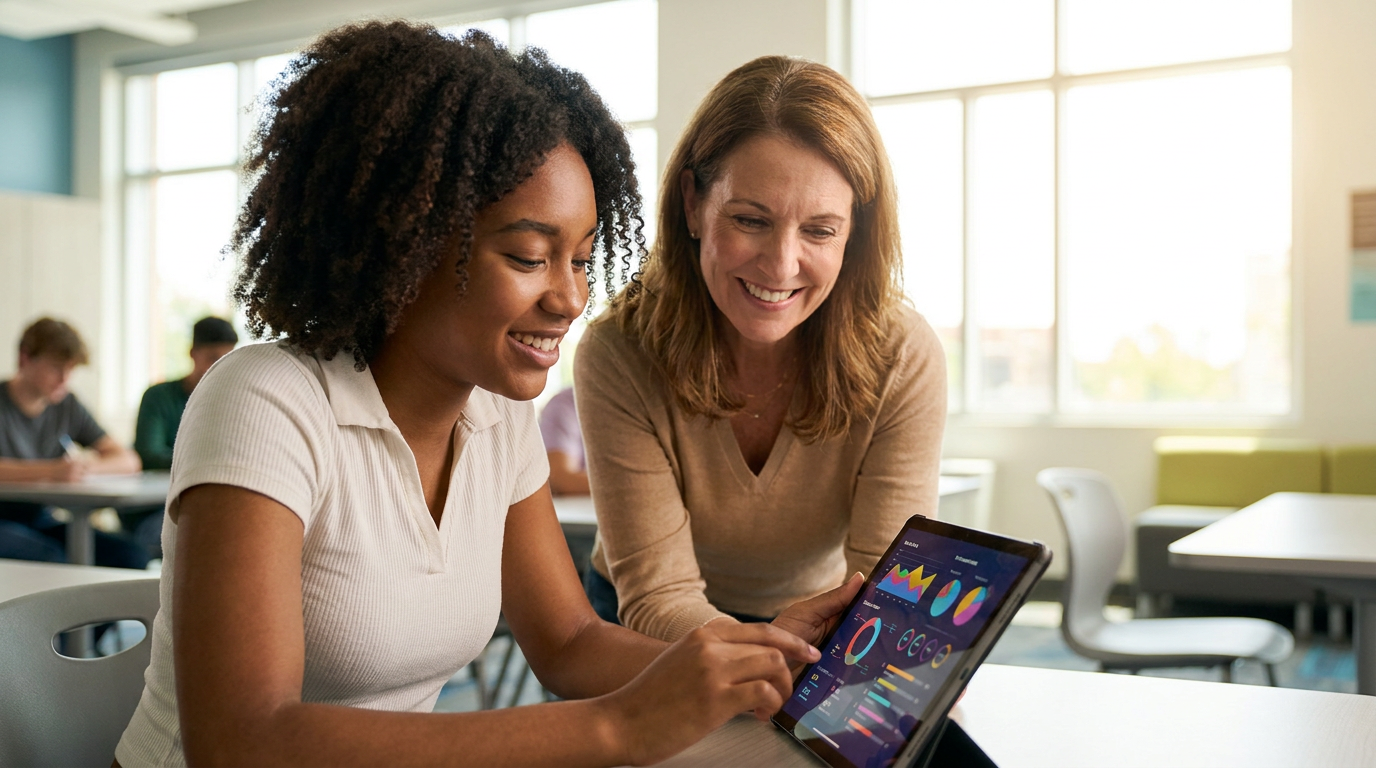
One-on-one tutoring has historically been the most effective way to learn, but its high cost made it inaccessible to most. Generative AI is finally democratizing this personalized support, fundamentally changing how students master complex subjects and how teachers manage their classrooms.
Key points
- Generative AI tutors have evolved from simple chatbots into sophisticated platforms that use Socratic dialogue to guide students.
- Empirical studies show AI tutoring systems produce learning gains comparable to traditional instructional methods.
- Educational researchers note that AI effectively handles the procedural and factual aspects of learning, which comprise about 16 percent of the educational process.
- The remaining 84 percent of learning—including social sense-making, empathy, and metacognition—requires human teachers.
- The most effective educational outcomes occur in hybrid models where AI handles repetitive drilling and humans provide emotional and pedagogical support.
The scale of generative AI in education has quietly shifted from experimental pilot programs to massive, systemic integration. By the 2024–2025 school year, platforms like Khan Academy's Khanmigo had expanded from 68,000 to over 700,000 student and teacher users across the United States. Simultaneously, in resource-constrained environments like India, AI tutoring platforms reached approximately 170,000 teachers and 200,000 students in less than a year. The initial panic over AI as a high-tech cheating mechanism has largely subsided, replaced by a nuanced understanding of how these tools can personalize learning at an unprecedented scale.[1][5][7]
To understand the significance of this shift, one must look back to 1984, when educational psychologist Benjamin Bloom identified the "2 sigma problem." Bloom discovered that average students who received one-on-one tutoring performed two standard deviations better than students in conventional classrooms—meaning an average tutored student outperformed 98 percent of their conventionally taught peers. The barrier to achieving this universally was always cost and scale. Generative AI is now attempting to bridge that historical gap by offering individualized instructional support at zero marginal cost.[1][2]
Modern AI tutors function very differently from the early, highly publicized chatbots that simply spat out essays and answers. The 2026-era platforms are explicitly engineered around Socratic dialogue. They are programmed to withhold direct solutions, instead asking guiding questions, identifying specific misconceptions in a student's logic, and forcing the learner to articulate their reasoning before moving forward.[1][7]

This mechanism of adaptive learning relies on real-time data analysis. These systems track a student's response times, error patterns, and engagement levels. If a student consistently struggles with unlike denominators in fractions, the AI dynamically scaffolds the problem. It might offer visual aids, break the concept into smaller, more digestible steps, or provide a targeted mini-lesson before allowing the student to progress to mixed operations.[1][2]
Theoretical optimism is now being backed by rigorous empirical efficacy data. A recent mixed-methods study published in the Journal of Teaching and Learning evaluated undergraduate physics students using AI tutors to learn complex scientific concepts. The quantitative analysis revealed significant learning gains across the board, with the AI tutoring system demonstrating an effect size (d=0.76) that is highly comparable to traditional instructional methods.[2]
Further empirical backing comes from global trials focused on diverse subjects. A World Bank study deploying AI chatbots to help senior secondary students learn English over a six-week period recorded a 0.31 standard deviation improvement in overall performance. These metrics confirm that when properly constrained and aligned with a structured curriculum, generative models can reliably drive academic achievement.[6]

However, as the technology matures, educational researchers are becoming increasingly precise about what AI tutors actually teach. Educational scientists note that current AI systems excel at delivering academic content, drilling factual knowledge, and guiding students through established procedures. Yet, this represents only a fraction of the holistic educational experience required to develop a capable human mind.[1][4]
However, as the technology matures, educational researchers are becoming increasingly precise about what AI tutors actually teach.
According to the CAPITAL framework of learning, AI tutors effectively support about 16 percent of the distinct acts through which real learning happens. They handle personal acts like rehearsal, basic exposition, and immediate feedback brilliantly. But they cannot model what it means to wrestle with the provisional nature of knowledge, nor can they develop a student's emotional regulation to persist through genuine intellectual difficulty.[4]
The remaining 84 percent of learning relies heavily on human intelligence and interaction. This vast domain includes social sense-making, metacognitive awareness—knowing what one does and does not know—and epistemological sophistication. An AI cannot teach a student to debate conflicting evidence with peers because it does not truly understand what evidence is, nor does it possess the lived experience required for genuine empathy.[4]

Because of these fundamental limitations, the most successful deployments of AI in education are strictly hybrid. Researchers at Stanford University have found that students use AI platforms far more effectively when a human educator is alongside them to provide emotional and pedagogical support. Autonomous usage often results in lower engagement, particularly for students who lack strong self-regulation skills.[3]
A randomized controlled trial in the United Kingdom, involving over 150 students across five schools, tested this exact dynamic. When students were assisted by a generative AI model but guided by human tutors who fine-tuned the Socratic approach, they were 5.5 percentage points more likely to solve novel mathematics problems than those supported by human tutors alone.[6]
In these hybrid environments, the technology acts as a powerful force multiplier for the teacher rather than a replacement. By offloading repetitive instructional demands, basic grading, and immediate procedural feedback to the AI, educators are freed to focus on high-value interventions. Teachers can dedicate their time to small-group instruction, complex problem-solving, and the emotional mentorship that algorithms cannot provide.[1][5][8]
This dynamic is also reshaping corporate and adult education. In professional environments, AI tutors provide "just-in-time" learning tailored to immediate workflow needs. An employee needing to master a new software tool or understand a complex regulatory requirement can engage with a conversational tutor 24/7, accelerating the time-to-competency far more efficiently than traditional, static training modules.[1]

The integration of visual inputs has further expanded the utility of these systems across all age groups. Recent updates to platforms like Khanmigo allow students to upload images of their work, enabling the AI to interact with visual representations in real-time. This capability is critical for subjects like geometry, physics, or architectural design, where spatial reasoning and diagrammatic analysis are essential.[7]
Despite the promising data, challenges remain regarding student engagement and digital literacy. Educational leaders note that the effectiveness of any tutoring system depends entirely on the student using it correctly. While highly motivated students thrive with AI, those lacking foundational self-regulation often struggle to maintain focus without the accountability provided by human oversight.[2][7]
Ultimately, the 2026 landscape of AI tutoring proves that technology can successfully democratize access to personalized, step-by-step academic support. By treating AI as a highly capable assistant for the procedural aspects of learning, the education sector is finally moving closer to solving the scale problem of one-on-one instruction, while simultaneously reaffirming the irreplaceable value of human teachers.[1][3][4]
How we got here
1984
Educational psychologist Benjamin Bloom identifies the '2 sigma problem', showing 1-on-1 tutoring dramatically improves student performance.
Late 2022
The public launch of ChatGPT introduces scalable generative AI to the general public, sparking initial fears of widespread academic cheating.
2023-2024
EdTech platforms like Khan Academy launch specialized, Socratic AI tutors designed to guide rather than give answers.
2025-2026
Empirical studies confirm AI tutors provide significant learning gains, while highlighting the necessity of hybrid human-AI models.
Viewpoints in depth
EdTech Innovators
Advocates focused on scaling personalized learning and democratizing access to tutoring.
This camp views generative AI as the ultimate solution to Benjamin Bloom's '2 sigma problem'—the historical barrier of providing affordable one-on-one instruction to every student. By driving the marginal cost of personalized tutoring to zero, innovators argue that AI can level the educational playing field globally. They point to rapid adoption metrics, such as Khanmigo's expansion to hundreds of thousands of students across the US and India, as proof that scalable, Socratic AI is both viable and highly demanded by resource-constrained public education systems.
Pedagogical Realists
Educators emphasizing the irreplaceable social and emotional dimensions of human teaching.
Realists caution against technological solutionism, arguing that education is fundamentally a human endeavor. Drawing on frameworks like the CAPITAL model of learning, they highlight that AI tutors only address the procedural and factual components of education—roughly 16 percent of how humans actually learn. They argue that critical skills like epistemological sophistication, debating conflicting evidence, and emotional regulation during intellectual struggle require a human teacher who possesses genuine empathy and lived experience.
Empirical Researchers
Academics focused on measurable outcomes and the efficacy of hybrid instructional models.
Rather than engaging in philosophical debates about AI versus humans, this group focuses strictly on the data. Empirical studies consistently show that AI tutors produce moderate to significant learning gains (effect sizes around d=0.76) when used correctly. However, researchers emphasize that the highest academic achievements occur in hybrid models. When AI handles repetitive drilling and immediate feedback, and human teachers provide overarching pedagogical strategy and emotional support, students demonstrate the highest rates of solving novel, complex problems.
What we don't know
- How long-term reliance on AI tutors will affect students' independent problem-solving skills over a multi-year period.
- Which specific student demographics and learning profiles benefit the most from autonomous AI tutoring versus human-led intervention.
- How the widespread adoption of AI tutors will permanently alter the daily workflow and job description of traditional classroom teachers.
Key terms
- Generative AI
- Artificial intelligence capable of creating new text, images, or code based on patterns learned from vast training data.
- Socratic Dialogue
- A pedagogical method where the teacher (or AI) asks a series of probing questions to lead the student to discover the answer independently.
- Effect Size (d)
- A statistical metric used in educational research to quantify the magnitude of a difference in learning outcomes between two groups.
- Metacognition
- The awareness and understanding of one's own thought processes; essentially, 'thinking about thinking.'
- 2 Sigma Problem
- An educational phenomenon identified in 1984 showing that students who receive one-on-one tutoring perform two standard deviations better than those in traditional classrooms.
Frequently asked
Can AI tutors replace human teachers?
No. Research shows AI tutors are highly effective for drilling facts and procedures, but they lack the empathy, social sense-making, and metacognitive modeling that human teachers provide.
Do AI tutors just give students the answers?
Modern educational AI platforms are explicitly programmed to use Socratic dialogue. They withhold direct answers and instead ask guiding questions to help students arrive at the solution themselves.
Are AI tutors effective for complex subjects like physics?
Yes. Recent studies show that AI tutoring systems can produce significant learning gains in undergraduate physics, demonstrating effect sizes comparable to traditional instructional methods.
Sources
Source coverage
8 outlets
3 viewpoints surfaced







[1]Factlen Editorial TeamEdTech Innovators
Synthesis by Factlen editorial team
Read on Factlen Editorial Team →[2]Journal of Teaching and LearningEmpirical Researchers
Leveraging 'Khanmigo' Generative AI-Powered Tool for Personalized Tutoring to Learn Scientific Concepts
Read on Journal of Teaching and Learning →[3]Stanford UniversityPedagogical Realists
Understanding disruptions: Causes of and variation in lost instructional time
Read on Stanford University →[4]Social Science SpacePedagogical Realists
AI Tutors Support 16 Percent of Learning. What About the Other 84 Percent?
Read on Social Science Space →[5]AI Impact CommonsEmpirical Researchers
Khanmigo - AI to augment teaching and student learning
Read on AI Impact Commons →[6]TuritoEdTech Innovators
Is an online AI tutor as effective as a human tutor?
Read on Turito →[7]MediumEdTech Innovators
Developing the Khan Academy's AI tutor Khanmigo
Read on Medium →[8]TeachBetterPedagogical Realists
TeachBetter.ai — AI for Teachers, Students & Schools
Read on TeachBetter →
More in education
See all 28 stories →Retirement Policy
How SECURE 2.0 Allows Employers to Match Student Loan Payments With 401(k) Contributions
9 sources

Direct Admissions
Direct Admissions Programs Expand Nationwide, Flipping the College Application Process
8 sources
Learning Science
The Science of Effective Learning: How Active Recall and Spaced Repetition Rewire the Brain
7 sources

Green Collar Trades
The Green Collar Boom: How Vocational Training is Powering the Clean Energy Transition
9 sources
Every angle. Every day.
Get education stories with full source coverage and perspective breakdowns delivered to your inbox.