
How AI is Decoding the Hidden Languages of Earth's Animals
Breakthroughs in machine learning are allowing scientists to identify phonetic alphabets and complex grammar in the vocalizations of sperm whales, belugas, and birds. By applying foundational AI models to bioacoustics, researchers are moving closer to understanding non-human intelligence and revolutionizing wildlife conservation.
By Factlen Editorial Team
- Bioacoustics & AI Researchers
- Focus on the data-driven discovery of complex syntax and structure in animal calls.
- Conservation Advocates
- Focus on utilizing communication insights to protect habitats and mitigate human impact on wildlife.
- Linguistics & Ethics Scholars
- Caution against assuming human-like semantics and warn of the ethical risks of translation technology.
What's not represented
- · Indigenous communities with traditional ecological knowledge of these species
- · Commercial fishing and shipping industries whose operations might be regulated by new bioacoustic findings
Why this matters
Decoding animal communication could fundamentally shift humanity's relationship with the natural world. Beyond the profound philosophical implications, these AI breakthroughs offer actionable tools to monitor ecosystem health, protect endangered species, and potentially establish legal rights for non-human intelligence.
Key points
- Interdisciplinary teams are applying large language model architectures to vast datasets of animal audio.
- Project CETI researchers have identified a highly structured 'phonetic alphabet' in the clicks of sperm whales.
- The Earth Species Project is developing NatureLM-audio, a foundational model for cross-species bioacoustics.
- AI tools are successfully isolating individual animal voices from noisy environments, solving the 'cocktail party problem'.
- Scientists are beginning to test synthetic, AI-generated calls on wild populations to validate their models.
- Linguists caution that discovering complex syntax does not automatically prove the existence of human-like meaning.
For centuries, humans have listened to the haunting songs of whales and the intricate melodies of birds, wondering what information might be hidden within those acoustic waves. Until recently, the sheer volume and complexity of these vocalizations made it impossible to decode them at scale, leaving researchers to rely on painstaking manual observation. Today, the landscape of bioacoustics is undergoing a seismic transformation. Artificial intelligence is providing scientists with the mathematical tools required to process, categorize, and analyze animal communication with unprecedented precision. By treating the natural world as a vast dataset, researchers are beginning to uncover hidden structures that challenge our fundamental understanding of non-human intelligence.[6]
The catalyst for this revolution is the rapid advancement of machine learning, specifically the architectures that power large language models. Just as these systems learn the statistical relationships between human words by ingesting massive amounts of text, they can be trained to recognize patterns in audio recordings of animal calls. Interdisciplinary teams of computer scientists, marine biologists, and linguists are now applying these neural networks to terabytes of bioacoustic data. This data-driven approach allows algorithms to identify structural axes of communication that cut across different species, moving the field away from hypothesis-limited studies and toward a new era of automated discovery.[4]
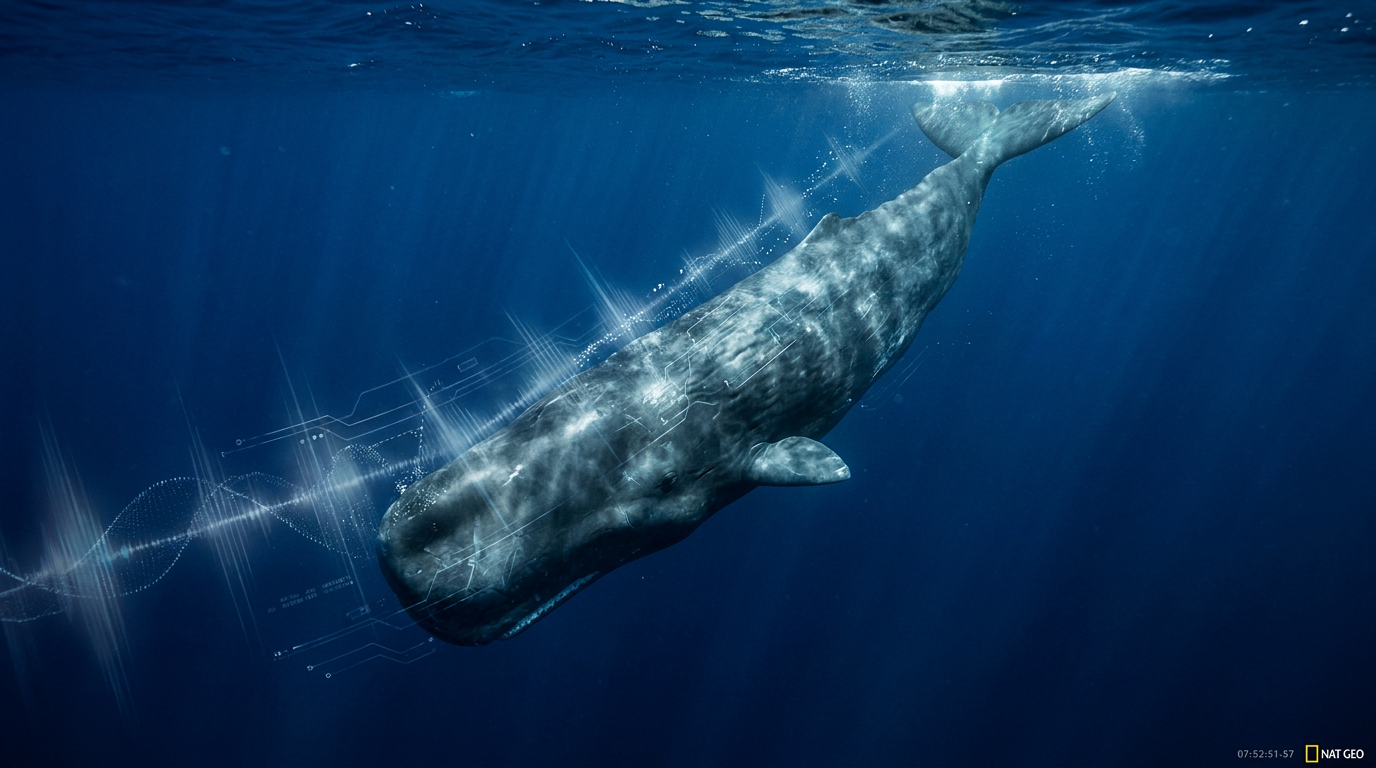
At the forefront of this effort is Project CETI, a multidisciplinary initiative dedicated to translating the communication of sperm whales. Researchers specifically chose sperm whales because they possess the largest brains on Earth and exhibit highly complex social behaviors. These marine mammals communicate across vast, dark ocean distances using rhythmic pulses of clicks known as codas. Because their vocalizations are entirely acoustic and highly structured, they provide an ideal dataset for machine learning algorithms designed to detect subtle patterns in sequential data.[5]
In a landmark breakthrough, researchers from the Massachusetts Institute of Technology and Project CETI successfully utilized machine learning algorithms to decode what they describe as a "sperm whale phonetic alphabet." By analyzing a massive dataset of over 9,000 codas collected from sperm whale families in the Eastern Caribbean, the algorithms revealed that these communications are far from random. Instead, the whales employ a sophisticated, combinatorial system that shares striking structural similarities with human phonetics and the communication systems of other highly intelligent species.[2]

The evidence for this phonetic alphabet lies in how the whales systematically modulate their clicks based on conversational context. The AI models identified specific elements—such as rhythm, tempo, and ornamentation—that the whales combine to form a vast array of distinguishable codas. Furthermore, the researchers discovered the use of "rubato," a musical term describing how the whales subtly and expressively vary the duration and timing of their calls during an exchange. This proves that sperm whale communication contains structured information content, challenging the long-held belief among many linguists that such complex, combinatorial communication is entirely unique to humans.[1][2]
The structural complexity extends even further when the temporal constraints of the ocean are removed. Sperm whales communicate very slowly compared to humans, a necessity dictated by the physics of sound traveling through water and their unhurried biological pace. However, when researchers sped up the recorded codas and removed the silences, they discovered acoustic elements that function remarkably like human vowels. The AI analysis identified distinct sounds that rise and fall in a manner similar to human diphthongs—where a vowel subtly glides from one sound to another, much like the transition in the human word "cow."[1]
While Project CETI focuses on the deep ocean, the Earth Species Project is taking a broader, cross-taxa approach to animal communication. Backed by significant philanthropic funding, including a recent $17 million injection from prominent tech foundations, the non-profit organization is developing "NatureLM-audio." This system is designed to be the first large-scale, foundational audio language model tailored specifically for the animal kingdom. By training the model on diverse datasets ranging from Arctic beluga whales to tropical birds, the organization aims to build a universal tool capable of identifying patterns across the entire Tree of Life.[3]
While Project CETI focuses on the deep ocean, the Earth Species Project is taking a broader, cross-taxa approach to animal communication.
The Earth Species Project has already demonstrated the efficacy of its algorithms in avian research. Working alongside biologists studying zebra finches, the AI models have shown that these birds utilize specific grammar rules in their vocalizations. The algorithms detected that zebra finches combine distinct vocal elements in specific sequences, and that altering the order of these elements changes the functional meaning of the call. This combinatorial syntax mirrors the way word order dictates meaning in human sentences, providing concrete mathematical evidence of complex linguistic structure in birdsong.[4]
One of the most significant technical hurdles in bioacoustics is the "cocktail party problem"—the challenge of isolating a single individual's voice from a chaotic recording filled with overlapping calls and environmental noise. The Earth Species Project has successfully trained machine learning models to solve this problem for wildlife. In studies involving St. Lawrence beluga whales, the AI was able to separate overlapping underwater vocalizations into distinct individual tracks. This capability allows researchers to accurately count populations, identify specific individuals, and map complex social networks that were previously obscured by acoustic clutter.[3][4]

To validate the patterns identified by the AI, researchers are transitioning from passive observation to active interaction through playback experiments. By generating synthetic, AI-crafted animal calls, scientists can play these specific sequences back to wild populations and observe their behavioral responses. If a wild zebra finch or beluga whale responds predictably to an AI-generated call, it provides critical grounding for the model's predictions. These experiments are vital for proving that the structural patterns identified by the algorithms actually correspond to real-world biological functions.[4]
Despite these remarkable technological leaps, a fierce scientific debate remains regarding the true nature of what the AI is uncovering. The core of the uncertainty lies in the distinction between syntax and semantics. While machine learning models excel at mapping the syntax—the structural rules, combinations, and phonetic alphabets of animal calls—translating that structure into semantics, or actual meaning, is an entirely different challenge. Researchers acknowledge that we are still in the early stages of understanding how these complex acoustic structures map to specific thoughts, emotions, or intentions.[6]
Skeptical linguists and ethicists caution against the human tendency to anthropomorphize these findings. Just because an algorithm detects a combinatorial structure that resembles human grammar does not automatically mean the animals are conveying human-like semantic meaning. The environmental contexts, sensory experiences, and evolutionary imperatives of a sperm whale are fundamentally alien to human experience. Therefore, assuming that their "vowels" or "alphabets" translate neatly into human concepts may obscure the unique, non-human reality of their intelligence.[1][6]
For conservation advocates, however, the exact semantic translation is less important than the actionable insights these models provide. The primary value of decoding animal communication lies in its potential to revolutionize ecological protection. If AI can reliably identify the specific vocalizations associated with distress, mating, or migration, conservationists can monitor the health of an ecosystem in real-time. This non-invasive acoustic monitoring offers a scalable way to track biodiversity and identify environmental stressors before they lead to population collapse.[3]

The practical applications of this technology are already coming into focus. For example, by utilizing machine learning tools to analyze the calls of endangered beluga whales, authorities could dynamically route commercial shipping traffic to avoid disrupting critical social interactions or calving grounds. Similarly, understanding the vocal vocabulary of Hawaiian crows could help conservationists determine if captive-bred birds have lost the cultural knowledge necessary to survive in the wild, allowing for targeted acoustic training before reintroduction.[4]
As the technology inches closer to enabling two-way communication between humans and wildlife, researchers are urgently drafting ethical guidelines. There are currently no formal international protections preventing animal translation technology from being weaponized or commercially exploited. Without strict ethical frameworks, these AI tools could theoretically be used by industrial fishing operations to precision-target specific marine populations, or by poachers to lure endangered species. Ensuring that this technology is used exclusively for the benefit and protection of nature is a paramount concern for the scientific community.[5][6]
Ultimately, the goal of applying artificial intelligence to bioacoustics is not necessarily to speak to animals, but to finally learn how to listen to them. By illuminating the diverse intelligences that share our planet, these breakthroughs have the power to shift humanity's perspective. Rather than viewing ourselves as the center of the natural world, decoding the hidden languages of Earth's animals invites us to become respectful participants in a vast, interconnected, and highly communicative ecosystem.[3][6]
How we got here
2020
Project CETI officially launches with catalytic funding to decode sperm whale communication.
2022
The Earth Species Project releases its first early foundational machine learning models for animal audio.
2024
Researchers publish findings revealing a highly structured 'phonetic alphabet' in sperm whale codas.
2025
ESP secures major new funding to expand NatureLM-audio and begins synthetic playback experiments in the wild.
Viewpoints in depth
Bioacoustics & AI Researchers
Focus on the data-driven discovery of complex syntax and structure in animal calls.
This camp, driven by computer scientists and marine biologists, argues that modern machine learning is the ultimate discovery engine for non-human intelligence. By treating vast datasets of animal vocalizations like human language data, they have uncovered undeniable combinatorial structures—such as the sperm whale phonetic alphabet and zebra finch grammar. They believe that with enough data, foundation models will eventually map the full structural complexity of communication across the Tree of Life.
Conservation Advocates
Focus on utilizing communication insights to protect habitats and mitigate human impact on wildlife.
For conservationists, the primary value of decoding animal communication is actionable ecological protection. If AI can identify specific beluga whale distress calls or map the social networks of endangered Hawaiian crows, authorities can implement targeted protections. This group advocates for using bioacoustic AI to monitor biodiversity in real-time and adjust human activities—like commercial shipping routes—to avoid disrupting critical animal behaviors.
Linguistics & Ethics Scholars
Caution against assuming human-like semantics and warn of the ethical risks of translation technology.
Scholars in this camp urge caution on two fronts. First, linguists warn against anthropomorphizing; just because an AI detects complex syntax does not mean the animals are conveying human-like semantic meaning. Second, ethicists warn that if two-way communication becomes possible, there are currently no international laws preventing the technology from being weaponized or used for commercial exploitation, such as precision-targeting fish populations or disrupting natural animal societies.
What we don't know
- Whether the complex syntax identified by AI translates to complex, human-like semantic meaning.
- How wild animal populations will ultimately react to synthetic, AI-generated playback calls over the long term.
- Whether these foundational models can generalize across vastly different species, from marine mammals to insects.
Key terms
- Codas
- Short, rhythmic bursts of clicks used by sperm whales to communicate across vast ocean distances.
- Rubato
- A musical term used by researchers to describe how whales subtly and expressively vary the timing and duration of their calls.
- Bioacoustics
- The cross-disciplinary science that combines biology and acoustics to study how animals produce and perceive sounds.
- NatureLM-audio
- A foundational artificial intelligence model developed by the Earth Species Project to analyze and categorize audio data across various animal species.
Frequently asked
Can AI actually translate what animals are saying?
Not yet. AI has successfully identified complex grammar and phonetic alphabets (syntax), but mapping those structures to specific meanings (semantics) remains an ongoing challenge.
Why are researchers focusing on sperm whales?
Sperm whales have the largest brains on Earth and communicate using highly structured, rhythmic clicks called codas that travel vast distances, making them ideal for pattern recognition algorithms.
What is the 'cocktail party problem' in this research?
It refers to the technical challenge of isolating a single animal's voice from a noisy recording containing multiple overlapping calls and environmental sounds.
Sources
Source coverage
6 outlets
3 viewpoints surfaced






[1]National GeographicLinguistics & Ethics Scholars
Sperm whales communicate through a phonetic system surprisingly similar to human language
Read on National Geographic →[2]MIT NewsBioacoustics & AI Researchers
Using machine learning to decode the sperm whale phonetic alphabet
Read on MIT News →[3]ForbesConservation Advocates
How The Earth Species Project Is Building A ChatGPT For Animals
Read on Forbes →[4]Earth Species ProjectBioacoustics & AI Researchers
Animal Language Processing: An AI Convergence In Animal Communication
Read on Earth Species Project →[5]Project CETIBioacoustics & AI Researchers
Understanding Communication Beneath the Waves
Read on Project CETI →[6]Factlen Editorial TeamLinguistics & Ethics Scholars
Synthesis by Factlen editorial team
Read on Factlen Editorial Team →



Every angle. Every day.
Get ai stories with full source coverage and perspective breakdowns delivered to your inbox.