
Open-Source AI Hits Frontier Milestone as New Models Democratize Local Computing
A wave of June 2026 releases, including MiniMax M3 and Google's DiffusionGemma, has pushed open-weight AI models to match commercial performance on local hardware, offering a massive leap for data privacy and enterprise deployment.
By Factlen Editorial Team
- Open-Source Advocates
- Argue that decentralized, open-weight models are essential for democratizing AI access and preventing cloud monopolies.
- Enterprise & Education Adopters
- Focus on the practical benefits of local AI execution, specifically regarding data privacy, regulatory compliance, and cost reduction.
- Hardware & Infrastructure Providers
- Emphasize the need for optimized local compute hardware to support the new wave of high-performance open models.
What's not represented
- · Proprietary Cloud AI Providers
- · Regulatory Policymakers
Why this matters
The ability to run frontier-level AI on local hardware means schools, hospitals, and small businesses can now use top-tier artificial intelligence without paying expensive cloud subscriptions or exposing sensitive user data to third-party tech giants.
Key points
- MiniMax M3 matches commercial frontier models in coding performance while offering a one-million-token context window.
- Google DeepMind's DiffusionGemma introduces parallel text generation, achieving speeds over 1,000 tokens per second.
- The ability to run these models locally solves major data privacy and compliance hurdles for schools and businesses.
- Open-source AI development has effectively closed the capability gap with proprietary cloud-based systems.
June 2026 marks a historic threshold for the artificial intelligence industry. A flurry of open-weight model releases has effectively closed the capability gap between proprietary cloud APIs and localized, open-source systems.[6]
The shift is being driven by two monumental releases: MiniMax M3, a Chinese-developed model that matches frontier coding performance, and Google DeepMind’s DiffusionGemma, an experimental architecture that fundamentally changes how AI generates text.[1][5]
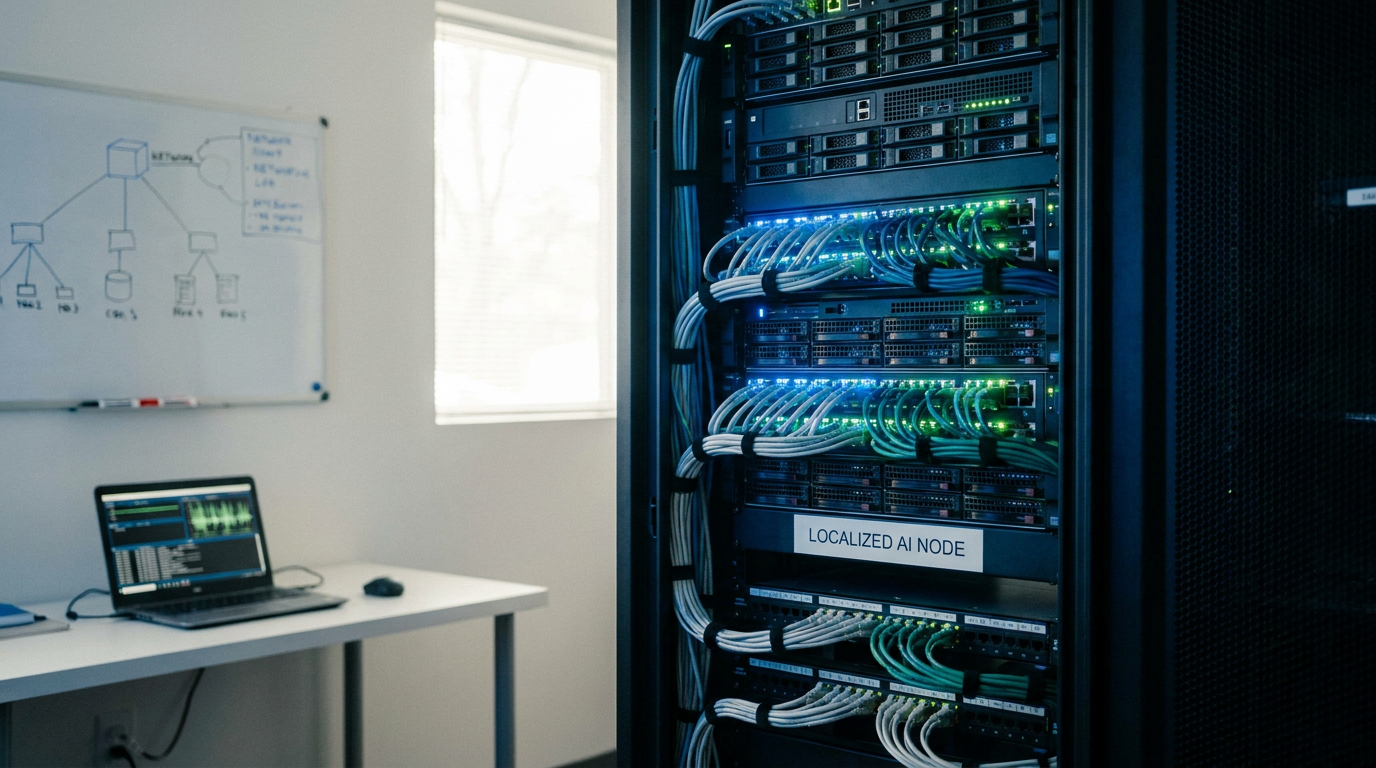
For developers, schools, and local enterprises, this convergence means that top-tier artificial intelligence can now be run entirely on-premise, bypassing expensive cloud subscriptions and eliminating severe data privacy concerns.[3]
The most disruptive release of the month is MiniMax M3, a 428-billion-parameter Mixture-of-Experts model developed by a Shanghai-based AI lab.[4]

M3 is the first open-weight model to combine frontier-level software engineering capabilities with a massive one-million-token context window and native multimodal understanding across text, image, and video.[1][4]
In benchmark testing, M3 reportedly outscores leading commercial models like GPT-4.5 and Gemini 2.5 Pro on SWEbench Pro, a rigorous evaluation that tests an AI’s ability to solve real-world GitHub bug fixes.[1]
To handle its massive context window without overwhelming hardware, MiniMax engineered a novel "Sparse Attention" architecture, which delivers a 15-fold decode speedup compared to previous generations and reduces per-token compute demands to a fraction of standard models.[4]
While MiniMax pushes the boundaries of context and coding, Google DeepMind has reimagined the mechanics of text generation with DiffusionGemma.[2]
While MiniMax pushes the boundaries of context and coding, Google DeepMind has reimagined the mechanics of text generation with DiffusionGemma.
Almost all modern large language models are autoregressive, meaning they generate text sequentially, predicting one word at a time. DeepMind’s new 26-billion-parameter model abandons this sequential bottleneck in favor of "discrete text diffusion."[5]
Instead of typing out words one by one, DiffusionGemma treats a 256-token block as a blank canvas, filling it with noise and refining all positions simultaneously. This parallel generation allows the model to self-correct earlier words as later concepts firm up.[5]

The speed gains are staggering. NVIDIA, which optimized the model for its RTX GPUs, reports that DiffusionGemma can generate over 1,000 tokens per second on a single H100 accelerator—up to four times faster than comparable autoregressive models.[2]
The availability of these models is triggering a massive shift in enterprise and educational software. The Linux Foundation reported that Docling, an open-source document AI project, recently surpassed 500,000 daily downloads, reflecting surging demand for local AI workflows.[3][7]
For K-12 school districts, the economics and compliance architecture of on-premise AI have completely changed. Because models like MiniMax M3 and DiffusionGemma can run on consumer-grade hardware like an NVIDIA RTX 4060, schools can deploy frontier AI without routing sensitive student data to a vendor's cloud.[3]

This localized approach automatically solves complex COPPA and FERPA privacy exposures, allowing institutions to build custom educational tools while maintaining absolute data sovereignty.[3]
Ultimately, the June 2026 open-source milestones represent the democratization of cognition. By decoupling frontier intelligence from centralized cloud infrastructure, the AI industry is ensuring that high-performance reasoning becomes a ubiquitous, locally owned utility rather than a rented luxury.[6]
How we got here
Early 2025
Open-source models begin closing the performance gap with proprietary systems on basic reasoning tasks.
Late 2025
The AI industry sees a surge in Mixture-of-Experts (MoE) architectures, allowing larger models to run efficiently on limited hardware.
June 3, 2026
MiniMax releases the M3 model, matching frontier commercial coding performance with a one-million token context window.
June 10, 2026
Google DeepMind introduces DiffusionGemma, pioneering parallel text generation for unprecedented inference speeds.
Viewpoints in depth
Open-Source Advocates
The push to decentralize artificial intelligence.
For the open-source community, the June 2026 releases validate a long-held belief: frontier intelligence should not be locked behind proprietary APIs. Advocates argue that models like MiniMax M3 and DiffusionGemma prove that collaborative, open-weight development can match the massive R&D budgets of centralized tech giants. By making these models freely available, the community aims to foster permissionless innovation, allowing developers globally to build specialized tools without paying per-token taxes to cloud providers.
Enterprise & Education Adopters
Prioritizing data sovereignty and regulatory compliance.
Organizations handling sensitive data—such as hospitals, law firms, and K-12 school districts—view local AI execution as a critical breakthrough. For years, deploying advanced AI meant sending proprietary or protected information to third-party servers, creating severe compliance risks under frameworks like HIPAA, FERPA, and COPPA. With the ability to run frontier-level models on local workstations, these institutions can now harness the full power of generative AI while maintaining absolute data sovereignty and significantly reducing operational costs.
Hardware & Infrastructure Providers
Optimizing the silicon for a local-first AI ecosystem.
Hardware manufacturers recognize that the shift toward open-source AI requires a new paradigm in consumer and enterprise computing. Companies like NVIDIA are aggressively optimizing their consumer-grade GPUs and enterprise superchips to handle massive context windows and novel architectures like discrete diffusion. For infrastructure providers, the goal is to ensure that the hardware bottleneck is eliminated, enabling seamless, low-latency AI execution on everything from a student's laptop to a corporate server rack.
What we don't know
- How quickly commercial cloud providers will adjust their pricing models in response to free, frontier-level open-source alternatives.
- Whether the discrete text diffusion architecture introduced by DiffusionGemma will become the new industry standard, replacing autoregressive models entirely.
- The long-term economic sustainability of AI labs releasing multi-million-dollar foundation models for free.
Key terms
- Open-Weight Model
- An AI model where the pre-trained parameters (weights) are made publicly available, allowing anyone to download and run the model locally.
- Mixture-of-Experts (MoE)
- An AI architecture that divides a model into specialized sub-networks, activating only a small fraction of the total parameters for any given task to save computing power.
- Context Window
- The maximum amount of text, code, or data an AI model can process and remember at one time during a single interaction.
- Discrete Text Diffusion
- A novel generation method where an AI refines an entire block of text simultaneously, rather than predicting words one at a time.
- Autoregressive Generation
- The standard method used by most language models, where text is generated sequentially, one token (or word) at a time.
Frequently asked
Can I run these new AI models on my personal computer?
Yes, models like DiffusionGemma and smaller quantizations of MiniMax M3 are optimized to run on consumer-grade hardware, such as NVIDIA RTX GPUs, without requiring cloud access.
Why is a one-million token context window important?
It allows the AI to analyze massive amounts of information at once, such as entire software codebases, multiple long books, or hours of video, without forgetting earlier details.
How does text diffusion differ from standard AI chatbots?
Standard chatbots type out answers one word at a time. Text diffusion models generate a whole block of text at once and iteratively refine it, resulting in much faster generation speeds.
Why are schools interested in open-source AI?
Running AI locally on school servers ensures that student data is never sent to third-party tech companies, keeping districts compliant with strict privacy laws like COPPA and FERPA.
Sources
Source coverage
7 outlets
3 viewpoints surfaced






[1]MindStudioEnterprise & Education Adopters
A New Challenger in the Coding Model Race: Minimax M3
Read on MindStudio →[2]NVIDIAHardware & Infrastructure Providers
Google DeepMind Releases DiffusionGemma for Exceptionally Fast Text Generation
Read on NVIDIA →[3]IBL NewsEnterprise & Education Adopters
Open-Source AI Models Now Match Commercial Quality — What This Means for K-12 Data Privacy
Read on IBL News →[4]Hugging FaceOpen-Source Advocates
MiniMax-M3 Model Card and Architecture
Read on Hugging Face →[5]Google DeepMindHardware & Infrastructure Providers
DiffusionGemma: A text diffusion model designed to maximize generation speed
Read on Google DeepMind →[6]DevFlokersOpen-Source Advocates
June 2026 Open-Source AI Developments: MiniMax M3 and Local Execution
Read on DevFlokers →[7]Linux FoundationOpen-Source Advocates
LF AI & Data Project Docling Surpasses 500,000 Daily Downloads
Read on Linux Foundation →



Every angle. Every day.
Get ai stories with full source coverage and perspective breakdowns delivered to your inbox.