
US Nuclear Pilot Program Notches Second Reactor Breakthrough as Valar Atomics Advances
Southern California startup Valar Atomics has reached a key milestone in the Department of Energy's fast-track nuclear program, keeping it on pace to achieve full reactor criticality by July 4.
By Factlen Editorial Team
- Advanced Nuclear Developers
- Startups argue that modular, factory-built reactors are the only way to meet modern industrial energy needs.
- Federal Policymakers
- The US government is focused on streamlining regulations to reclaim global leadership in nuclear technology.
- Defense & Tech Investors
- Silicon Valley views advanced nuclear as a critical infrastructure layer for the future of computing.
- Local Economic Development
- Regional governments see microreactor testing as a driver for high-tech jobs and clean energy leadership.
What's not represented
- · Environmental Non-Governmental Organizations (NGOs)
- · Traditional Utility Companies
- · Nuclear Non-Proliferation Advocates
Why this matters
The rapid progress of advanced nuclear startups proves that regulatory and engineering timelines can be radically compressed. If successful, these small reactors could provide the massive, carbon-free baseload power required to sustain the artificial intelligence boom without overwhelming the traditional electrical grid.
Key points
- Valar Atomics has achieved a second major technical breakthrough under the DOE's fast-track nuclear pilot program.
- The startup is developing high-temperature gas-cooled reactors designed to power AI data centers and heavy industry.
- Valar recently raised $450 million at a $2 billion valuation, backed by prominent defense-tech investors.
- The DOE program aims to have at least three advanced test reactors achieve criticality by July 4, 2026.
- Valar's Ward250 test reactor is currently being prepared for power operations at a research center in Utah.
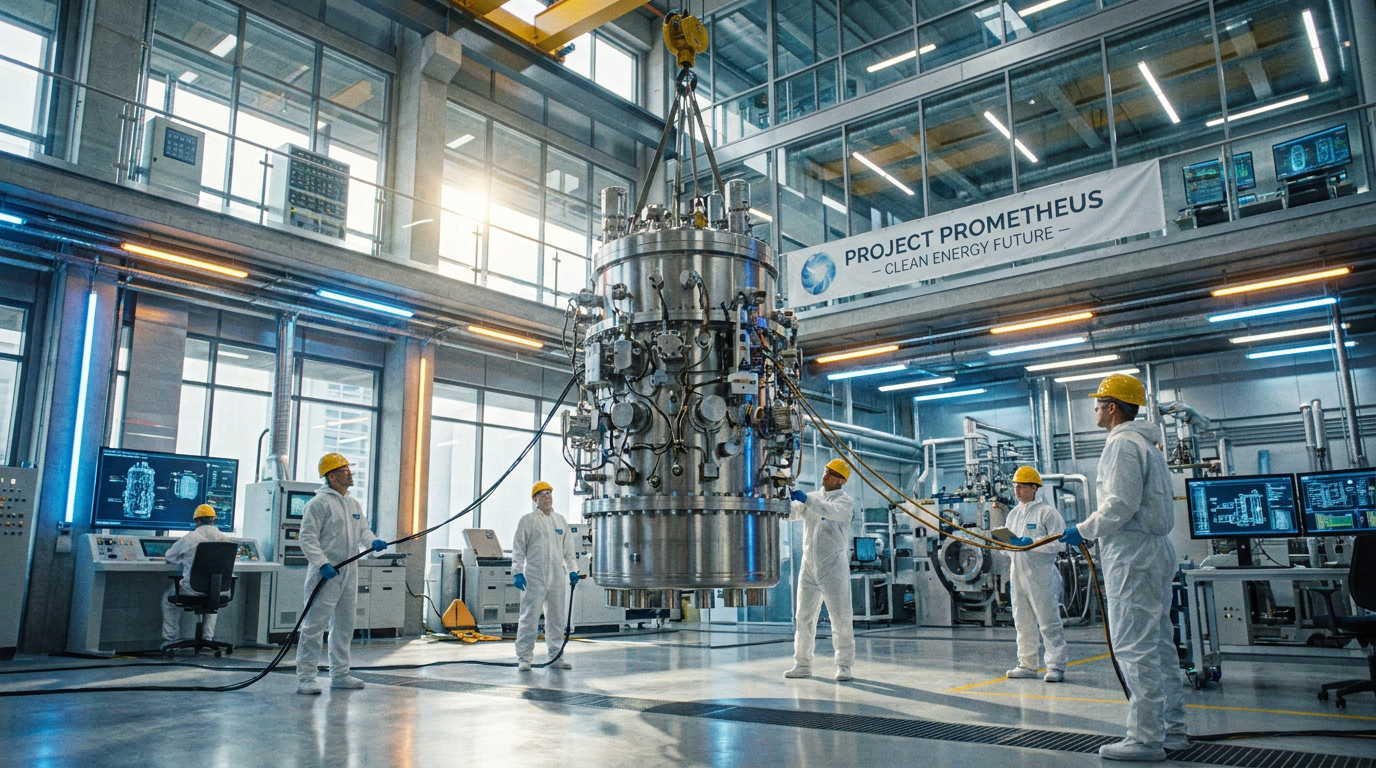
The race to deploy next-generation nuclear energy has crossed another major threshold, signaling that the industry's ambitious timelines may actually be achievable. Valar Atomics, a Southern California-based energy startup backed by prominent defense-tech investors, has notched a critical milestone in the development of its small modular reactors. According to recent reports, this marks the second major breakthrough under a fast-tracked United States federal initiative aimed at revitalizing domestic nuclear capabilities. The achievement keeps the company on a highly compressed schedule to demonstrate a working, self-sustaining nuclear chain reaction by mid-summer, a feat that would validate a radically new approach to powering the modern industrial economy.[1][7]
The milestone falls under the Department of Energy's Nuclear Reactor Pilot Program, an ambitious initiative launched in August 2025 following an executive order designed to reform and accelerate reactor testing outside of traditional national laboratories. The program selected 11 advanced nuclear companies—including Valar, Oklo, and Terrestrial Energy—and set a bold, unprecedented mandate: construct, operate, and achieve criticality for at least three test reactors by July 4, 2026. Valar's latest technical breakthrough signals that the industry is successfully navigating the accelerated regulatory and engineering pathways, proving that the federal government's push to cut red tape is yielding tangible hardware advancements on the ground.[1][2][5]
Unlike the multi-gigawatt behemoths that defined the Cold War era of nuclear power—facilities that took decades to build and cost billions of dollars—Valar Atomics is engineering high-temperature gas-cooled reactors (HTGRs). These compact, modular units utilize helium as a coolant and rely on TRISO fuel, which consists of uranium kernels encased in robust graphite and ceramic layers. This unique architecture allows the reactors to operate safely at significantly higher temperatures than conventional light-water designs, making them virtually meltdown-proof. More importantly, the high-grade heat generated by these systems unlocks entirely new industrial applications beyond standard electricity generation, offering a pathway to decarbonize heavy manufacturing.[3][6]

The startup's business model is as radical as its underlying engineering. Rather than feeding power into the traditional, often-congested electrical grid—which struggles with transmission losses and interconnection delays—Valar plans to build what it calls "gigasites." These sprawling industrial campuses would host clusters of hundreds of small reactors operating in tandem. The sites are purpose-built to deliver dense, steady, carbon-free power directly behind the fence line to hyperscale artificial intelligence data centers, heavy manufacturing facilities, and synthetic fuel production plants, effectively divorcing high-demand energy consumers from the limitations of the public utility grid.[3][4]
Valar has been moving at a blistering pace to validate its technology and satisfy the Department of Energy's rigorous testing requirements. In November 2025, the company's NOVA Core achieved "zero-power criticality" at the Los Alamos National Laboratory's National Criticality Experiments Research Center. That crucial test successfully demonstrated a self-sustaining chain reaction of uranium-235 at low temperatures, proving the core's neutronic characteristics and validating the company's fundamental design assumptions. Conducted under the strict oversight of the National Nuclear Security Administration, the experiment marked the first time in over two decades that such a milestone was reached using advanced high-assay low-enriched uranium fuel in the United States.[2]
Valar has been moving at a blistering pace to validate its technology and satisfy the Department of Energy's rigorous testing requirements.
The physical deployment of the hardware has been equally dramatic, underscoring the strategic national security importance placed on the project. In February 2026, Valar's 100-kilowatt thermal test unit, dubbed the Ward250, was airlifted from its manufacturing facility in California to Utah aboard three C-17 Globemaster military cargo aircraft. The joint operation between the Department of Defense and the Department of Energy served as a high-profile proof of concept for the rapid, modular deployment of nuclear assets. By demonstrating that a functional reactor core could be safely transported by air, the government validated the logistical feasibility of deploying microreactors to remote or grid-constrained regions.[3][6]
The Ward250 reactor is now being meticulously prepared for power operations at the Utah San Rafael Energy Research Center in Emery County. State and local officials have enthusiastically embraced the project, viewing the advanced test site as a cornerstone of Utah's broader clean energy initiatives and a powerful magnet for high-tech research and development jobs. The facility is primarily focused on validating reactor components, training a new generation of nuclear operators, and informing future regulatory processes ahead of commercial scaling. By hosting the pilot program, Utah is positioning itself as a premier destination for energy-sector innovation in the American West.[6]
Investors have aggressively backed Valar's vision, recognizing the acute, impending need for firm baseload power in the artificial intelligence era. Earlier this spring, the startup raised a staggering $450 million in fresh capital, comprising $340 million in equity and $110 million in debt, propelling its overall valuation to $2 billion. The funding round drew heavy participation from the highest echelons of the American defense-tech establishment, including Anduril Industries founder Palmer Luckey, Palantir Chief Technology Officer Shyam Sankar, and Snowpoint Ventures. This influx of capital provides Valar with the financial runway needed to transition from prototype testing to mass manufacturing.[3][4]

The massive financial backing highlights a growing consensus in Silicon Valley: the artificial intelligence boom simply cannot be sustained by intermittent renewable energy sources alone. With the International Energy Agency projecting that global data center power consumption will double by the end of 2026, tech giants and defense contractors are increasingly viewing advanced nuclear power as the only viable solution. Wind and solar power, while crucial for the broader grid, lack the "always-on" reliability required to run hyperscale GPU clusters 24 hours a day. Consequently, private capital is flooding into the nuclear sector to secure the energy infrastructure necessary to win the global AI arms race.[3][4]
As the ambitious July 4 deadline approaches, the Department of Energy remains highly confident that the pilot program will successfully meet its mandate. Federal officials have publicly noted that the rapid progress of companies like Valar demonstrates that American nuclear innovation can be fully unleashed when bureaucratic hurdles are streamlined and private enterprise is empowered. If the Ward250 successfully achieves full criticality this summer, it will not only satisfy the pilot program's requirements but also pave the way for Valar to begin mass-manufacturing its reactors, potentially breaking ground on its first commercial gigasites before the end of the decade.[2][5]
How we got here
May 2025
Executive Order 14301 is signed, reforming reactor testing and setting the July 2026 criticality deadline.
August 2025
The DOE officially launches the Nuclear Reactor Pilot Program, selecting 11 advanced reactor projects.
November 2025
Valar Atomics achieves zero-power criticality with its NOVA Core at Los Alamos National Laboratory.
February 2026
Valar's Ward250 test reactor is airlifted by military cargo planes to the Utah San Rafael Energy Research Center.
June 2026
Valar notches a second major reactor breakthrough, keeping it on pace for summer power operations.
Viewpoints in depth
Advanced Nuclear Developers
Startups argue that modular, factory-built reactors are the only way to meet modern industrial energy needs.
Companies like Valar Atomics, Oklo, and Terrestrial Energy believe the traditional model of building multi-gigawatt nuclear plants over decades is economically obsolete. By mass-manufacturing small, high-temperature reactors and deploying them in clusters directly at the point of demand—such as data centers and synthetic fuel plants—they argue the industry can bypass grid congestion, drive down costs through economies of scale, and provide the massive carbon-free baseload power required by the AI revolution.
Federal Policymakers
The US government is focused on streamlining regulations to reclaim global leadership in nuclear technology.
The Department of Energy and the National Nuclear Security Administration view the fast-track pilot program as a critical national security and economic imperative. By authorizing testing outside of traditional national laboratories and setting aggressive deadlines, federal officials aim to prove that American regulatory frameworks can adapt to rapid innovation. They argue that supporting domestic startups is essential to prevent rival nations from dominating the next generation of global energy infrastructure.
Defense & Tech Investors
Silicon Valley views advanced nuclear as a critical infrastructure layer for the future of computing.
Prominent venture capitalists and defense-tech founders are pouring billions into nuclear startups because they see an impending energy bottleneck. Investors argue that intermittent renewables like wind and solar cannot provide the "always-on" reliability required by hyperscale GPU clusters and military installations. For this camp, funding advanced nuclear is not just an energy play, but a necessary prerequisite for winning the global AI arms race.
What we don't know
- Whether Valar Atomics and the other pilot program participants will successfully hit the July 4, 2026 criticality deadline without technical delays.
- How quickly the Nuclear Regulatory Commission will approve commercial licenses for these "gigasite" reactor clusters once the test phase is complete.
- The final localized cost per megawatt-hour of electricity produced by these small modular reactors compared to established natural gas or renewable sources.
Key terms
- Criticality
- The point at which a nuclear reactor sustains a stable, ongoing chain reaction of nuclear fission.
- TRISO Fuel
- Tri-structural isotropic fuel; uranium kernels coated in layers of carbon and ceramics that make them highly resistant to melting at extreme temperatures.
- High-Temperature Gas-Cooled Reactor (HTGR)
- An advanced nuclear reactor design that uses a gas, such as helium, to cool the core, allowing it to operate safely at much higher temperatures than water-cooled reactors.
- Baseload Power
- The minimum amount of electric power needed to be supplied to the electrical grid at any given time, requiring energy sources that can run continuously.
- Zero-Power Criticality
- A self-sustaining nuclear chain reaction achieved at very low power levels, used to test and validate a reactor's core physics without generating significant heat.
Frequently asked
What is the DOE Nuclear Reactor Pilot Program?
It is a federal initiative launched in 2025 to accelerate the testing and deployment of advanced nuclear technologies, aiming to have at least three test reactors achieve criticality by July 4, 2026.
How is Valar Atomics' reactor different from traditional nuclear plants?
Valar builds small, modular high-temperature gas-cooled reactors that use helium and TRISO fuel, designed to be mass-manufactured and deployed in clusters rather than as massive, custom-built facilities.
Why are tech investors funding nuclear energy?
The artificial intelligence boom requires massive amounts of reliable, 24/7 electricity. Investors believe advanced nuclear is the only carbon-free energy source capable of meeting this demand.
Where is Valar testing its reactor?
The company's Ward250 test reactor is located at the Utah San Rafael Energy Research Center in Emery County, Utah.
Sources
Source coverage
7 outlets
4 viewpoints surfaced







[1]BloombergDefense & Tech Investors
US Nuclear Pilot Program Notches Second Reactor Breakthrough
Read on Bloomberg →[2]World Nuclear NewsFederal Policymakers
DOE announces first selections for pilot reactor programme
Read on World Nuclear News →[3]The Next WebAdvanced Nuclear Developers
Palmer Luckey-backed Valar lands $450M at $2B valuation to power AI with small reactors
Read on The Next Web →[4]Pulse 2.0Advanced Nuclear Developers
Valar Atomics Raises Funding At A $2 Billion Valuation
Read on Pulse 2.0 →[5]Department of EnergyFederal Policymakers
DOE Launches Nuclear Pilot Program
Read on Department of Energy →[6]Utah Office of Energy DevelopmentLocal Economic Development
Utah's San Rafael Energy Research Center to host pioneering nuclear test reactor
Read on Utah Office of Energy Development →[7]Binance News
Valar Atomics Hits Second Reactor Milestone in US Nuclear Pilot Program
Read on Binance News →


Every angle. Every day.
Get business stories with full source coverage and perspective breakdowns delivered to your inbox.